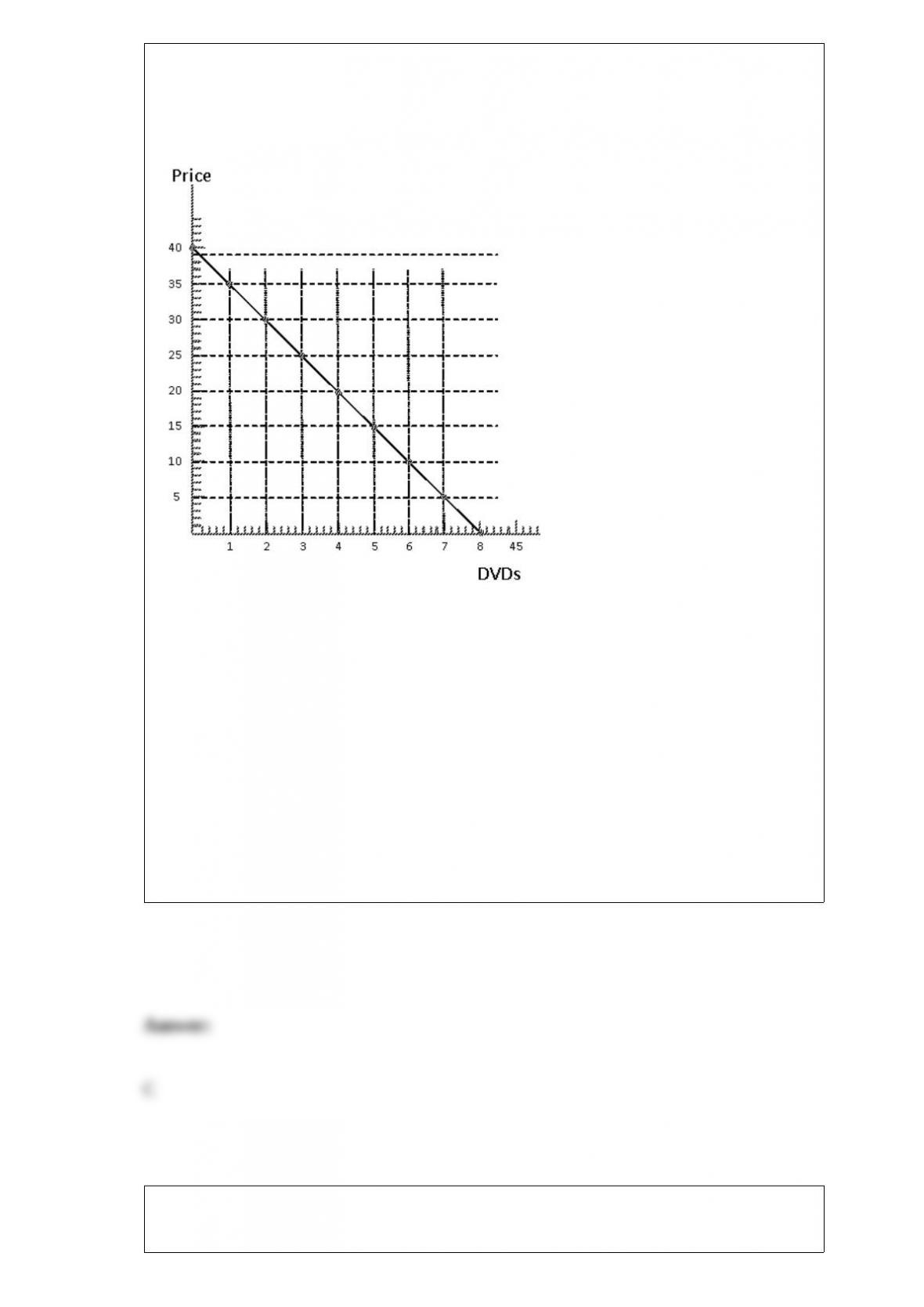
Exhibit 6-17
Consider Exhibit 6-17 which represents the market demand for DVDs. If the price of
DVDs is $20 how much is consumer’s surplus?
a. $0
b. $20
c. $40
d. $60
e. $80
Ten cases of spring water are sold for $6 each, and the marginal product of the last unit
of labor is 5. If the price of a case increases from $6 to $8, then the marginal revenue

product of the last unit of labor would
a. decrease by $10
b. increase by $40
c. decrease by $30
d. increase by $10
e. not change
Japan has more vending machines per capita than any other country in the world. One
explanation for this phenomenon is that
a. vending machines are very expensive in Japan
b. the customs of the Japanese marketplace encourage businesses to install vending
machines
c. vending machines were invented in Japan
d. time is less valuable in Japan than it is elsewhere
e. most products commonly purchased by Japanese consumers are small enough to be
sold in vending machines

Two events occur simultaneously in the market for automobiles: (1) an improvement in
assembly line technology and (2) the economy enters a recession (which decreases
consumers’ income). An economist would predict with certainty that
a. equilibrium quantity will rise
b. equilibrium quantity will fall
c. equilibrium price will rise
d. equilibrium price will fall
e. the equilibrium price will remain the same
The average cost curve for a natural monopoly is downward sloping where it intersects
the market demand curve.
a. True
b. False
The opportunity cost of producing capital is
a. decreased current production of consumption goods
b. increased future production of consumption goods
c. the amount of roundabout production
d. abundant capital accumulation

e. the decreased amount of future capital available
A firm in perfectly competitive industry is maximizing profit at Q = 3,000. Then its
fixed cost increases. The profit-maximizing output is now
a. greater than 3,000 and profit decreases
b. less than 3,000 and profit decreases
c. greater than 3,000 and profit is unchanged
d. equal to 3,000 and profit decreases
e. equal to 3,000 and profit increases
If the interest rate is 8 percent, a person who is offered the opportunity to buy an
annuity paying $30,000 per year forever should
a. do so if the price is greater than $375,000
b. do so if the price is less than $375,000
c. be willing to pay only $37,037 for it
d. be willing to pay $77,037 for it
e. be willing to pay no more than $300,000 for it
In a system of impersonal exchange,
a. bureaucratic ties on the production side are critical
b. the economy benefits from specialization and modern technology
c. inside connections on the consumption side are necessary
d. successful institutional evolution makes no difference
e. there is very little division of labor
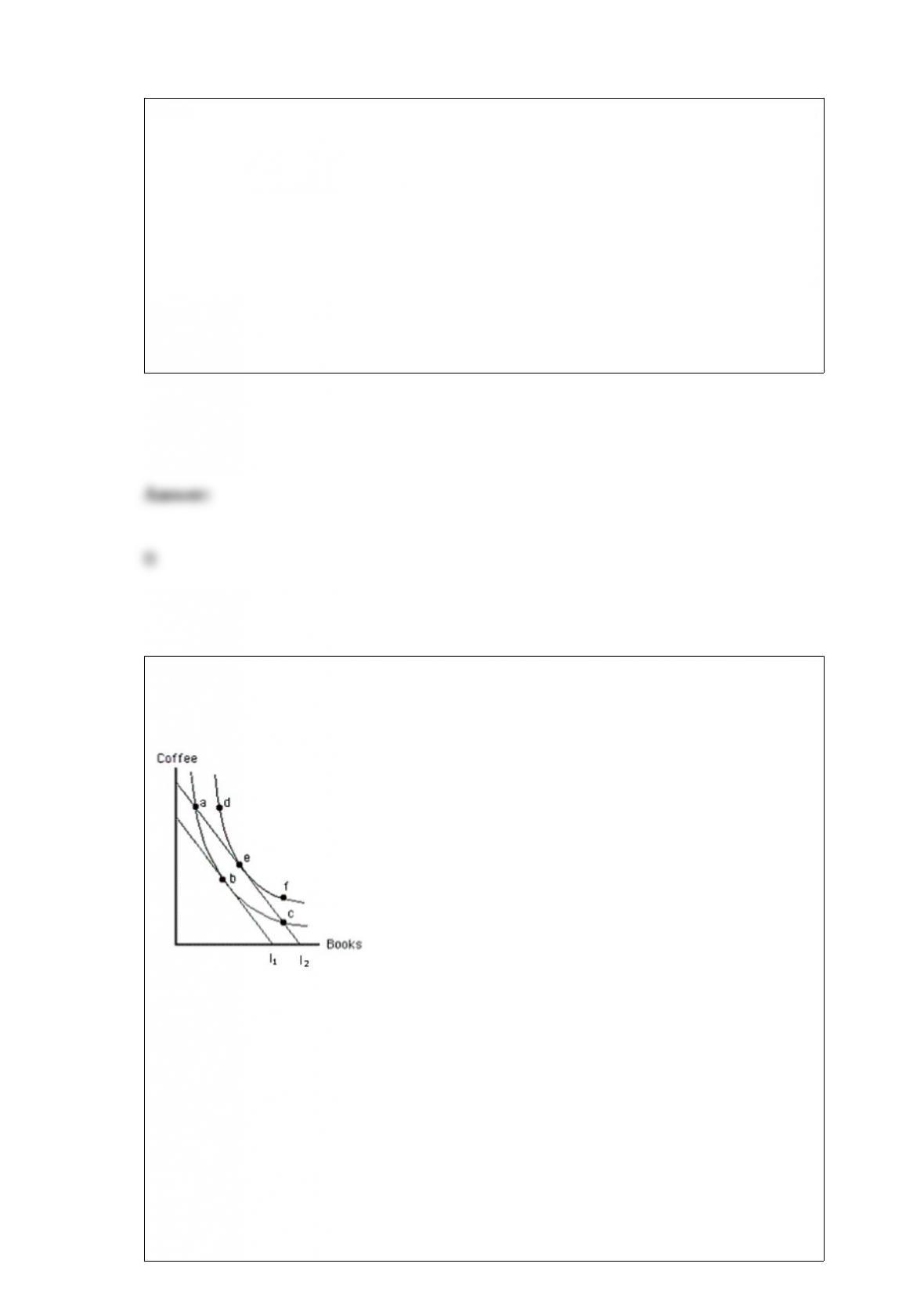
Exhibit 6-25
Which of the following points in Exhibit 6-25 represent combinations of goods that cost
the consumer the same amount of money to purchase?
a. points a, b, and c
b. points d, e, and f
c. points a, e, and c
d. points d, b, and f

e. points b and e
Which of the following is a social insurance program?
a. Medicaid
b. Food stamps
c. Social Security
d. Temporary Assistance for Needy Families
e. FDIC
The slope of an isoquant is equal to
a. the marginal rate of substitution
b. the marginal rate of technical substitution
c. the rate of diminishing marginal utility
d. the rate of diminishing marginal returns
e. economies of scale

If the loss-minimizing output for a perfectly competitive firm is zero, then, at all other
output levels,
a. price must be greater than average variable cost
b. the marginal cost curve must slope downward
c. marginal cost is less than marginal revenue
d. total revenue is less than total variable cost
e. total revenue is less than average variable cost
When demand is elastic, an increase in price will lead to an increase in total revenue
a. True
b. False
Exhibit 17-1
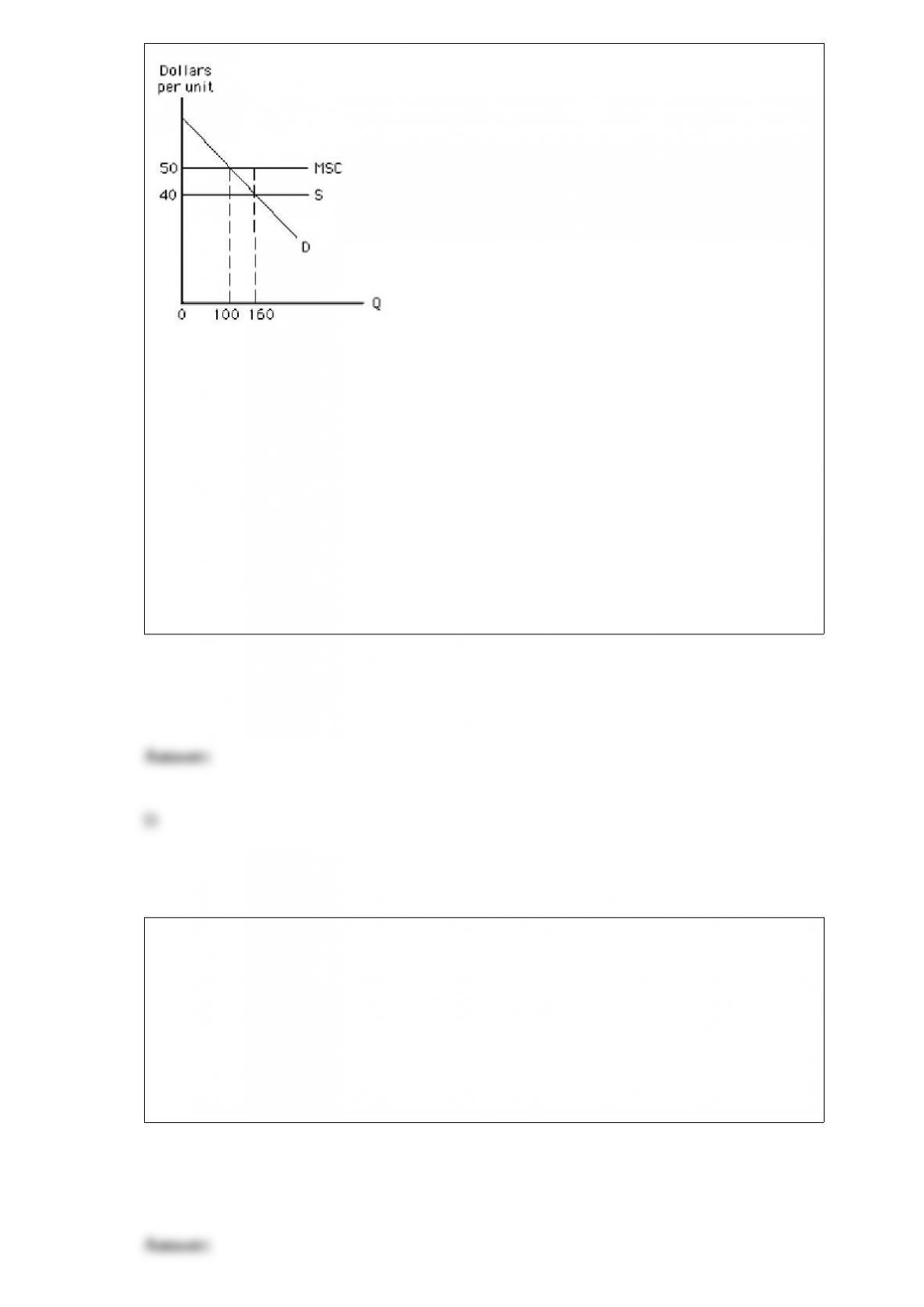
In Exhibit 17-1, the amount by which the total social cost of producing the private
equilibrium level of output exceeds the total social benefit is
a. $300
b. $50
c. $5,000
d. $1,600
e. $8,000
Willie Stand obtains a patent on his new invention, the bipod. After twenty years,
a. he can renew his patent
b. new entrants will begin bipod production if price exceeds average variable cost
c. new entrants will drive up the price of the bipod
d. Willie will eventually earn no more than a normal profit
e. Willie will continue to earn a positive economic profit, because entry will not affect
the price of bipods

Which of the following provides a positive externality?
a. smog
b. inoculating children against measles
c. hamburgers
d. litter
e. an increase in your earnings
If total product for each of five units of labor is 10, 16, 20, 30, and 34, respectively, the
marginal product of the third unit is
a. 20
b. 10
c. 4
d. 0
e. 6

Which of the following is not true about the U.S. trade balance since 1979?
a. The balance of trade has been in deficit.
b. During recessions the balance has usually been flat.
c. The balance of trade has been in surplus.
d. When the economy expanded, the demand for imports increased.
e. When the economy expanded, the trade balance worsened.
The midpoint price between $20 and $40 is
a. $10
b. $20
c. $30
d. $15
e. $200
Product differentiation helps determine the slope of the demand curve facing a firm in

monopolistic competition.
a. True
b. False
Diminishing marginal utility means that
a. as you consume more of a good, other things constant, the total satisfaction you
obtain from consuming this good tends to fall
b. as you hire more labor, other things constant, the total amount produced begins to fall
c. as you hire more labor, other things constant, the marginal product begins to fall
d. as you consume more of a good, other things constant, the additional satisfaction you
obtain from each additional unit of the good tends to fall
e. as you consume more of a good, other things constant, the extra satisfaction you
obtain from each extra good becomes negative
Which of the following is true about entrepreneurs?
a. They have the talent required to dream up a new product or find a better way to
produce an existing one.
b. They are rewarded by profits.

c. They sometimes suffer losses.
d. They benefit from what’s left over after paying other resource suppliers.
e. All of the answers are correct.
We may see government supply social work internally rather than through private firms
because
a. it is a public good
b. it is difficult to monitor the quantity and quality of social work provided
c. private firms would seek to cover their costs
d. a government bureau would maximize its budget
e. there is a great demand for such services
A test was scheduled for Monday morning, but you went to a party on Saturday night. If
you hadn’t attended the party, you could have studied for the test or gone to a movie.
Which of the following is true?
a. The opportunity cost of going to the movie is studying for the test.
b. The opportunity cost of going to the party is the movie.

c. The opportunity cost of going to the party is both the movie and the study time.
d. Because you could go to the party only that night but could go to a movie any time,
the opportunity cost of the party is the study time.
e. From the above information, it’s not possible to determine the opportunity cost of
attending the party.
As the price of a resource (e.g., labor) decreases,
a. demand for that resource increases
b. the quantity demanded of that resource decreases
c. the supply of that resource increases
d. producers are more willing and able to hire that resource
e. producers are less willing and able to hire that resource
Exhibit 18-1
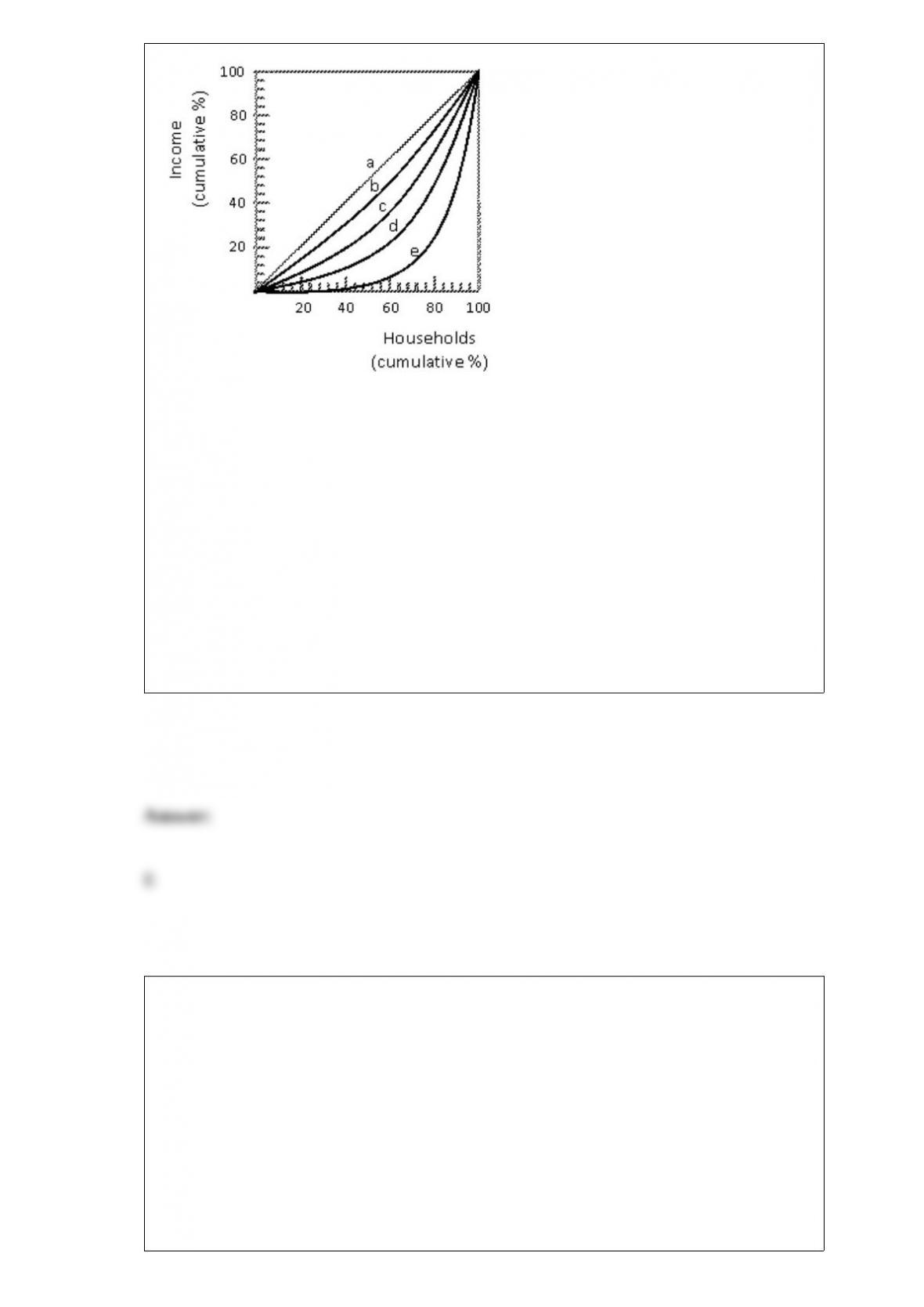
Exhibit 18-1 shows five different Lorenz curves. Which curve shows the most unequal
distribution of income?
a. a
b. b
c. c
d. d
e. e
Compared to a firm in perfect competition, the monopolistically competitive firm tends
to
a. produce less and charge a higher price
b. produce less and charge a lower price
c. produce more and charge a lower price
d. produce more and charge a higher price

e. produce the same quantity
If you are to receive a payment of $200 at the end of the first year and a payment of
$250 at the end of the second year and the market interest rate is 5 percent, the present
value of this income stream is
a. $400.37
b. $417.23
c. $450.00
d. $475.37
e. $490.13
The demand for flour is
a. inelastic because there are few substitutes for flour and it represents a large
percentage of a consumer’s budget
b. inelastic because there are many substitutes for flour and it represents a large
percentage of a consumer’s budget
c. inelastic because there are few substitutes for flour and it represents a small
percentage of a consumer’s budget
d. elastic because there are no substitutes for flour and it represents a large percentage
of a consumer’s budget
e. elastic because there are many substitutes for flour and it represents a large

percentage of a consumer’s budget