
If a consumer moves from point a to point b on the indifference curve shown in Exhibit
6-22,
a. the marginal rate of substitution between books and movies falls
b. the marginal rate of substitution between books and movies stays the same
c. the marginal rate of substitution between books and movies increases
d. the marginal rate of substitution between books and movies becomes negative
e. the marginal rate of substitution between books and movies becomes zero
For which of the following goods is the value of income elasticity most likely to be
negative?
a. macaroni and cheese
b. champagne
c. airline tickets
d. clothes
e. toothpaste
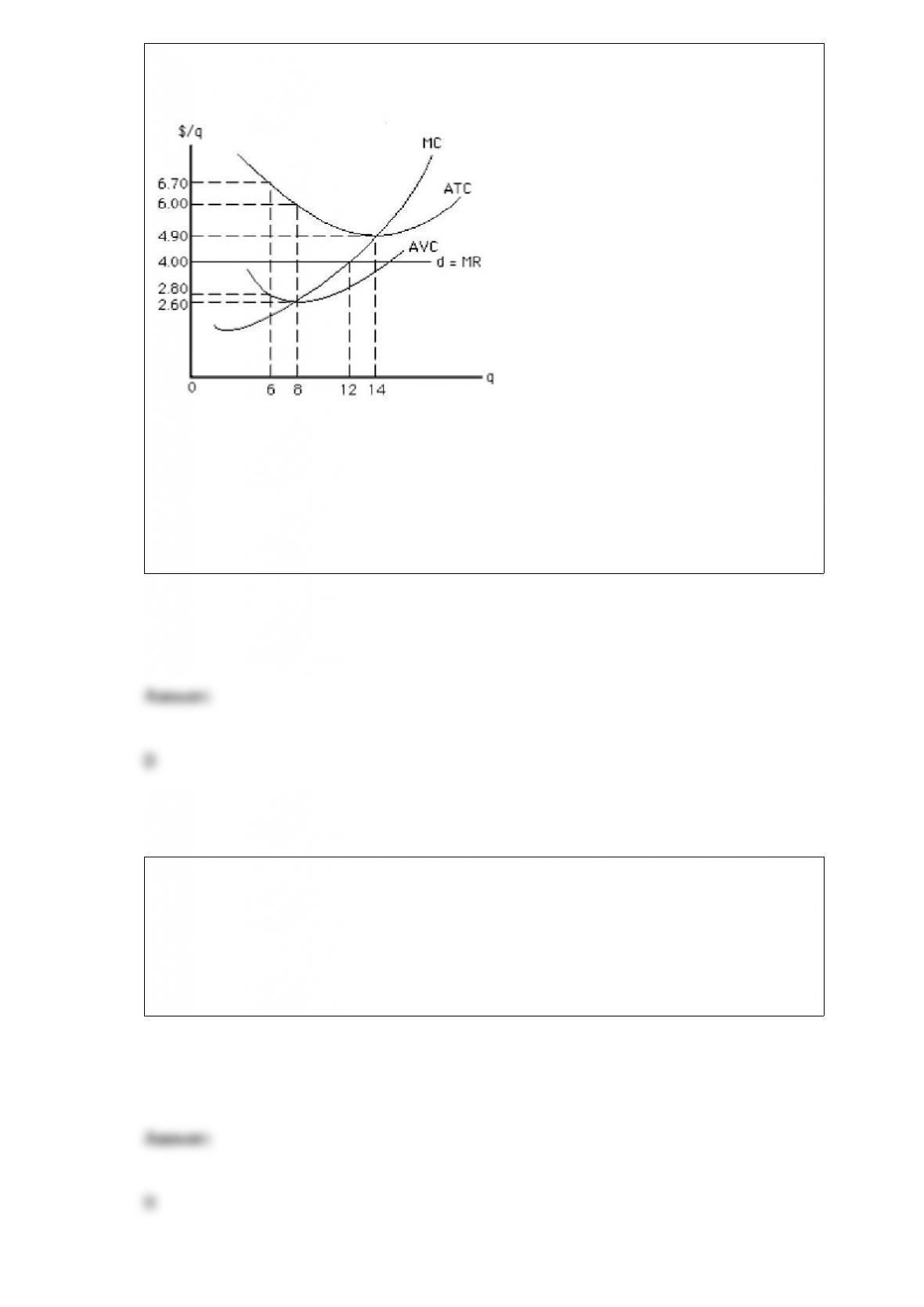
Exhibit 8-8
If the price-taking firm in Exhibit 8-8 is currently producing 6 units, then to maximize
profit in the short run, it should
a. keep producing 6 units
b. increase production to 12 units
c. increase production to 14 units
d. increase production to 8 units
e. shut down
The winner’s curse is more likely when the value of a good at auction is common
knowledge.
a. True
b. False

Which of the following groups has the lowest malnutrition rate among children less
than 5 years of age?
a. middle-income economies
b. low-income economies
c. high-income economies
d. sub-Saharan African economies
e. all the world’s economies
A nondiscriminating monopolist earning positive short-run economic profit determines
that its current marginal cost is $15 and its current marginal revenue is $20. To
maximize profit, a firm should
a. raise price and increase output
b. raise price and decrease output
c. maintain a constant price and increase output
d. reduce price and increase output
e. shut down
The short-run industry supply curve in a perfectly competitive market is the horizontal

sum of each firm’s short-run supply curve.
a. True
b. False
Upon opening a printing and copy shop, a firm budgets $40,000 for copy machines and
labor. The firm can operate its copy machine for 2,000 hours if it doesn’t hire any labor.
What is the hourly wage the firm must pay?
a. $1.25
b. $2.50
c. $5
d. $8
e. It is impossible to tell from the information given.
Suppose you have a choice of going full-time to summer school or going to school
full-time and working part-time. Summer tuition and books are $2,200. If you worked
part-time, you could make $1,000. Your rent is $1,000 for the summer, regardless of
your choice. The opportunity cost of going to summer school full-time and not working
is, therefore,
a. $1,000
b. $2,000

c. $3,200
d. $4,200
e. cannot be determined from information given
If people believe that prices are going to be higher in the future then they are today, they
will
a. wait until the future to purchase the things they wand
b. decrease their demand now
c. increase their demand now
d. increase their supply now
e. save more today so they have the income to buy more in the future
If the U.S. dollar appreciates relative to the Brazilian cruzeiro, then
a. the U.S. dollar-cruzeiro exchange rate will increase
b. U.S. goods become less expensive in Brazil
c. Brazilian goods become more expensive in the U.S.

d. Brazilian investors will pay fewer cruzeiros to buy each U.S. dollar
e. the U.S. will import more from Brazil
The fact that some people now work in virtual offices is an example of the
a. high cost of office space
b. Information Revolution
c. breakdown of society
d. Industrial Revolution
e. success of not-for-profit organizations
Which economic concept does the expression “there’s no such thing as a free lunch”
reflect?
a. opportunity cost
b. specialization
c. market exchange
d. comparative advantage

e. efficiency
Which of the following describes a situation in which demand must be elastic?
a. The price of pens rises by 10 cents, and quantity of pens demanded falls by 50.
b. The price of pens rises by 10 cents, and total revenue rises.
c. A 20 percent increase in the price of pens leads to a 20 percent decrease in the
quantity of pens demanded.
d. Total revenue does not change when the price of pens rises.
e. Total revenue decreases when the price of pencils rises.
Food stamps and Medicaid are in-kind transfer programs.
a. True
b. False

If a government regulation states that fluorocarbon emissions should be abated by 75
percent but the optimal level of pollution abatement is 85 percent, which of the
following must be true?
a. The free market will not reduce pollution by less than 85 percent.
b. The free market will accomplish 85 percent abatement, but it will be inefficient.
c. If only 75 percent of the pollution is abated, the society will be better off than if 85
percent had been abated.
d. If only 75 percent of the pollution is abated, the society will be worse off than if 85
percent had been abated.
e. If 75 percent of the pollution is abated, then in the next period the government should
set the abatement level at 95 percent.
A major fruit juice manufacturer failed in its attempt to engage in price discrimination
between students and all other consumers. What is a possible explanation for this
failure?
a. There was nothing to prevent the students from reselling the fruit juice to other
consumers.
b. The fruit juice manufacturer produced in a perfectly competitive market.
c. The two groups of consumers probably have the same demand elasticity for fruit
juice.
d. The cost of producing the product is relatively high.
e. Demand for fruit juice is probably inelastic.

Nondiscriminating monopoly is similar to perfect competition in that
a. they have the same level of barriers to entry
b. they have a similar number of firms in the industry
c. the demand curve facing the firm is perfectly elastic for both
d. price equals marginal revenue for both
e. price equals average revenue for both
Along the supply curve of lifeguards at local public pools,
a. the wage paid to lifeguards is held constant
b. the number of lifeguards is held constant
c. the wage paid to lifeguards at private clubs is held constant
d. the demand for lifeguards is assumed constant
e. the admission price to these public pools rises as the wage rate for lifeguards
increases

The main goal of the Bretton Woods meeting was to
a. curb inflation
b. encourage gold production
c. set world prices for gold
d. set up a new international system of payments and to stabilize exchange rates
e. help less-developed countries of the Third World to develop economically
Theory in economics
a. involves some simplification of reality
b. bears no relation to reality
c. approaches reality in all its complexity
d. involves so much distortion of reality that it is worthless
e. focuses on the unique aspects of each situation
The demand curve a monopolist uses in making an output decision is
a. the same as the demand curve facing a perfectly competitive firm

b. vertical because there are no close substitutes for its product
c. horizontal because there are no close substitutes for its product
d. the same as the market demand curve
e. perfectly inelastic
The principal-agent problem arises because of
a. natural selection
b. diminishing marginal returns
c. hidden actions
d. the winner’s curse
e. hidden characteristics
Which of the following is true of union membership rates in the United States?
a. The rate for males is greater than the rate for females because there are more males in
the service sector.
b. The rate for males is greater than the rate for females because there are more females
in the service sector.
c. The rate for whites is greater than the rate for blacks because there are more blacks in
the service sector.

d. The rate for blacks is greater than the rate for whites because there are more whites in
heavy industry.
e. The rate for blacks is less than the rate for whites because there are more whites in
heavy industry.
If a market is initially operating competitively and then the government imposes a price
floor above the equilibrium price,
a. there will be more resources will be devoted to the production of this product
b. quantity demanded will rise
c. producer surplus will fall in the short run
d. imposition of the floor is probably a positive-sum game
e. consumer surplus will fall
The present value of a promise to pay $100 one year from now is approximately $90.91
if the interest rate is 10 percent.
a. True
b. False

Suppose a company that produces mouthwash branches out into producing toothpaste.
If this expansion reduces the average cost per unit, the company must
a. benefit from vertical integration
b. benefit from horizontal integration
c. experience economies of scale
d. experience economies of scope
e. have no transaction costs
If a firm with a 10 percent market share merges with a firm with 15 percent of the
market, by how much will the Herfindahl index change? The other firms have 40
percent, 15 percent, 10 percent, and 10 percent shares.
a. It rises by 100.
b. It rises by 300.
c. It falls by 200.
d. It falls by 250.
e. It rises by 25.

Suppose that U.S. incomes rise relative to British incomes. Then,
a. the dollar will appreciate and the pound will depreciate
b. the dollar will depreciate and the pound will appreciate
c. the dollar will depreciate and the pound’s value will remain constant
d. the dollar will appreciate and the pound’s value will remain constant
e. neither the dollar nor the pound will be affected
Which of the following occurs last in the sequence?
a. A power couple has children
b. At the best colleges, the now grown children meet their future spouses
c. A power couple marries
d. With a head start in life, many of the children go to the best colleges
e. The children benefit from the high income and genetic endowment passed along from
their well-educated parents
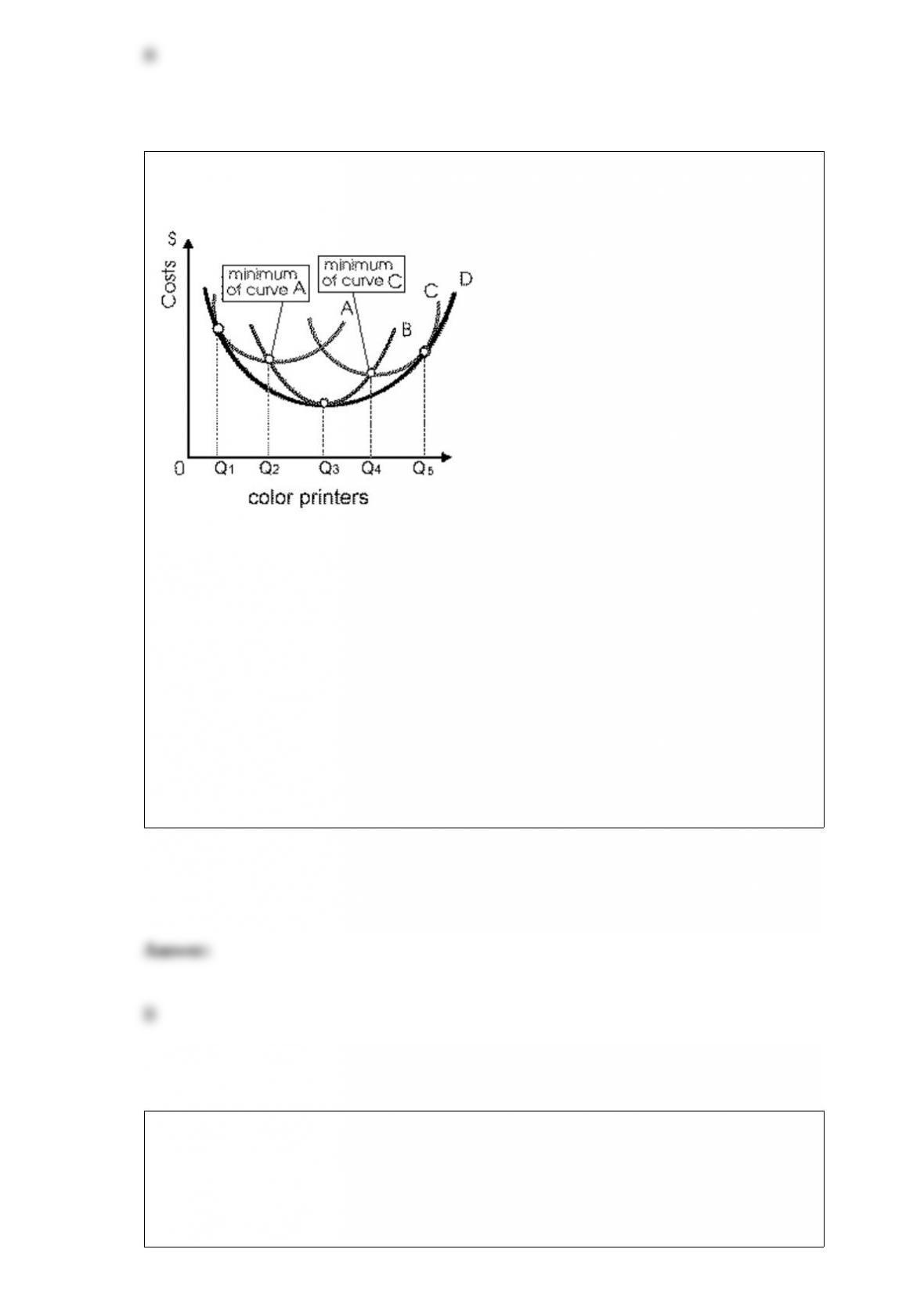
Exhibit 7-15 Long and Short-Run cost of Producing Color Printers
If the firm represented in Exhibit 7-15 wants to produce output level Q3, then in the
long run it should build a plant size with average total cost curve of
a. A
b. B
c. C
d. A or B
e. the question cannot be answered with the information given
Which of the following is a major criticism of a monopoly as a cause of allocative
inefficiency?
a. A monopolist fails to expand output to the level where the consumers’ evaluation of
an additional unit is just equal to its opportunity cost
b. A monopolist has no incentive to produce efficiently, because even if it pays no
attention to the costs of production, it will be guaranteed an economic profit
c. A monopolist will always make profits therefore providing an incentive to keep
prices at the level that maximizes consumer surplus
d. A monopolist has an advantage because it can purchase the resources in a competitive
market
e. Consumer surplus would no longer be equal to producer surplus
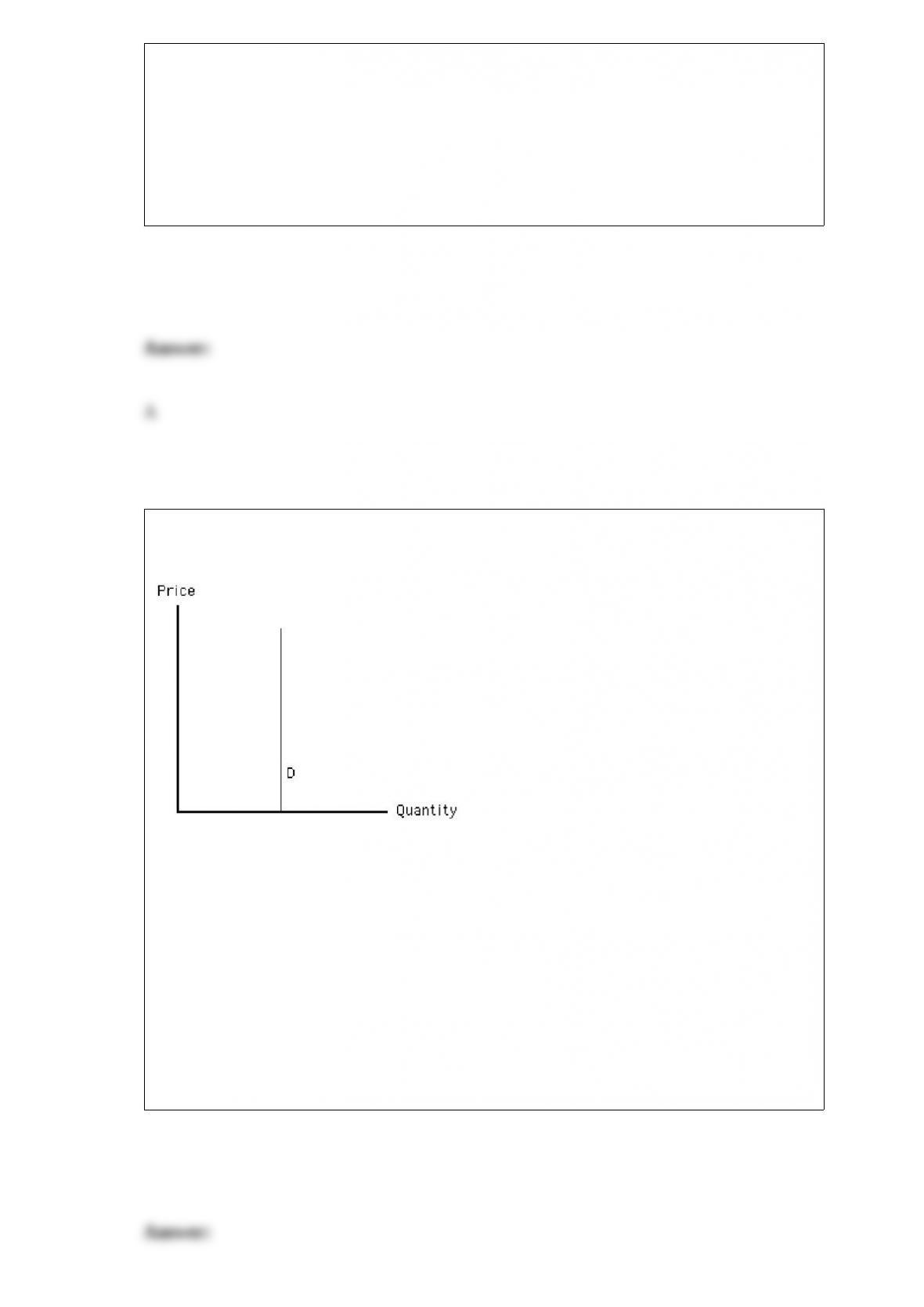
Exhibit 5-4
What is the price elasticity of demand in Exhibit 5-4?
a. 0
b. -1
c. negative infinity
d. 1
e. -100