Taxes and in-kind transfers make the distribution of income more unequal.
a. True
b. False
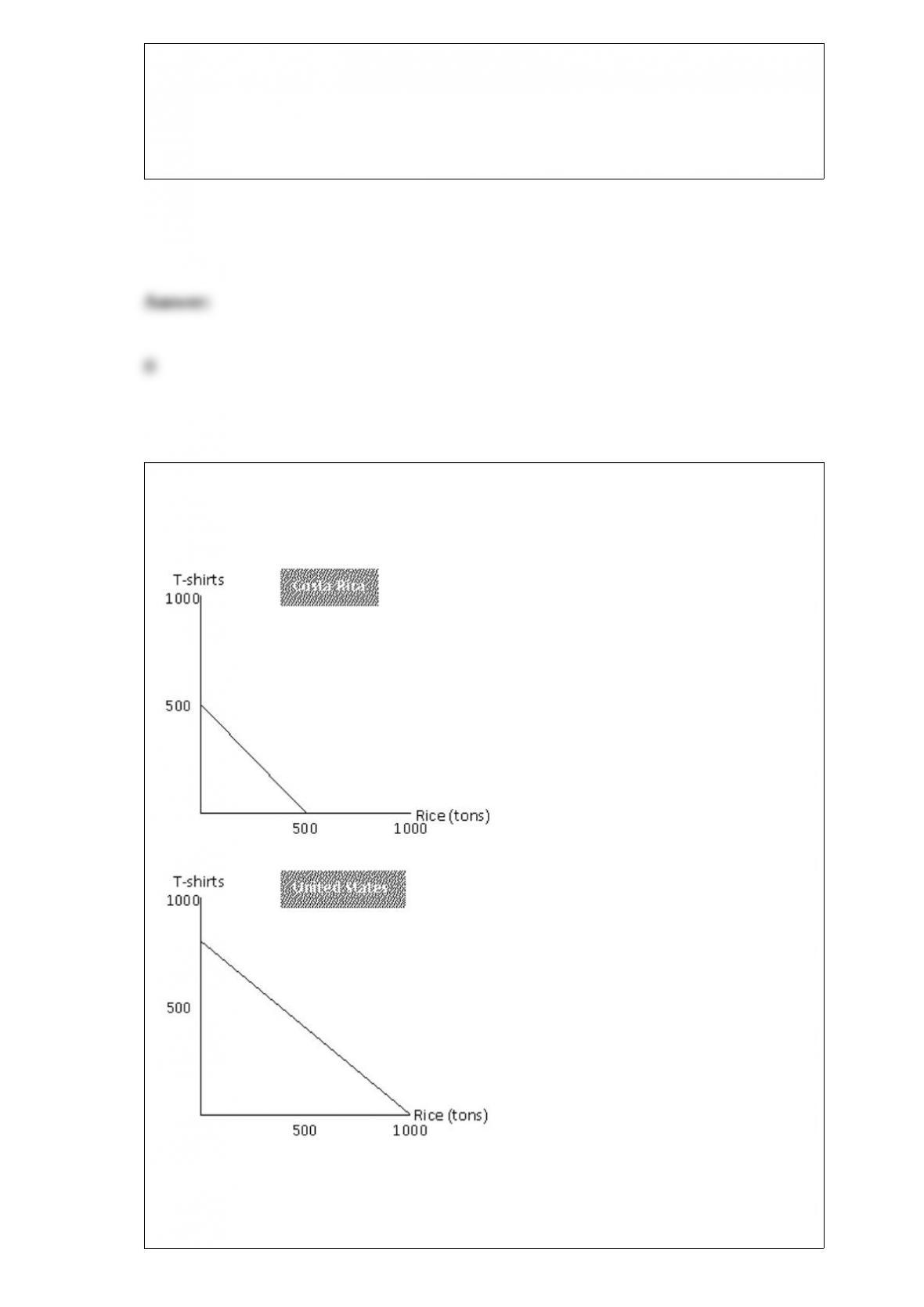
Exhibit 2-11
Refer to exhibit 2-11. In Costa Rica the opportunity cost of 1 ton of rice is:
a. 1/2 of a T-shirt
b. 3/4 of a T-shirt
c. 1 T-shirt
d. 11/2 T-shirts
e. 2 T-shirts
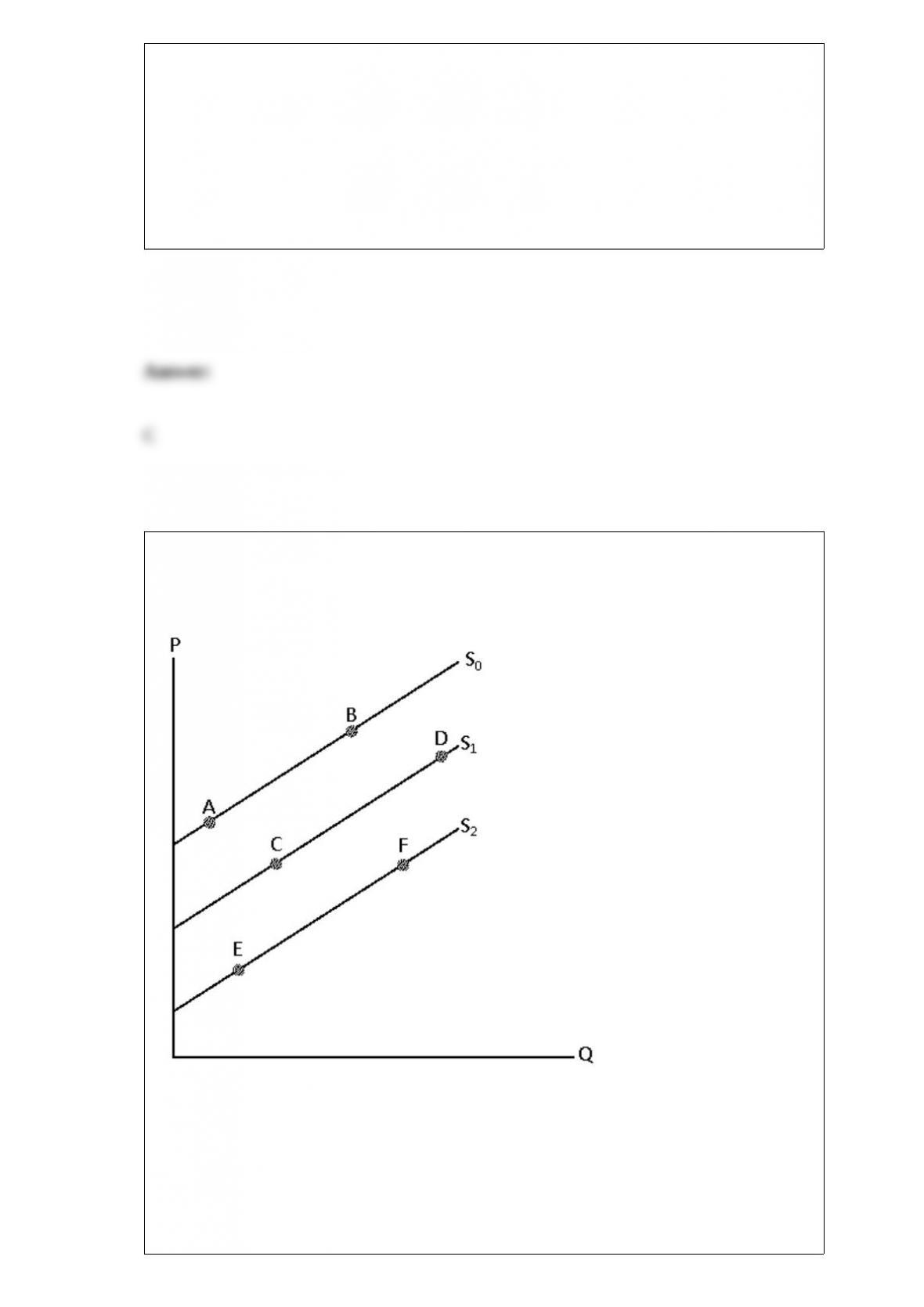
Exhibit 4-2
Consider Exhibit 4-2 which shows 3 supply curves for milk. Which of the following
would shift the supply curve for milk from S1 to S2?
a. an increase in the price cattle feed
b. the expectation of a higher price in the near future

c. an increase in the price of milk
d. an increase in the price of beef
e. a decrease in the number of dairy farmers
The fewer alternative uses a resource has,
a. the greater the proportion of its earnings that is economic rent
b. the smaller the proportion of its earnings that is economic rent
c. the more elastic its supply
d. the more elastic its demand
e. the less elastic its supply
If a nondiscriminating monopolist is operating at an output level where price equals
average total cost, we can conclude that
a. economic profit is $0
b. the firm is not maximizing profit
c. the firm should go out of business in the long run
d. the firm is not earning its normal profit
e. the firm should shut down in the short run

The yardstick most often used to compare living standards across nations is
a. average production cost per unit
b. sales revenue per month
c. utility per capita
d. output per capita
e. imports per year
Which of the following is not a form of social insurance?
a. Social Security
b. Temporary Assistance for Needy Families
c. Medicare
d. unemployment insurance
e. workers’ compensation

The expression “There’s no such thing as a free lunch” means
a. that even if the lunch is free, we pay for it in extra calories
b. that resources used up in producing the lunch are not available to satisfy other wants
c. the same thing as “The best things in life are free”
d. you can eat only if you work first
e. neither sea water nor air is free
A monopolistically competitive firm can raise price somewhat due to
a. product differentiation
b. barriers to entry
c. product similarity
d. its homogeneous product
e. high tariffs

In 2011, the United States largest balance of trade deficit was with
a. the European Union
b. Canada
c. China
d. Mexico
e. Brazil
If both supply and demand increase, then the change in equilibrium quantity is
indeterminate.
a. True
b. False
Exhibit 9-7
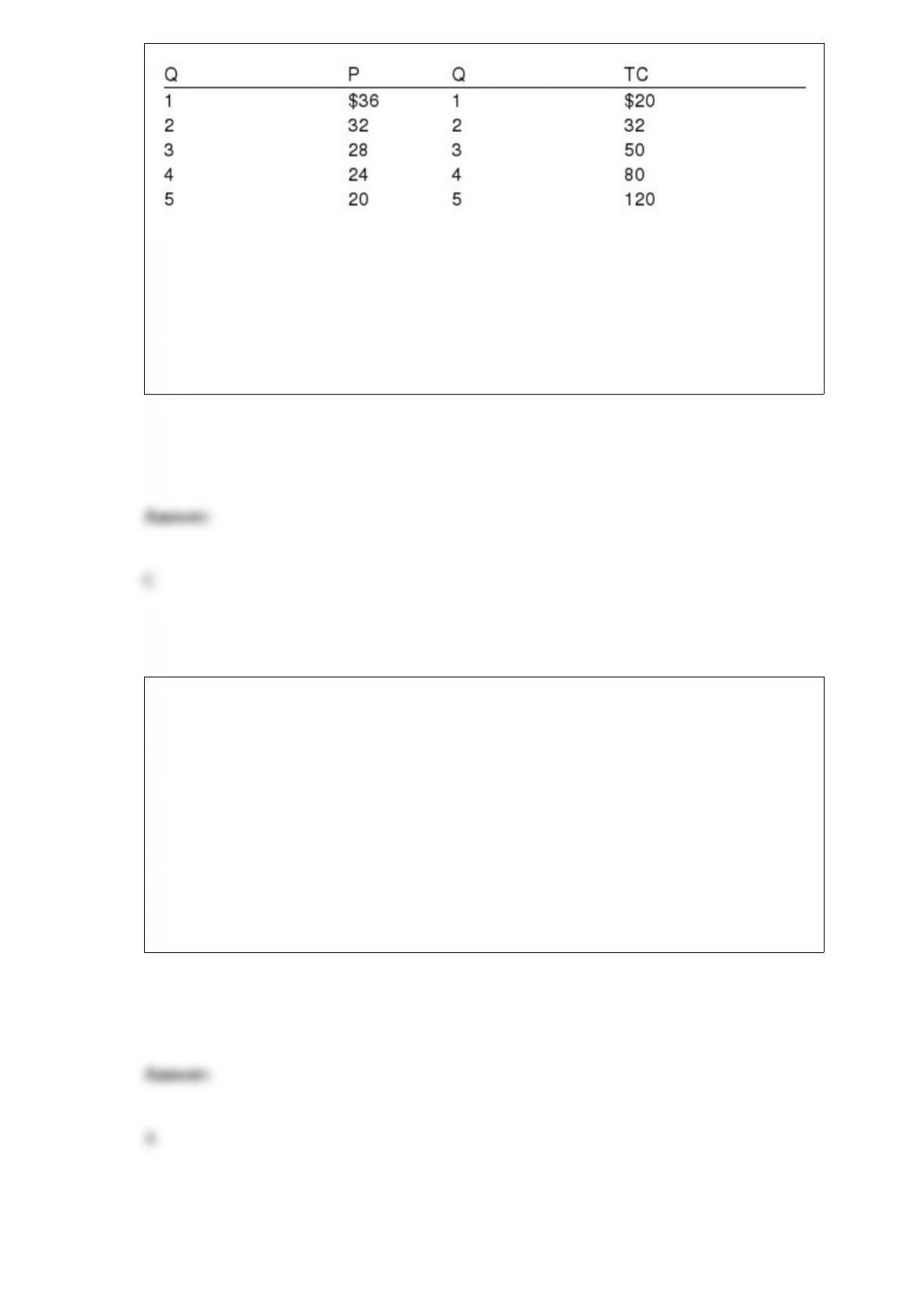
Consider Exhibit 9-7. What is the profit-maximizing output for a monopolist that does
not price discriminate?
a. 1 unit
b. 2 units
c. 3 units
d. 4 units
e. 5 units
Restricting imports of Brazilian shoes will
a. raise the price of both Brazilian and domestically produced shoes
b. raise the price of Brazilian shoes but lower the price of domestically produced shoes
c. lower the price of Brazilian shoes but raise the price of domestically produced shoes
d. lower the price of both Brazilian and domestically produced shoes
e. benefit the producers of shoes in Brazil
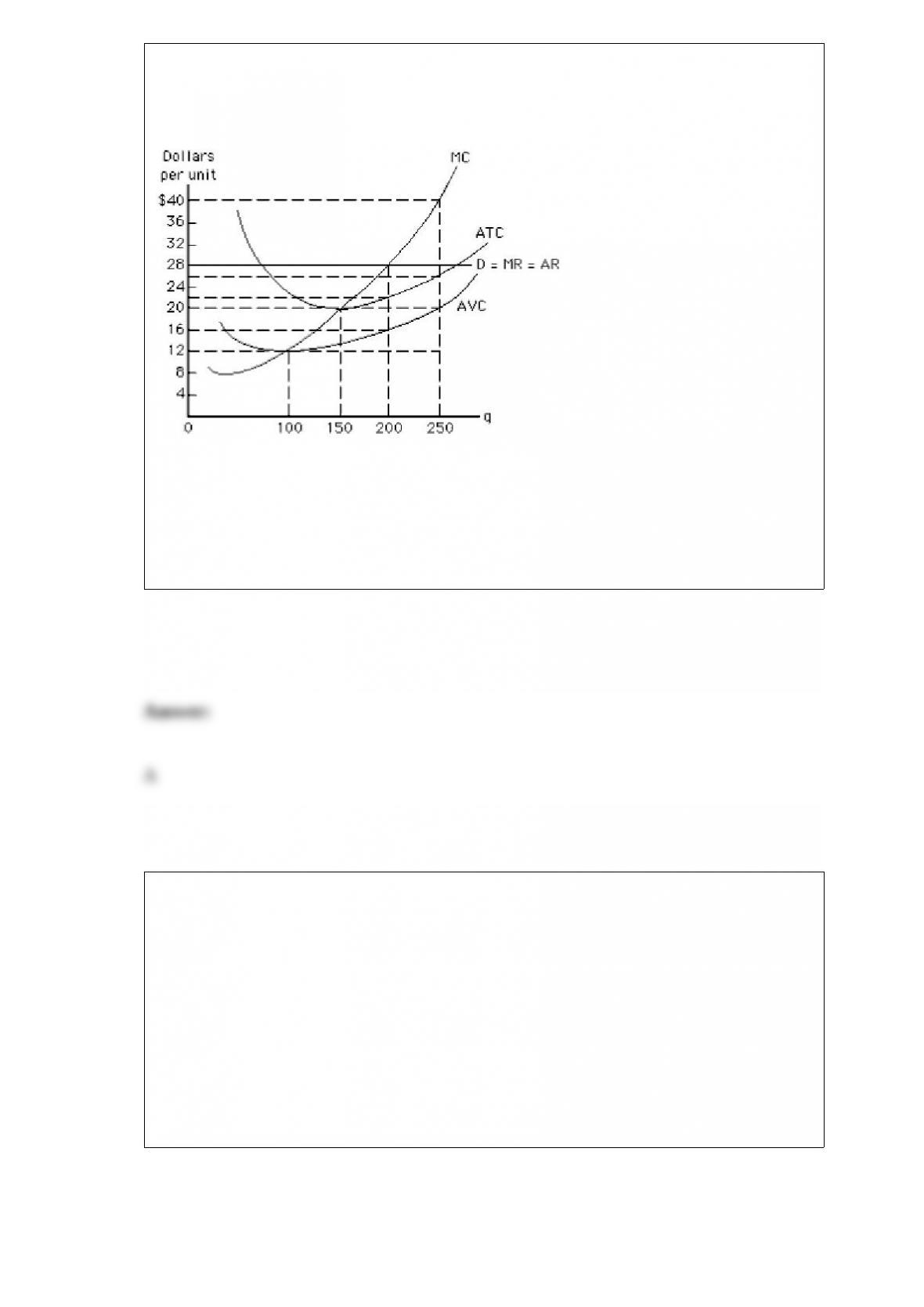
Exhibit 8-9
In Exhibit 8-9, total cost at the profit-maximizing output equals
a. $4,400
b. $4,800
c. $5,600
d. $2,400
e. $5,200
A profit-maximizing firm will hire extra units of a resource when
a. marginal resource cost exceeds marginal revenue product
b. marginal resource cost is equal to marginal revenue product
c. marginal resource cost is less than marginal revenue product
d. temporary resource price differentials exceed the marginal resource cost
e. the average resource cost and marginal resource cost curves are equal

Dusty Rags, Inc. provides janitorial services to retail stores. Dusty had been charging
$10 per hour and selling 400 hours of service per week at that rate. When he raised his
price to $15 per hour, his customers cut back to 300 weekly hours of service. Which of
the following is true?
a. Revenue went from $4,000 per week to $4,500 per week, indicating that the demand
curve for his services must have shifted to the right.
b. Revenue went from $4,000 per week to $4,500 per week, indicating that the demand
for his services must be elastic.
c. Revenue went from $4,000 per week to $4,500 per week, indicating that the demand
for his services must be inelastic.
d. Revenue went from $400 to $300 per week, indicating that demand must be elastic.
e. Revenue went from $10 to $15 per week, indicating that demand must be inelastic.
Exhibit 7-16
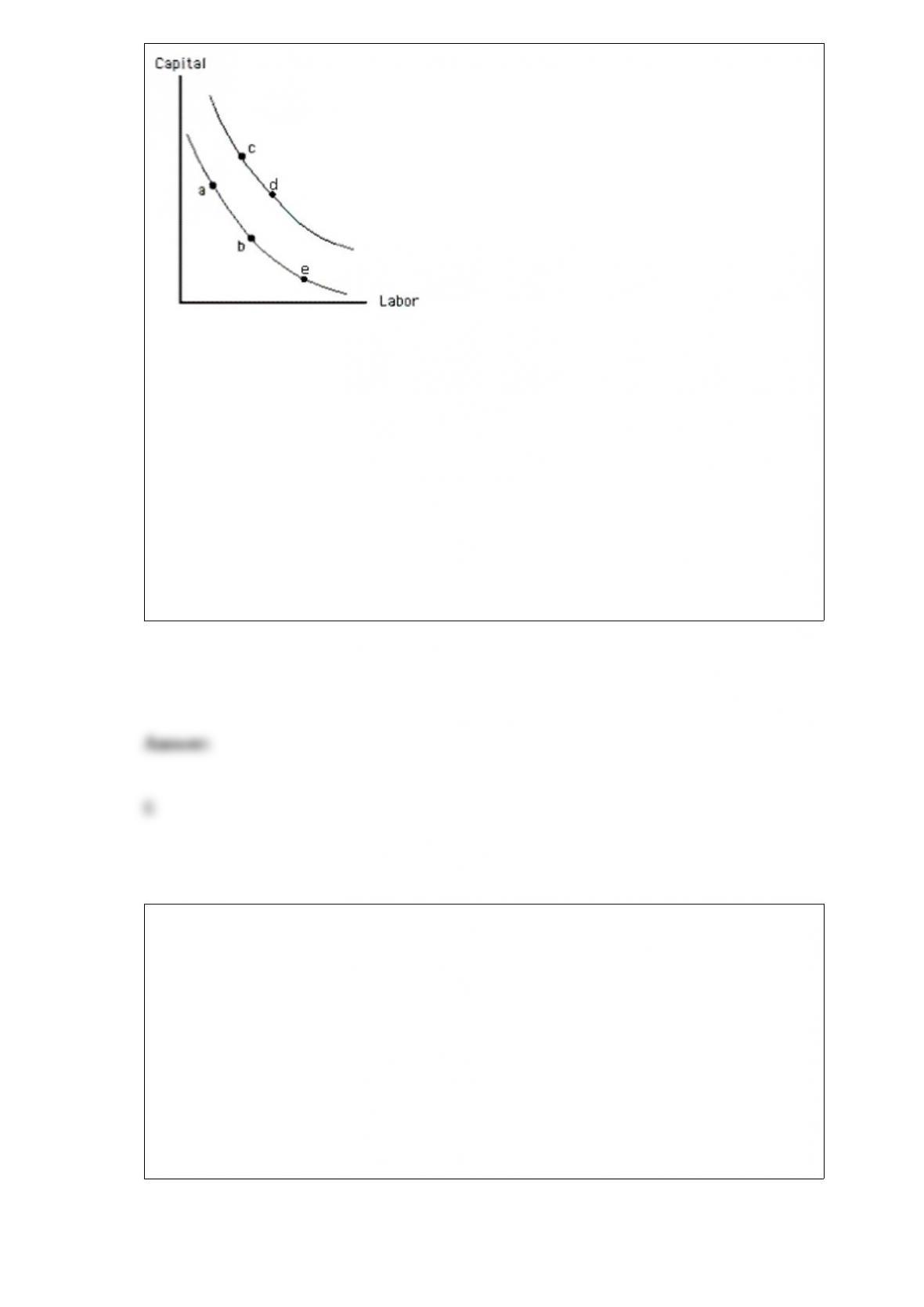
Which combination of capital and labor illustrated in Exhibit 7-16 will be the least
costly?
a. a
b. b
c. c
d. e
e. cannot tell from information given
Which form of business organization is the least common in the United States?
a. sole proprietorship
b. partnership
c. corporation
d. nonprofit organization
e. conglomerate

A tire manufacturer decides to expand into the production of rubber roofing and as a
result finds that its per unit production costs for tires falls. This is an example of
economies of scope.
a. True
b. False
Which of the following may be used by a plumber’s union or a medical professional
association to restrict membership?
a. all of the following are correct
b. long apprenticeship periods
c. difficult qualification exams
d. stringent education standards
e. high initiation fees
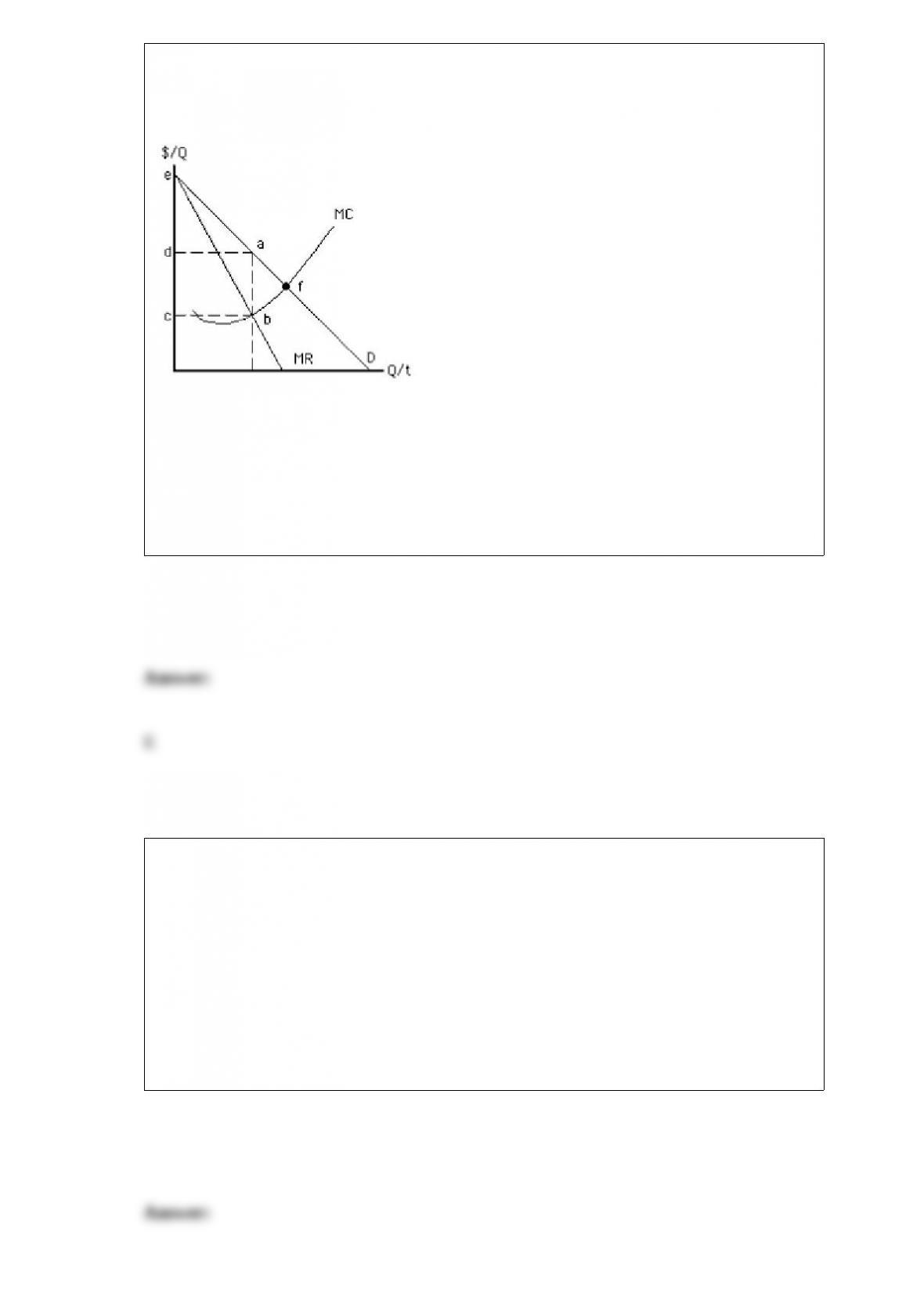
Exhibit 9-15
Why might the true deadweight loss from a nondiscriminating monopolist be lower
than the loss indicated in Exhibit 9-15
a. b, c, and e are correct
b. Resources may be spent to maintain the monopoly
c. The monopolist might engage in rent seeking
d. Inefficiency may increase because the monopolist is insulated from competition
e. The monopolist might charge a lower price to discourage entry
Suppose that a firm’s capital equipment is expected to last indefinitely, that operating
expenses on the equipment are negligible, and that the price of the firm’s product is
expected to remain constant in the future. Under these circumstances, the firm’s
marginal rate of return on investment is equal to capital’s
a. marginal resource cost as a percentage of its marginal revenue product
b. marginal product as a percentage of its marginal revenue product
c. marginal revenue product as a percentage of its marginal product
d. marginal resource cost as a percentage of the price of capital
e. marginal revenue product as a percentage of its marginal resource cost

A young chef is considering opening his own sushi bar. To do so, he would have to quit
his current job, which pays $20,000 a year, and take over a store building that he owns
and currently rents to his brother for $6,000 a year. His expenses at the sushi bar would
be $50,000 for food and $2,000 for gas and electricity. What are his implicit costs?
a. $26,000
b. $66,000
c. $78,000
d. $52,000
e. $72,000
Which of the following will not reduce the likelihood of a principal-agent problem
when getting your car repaired?
a. asking to see the replaced parts
b. staying to watch the repair being done
c. gathering information on car repair
d. not paying until after the repair job is finished
e. persuading the mechanic you know a lot about cars
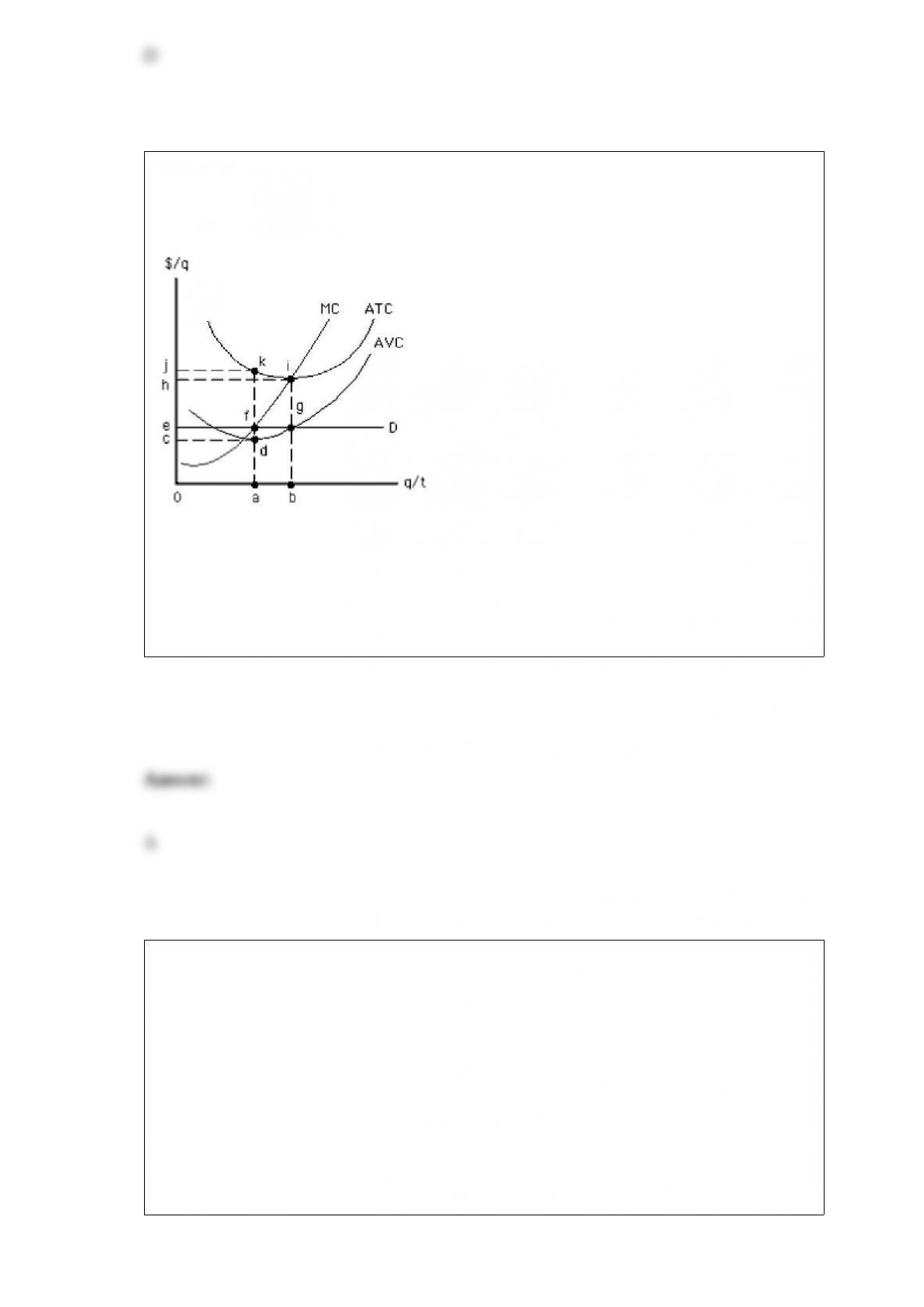
Exhibit 8-14
In Exhibit 8-14, what area represents variable cost at the loss-minimizing output?
a. 0cda
b. 0jka
c. 0efa
d. cefd
e. cjkd
In the short run, producers derive surplus from market exchange because
a. total revenue is greater than the minimum amount they would require to sell the good
b. total revenue is equal to the minimum amount they would require to sell the good
c. total revenue is less than the minimum amount they would require to sell the good
d. marginal revenue equals average total cost
e. they can rob consumers of most of their consumer surplus
A large U.S. steel firm wants to restrict imports of Japanese steel, but Ford Motor
Company wants fewer restrictions on steel so that the price of steel will go down. This
can best be described as
a. a zero-sum game
b. a competing-interest situation
c. a special-interest situation
d. a situation without widespread costs and benefits
e. an argument over distribution of a public good
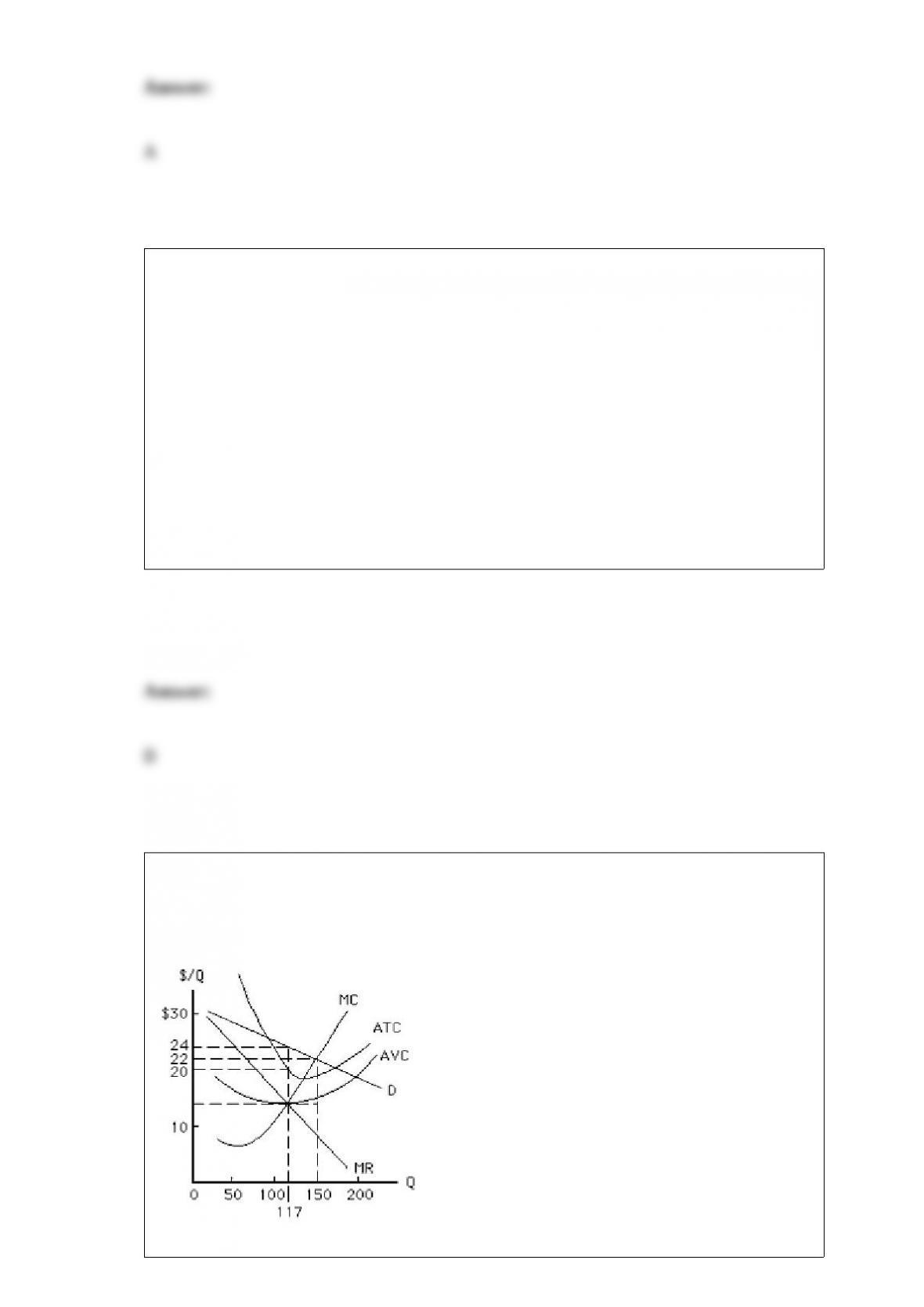
Exhibit 9-3
The firm in Exhibit 9-3, a monopolist that maximizes profit by charging all customers

the same price, is making a profit of
a. $0
b. $234
c. $482
d. $960
e. $468
Externalities can occur as a result of either production or consumption activities.
a. True
b. False
If marginal cost is positive, which of the following is true?
a. A monopolist always produces on the inelastic portion of the firm’s demand curve.
b. A monopolist always produces on the inelastic portion of the market demand curve.
c. A monopolist always produces on the elastic portion of the market demand curve.
d. A monopolist always produces on the unit elastic portion of the market demand
curve.
e. The presence of a monopolist increases the elasticity of demand.