
The change in total revenue that results from a one-unit change in the amount of a
variable resource used is
a. average resource cost
b. marginal resource cost
c. marginal product
d. marginal revenue product
e. average revenue product
Goods and services are scarce because
a. people are greedy
b. they are produced using scarce resources
c. firms keep production low in order to earn higher profits
d. they are produced by firms that seeks profits
e. government wants to maintain its power over the economy
If the British pound appreciates, U.S. television stations need fewer dollars to buy
episodes of a Britcom from the British Broadcasting Company.

a. True
b. False
The marginal rate of technical substitution between labor (L) and capital (C) equals
a. MUL/MUC
b. AVC
c. MPL/MPC
d. the capital-labor ratio
e. the labor-capital ratio
If a person produces capital goods, she sacrifices current production of consumer goods
in order to obtain the capability of producing more goods and services in the future.
This is called roundabout production.
a. True
b. False
As price decreases along a linear demand curve, price elasticity of demand decreases.
a. True
b. False
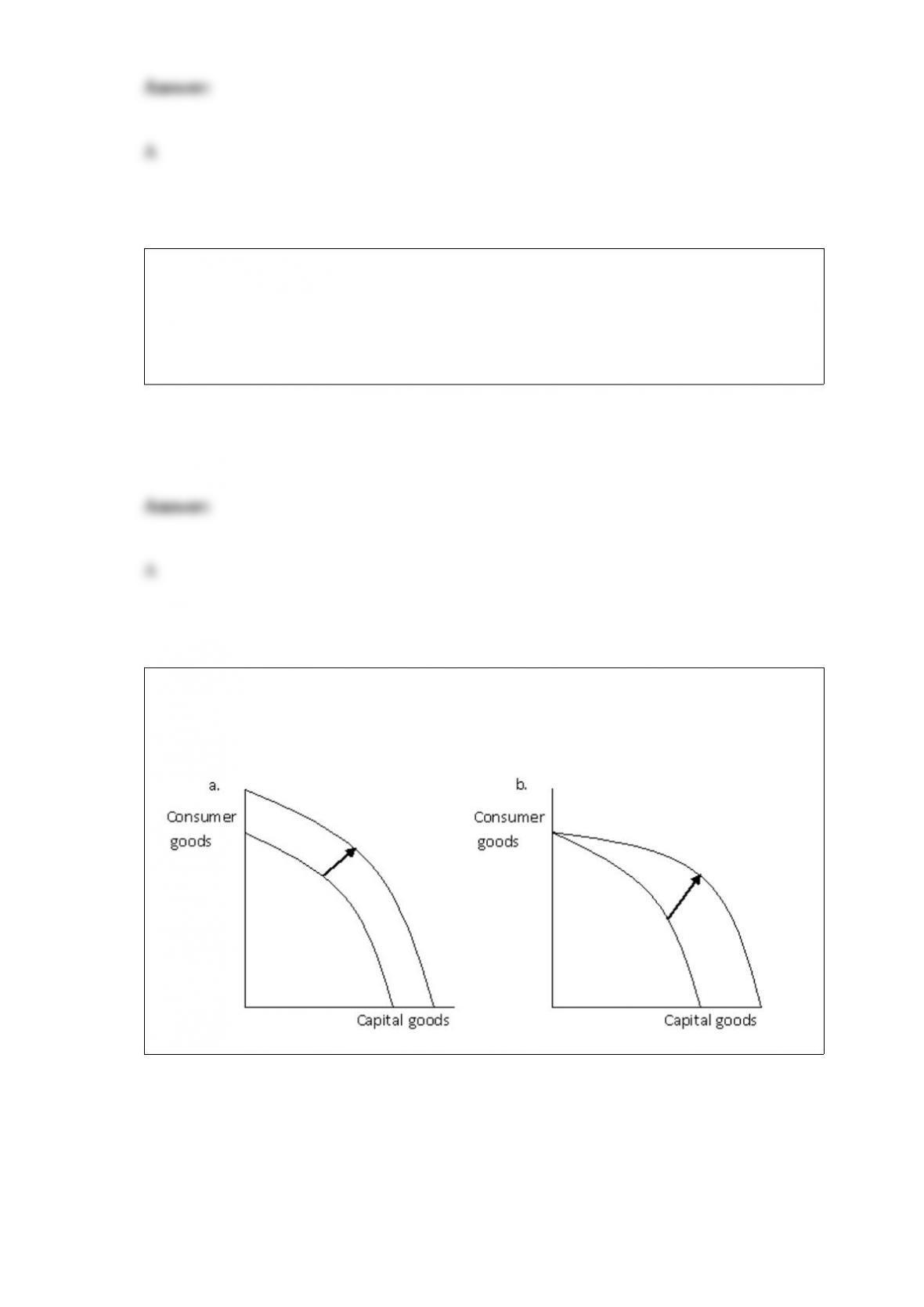
Exhibit 2-10
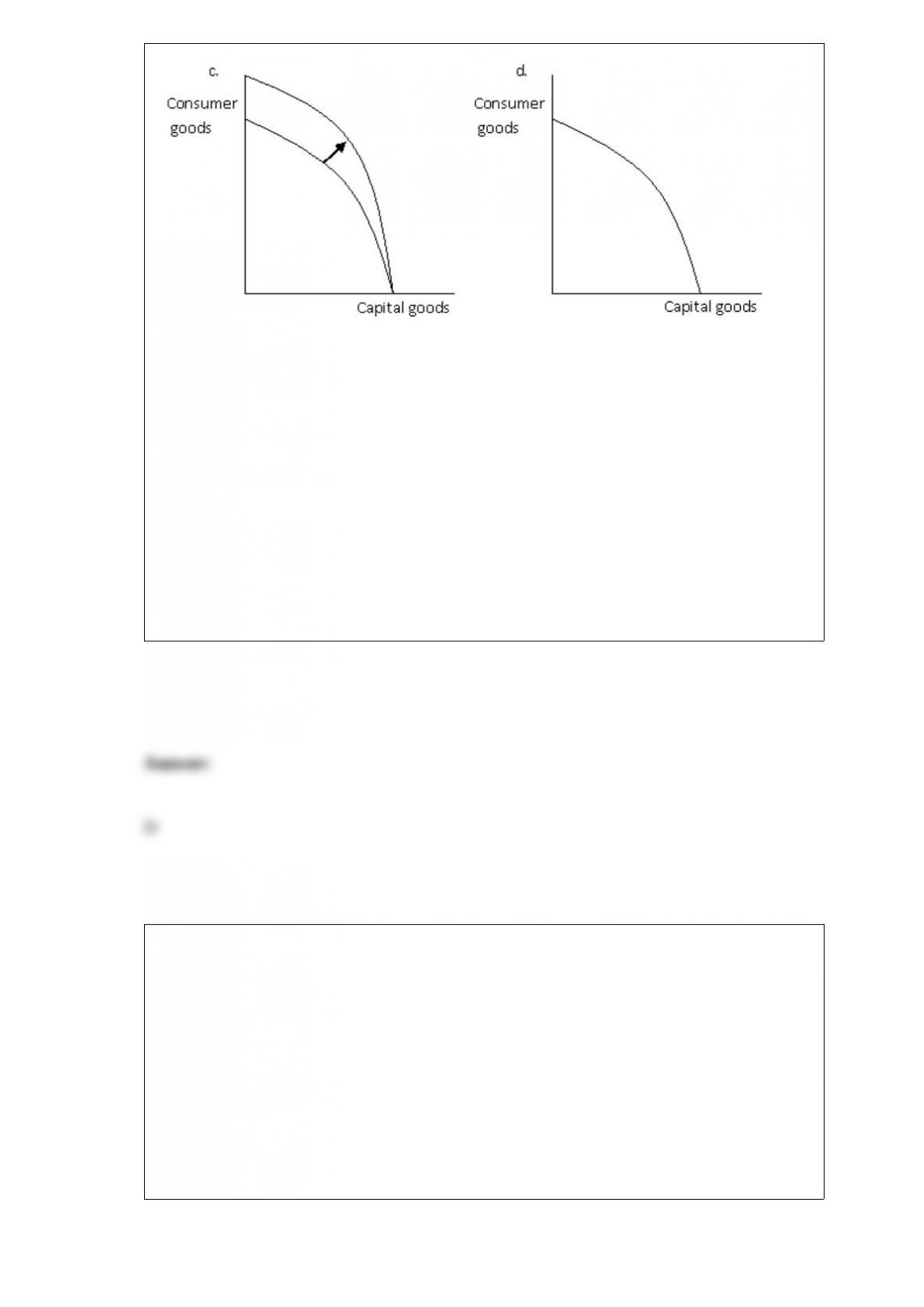
Refer to Exhibit 2-10. Which of the graphs best illustrates the impact on the production
possibilities frontier of a decrease in unemployment?
a. a
b. b
c. c
d. d
e. a, b and c
A consumer maximizes utility where the
a. budget line intersects an indifference curve
b. budget line is tangent to an indifference curve
c. distance between the budget line and an indifference curve is greatest
d. indifference curve farthest from the origin intersects the budget line twice
e. area between the indifference curve and the budget line is the greatest

Suppose, at its present rate of output, a perfectly competitive firm’s marginal revenue
exceeds both its marginal cost and its average variable cost. To maximize profit, the
firm should
a. lower the price
b. raise the price
c. increase output
d. reduce output
e. maintain its current rate of output
If ZipCo’s marginal revenue product curves slope downward, what can we conclude
about the structure of the market in which ZipCo sells its product?
a. The firm is a price searcher because price is greater than marginal revenue.
b. The firm is a price taker because price is equal to marginal revenue.
c. The firm is a price searcher because the price of each resource is constant.
d. The firm is a price taker because the price of each resource is constant.
e. Nothing.

As the wage rate increases, the income effect tends to reduce the quantity of labor
supplied to the market.
a. True
b. False
Natural monopolies are firms that
a. have a downward-sloping long-run average cost curve over the entire range of market
demand
b. have an upward-sloping long-run average cost curve over the entire range of market
demand
c. are protected against the entry of new firms by patents, licenses, or other legal
restrictions
d. control a nonreproducible resource that is critical to production
e. have been created over time by the mergers of many smaller firms
In a labor negotiation, a mediator
a. represents the union rank-and-file members

b. represents the management side
c. is an impartial observer
d. can call a strike
e. can force both sides to agree to a contract
A demand curve shows how quantity demanded changes as the price changes. It implies
that
a. only a change in price can shift a demand curve
b. everything else that affects demand is assumed to be constant
c. quantity demanded is unrelated to price
d. economists are concerned only with money
e. it is impossible to show how anything but price affects demand
Imagine that there are only two nations in the world, the United States and Mexico. If
Mexico experiences a drop in the price of foreign exchange, people in Mexico will
a. have to buy more U.S. currency, because prices of imports from the United States
will have increased

b. end up buying less U.S. currency, because U.S. prices on goods will decrease to
everyone
c. be able to afford less U.S. currency, and imports from the United States will be more
expensive
d. be able to afford more U.S. currency, and imports from the United States will be
cheaper
e. be able to afford more U.S. currency, and imports from the United States will be
more expensive
Which of the following may result when workers have much better information about
their own productivities than employers have?
a. discrimination
b. natural selection
c. principal-agent problems
d. unemployment
e. adverse selection
The basic difference between a public bureau and a market firm is that the bureau

a. has an incentive to maximize profits
b. has no incentive to minimize costs
c. managers do not attempt to maximize their self interest
d. managers are more likely to be concerned with the public interest than their own self
interest
e. faces a budget constraint placed up it by the voters
Which of the following is the reason supply curves typically slope upward?
a. Opportunity cost of production increases as quantity supplied increases.
b. Supply increases as opportunity cost decreases.
c. Price increases as supply decreases.
d. Quantity supplied is unrelated to price.
e. The income and substitution effects of a price change.
Although some of the statements below are true of both normal goods and inferior
goods, only one of the statements defines a normal good. Which one?

a. Normal goods are those for which the demand curve slopes downward.
b. Normal goods are those for which indifference curves slope downward.
c. Normal goods are those whose demand curves shift rightward when income
increases.
d. Normal goods are those whose indifference curves shift rightward when income
increases.
e. Normal goods are those for which demand decreases when price increases.
Corporations can obtain investment funds by
a. buying government securities
b. selling stock
c. increasing dividends
d. purchasing more capital
e. buying back stock
In order to increase society’s total welfare, a production process that produces a
negative externality should be
a. taxed
b. provided by the government

c. ignored
d. subsidized
e. exported
For which of the following is demand likely to be most price-elastic?
a. steak
b. beef (including steak, ribs, hamburger, etc.)
c. meat (including beef, pork, chicken, lamb, etc.)
d. protein foods (including meat, cheese, beans, eggs, fish, etc.)
e. none of the above (they will all have the same elasticity)
The market supply curve of a resource is
a. downward sloping
b. upward sloping
c. horizontal at the market price
d. vertical

e. determined by firms
In the short run, if a firm shuts down, its total revenue is
a. $0
b. equal to its fixed costs
c. greater than its variable costs
d. greater than its fixed costs
e. less than its variable costs
Cost-plus pricing
a. is used only in oligopolistic market structures
b. simplifies pricing policy by adding a markup to average total cost
c. in actual practice leads to markups which are greater for more elastic demand curves
d. is likely to increase profits more than the use of marginal analysis
e. requires the firm to project the amount which will be sold and then “mark-up” the
price based on average variable cost

In 2011, the average GDP per capita among the world’s economies was slightly more
than $11,000 per year.
a. True
b. False
Suppose a basket of goods costs $400 in the United States and 200 in Britain. If the
exchange rate is $1/pound, what will happen in the foreign exchange market, according
to the purchasing power parity theory?
a. The market will go further out of equilibrium because of increased activity.
b. An increase in demand for pounds will lead to an increase in the price of pounds.
c. An increase in demand for dollars will lead to an increase in the price of dollars.
d. An increase in demand for dollars will lead to a decrease in the price of dollars.
e. An increase in demand for pounds will lead to a decrease in the price of pounds.
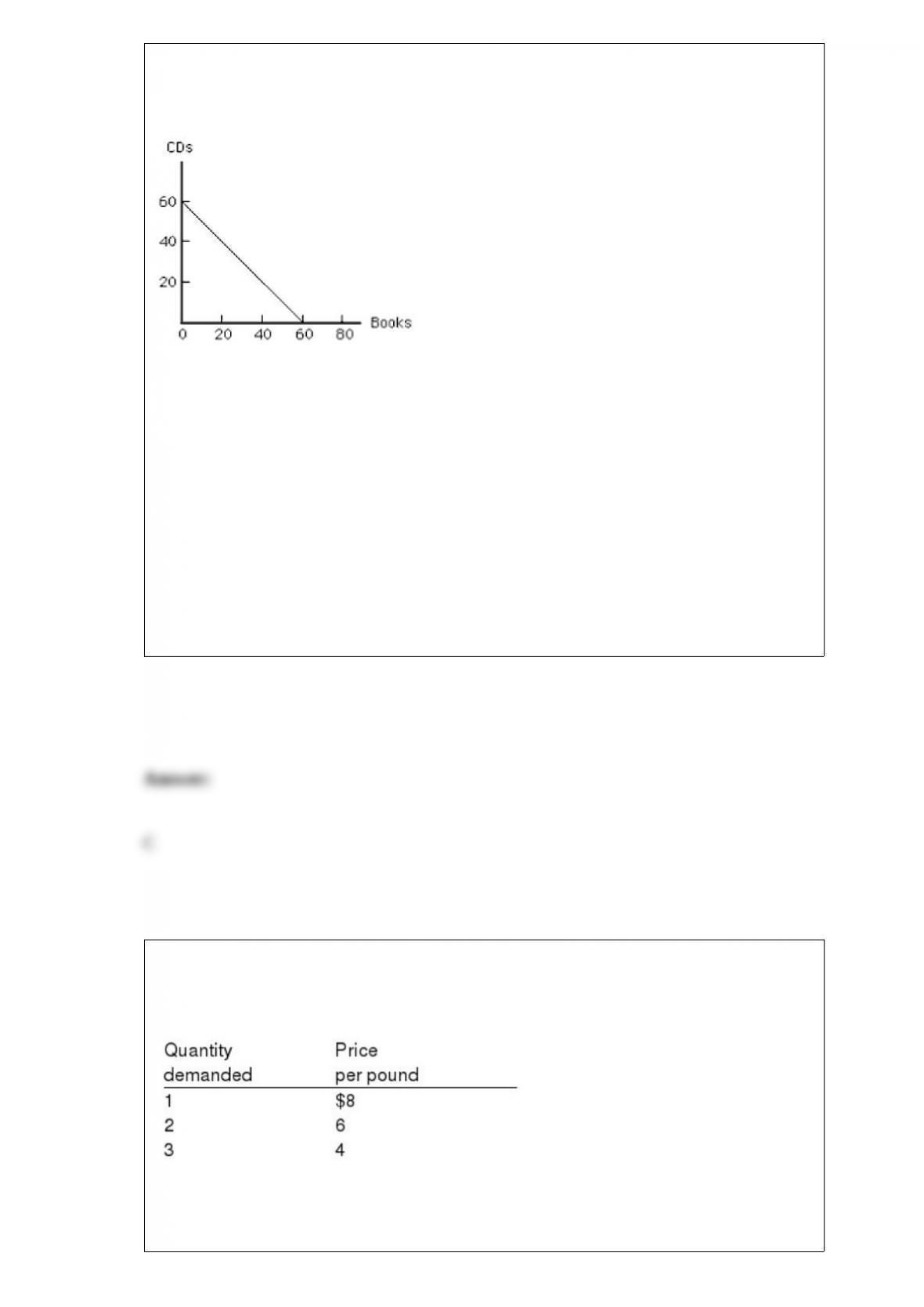
Exhibit 6-30
Consider Exhibit 6-30. Assume that you initially have $600 to spend on books and
compact disks. What happens if the amount you have to spend increases to $800?
a. The budget line shifts inward along the horizontal axis.
b. The budget line shifts inward along the vertical axis.
c. The budget line shifts outward along the horizontal axis and the vertical axis.
d. The budget line shifts outward along the vertical axis.
e. The budget line shifts outward along the horizontal axis.
Exhibit 6-16
Exhibit 6-16 shows Reggie’s demand for apples. If there are 100 people in this
economy, and each has the same demand for apples as Reggie, what is the total quantity

demanded in the market for apples at P = $6?
a. 600 pounds of apples
b. 200 pounds of apples
c. the average of all the quantities demanded
d. the average of all the prices
e. the average quantity demanded divided by the average price
The difference between fiscal policy and monetary policy is that
a. fiscal policy is macroeconomic policy and monetary policy is microeconomic policy
b. monetary policy is macroeconomic policy and fiscal policy is microeconomic policy
c. fiscal policy involves regulation of natural monopolies and monetary policy involves
the provision of public goods
d. monetary policy involves regulation of the money supply and fiscal policy involves
government spending and taxing
e. fiscal policy involves the promotion of competition and monetary policy involves
collecting money to pay for taxes

Economic profit is defined as
a. total revenue minus price
b. price minus quantity
c. total revenue minus what must be paid to resources to attract them from their best
alternative use
d. total revenue divided by what must be paid to resources to attract them from their
best alternative use
e. total revenue plus what must be paid to resources to attract them from their best
alternative use
A formal agreement among the firms in an industry to coordinate their production and
pricing decisions in order to earn monopoly profits is known as
a. price discrimination
b. the kinked demand curve
c. monopolistic competition
d. a cartel
e. joint competition
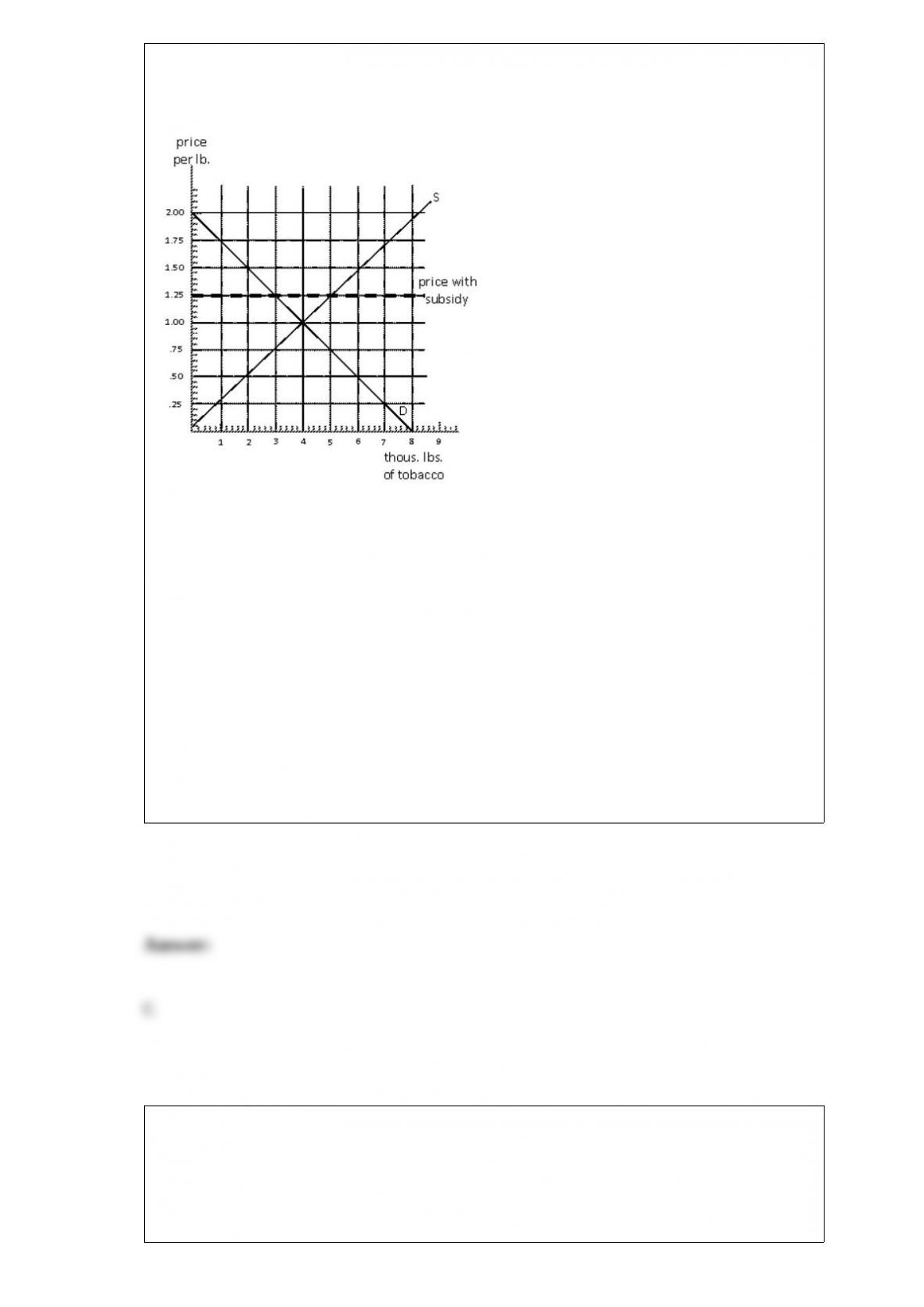
Exhibit 16-5
Exhibit 16-5 represents the market for leaf tobacco. Suppose the government imposes a
floor of $1.25 in this market. How much consumer surplus would be lost as a result of
this price support?
a. $725
b. $800
c. $875
d. $950
e. $1025
The balance of payments always balances, because each of the specific accounts must,
by definition, be in balance.
a. True

b. False