
As the price of land decreases along its demand curve, the relative price of land
a. increases because the prices of other resources have also decreased
b. decreases because the prices of other resources have also decreased
c. increases because the prices of other resources have increased
d. decreases because the prices of other resources are held constant
e. remains constant because the prices of other resources also increase
Along a linear demand curve, as the price rises, demand becomes more
a. steep
b. elastic
c. inelastic
d. unit elastic
e. variable
Exhibit 17-4
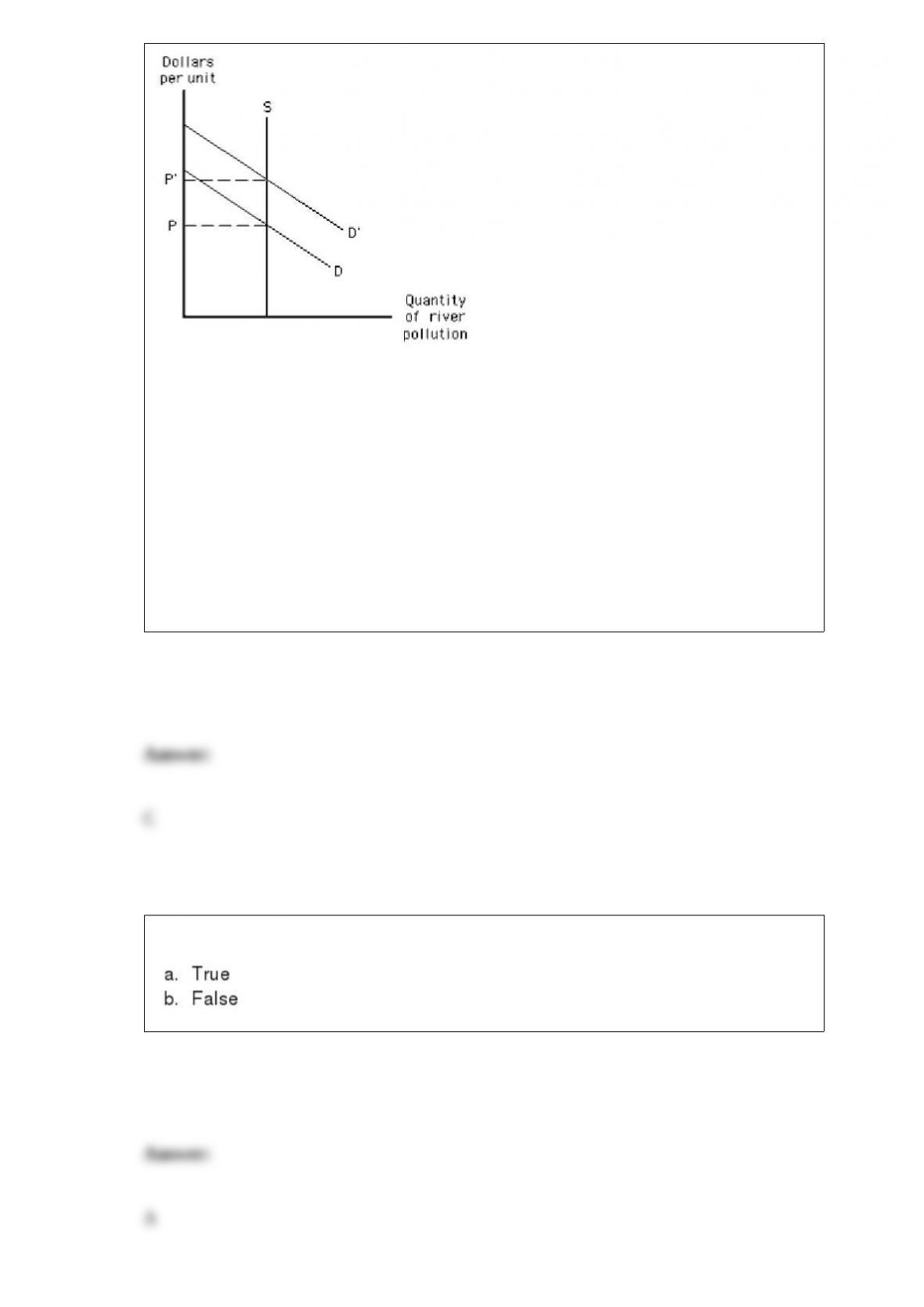
The supply curve in Exhibit 17-4 represents the amount of
a. pollution individuals and firms want to dump into the river
b. the river that can still serve as a resource
c. pollution the river can accept
d. pollution the owner or manager of the resource is willing to clean up
e. the pollution-causing good supplied by the industry
A consumer can afford to move between any two points on his current budget line.

A game show host who gave up his job as a teacher brags about his salary, saying “the
rest is pure gravy.” Here, “the rest” refers to
a. opportunity cost
b. implicit cost
c. explicit cost
d. the height of his labor supply curve
e. economic rent
Economists distinguish between normal and inferior goods using
a. price elasticity of demand
b. price elasticity of supply
c. income elasticity of demand
d. cross-price elasticity of demand
e. tax incidence

If Dalene’s marginal benefit from consuming another cookie is greater than the price of
the cookie, then
a. Dalene will not purchase any more cookies
b. the opportunity cost of the cookie is lower than the price
c. Dalene’s utility will decrease if she purchases the cookie
d. Dalene will increase her total satisfaction by purchasing the additional cookie
e. she has purchased too many cookies
Increased international trade and deregulation have resulted in
a. increased competition in the U.S. economy
b. greater monopolization of industries in the U.S. economy
c. more oligopolies and cartels in the U.S. economy
d. greater government intervention in the U.S. economy
e. no changes in the U.S. economy
Welfare benefits

a. may do of all of the following
b. may discourage poor people from taking jobs
c. may cause job skills to deteriorate
d. take the form of cash or in-kind transfers
e. allow increased consumption by many poor children
From the following demand schedule for a monopolist, what is the marginal revenue
associated with the sale of the fourth unit?
a. $10
b. $30
c. $60
d. $240
e. marginal revenue cannot be determined from the information given

Exhibit 7-3
In Exhibit 7-3, the marginal product of the third worker is
a. 20
b. 100/3
c. 60
d. 50
e. 140
The process by which union members and the firm’s management negotiate a contract is
called
a. settlement negotiation
b. collective bargaining
c. a union contract
d. collection arbitration

e. settlement bargaining
Which of the following is not true about income quintiles?
a. Only one in seven households in the bottom quintile has anybody working full time
b. Only one in three households in the top quintile has anybody working at all
c. A primary contributor to the smaller share of income going to the bottom quintile has
been the growth of single-parent households
d. Three out of four households in the top quintile have two or more working
e. A primary contributor to the larger share of income going to the top quintile has been
the growth of two-earner households
Public utilities are either government-owned or government-regulated firms.
a. True
b. False

A horizontally integrated firm produces products in a variety of industries (e.g., General
Electric, which produces jet engines, air conditioners and microwave ovens).
a. True
b. False
An externality is
a. a cost of a transaction that is borne by a third party
b. a benefit of a transaction that is enjoyed by a third party
c. a cost or benefit that arises when market price changes
d. any cost or benefit of a transaction that is not accounted for in the market price
e. the external revenue generated by a firm
Barriers to entry

a. prevent monopolies from earning profit in the long run
b. prevent monopolies from earning profit in the short run
c. may allow monopolies to earn profit in the long run
d. prevent government from regulating a monopoly
e. prevent a natural monopoly from raising its price
The more complicated the process used to produce a good,
a. the greater are the transaction costs of organizing production through markets
b. the lower are the transaction costs of organizing production through markets
c. the less likely a firm will use administrative controls to organize the production
process
d. the more likely a firm will use the market to organize the production process
e. the more likely consumers will choose to purchase the good over other alternatives in
the market
The problem of scarce resources
a. means that in some cities there are not enough jobs
b. could be solved if the unemployment rate fell
c. is that there are not enough resources to satisfy people’s unlimited wants
d. is that resources are used inefficiently
e. can be solved by lowering taxes
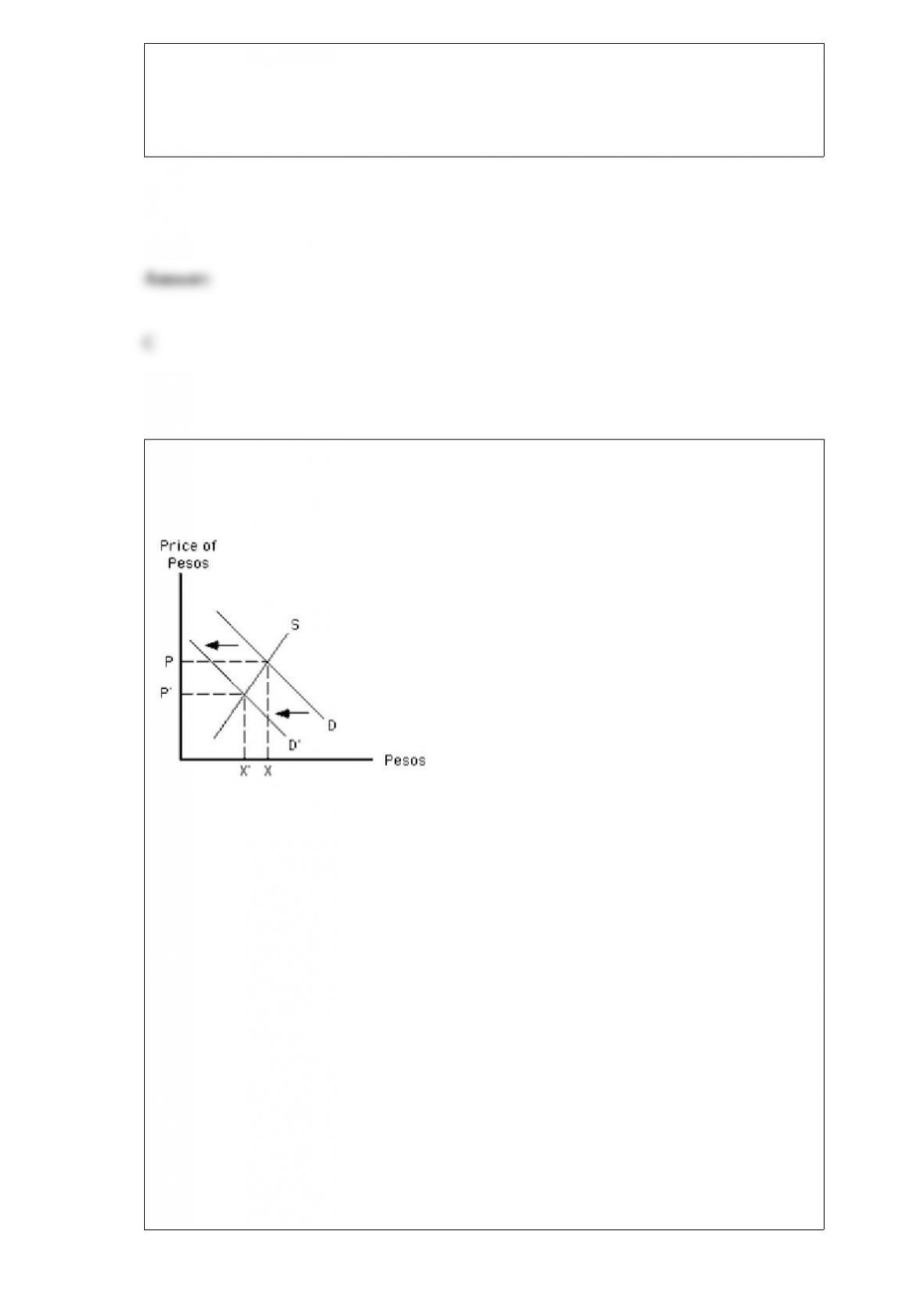
Exhibit 20-7
Suppose that in response to the demand shift shown in Exhibit 20-7, Mexico’s central
bank takes action to protect its currency, the peso, from depreciating. Enforcing a floor
such as Mexico establishes is
a. easier in the long run, when policy makers at the central bank can focus beyond
temporary fluctuations, than in the short run
b. easier in the long run, since over time new funds are always earned in international
goods transactions
c. harder in the long run, when policy makers at the central bank can become confused
by repeated fluctuations
d. easier in the long run, since a country’s import and export position will not change
rapidly as long as the floor is maintained
e. harder in the long run, since policy makers at the central bank will run out of reserves
of other currency with which to buy back domestic currency

If education creates positive externalities,
a. private markets provide less than the socially optimal quantity of education
b. private markets provide more than the socially optimal quantity of education
c. the marginal private benefit curve is higher than the marginal social benefit curve
d. the marginal private cost curve is higher than the marginal social cost curve
e. the government should impose a depletion tax
Suppose you form a legal partnership with your best friend, and she purchases
consulting services calling for a $100,000 fee. Your business is broke, and you never
wanted the consultants to work for you — only your partner did. For how much of this
debt are you legally liable?
a. none of it
b. all of the $100,000
c. the proportion reflected by the proportion of the business owned
d. only an amount equal to the assets of the business
e. $50,000
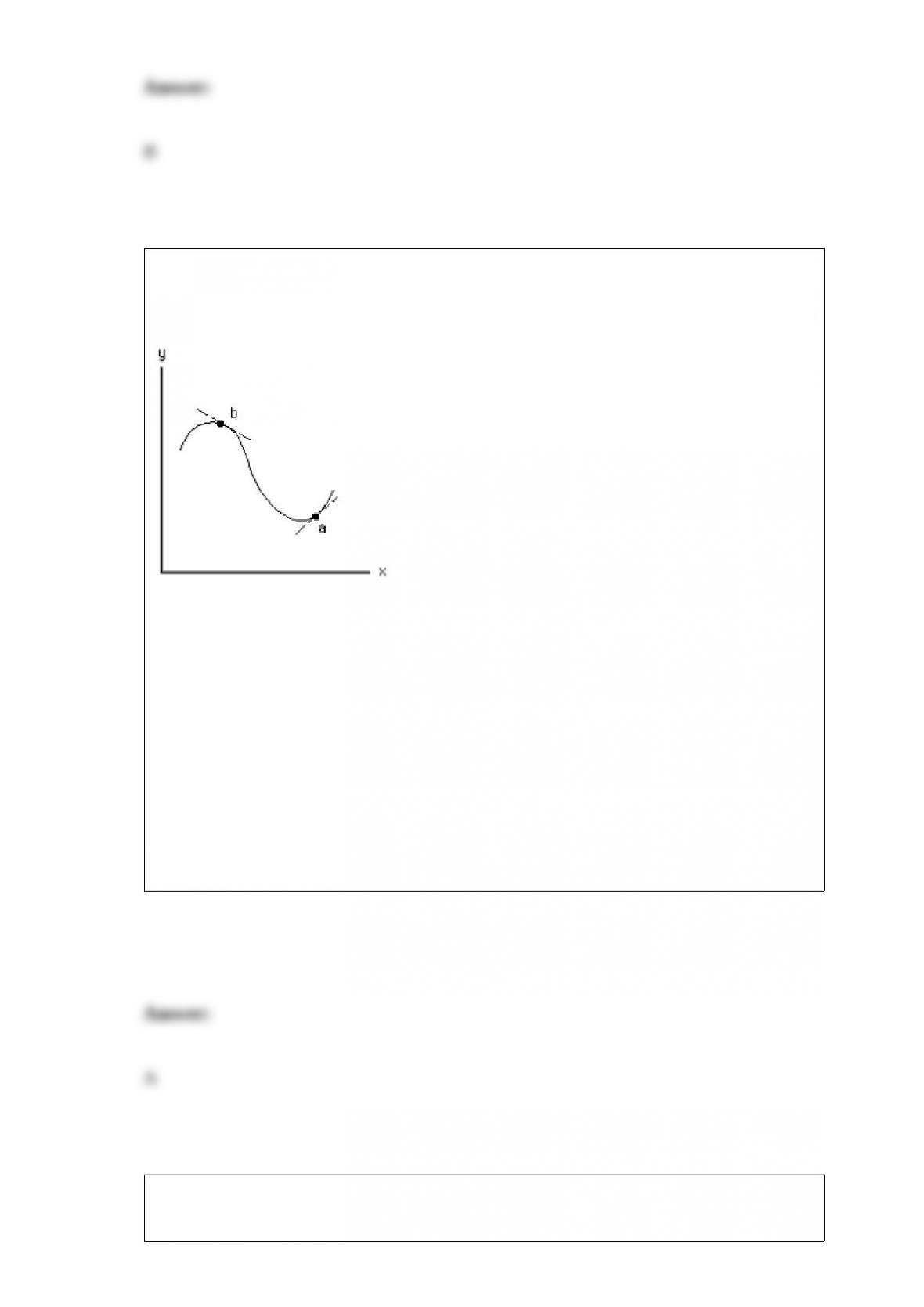
Exhibit 1-13
Compare the slopes of the tangents at points a and b in Exhibit 1-13. Which of the
following statements is true?
a. The slope at a is positive, and the slope at b is negative.
b. The slope at a is negative, and the slope at b is positive.
c. The slope is positive at both a and b.
d. The slope is negative at both a and b.
e. The slope at a is equal to the slope at b.
Predatory dumping is the practice of

a. rejecting imports
b. persistently selling a good in another country for a price lower than the world price
c. persistently selling a good in another country for a price lower than the domestic
price
d. temporarily selling a good in another country for a price lower than the world price to
drive out competing producers
e. temporarily selling a good in another country for a price lower than the domestic
price to drive out competing producers
The supply of loanable funds curve reflects
a. the inverse relationship between the market interest rate and the quantity of borrowed
funds
b. the inverse relationship between the market interest rate and the quantity of saving
c. the direct relationship between the market interest rate and the quantity of borrowed
funds
d. the direct relationship between the market interest rate and the quantity of saving
e. the direct relationship between the market interest rate and the quantity of present
consumption
Which of the following is an example of a temporary price differential in a resource
market?

a. land downtown is more expensive than land in the suburbs
b. a superstar professional basketball player is paid more than the average professional
player
c. cable television installers have a higher wage than telephone installers
d. an airline pilot is paid more than a flight attendant
e. a worker in a toxic waste plant earns more than a teacher
If the sellers in the cigarette industry formed a cartel and decided to set price along a
straight-line downward-sloping demand curve, which point would they choose if they
wanted to gain the highest total revenue?
a. The point nearest the vertical axis, where the price is highest.
b. The point nearest the horizontal axis, where quantity demanded is greatest.
c. One of the points higher up on the demand curve, where demand is elastic.
d. One of the points lower down on the demand curve, where demand is inelastic.
e. The point of unit elasticity, in the middle of the demand curve.
All combinations of goods along the same indifference curve represent the same level
of utility.
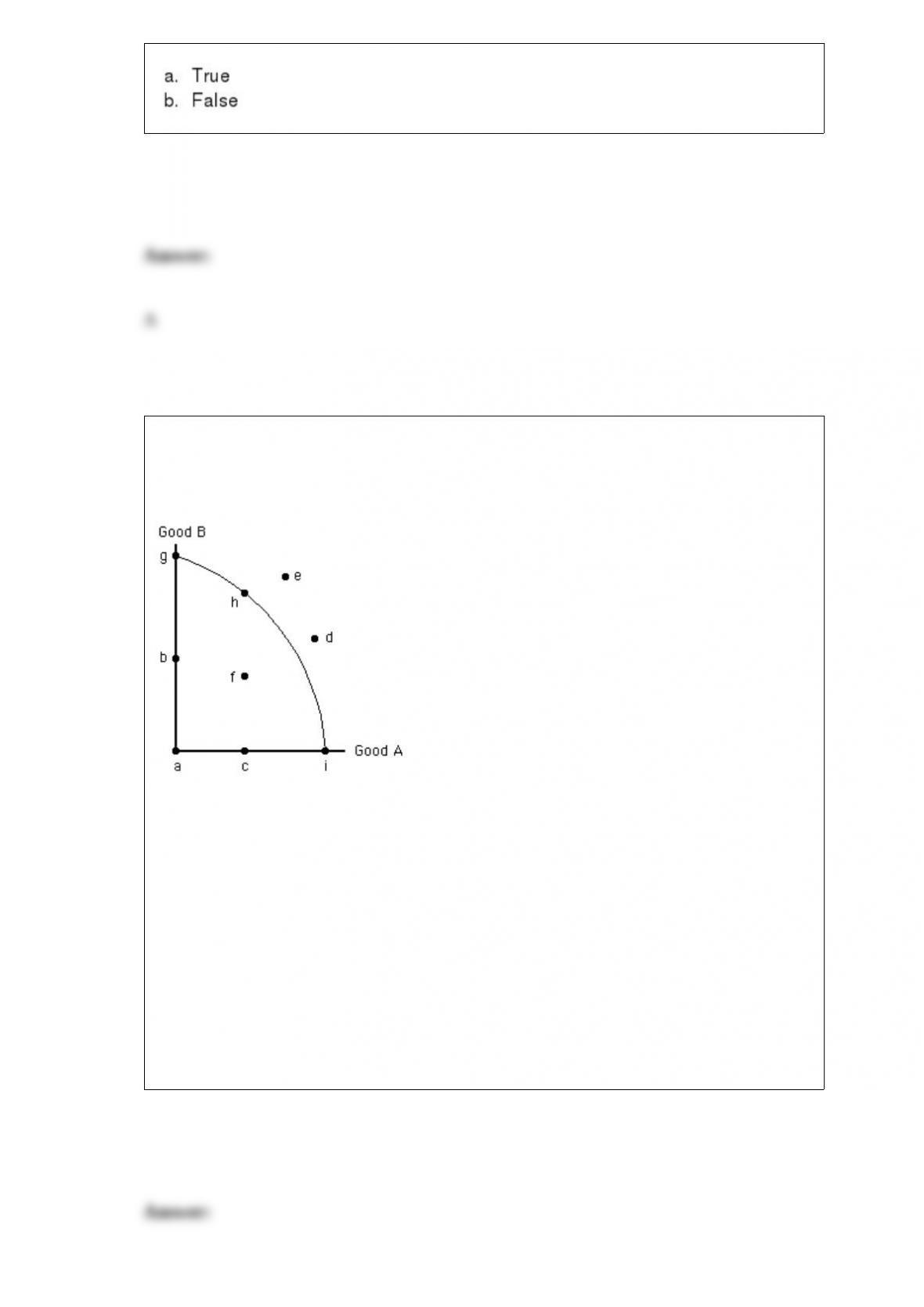
Exhibit 2-4
Which of the following points in Exhibit 2-4 represents an inefficient use of the
economy’s resources?
a. g
b. i
c. f
d. d
e. h
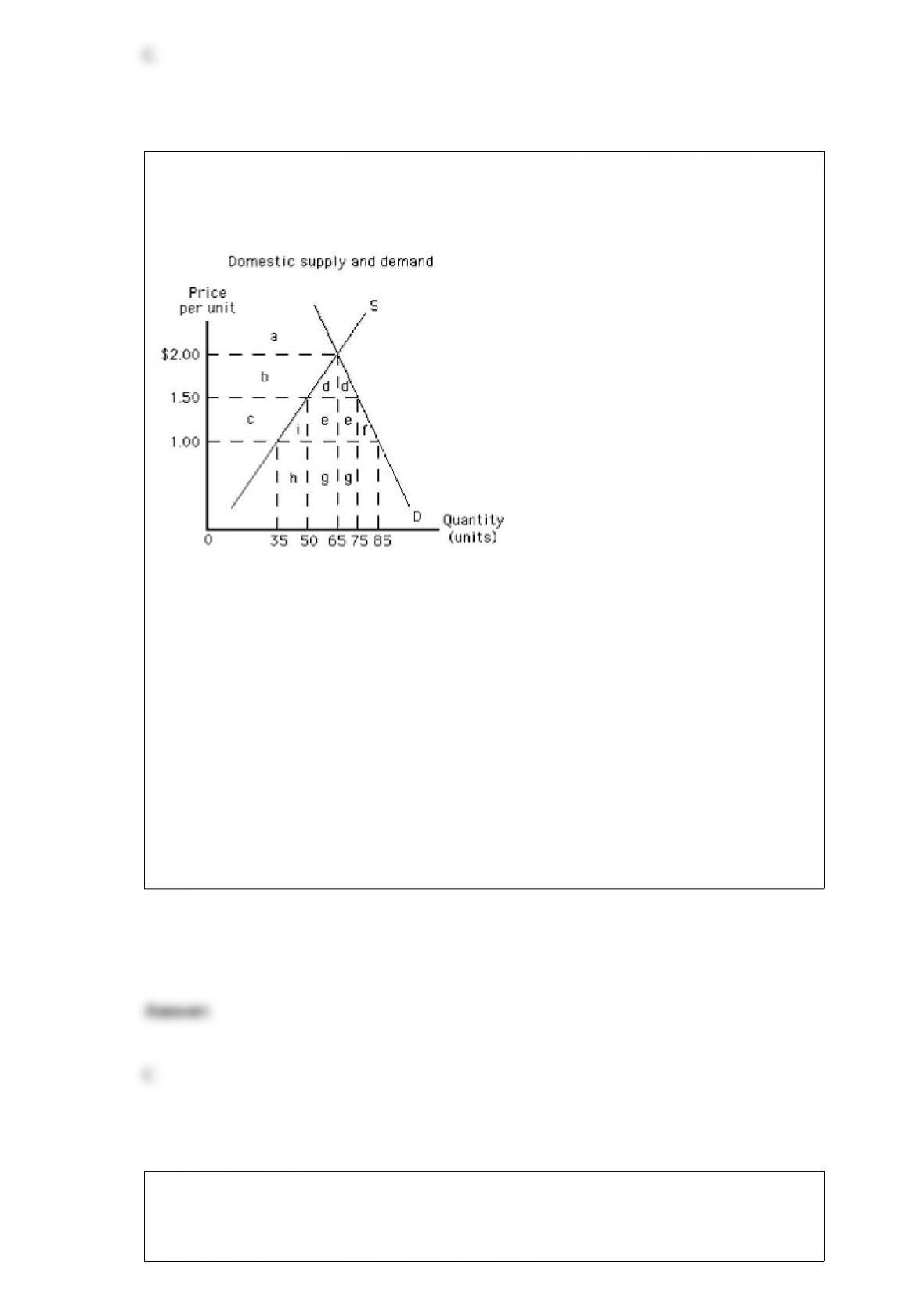
Exhibit 19-5
If the country illustrated in Exhibit 19-5 is initially trading without restrictions at a
world price of $1.00, the gain in producer surplus as a result of a tariff of $0.50 per unit
is represented by area
a. c + h
b. h
c. c
d. c + g
e. g
For any given price, the more elastic the demand for a product is, the greater will be the
consumer surplus.

a. True
b. False
Opportunity cost is defined
a. only in terms of money spent
b. as the value of all alternatives not chosen
c. as the value of the best alternative not chosen
d. as the difference between the benefits from a choice and the benefits from the next
best alternative
e. as the difference between the benefits from a choice and the costs of that choice
Inputs that can be increased or decreased in the short run are called
a. fixed inputs
b. variable inputs
c. economic inputs
d. accounting inputs

e. normal inputs
The income effect of an increase in the price of backpacks (a normal good) is a(n)
a. decrease in the demand for backpacks
b. decrease in the quantity demanded of backpacks
c. increase in the demand for backpacks
d. increase in the quantity demanded of backpacks
e. new demand curve because everything else is no longer constant