
Resources are divided into the following broad categories:
a. people, money, and machines
b. saving, spending, investment, and capital
c. human, technological, and government
d. natural resources, labor, capital, and entrepreneurial ability
e. free, scarce, abundant, and unlimited
The chances of successful collusion are greatest when
a. firms are producing a differentiated product
b. there are many firms in the industry
c. there are tiny firms and huge firms together in the same industry
d. demand curves and cost curves are similar among the firms in the industry
e. demand is falling
Suppose that a monopolist must choose between two points on its demand curve: it can
sell 100 units for $3 each, or it can sell 140 units for $2 each. Which of the following is

true?
a. The monopolist is facing elastic demand.
b. The monopolist is facing unit elastic demand.
c. The monopolist is facing inelastic demand.
d. The monopolist is facing perfectly elastic demand.
e. The elasticity of demand cannot be determined with the information given.
To solve the common pool problem in fishing, governments can __________, or
__________.
a. impose a depletion tax; prohibit resource use entirely
b. impose a depletion tax; restrict output
c. introduce an offsetting positive externality; prohibit resource use entirely
d. use a variable technology; impose a depletion tax
e. restrict output; prohibit resource use entirely
If demand is price elastic, total revenue is
a. directly related to quantity demanded
b. inversely related to quantity demanded
c. directly related to price
d. directly related to price and inversely related to quantity demanded
e. not related to either price or to quantity demanded
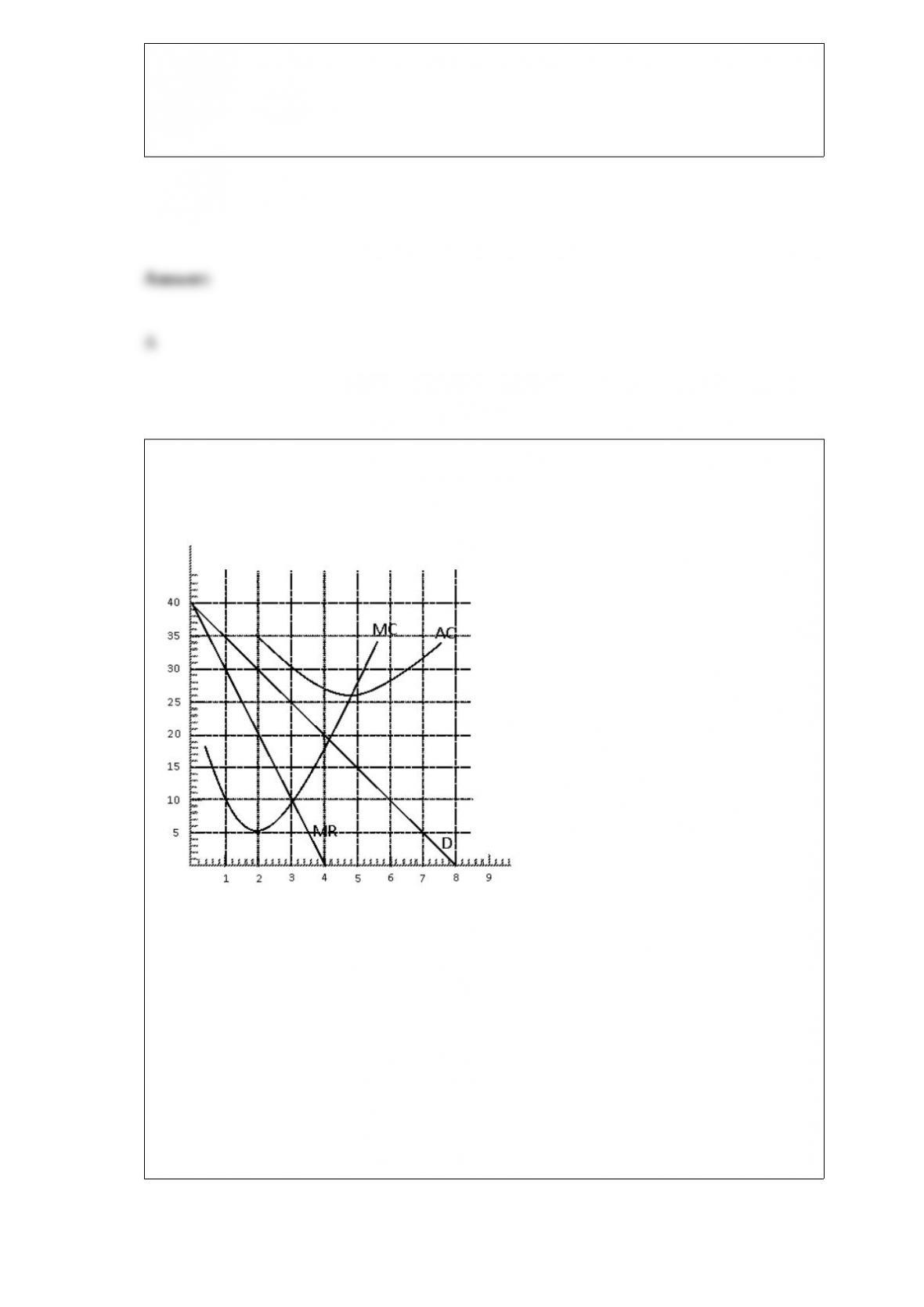
Exhibit 10-17
In Exhibit 10-17, the monopolistic competitor’s profit-maximizing price is
a. $10
b. $15
c. $20
d. $25
e. $30
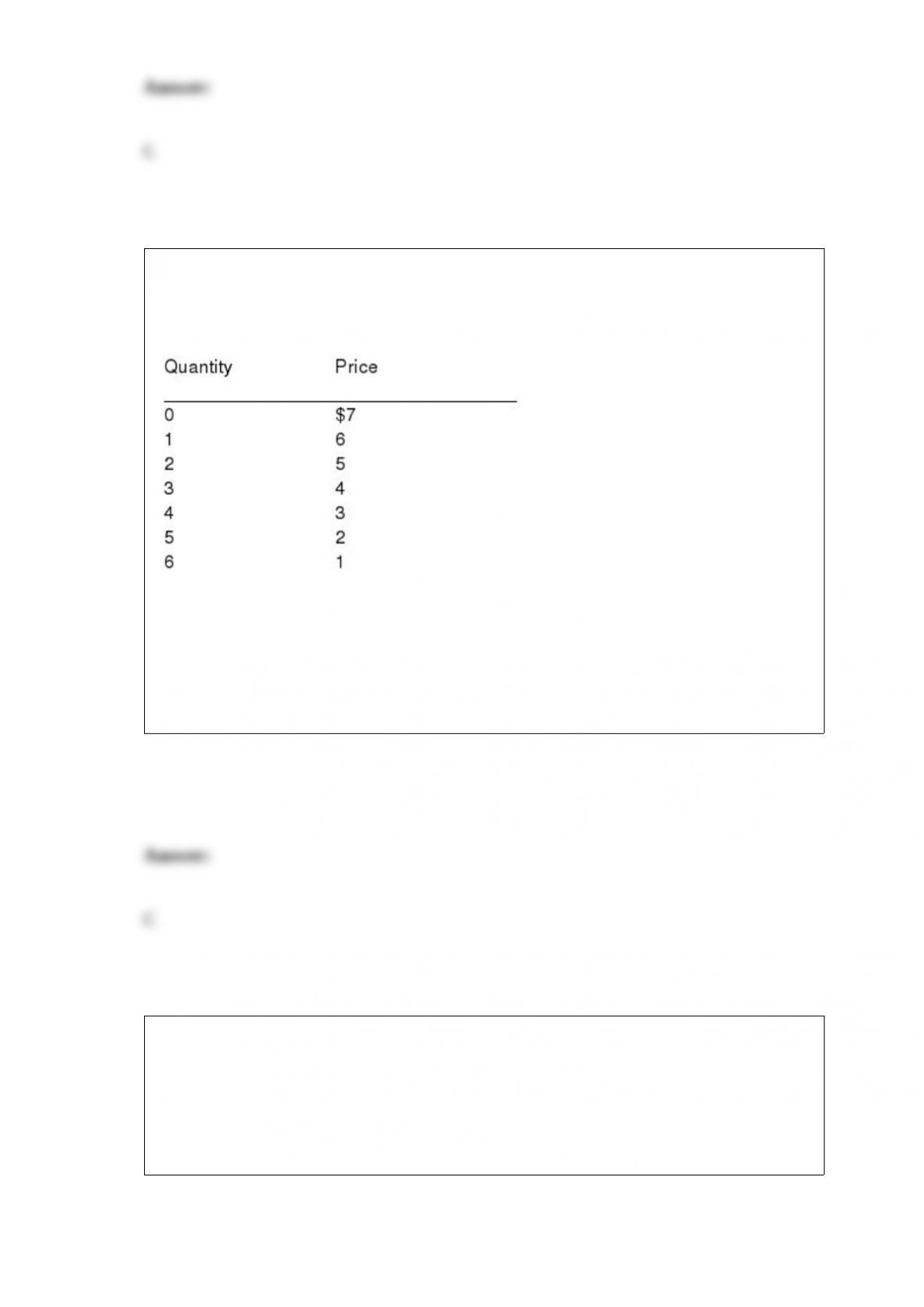
Exhibit 9-2
Between which quantities in Exhibit 9-2 is demand unit elastic?
a. 1 and 2
b. 2 and 3
c. 3 and 4
d. 4 and 5
e. 5 and 6
Current account transactions are records of the income and expenditures from exports
and imports, plus international financial investments and borrowing.
a. True
b. False

Tax evasion differs from tax avoidance in the sense that evasion
a. is easier
b. can only be done through an accountant
c. is legal
d. is illegal
e. is encouraged by the Internal Revenue Service
Economists emphasize the importance of equilibrium in markets because
a. trading in markets can only occur at the equilibrium price and quantity
b. the behavior of buyers and sellers will automatically guide the market toward the
equilibrium price and quantity
c. all buyers and sellers are better off at the equilibrium point than any other price and
quantity combination
d. it represents a compromise between sellers hoping for low prices and buyers
searching for high prices
e. it is the only price-quantity combination that guarantees that the poorest members of
society can purchase the good or service

Which of the following best describes a graph showing the supply and demand for
foreign exchange?
a. The quantity of foreign exchange is on the horizontal axis and the quantity of the
domestic currency is on the vertical axis.
b. The quantity of the domestic currency is on the horizontal axis and the quantity of
foreign exchange is on the vertical axis.
c. The quantity of foreign exchange is on the horizontal axis and the price of foreign
exchange in terms of the domestic currency is on the vertical axis.
d. The quantity of foreign exchange is on the vertical axis and the price of foreign
exchange in terms of the domestic currency is on the horizontal axis.
e. The quantity of the domestic currency is on the horizontal axis and the price of
foreign exchange in terms of dollars is on the vertical axis.
If a firm with a 20 percent market share merges with a firm with 5 percent of the
market, by how much will the Herfindahl index change? The other firms have 40
percent, 15 percent, 10 percent, and 10 percent shares.
a. It rises by 100.
b. It rises by 200.
c. It falls by 100.
d. It falls by 200.

e. It rises by 25.
The rate of time preference is positive
a. only when interest rates are positive
b. because interest rates are positive
c. only when people save
d. because people save
e. because people prefer goods now to the same goods later
Demand is more elastic
a. in the short run than in the long run
b. for necessities than for luxuries
c. for food than for hamburgers
d. for goods with many substitutes than for goods with only a few
e. for broadly defined goods than for narrowly defined ones

Externalities are defined as
a. any transaction external to the firm
b. costs or benefits that fall on third parties
c. policies that firms undertake to sell products outside the country
d. managers’ dealings with stockholders outside the firm
e. costs of maintaining plant and equipment to avoid the scrutiny of external auditors
Transfer payments have reduced poverty among the elderly, but poverty among females
has not fallen.
a. True
b. False
Which of the following is a positive externality of consumption?

a. inoculations against a disease reduce the likelihood of transmitting it to others
b. phosphates from laundry detergents
c. litter from fast-food containers
d. ozone depletion from the production of fast-food containers
e. the greenhouse effect
The administration costs of a loan as a proportion of the total cost of the loan typically
a. decrease as the size of the loan increases. Therefore, the larger the loan, other things
constant, the lower the interest rate
b. decrease as the size of the loan increases. Therefore, the larger the loan, other things
constant, the higher the interest rate
c. increase as the size of the loan increases. Therefore, the larger the loan, other things
constant, the lower the interest rate
d. increase as the size of the loan increases. Therefore, the larger the loan, other things
constant, the higher the interest rate
e. increase as the size of the loan increases, but this has no impact on the interest rates
charged for large loans compared to small loans
In long-run equilibrium, a monopolistically competitive firm will produce
a. at the minimum average cost

b. at full capacity
c. along the downward-sloping portion of its ATC curve
d. along the upward-sloping portion of its ATC curve
e. at the minimum of marginal cost
Utility is
a. easily measured because all people derive the same utility from consumption
b. easily measured because it is an objective concept
c. easily measured because it is a subjective concept
d. hard to measure because it is a subjective concept
e. hard to measure because it is an objective concept
A monopolist’s demand curve is
a. its marginal cost curve
b. its marginal revenue curve
c. identical to the market demand curve
d. the same as the demand curve of a firm in perfect competition
e. nonexistent

When an activity results in the creation of external benefits, markets will produce more
than the socially optimal level of that activity.
a. True
b. False
Waiters, barbers, and bellhops are paid primarily through tips because
a. managers can easily assess their productivity
b. managers are better at judging their productivity than are consumers
c. consumers can judge their productivity easily
d. it’s always been done that way
e. union regulations require this form of payment

Developing countries must confront industrial countries’ trade restrictions, such as
tariffs and quotas.
a. True
b. False
For which of the following is demand most likely to be perfectly inelastic?
a. BMW automobiles
b. Pepsi Cola
c. hot dogs
d. insulin
e. Tylenol
If new firms enter a perfectly competitive industry seeking economic profit and begin
producing goods, which of the following will occur?
a. The market supply curve will shift leftward with movement along an unchanged
demand curve.
b. The market supply curve will shift rightward with movement along an unchanged

demand curve.
c. The market supply and demand curves will both shift to the left.
d. The market supply and demand curves will both shift to the right.
e. There will be movement down and to the right along a fixed supply curve.
Which of the following is correct when a price is set below a market’s equilibrium
price?
a. quantity demanded exceeds quantity supplied at the set price
b. quantity demanded is less than quantity supplied at the set price
c. quantity demanded is equal to quantity supplied at the set price
d. at the set price there is a surplus
e. the market price is less than the ceiling price
Exhibit 10-1
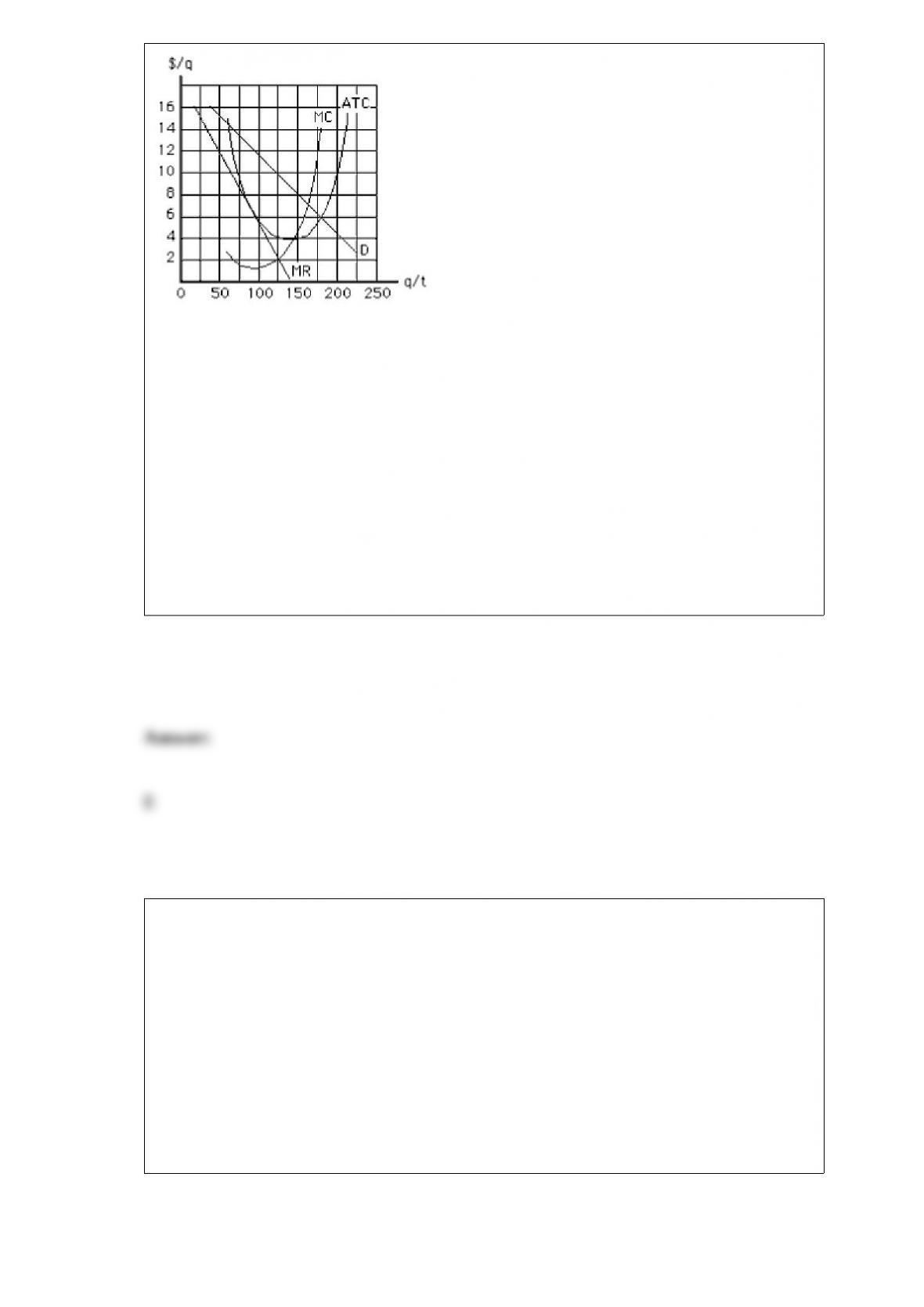
In Exhibit 10-1, the monopolistic competitor’s total economic profit at the
profit-maximizing level of output is
a. $0
b. $4
c. $600
d. $6
e. $750
The 2007 minimum wage law covered nearly __________ percent of the workforce.
a. 9
b. 43
c. 67
d. 90
e. 99.99

According to the search model, the marginal benefit of acquiring information about a
product is greater for expensive items than for cheap items.
a. True
b. False
An intersection known as Four Corners lies 300 miles from the nearest town. At this
intersection are three independently owned gas stations and one small pharmacy. Which
of the following is true?
a. The firms are all perfectly competitive because of their size.
b. It would be easier for all four firms to form a cartel than for only the gas stations to
do so.
c. The gas stations are monopolistically competitive because there are so few of them
that they are almost monopolists.
d. The gas stations are perfectly competitive; the pharmacy is not.
e. The gas stations are oligopolists; the pharmacy is a monopolist.

Resource owners will supply additional units of a resource as long as
a. doing so increases their costs
b. doing so increases production
c. the quantity of the resource demanded exceeds the resource price
d. resource users demand the resource
e. doing so increases their utility