Archives: Quiz
978-1305263475 Chapter 16
Chapter 16—Communicating Research Results TRUE/FALSE 1. The conclusions and recommendations section presents the findings of the project and should include tables and charts of the research results. 2. Only research reports that are customized for the project that is represented […]
978-1305263475 Chapter 15
Chapter 15—Testing for Differences Between Groups and for Predictive Relationships TRUE/FALSE 1. Cross-tabulation tables typically provide an easy, intuitive way of understanding data. 2. When the difference between two groups is measured, bivariate statistics are used. ANS: T REF: Cross-Tabulation […]
978-1305263475 Chapter 14
Chapter 14—Basic Data Analysis TRUE/FALSE 1. Descriptive statistics are a type of univariate statistics. 2. The type of measurement scale used in the research study determines the possible statistical tests that can be used appropriately with the resulting data. ANS: […]
978-1305263475 Chapter 13
Chapter 13— Big Data Basics: Describing Samples and Populations TRUE/FALSE 1. Auxiliary variables are those that the researcher should build into a survey that allow a comparison between sample units that do respond and those that do not respond. 2. […]
978-1305263475 Chapter 12
Chapter 12—Sampling Designs and Sampling Procedures TRUE/FALSE 1. Sampling involves using a small number of people in the target market to make conclusions about the entire target market population. 2. A census is any complete group whose members share some […]
978-1305263475 Chapter 11
Chapter 11—Questionnaire Design TRUE/FALSE 1. For a questionnaire to fulfill a researcher’s purposes, the questions must meet the basic criteria of relevance and accuracy. 2. A questionnaire is accurate to the extent that no unnecessary information is collected in order […]
978-1305263475 Chapter 10
Chapter 10—Measurement and Attitude Scaling TRUE/FALSE 1. Measurement is the process of describing some property of a phenomenon, usually by assigning numbers, in a reliable and valid way. 2. A scale can be thought of as a generalized idea that […]
978-1305263475 Chapter 9
Chapter 9—Conducting Marketing Experiments TRUE/FALSE 1. Experimental research attempts to find causal relationships among variables. 2. In an experiment, the researcher manipulates the dependent variable and measures its effect on the independent variable. ANS: F The researcher manipulates the independent […]
978-1305263475 Chapter 8
Chapter 8—Observation TRUE/FALSE 1. It is typical in observation studies for the observer to ask questions of the person who is being observed. 2. Attitudes cannot be directly observed but can be inferred from other measures. ANS: T REF: Technology […]
978-1305263475 Chapter 7
Chapter 7—Survey Research TRUE/FALSE 1. The purpose of survey research is to collect secondary data. 2. All marketing-related survey research is conducted with the ultimate consumer in mind. ANS: F Studies also focus on wholesalers, retailers, or industrial buyers. REF: […]
978-1305263475 Chapter 6
Chapter 6—Secondary Data Research in a Digital Age TRUE/FALSE 1. Secondary data are data that have already been collected for some other purpose than the one at hand. 2. The use of secondary data requires current access to respondents who […]
978-1305263475 Chapter 5
Chapter 5—Qualitative Research Tools TRUE/FALSE 1. The focus of qualitative research is on producing “numbers” that can be used in statistical tests. 2. Qualitative research is subjective in the sense that the researcher must extract meaning from open- ended responses. […]
978-1305263475 Chapter 4
Chapter 4—The Human Side of Marketing Research: Organizational and Ethical Issues TRUE/FALSE 1. One reason for an organization to hire an outside research supplier is to acquire access to that organization’s experience in critical situations. 2. When secrecy is a […]
978-1305263475 Chapter 3
Chapter 3—The Marketing Research Process TRUE/FALSE 1. Research is the process of developing and selecting from alternative ways of resolving a problem or choosing from among alternative opportunities. 2. A market opportunity is a situation that makes some potential competitive […]
978-1305263475 Chapter 2
Chapter 2—Information Systems and Knowledge Management TRUE/FALSE 1. Data, information, and intelligence all have the potential to create value to a firm through better decision making. 2. Relevant data are facts about things that cannot be changed. ANS: F Relevant […]
978-1305263475 Chapter 1
Chapter 1: The Role of Marketing Research TRUE/FALSE 1. Marketing research attempts to provide accurate information in order to reduce uncertainty in decision– making. ANS: T REF: What Is Marketing Research? NAT: BUSPROG: Analytic 2. Marketing research involves more than […]
978-1305087330 Chapter 15
Copyright Cengage Learning. Powered by Cognero. Page 1 Indicate which level of competence is being illustrated. 3. You are able to take a client and teach them attending behavior skills in the interview. a. identification and classification competence b. basic […]
978-1305087330 Chapter 14
Copyright Cengage Learning. Powered by Cognero. Page 1 Multiple Choice 1. Crisis counseling is a. the most pragmatic and action oriented form of helping. b. the most desperate and hectic form of helping. c. the most insightful and revealing form […]
978-1305087330 Chapter 13
Copyright Cengage Learning. Powered by Cognero. Page 1 Essay 1. You are about to see a client for the first time. You know that it is a career problem, that the client is female, and 32 years old. The client […]
978-1305087330 Chapter 12
Copyright Cengage Learning. Powered by Cognero. Page 1 Multiple Choice 1. Giving information and advice a. should be used sparingly. b. should be concrete and specific. c. all of these. d. none of these. ANSWER: d POINTS: 1 REFERENCES: Defining […]
978-1305087330 Chapter 11
Copyright Cengage Learning. Powered by Cognero. Page 1 Multiple Choice 1. Self-disclosure is a. ever present. b. unavoidable. c. part of counseling. d. all of these. ANSWER: d POINTS: 1 REFERENCES: Defining Empathic Self-Disclosure QUESTION TYPE: Multiple Choice HAS VARIABLES: […]
978-1305087330 Chapter 10
Copyright Cengage Learning. Powered by Cognero. Page 1 1. Which of the following is true about reflection of meaning and interpretation/reframe? a. Both help explore in-depth issues below the surface of client conversation. b. Reflecting meaning helps clients to clarify […]
978-1305087330 Chapter 9
Copyright Cengage Learning. Powered by Cognero. Page 1 Multiple Choice 1. Empathic confrontation is a. a direct challenge. b. a harsh action. c. going against the client. d. a gentle skill. ANSWER: d POINTS: 1 REFERENCES: Defining Empathic Confrontation QUESTION […]
978-1305087330 Chapter 8
Copyright Cengage Learning. Powered by Cognero. Page 1 Multiple Choice 1. Which of the following is correct regarding focusing? a. It is an important skill. b. It enables clients to gain more complete understanding of issues affecting their life. c. […]
978-1305087330 Chapter 7
Copyright Cengage Learning. Powered by Cognero. Page 1 1. The basic listening sequence can be used in which setting? a. management b. sales c. medicine d. management and medicine e. all of these ANSWER: e POINTS: 1 REFERENCES: Defining The […]
978-1305087330 Chapter 6
Copyright Cengage Learning. Powered by Cognero. Page 1 Classify each of the following counseling leads as a paraphrase (P), encourage (E), or reflection of feeling (RF). Client: I really wonder what’s going to happen to me. I find myself aging […]
978-1305087330 Chapter 5
Copyright Cengage Learning. Powered by Cognero. Page 1 Multiple Choice 1. Active listening is: a. a passive process by which clients communicate their intentions to comply with counseling. b. is a term used to indicate client is paying attention. c. […]
978-1305087330 Chapter 4
Copyright Cengage Learning. Powered by Cognero. Page 1 Multiple Choice For the following questions, indicate which are open and which are closed. 1. Did you go to the office today? a. open b. closed ANSWER: b POINTS: 1 REFERENCES: Defining: […]
978-1305087330 Chapter 3
Copyright Cengage Learning. Powered by Cognero. Page 1 Multiple Choice 1. Attending behavior includes individually and culturally appropriate __________________. a. visuals. b. verbal tracking. c. body language. d. all of these. ANSWER: d POINTS: 1 REFERENCES: Defining Attending Behavior QUESTION […]
978-1305087330 Chapter 2
Copyright Cengage Learning. Powered by Cognero. Page 1 Multiple Choice 1. Which of the following is correct? a. Multicultural competence is essential for the interview process. b. Awareness of our clients’ multicultural backgrounds helps us gain a better understanding of […]
978-1305087330 Chapter 1
Copyright Cengage Learning. Powered by Cognero. Page 1 Multiple Choice 1. Kathryn faced a complex case with no clear positive outcome. Establishing an empathic relationship and listening carefully to the client story may result in ___________________ a. deeper distress and […]
978-1285749907 Chapter 9
1. Which of the following assists in the establishment of a professional identity for members of a profession? a. a behavior standard b. a code of ethics c. an identity management d. a philosophy ANSWER: b 2. Which of the […]
978-1285749907 Chapter 8
1. The agency mission a. states specific goals of the agency b. is used for publicity c. refers to how funds should be spent d. states guiding principles ANSWER: d 2. A job description a. provides the exact job responsibilities […]
978-1285749907 Chapter 7
1. “Whatishelpful?”and“Howcantheneedsoftheclientbemet?”arethetwoquestionsthatguide a. crisis intervention strategies b. the generalist c. helping d. the selection of roles ANSWER: c 2. Encouraging responsibility and promoting self-help are a. the focus of questioning b. supported by the office setting c. the result of […]
978-1285749907 Chapter 6
1. Individuals choose to work in the helping professions for which of the following reasons? a. human service job market is stable b. status is associated with human service work c. human service jobs contribute to client growth d. clients […]
978-1285749907 Chapter 5
1. The term client refers to all but which of the following? a. individuals, family, neighborhood b. working poor, AIDS patients, underclass c. Hurricane Katrina victims, Oklahoma City bombing victims, Mississippi River flood victims d. students, teachers, co-workers ANSWER: d […]
978-1285749907 Chapter 4
1. Information about models of service delivery is important to human service professionals because a. they are likely to be working with professionals who practice other models b. agencies hire those who are skilled in more than one model c. […]
978-1285749907 Chapter 3
1. Community-based care is a. located in a calm, pastoral setting b. focused on health and wellness c. focused on the primary client d. based on professional not client responsibility ANSWER: b 2. Human service delivery in the rural areas […]
978-1285749907 Chapter 2
1. Until the Middle Ages people believed that mental illness was caused by the presence of _____________ in the body. a. chemicals b. evil spirits c. heredity d. natural causes ANSWER: b 2. Hippocrates, a doctor in the third century […]
978-1285749907 Chapter 1
1. “Problemsinliving”refersto a. problems that overwhelm the client b. problems that require the help of several professionals c. problems that are related to the life cycle d. problems that resulted from the economic downturn ANSWER: c 2. In the last […]
978-1260169829 Chapter 14 Part 4
123) Which of the following statements is LEAST likely to be true about networking? A) Networking is your personal array of relationship. B) Salespeople should always ask themselves how they can help those in their network. C) Building and maintaining […]
978-1260169829 Chapter 14 Part 3
92) All of the following are true for multivariable account segmentation EXCEPT that it: A) characterizes the organization’s account using more than one criterion. B) is used by sales organizations who sell to several markets. C) emphasizes the supply of […]
978-1260169829 Chapter 14 Part 2
52) Which one of the following is NOT a time management skill that can help sales professionals in achieving success: A) Be selective in prioritizing time and spend time on high-priority tasks B) Have a better sense of the time […]
978-1260169829 Chapter 14 Part 1
ABC’s of Relationship Selling, 13e (Futrell) Chapter 14 Time, Territory, and Self-Management: Keys to Success 1) According to the Core Principles of Professional Selling, how you spend your time greatly influences your level of sales success. Answer: TRUE Explanation: How […]
978-1260169829 Chapter 13 Part 4
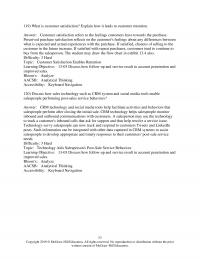
119) What is customer satisfaction? Explain how it leads to customer retention. Answer: Customer satisfaction refers to the feelings customers have towards the purchase. Perceived purchase satisfaction reflects on the customer’s feelings about any differences between what is expected and […]
978-1260169829 Chapter 13 Part 3
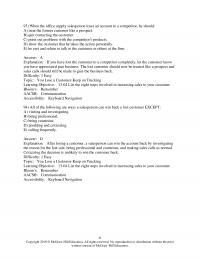
93) When the office supply salesperson loses an account to a competitor, he should: A) treat the former customer like a prospect. B) quit contacting the customer. C) point out problems with the competitor’s products. D) show the customer that […]
978-1260169829 Chapter 13 Part 2
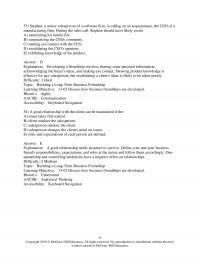
53) Stephen, a senior salesperson of a software firm, is calling on an acquaintance, the CEO of a manufacturing firm. During the sales call, Stephen should most likely avoid: A) mentioning his family life. B) summarizing the CEOs comments. C) […]
978-1260169829 Chapter 13 Part 1
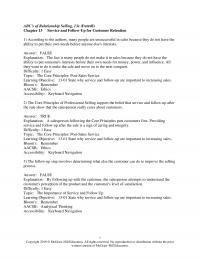
ABC’s of Relationship Selling, 13e (Futrell) Chapter 13 Service and Follow-Up for Customer Retention 1) According to the authors, many people are unsuccessful in sales because they do not have the ability to put their own needs before anyone else’s […]
978-1260169829 Chapter 12 Part 4
126) Which technique would be most effective for a customer who really wants a good deal on a new boat? A) Standing-room-only B) Assumptive C) Minor points D) Alternative close E) Summary Answer: A Explanation: A greedy customer who really […]
978-1260169829 Chapter 12 Part 3
94) Which of the following is true regarding the summary-of-benefits close? A) It is infrequently used by salespeople. B) It aims at a specific prospect’s personality. C) It cannot be used easily as it involves a complex process. D) The […]