92) All of the following are true for multivariable account segmentation EXCEPT that it:
A) characterizes the organization’s account using more than one criterion.
B) is used by sales organizations who sell to several markets.
C) emphasizes the supply of similar products to channel members.
D) is used because organizations use many channel members.
E) allows sales personnel to develop plans for selling various products to specific segments of
their accounts.
93) James Lambert is an assistant territory sales manager at Cellcom, a leading wireless service
provider in Europe. James manages the salespeople in a small city in France. There are many
players in the wireless service provider market, and it is becoming increasingly difficult to
position the company as unique. What can James do to position Cellcom as a unique company,
when compared to its competitors?
A) Reduce the call rates by half.
B) Increase the mass media advertising of Cellcom.
C) Instruct salespeople to spend more time on each sales call.
D) Ask salespeople to discuss the weakness of competition in every sales call.
E) Substantially reduce the salespeople’s visits to the small accounts and increase the visits to
key accounts.
94) Dividing accounts on the basis of market type and sales volume would be an example of:
A) multivariable account segmentation.
B) dual segmentation marketing.
C) reciprocal sales differentiation.
D) total territory management.
E) dual positioning.
95) Jayson Jaworski is a manufacturer’s salesperson. He finds it useful to divide the accounts in
his territory on the basis of whether the buyer sells at the wholesale or retail level as well as
according to the account’s potential sales volume. Jaworski is using:
A) multivariable account segmentation.
B) dual segmentation marketing.
C) differentiated segmentation.
D) total territory management.
E) dual positioning.
96) Hancock Distribution Company characterizes its customers according to their yearly sales
potential and whether the account is a builder, a homeowner, or a government facility. This
approach to segmentation is called:
A) OAKS selling.
B) multivariable account segmentation.
C) dual differentiation.
D) dual segmentation marketing.
E) total territory management.
97) “To increase the total number of sales calls every month by 10,” is an example of a(n):
A) territory allocation.
B) account analysis.
C) account objective.
D) sales quota.
E) sales positioning.
98) “To increase the product assortment purchased by current customers by two percent during
the next three months,” is an example of a(n):
A) market quota.
B) derived demand.
C) account objective.
D) future product quotient.
E) net product forecast.
99) Which of the following is a basic factor to consider in sales call allocation?
A) Nonselling time
B) Cost of goods sold
C) Personality style of customers
D) Structure of sales presentation
E) Revenue projections for the year
100) Which of the following is one of the six basic factors the text indicates must be considered
in developing a plan for sales call allocation?
A) Types of products being sold
B) Cost of goods sold
C) Personality of the salesperson
D) Number of visual aids used in sales presentation
E) Number of accounts in the territory
101) Which of the following is NOT one of the six basic factors to consider in the allocation of a
salesperson’s calls?
A) Frequency of customer sales calls
B) Number of accounts in the territory
C) Nonselling time
D) Compensation
E) Travel time
102) If a territorial evaluation indicates that a salesperson’s quotas are not met, then it is most
likely that:
A) territories will be expanded.
B) sales methods will be changed.
C) routing will be re-measured.
D) key accounts will be dropped.
E) new territory plans will be developed.
103) Madison works for a weed killer manufacturing company. The products have only been
available in a concentrated liquid form, but now the firm is introducing a pre-mixed version that
should be easier for consumers to use. Madison will most likely increase the frequency of sales
calls because:
A) the available supply is limited and costly.
B) there is no competition within the sales territory.
C) demand is low for his company’s older products.
D) customers are less likely to buy products from the competition.
E) his company has increased the number of product lines available.
104) Which among the following is NOT a reason for increasing the number of sales calls?
A) Increase of potential future sales
B) Increase of orders placed
C) Increase of product lines sold
D) Increase of cost of goods sold
E) Increase in servicing requirements
105) You are the salesperson for a manufacturing business that makes various scents used in
soap and candle making. Your sales manager expects your frequency of sales calls on a
particular customer will increase when the:
A) complexity of the scent mixtures sold decreases.
B) number of orders placed for different scents diminishes.
C) future sales potential for your company’s products decreases.
D) number of product lines sold carried by the wholesaler increases.
E) total number of managerial levels increases at the end of the year.
106) A salesperson invests time in direct proportion to the actual or potential sales that the
account represents. This relationship of sales volume to sales calls is the:
A) break-even point.
B) sales response function.
C) basis for sales call allocation.
D) basis for territory formation.
E) correlation of effort and skill.
107) According to the suggestions in the text, daily planning by the salesperson would be
LEAST likely to include:
A) determination of the time to contact the customer.
B) analysis of territorial gains and losses.
C) selection of the next day’s prospects.
D) organization of facts and figures.
E) preparation of sales presentation materials.
108) As the sales rep for Whirlpool appliances plans her activities for the next week, she is
establishing a certain day and time to visit each customer’s place of business. She is engaged in
the process of:
A) networking.
B) scheduling.
C) customer allocation.
D) customer sales planning.
E) routing.
109) Establishing a travel pattern to be used for working your territory is called:
A) Account grouping.
B) Account call allocation.
C) Customer sales planning.
D) Routing.
E) Scheduling.
110) Some companies give their salespeople strict formal route plans in order to:
A) improve collection of overdue accounts.
B) improve territory coverage.
C) promote the individual’s planning experience.
D) minimize territory size.
E) maximize the utility of the salesperson’s weekly report.
111) Which of the following statements about routing reports is true?
A) A routing report is usually filed monthly and submitted to the manager.
B) Companies usually require route reports even if no overnight travel is involved.
C) Salespeople are seldom asked to specify times and accounts on routing reports.
D) Routing reports allow sales managers to know where salespeople are located.
E) Most companies allow very little latitude for salespeople in routing.
112) Which of the following statements about routing is true?
A) Global positioning systems have eliminated the need for routing reports.
B) The best routing pattern to use is the cloverleaf pattern.
C) The critical factor in sales routing is to minimize the number of miles you drive.
D) Under the ELMS classification system, the S (super-size) accounts should be called on with
greatest frequency.
E) Most companies allow considerable flexibility in routing.
113) M & N Enterprises uses strict route designs for its large sales team. M & N most likely
wants to:
A) reduce vacation time.
B) eliminate overnight travel.
C) establish performance goals.
D) improve territory coverage.
E) ensure the safety of salespeople.
114) A company uses formal route designs to:
A) overcome territory disagreements.
B) reach small to medium size territories.
C) provide greater latitude to salespeople.
D) establish communication between management and the sales force.
E) reduce the promotional and distribution costs of new products.
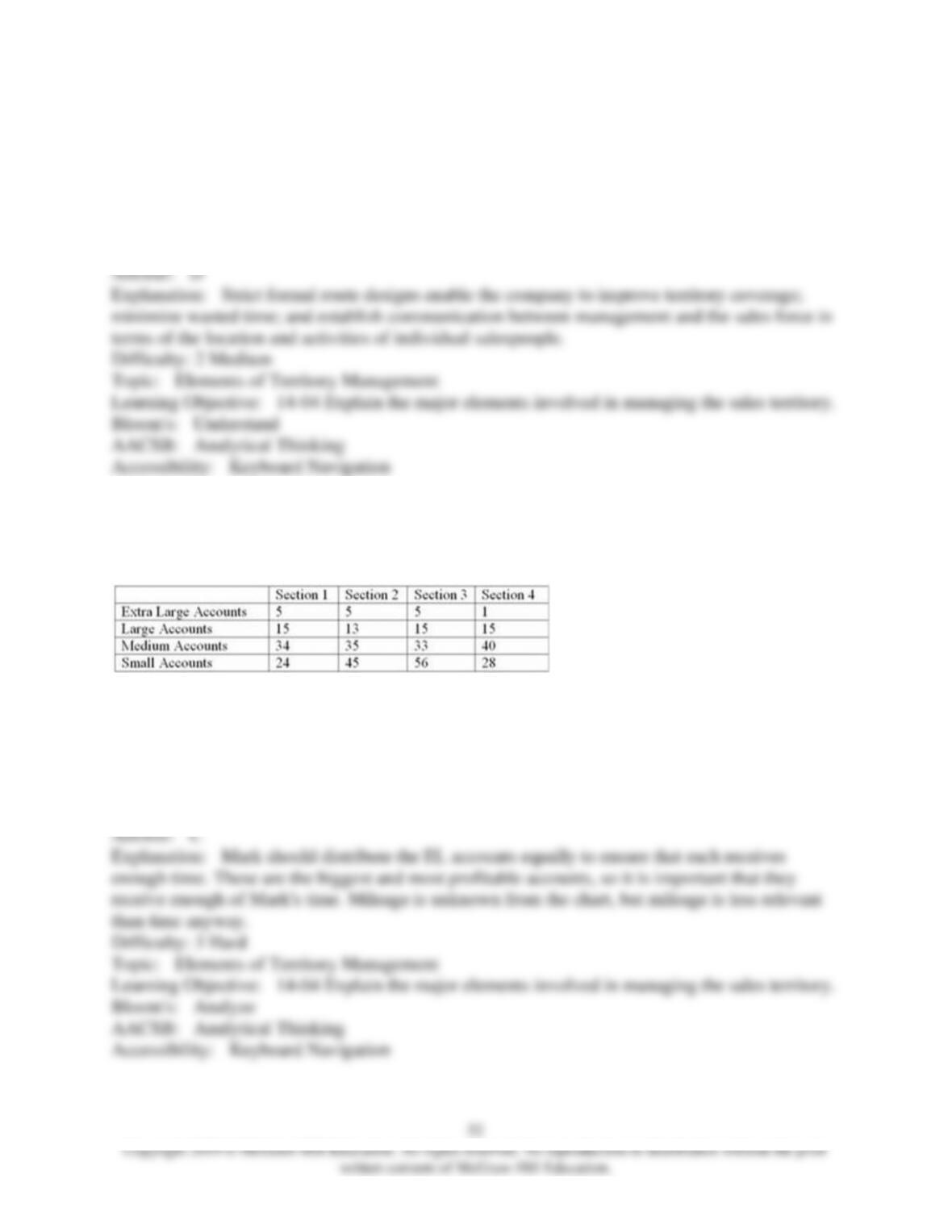
115) Mark Adams is a salesperson with a pharmaceutical company. Mark divided his territory
into four sections as shown below. What is the major flaw in arranging the accounts in this
fashion?
A) The number of sections formed by Mark allows little flexibility.
B) The small accounts are unequally distributed.
C) The extra-large accounts are unequally distributed.
D) The number of sections should be an odd number.
E) Daily mileage is greatest in section 3.
116) During a salesperson’s ________, her actual performance is compared with the performance
standards set for her sales territory.
A) Territorial evaluation
B) MBO review
C) Break-even analysis
D) ELMS review
E) Market audit
117) Which of the following statements is most likely true about territorial evaluation?
A) In territorial evaluation, actual performance is evaluated separately from goals.
B) Territorial evaluation monitors the time interval between multiple sales calls.
C) Qualitative quotas and performance are not considered in territorial evaluation.
D) Territorial evaluation establishes performance standards in the form of quotas or goals.
E) During the evaluation, managers reports are considered instead of individual salespeople’s
reports.
118) Which of the following statements about using the sales technology for territory coverage is
INCORRECT?
A) Sales technology tools assist salespeople with routine as well as strategic tasks.
B) Applications such as calendaring and routing tables can transform salespeople’s typical sales
routines and thus reduce downtime.
C) Sales technology aids salespeople by managing information about a larger number of
customers.
D) Sales technology tools hinders salespeople’s abilities to focus on actual selling time.
E) Salespeople using CRM system may be able to save time by speeding the process of sales call
planning..
119) Which of the following statements about executive presence is INCORRECT?
A) Sales managers and executives do not want their emerging salespeople to develop an
executive presence.
B) Executive presence is about the perception results from your initial interaction with a group as
well as your ongoing interactions.
C) Executive presence is about the perception held by customers about you.
D) Executive presence is about the perception (held by others) that you have a certain level of
gravitas and influence.
E) Executive presence is about how others perceive you.
120) All of the following statements reflect sales managers’ expectations of new salespeople,
EXCEPT:
A) A salesperson should be honest and ethical.
B) A salesperson should not take initiatives.
C) A salesperson should accept feedback and coaching.
D) A salesperson should leverage internal resources.
E) A salesperson should understand attitude.
121) Which of the following statements about using the calendar and time management systems
such as Microsoft Outlook and Google Calendar is INCORRECT?
A) Reserve and schedule blocks of time to work on key projects.
B) Reserve conference rooms within salesperson’s company.
C) Review the availability of internal colleagues to meet on certain times and dates (i.e. search
their schedules).
D) Provide reminders of key deadlines.
E) Upload customers’ list into the system and analyze data based on purchase volume, purchase
types and, purchase frequency.
122) All of the following statements reflect sales managers’ expectations of new salespeople,
EXCEPT:
A) A salesperson should be proactive and ask her colleagues and managers when she has a
challenge or is unsure of the next step.
B) A salesperson should set unrealistic deadlines to keep herself motivated.
C) A salesperson needs to be an ongoing learner.
D) A salesperson should learn what bothers her and develops coping skills to manage frustration
during challenging times.
E) A salesperson should enjoy the successes and learn from the failures.