Chapter 16—Communicating Research Results
TRUE/FALSE
1. The conclusions and recommendations section presents the findings of the project and should include
tables and charts of the research results.
2. Only research reports that are customized for the project that is represented can be formally called
“research reports.”
3. The general rule is to include all the parts of a formal research report in the reports for all projects and
leave it up to the client to decide which information is useful.
4. Research reports are a form of technical writing.
5. Relatively formal and very formal research reports include a letter of transition, which has the purpose
of releasing or delivering the report to the recipient.
6. The letter of authorization is a letter to the researcher that approves the project, details who has
responsibility for it, and describes the resources available to support it.
7. The summary of the research report should be written before the report itself is written.
8. The body of a research report begins with an introduction section.
9. The bulk of a research report should be contained in the “conclusions and recommendations” section
of the report.
10. The limitations of the research study should not be discussed in the research report.
11. Highly technical sections of the research report should be presented in an appendix to the report.
12. Detailed and comprehensive tables should be presented in an appendix to the research report.
13. The outline for a basic research report is the same as that for an applied research report.
14. Graphics used in a research report do not need to be interpreted for the reader in the text of the report.
15. The boxheads of a table contain the captions for the rows of the table.
16. The purpose of charts in a research report is to translate numbers into a visual form that displays the
relationship between the numbers.
17. The main advantage of using charts is that they are not subject to distortion.
18. In general, a pie chart should have, at most, six “slices.”
19. The most common independent variable for line charts is time.
20. The purpose of an oral presentation of a research report is to present all of the details of the research.
21. Thorough preparation and practice for an oral presentation of a research report is one of the keys to an
effective presentation.
22. An effective oral presentation of a research report should include adapting the report to fit the needs of
the audience.
23. A good rule-of-thumb for an oral presentation of a research report is avoid repeating yourself.
24. One way to communicate a research report to the managers of an organization is through the
organization’s Intranet.

25. When a researcher contacts a decision-maker after the decision-maker has had a chance to read the
research report to ask if any part of the report needs further clarification, the researcher is engaging in
a research follow-up.
MULTIPLE CHOICE
1. A written statement of a research study and its results is known as a(n) ____.
a.
communicator
b.
medium
c.
field of experience
d.
research report
2. The arrangement of the parts of a research report is known as the ____.
a.
results
b.
format
c.
introduction
d.
summary
3. All of the following are elements of a research report EXCEPT for the ____.
a.
title page
b.
executive summary
c.
body
d.
feedback notes
4. Which element of a research report should state the title of the report, for whom the report is prepared,
by whom it was prepared, and the date of releases or presentation?
a.
preamble
b.
appendix
c.
letter of transmittal
d.
title page
5. Hans is writing a letter to include after the title page of a research report. The purpose of this letter is
to release or deliver the report to the recipient rather than provide detailed information of the research
findings. What is this letter called?
a.
letter of authorization

b.
letter of transmittal
c.
introductory letter
d.
formality letter
6. The document to the researcher that approves the project, details who has responsibility for it, and
describes the resources available to support it is called the ____.
a.
letter of authorization
b.
letter of transmittal
c.
introductory letter
d.
formality letter
7. The last portion to be written in a research report should be the ____.
a.
summary
b.
body
c.
introduction
d.
appendix
8. All of the following are elements of the executive summary of research report EXCEPT for ____.
a.
recommendations, or suggestions for action, based on the conclusions
b.
objective of the report
c.
the methodology and the major results
d.
detailed charts and tables with results
9. The specific objectives of the research report should be presented in the ____.
a.
appendix
b.
introduction
c.
results
d.
recommendations
10. Which aspect of the research methodology section of the research report should include an explanation
of whether the research was exploratory, descriptive, or causal?
a.
sample design
b.
research design
c.
analysis
d.
data collection
11. The findings of the study should be presented in the ____ section.
a.
introduction

b.
recommendations
c.
appendix
d.
results
12. In which section of the research report should extremely comprehensive or detailed charts be placed?
a.
introduction
b.
body
c.
executive summary
d.
appendix
13. In the research report, suggestions about the next steps appear in the ____ section.
a.
title page
b.
introduction
c.
conclusions and recommendations
d.
body
14. When a researcher uses pictures, tables, or charts to clarify complex points or emphasize a message in
a research report, he or she is using ____.
a.
verbal elements
b.
medium elements
c.
graphic aids
d.
formalizers
15. Which element contains the captions for the rows of a table?
a.
boxheads
b.
footnotes
c.
source notes
d.
stubheads
16. In which type of chart do the slices represent a percentage of the whole?
a.
bar chart
b.
line chart
c.
column chart
d.
pie chart
17. In a typical line graph, the ____ variable is shown on the vertical y-axis and the ____ variable is
shown on the horizontal x-axis.
a.
dependent; independent

b.
ratio; nominal
c.
independent; dependent
d.
primary; secondary
18. In the typical bar chart, the ____ variable is plotted on the vertical y-axis while the ____ variable is
plotted on the horizontal x-axis.
a.
independent; dependent
b.
nominal; interval
c.
dependent; independent
d.
ratio; ordinal
19. When a researcher contacts a client after the client has had a chance to review the research report, the
research is engaging in a(n) ____.
a.
oral presentation
b.
letter of transmittal
c.
letter of approval
d.
research follow-up
20. Tables are most useful for presenting ____ information.
a.
symbolic
b.
verbal
c.
pictorial
d.
numerical
21. All of the following are elements of a table EXCEPT for the ____.
a.
source notes
b.
title
c.
stubheads
d.
explanatory legend
22. Which element should be used to indicate the contents of the table?
a.
source notes
b.
title
c.
stubhead
d.
explanatory legend
23. Which element should contain the captions for the columns of the table?
a.
source notes

b.
title
c.
bannerheads
d.
explanatory legend
24. All of the following are elements of a chart EXCEPT for the ____.
a.
footnotes
b.
title
c.
stubheads
d.
explanatory legend
25. The contents of a chart should be described in the ____.
a.
footnotes
b.
title
c.
stubheads
d.
explanatory legend
26. The ____ should help the reader interpret the chart without having to read the detailed report.
a.
footnotes
b.
title
c.
stubheads
d.
explanatory legend
27. Which element can influence interpretation of a chart by making differences appear larger than they
are?
a.
footnotes
b.
title
c.
explanatory legend
d.
axes values
28. Which graphic aid is useful for showing the relationship of one variable to another?
a.
line chart
b.
bar chart
c.
table
d.
pie chart
29. Which graphic aid is useful for showing how several variables relate to the primary variable?
a.
line chart
b.
multiple-bar chart
c.
table
d.
pie chart
30. Which behavior should a presenter avoid during the oral presentation?
a.
using jargon
b.
maintaining eye contact
c.
repeating the main points
d.
using short, familiar words
COMPLETION
1. An oral or written statement of the results of the research study, its strategic recommendations, and its
other conclusions presented to a specific audience is known as the ____________________.
2. The arrangement of the parts of a research report needed to create a good report is known as the
____________________.
3. The part of a research report that releases or delivers the report to the recipient is called the
____________________.
4. The last step in the writing of the research report is to write the ____________________.
5. The part of the body of the research report that discusses the specific objectives of the research project
is known as the ____________________ section of the report.
6. The part of the research report body that must explain technical procedures of the research in a manner
appropriate for the audience is called the ____________________ section of the report.
7. Any material that is too technical or too detailed should go in the element of the research report called
the ____________________.
8. The diagrams included in the research report that are used to clarify complex points are known as
____________________.
9. In a table, the titles of the rows of the table are known as ____________________.
10. If a table is based on material from one or more secondary sources rather than on new data generated
by the project, this should be acknowledged in the table’s ____________________.
11. The typical maximum of slices in a pie chart is ____________________ slices.
12. The ____________________ provides a name for the report, tells for whom the report was prepared,
tells who performed the research and wrote the report, and gives the date of release or presentation.
13. The ____________________ of the report contains several sections, including the introduction,
methodology, and results.
14. The ____________________briefly explains why the research project was conducted, what aspects of
the problem were considered, what the outcome was, and what should be done.
15. The ____________________ section should include the research design, sample design, data
collection and fieldwork, and analysis.
ESSAY
1. List the seven major elements of a formal research report.
2. Discuss what is included in the body of a research report.
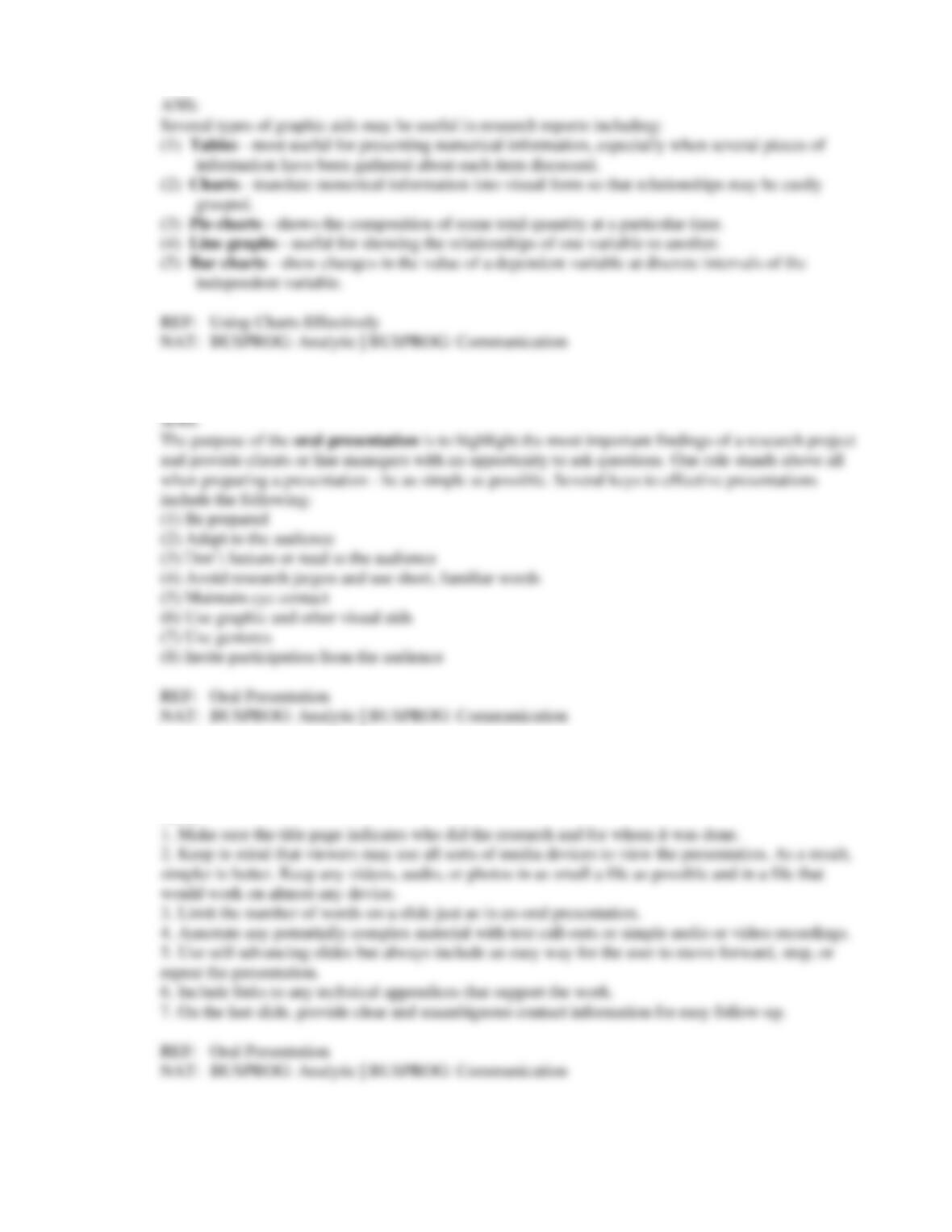
3. Discuss the various types of graphic aids marketing researchers can include in a research report.
4. Describe the purpose of the oral presentation and list suggestions for effective presentations.
5. List FIVE of the SEVEN key points to keep in mind when preparing a stand-alone presentation that
can be viewed at the convenience of the user.
ANS: