Archives: Quiz
978-1285161594 Chapter 7
1 Chapter 7. Introduction to Strategies CHAPTER REVIEW Chapter 7 provides an overview of the helping strategies derived from the theories discussed in Chapters 5 and 6. In addition to describing and presenting case examples, the chapter suggests skills and […]
978-1285161594 Chapter 6
1 Chapter 6. Current Theoretical Perspectives CHAPTER REVIEW Chapter 6 provides an introduction to contemporary postmodern perspectives of the helping relationship and psychological processes of human development and change. These perspectives transcend the traditional theories discussed in Chapter 5. They […]
978-1285161594 Chapter 5
1 Chapter 5. Helping Theory CHAPTER REVIEW Chapter 5 presents an overview of the major traditional theories of helping. The chapter begins by stressing the need to become aware of one’s personal theory of helping. One must consider one’s assumptions […]
978-1285161594 Chapter 4
1 Chapter 4. Stage 1: Building Relationships and Establishing Goals CHAPTER REVIEW This chapter focuses on Stage 1 of the human relations counseling model, Building Relationships and Establishing Goals. The inherent conditions affecting the relationship stage are presented. These conditions […]
978-1285161594 Chapter 3
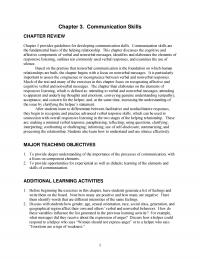
1 Chapter 3. Communication Skills CHAPTER REVIEW Chapter 3 provides guidelines for developing communication skills. Communication skills are the fundamental basis of the helping relationship. This chapter discusses the cognitive and affective components of verbal and nonverbal messages, identifies and […]
978-1285161594 Chapter 2
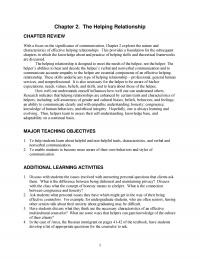
1 Chapter 2. The Helping Relationship CHAPTER REVIEW With a focus on the significance of communication, Chapter 2 explores the nature and characteristics of effective helping relationships. This provides a foundation for the subsequent chapters in which the knowledge about […]
978-1285161594 Chapter 1
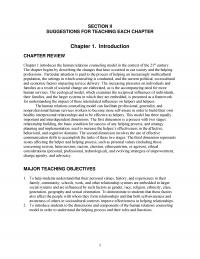
1 SECTION II SUGGESTIONS FOR TEACHING EACH CHAPTER Chapter 1. Introduction CHAPTER REVIEW Chapter 1 introduces the human relations counseling model in the context of the 21st century. The chapter begins by describing the changes that have occurred in our […]
978-1260411997 Chapter 12 Part 3
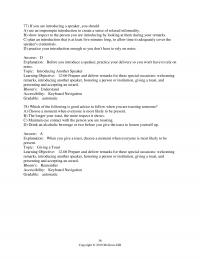
77) If you are introducing a speaker, you should A) use an impromptu introduction to create a sense of relaxed informality. B) show respect to the person you are introducing by looking at them during your remarks. C) plan an […]
978-1260411997 Chapter 12 Part 2
41) Use a ________ pattern of organization when the audience is already aware that a problem exists and they are trying to decide among several potential solutions. A) problem solution B) criteria satisfaction C) comparative advantages D) motivated sequence Answer: […]
978-1260411997 Chapter 12 Part 1
Communicating at Work, 12e (Adler) Chapter 12 Types of Business Presentations 1) A ________ is a short presentation that provides an interested and knowledgeable workplace audience with specific information they need to know to do their jobs. A) report B) […]
978-1260411997 Chapter 11 Part 2
45) All of the following are true about vocal delivery EXCEPT A) if you speak so loudly that it sounds as though you are shouting, it may seem offensive to the audience. B) audiences often interpret a soft voice as […]
978-1260411997 Chapter 11 Part 1
Communicating at Work, 12e (Adler) Chapter 11 Delivering the Presentation 1) All of the following presentation styles are used in business and professional presentations EXCEPT A) dialogue. B) interactive. C) guided discussion. D) monologue. Answer: A Explanation: The three patterns […]
978-1260411997 Chapter 10 Part 3
67) Vincent enthusiastically explained to his boss the reasons he thought he should get a raise. However, Vincent did not organize his thoughts clearly or back up his claims with solid evidence. It is NOT likely that Vincent’s boss will […]
978-1260411997 Chapter 10 Part 2
41) Jessica plans to describe the new advances her company has made in the development of allergy medicine over the past 10 years. Which of the following visual aids would be most effective in demonstrating this change over time? A) […]
978-1260411997 Chapter 10 Part 1
Communicating at Work, 12e (Adler) Chapter 10 Verbal and Visual Support in Presentations 1) If well used, supporting materials can make your presentation more A) understandable. B) cumbersome. C) interesting. D) convincing. Answer: A, C, D If well used, supporting […]
978-1260411997 Chapter 9 Part 3
81) Which of the following statements would be appropriate in the conclusion of a presentation? Check all that apply. A) “As I asked at the beginning of my talk, why does the government process take so long?” B) “So now […]
978-1260411997 Chapter 9 Part 2
45) Ellie’s advertising division has been asked to provide a presentation regarding the three major media options they provide: print, television, and Internet. Which of the following would be the most appropriate organizational pattern for this presentation? A) chronological B) […]
978-1260411997 Chapter 9 Part 1
Communicating at Work, 12e (Adler) Chapter 9 Developing and Organizing the Presentation 1) Which of the following is NOT a reason for presenting your ideas in person rather than in written form? A) If a presenter speaks with knowledge, enthusiasm, […]
978-1260411997 Chapter 8 Part 3
74) Why should a meeting leader create a new agenda following a completed meeting? A) A new agenda allows the leader to list any items that were not fully addressed during the concluded meeting so they can be discussed at […]
978-1260411997 Chapter 8 Part 2
45) Which of the following does not describe the “majority vote” method of decision-making? A) A substantial minority may feel resentful after the decision is made. B) The group can be railroaded into accepting a plan. C) Majority vote is […]
978-1260411997 Chapter 8 Part 1
Communicating at Work, 12e (Adler) Chapter 8 Effective Meetings 1) Which of the following statements about meetings is true? A) Information sharing is the primary function of a ritual activity. B) Common types of meetings include information-sharing meetings, problem-solving meetings, […]
978-1260411997 Chapter 7 Part 3
79) A high level of team cohesiveness can be detrimental when A) team members experience lower rates of tension. B) team norms are contrary to the overall productivity of the organization. C) team members become interdependent. D) the team is […]
978-1260411997 Chapter 7 Part 2
45) Drake completed a short course in computer technology during summer vacation. Now his parents’ friends call him when they have questions about their personal computers. Drake has earned some A) position power. B) expert power. C) reward power. D) […]
978-1260411997 Chapter 7 Part 1
Communicating at Work, 12e (Adler) Chapter 7 Leading and Working in Teams 1) Groups tend to outperform individuals when A) time pressures are intense. B) members share similar opinions. C) standards of excellence are high. D) employees are not highly […]
978-1260411997 Chapter 6 Part 4
114) The first step in an information-gathering interview is to choose the right interviewee. Answer: FALSE Explanation: Before you choose your interviewee, you should define what your goals are for your interview and develop questions that will accomplish that goal. […]
978-1260411997 Chapter 6 Part 3
82) If I asked someone, “Which do you prefer, working alone or working with others?” during an interview, which type of question would I be using? A) factual B) opinion C) hypothetical D) indirect Answer: B Explanation: Opinion-seeking questions ask […]
978-1260411997 Chapter 6 Part 2
41) The “PAR” approach refers to A) “prepare,” “answer,” and “review.” B) “personality,” “appearance,” and “references.” C) a method of backing up your interview answers with evidence. D) an honesty test that is frequently administered to potential job candidates. Answer: […]
978-1260411997 Chapter 6 Part 1
Communicating at Work, 12e (Adler) Chapter 6 Principles of Interviewing 1) All of the following are typical types of workplace interviews EXCEPT A) diagnostic interviews. B) investigative interviews. C) exit interviews. D) portfolio interviews. Answer: D Explanation: Types of workplace […]
978-1260411997 Chapter 5 Part 3
81) Which of the following statements best describes a compromising orientation to negotiating? A) It attains the best possible outcomes for both parties. B) It emphasizes relationship goals over task goals. C) It is a long-term approach that seeks to […]
978-1260411997 Chapter 5 Part 2
44) Most bullies A) move on to hassle new targets, after their initial target quits or is fired. B) stop bullying once they know their victim feels frustrated. C) are silenced by the boss before they can do much harm. […]
978-1260411997 Chapter 5 Part 1
Communicating at Work, 12e (Adler) Chapter 5 Interpersonal Skills and Success 1) In a recent survey of millennial employees, the overriding characteristic identified for ideal management was A) the ability to work well with others. B) the ability to give […]
978-1260411997 Chapter 4 Part 3
76) You have just been hired as a manager. Unwisely, you want to send the message to anyone who comes to talk to you that you are in charge. How would you arrange your office? A) You would sit behind […]
978-1260411997 Chapter 4 Part 2
48) Carlos notices some mistakes in a report and tells his manager about it by using a feminine conversational style. Considering this, which of the following would Carlos most likely say? A) This report definitely has some statistical mistakes. B) […]
978-1260411997 Chapter 4 Part 1
Communicating at Work, 12e (Adler) Chapter 4 Verbal and Nonverbal Messages 1) Which of the following terms represents words that have more than one common meaning? A) annotative B) judicious C) jargon D) equivocal Answer: D Explanation: Equivocal terms are […]
978-1260411997 Chapter 3 Part 3
32 Copyright © 2019 McGraw-Hill 65) Listening is one of the most important career skills you can develop. Answer: TRUE Explanation: Listening ranks first as the ideal manager’s skill. Topic: The Importance of Listening Learning Objective: 03-01 Describe how effective […]
978-1260411997 Chapter 3 Part 2
21 Copyright © 2019 McGraw-Hill 43) Which of the following is a paraphrasing response? A) “Can you give me more details?” B) “I don’t understand. Would you go over that again?” C) “So you’re saying . . .” (repeat speaker’s […]
978-1260411997 Chapter 3 Part 1
1 Copyright © 2019 McGraw-Hill Communicating at Work, 12e (Adler) Chapter 3 Listening 1) Listening skills contribute to career success in all of the following aspects EXCEPT A) your effectiveness in an organization. B) your upward mobility. C) your productivity. […]
978-1260411997 Chapter 2 Part 3
77) Which of the following is not recommended as a way to improve your own communication with members of other cultures? A) Gain more knowledge about other cultures. B) Recognize that persons of differing backgrounds can offer useful insights. C) […]
978-1260411997 Chapter 2 Part 2
46) Skylar is a very organized and timely individual. He always shows up for meetings 15 minutes early. He frowns upon colleagues who fail to arrive on time. Which orientation toward time would most accurately describe Skylar’s behavior? A) high-context […]
978-1260411997 Chapter 2 Part 1
Communicating at Work, 12e (Adler) Chapter 2 Communication, Culture, and Work 1) Which of the following statements is true of the U.S. workforce? A) In the United States, engineering companies that have embraced diversity are losing their competitive edge. B) […]
978-1260411997 Chapter 1 Part 3
79) Doyle has recently graduated with a degree in chemistry and has taken a job as a research scientist at a plastics manufacturer. The type of personal network that is likely to be most helpful to Doyle’s career is a […]
978-1260411997 Chapter 1 Part 2
41) You should choose written communication in preference to other channels when A) you want to decrease your chance of making errors. B) the situation requires a personal touch. C) you want to save time. D) there is a need […]
978-1260411997 Chapter 1 Part 1
Communicating at Work, 12e (Adler) Chapter 1 Communicating at Work 1) Which of the following is NOT an accurate statement? A) William Schaffer, International Business Development Manager for Sun Microsystems has stated, “If there’s one skill that’s required for success […]
978-1260397246 Chapter 15
Experience Communication, 2e (Child) Chapter 15 Using Communication Skills as You Enter the Workplace 1) People in hiring positions prefer hiring people with communication skills training. Answer: TRUE Topic: Communication careers Learning Objective: 15-01 Discuss some of the contemporary jobs […]
978-1260397246 Chapter 14
Experience Communication, 2e (Child) Chapter 14 Public Presentations to Persuade 1) You have a very difficult class and you are thinking about dropping it. You estimate that you currently have an F in the class. You make an appointment with […]
978-1260397246 Chapter 13
Experience Communication, 2e (Child) Chapter 13 Public Presentations to Inform 1) If you are going to speak about geopolitics in an informative speech, your immediate behavioral purpose might be to define terms or describe objects people, or issues. Answer: TRUE […]
978-1260397246 Chapter 12
Experience Communication, 2e (Child) Chapter 12 Communication Apprehension and Delivery 1) Most people experience extreme communication apprehension in public speaking situations. Answer: FALSE Topic: Delivery skills Learning Objective: 12-01 Explain the relationship between delivery and communication anxiety. Bloom’s: Understand Accessibility: […]
978-1260397246 Chapter 11
Experience Communication, 2e (Child) Chapter 11 Gathering Information and Supporting Materials 1) If you are interested in learning about the relative proportion of students in given majors in your college, you can get information from the registrar. These numbers are […]
978-1260397246 Chapter 10
Experience Communication, 2e (Child) Chapter 10 Organizing Your Presentation 1) To gain and maintain the audience’s attention, tell a fairly detailed narrative. Answer: FALSE Topic: Introductions Learning Objective: 10-01 Explain the five functions an effective introduction fulfills. Bloom’s: Understand Accessibility: […]
978-1260397246 Chapter 9
Experience Communication, 2e (Child) Chapter 9 Topic Selection and Audience Analysis 1) Surveying your interests is a good starting point for identifying a topic appropriate for a public speech. Answer: TRUE Topic: Topic selection Learning Objective: 09-01 Know how to […]