Archives: Quiz
BISC 176 Test 2
The Ig -associated tyrosine kinase _____ phosphorylates the cytoplasmic tail of CD19, which mediates signal transduction in activated B cells. a.CD81 b.Blk c.Fyn d.Lyn e.Syk. An important way in which effector T cells differ from naive T cells is that […]
BISC 398 Test
Dominant mutant forms of exhibit all of the following in heterozygotes except _____. a.they are recycled by endocytosis more quickly than the normal receptor b.the cytoplasmic tail is truncated c.they are able to form stable dimers with the normal form […]
BISC 109
Which of the following are potential means by which type I allergic reactions can be managed or treated? (Select all that apply.) a.Use antihistamines to block histamine binding to H1 histamine receptors. b.Use corticosteroids to suppress inflammation. c.Desensitize the patient […]
BISC 209 Final
Charlene Cook, a 38-year-old primigravida, is 35 weeks pregnant. Until recently she has had an uneventful pregnancy. Two weeks ago, her obstetrician noted lower-extremity edema, trace protein in her urine (10-20mg/dl), and normal blood pressure (120/80mmHg). At today’s appointment her […]
CAS BI 251 Test
The significance of MAdCAM-1 on the endothelium of blood vessels is that it binds to _____. a.the integrin on effector lymphocytes homing to mucosal tissues b.B cells destined to become intraepithelial lymphocytes c.dendritic cells, and causes the upregulation of antigen […]
Biology 810 Test
The thin layer of cells that makes up the interior lining of the blood vessels is called the _____. a.mucosa b.epithelium c.endothelium d.connective tissue e.lymphoid tissue. The combination of all HLA class I and class II allotypes that an individual […]
BIOL 311 Test
All of the following cell-surface glycoproteins are expressed by double-negative thymocytes undergoing maturation in the thymus except _____. (Select all that apply.) a.CD2 b.CD5 c.CD127 (IL-7 receptor) d.CD34 e.CD1A f.CD4. _____ accounts for the production of different isoforms of the […]
CAS BI 381
When comparing the T-cell receptor -chain locus with the immunoglobulin heavy-chain locus, all of the following are correct except a.the T-cell receptor locus differs because it has embedded within its sequence another locus that encodes a different type of T-cell […]
BIO 115
What are the roles of the following molecules in the signal transduction pathway leading from the T-cell receptor: (i) the CD3 complex; (ii) protein tyrosine kinase Lck; (iii) CD45; (iv) ZAP-70; (v) the chain; (vi) inositol trisphosphate (IP3); (vii) calcineurin? […]
BISC 378 Midterm 1
The GM progenitor cell gives rise to two main classes of white blood cells in the presence of appropriate colony-stimulating factors. Both of these cell types … A.have relatively long half-lives, being capable of living for months if not years. […]
Biology 512 Midterm 1
Which of the following molecules is capable of tension-sensing by exposing binding sites for other proteins when mechanically stretched? A. -Catenin B.Talin C.Fibronectin D.All of the above Which of the following drugs is toxic for our cells? A.Cytochalasin B, which […]
BIOL 239 Quiz 2
Cofilin binds preferentially to ADP-containing actin filaments rather than to ATP-containing filaments. Consequently, this protein … A.competes with profilin for actin binding. B.binds to older actin filaments. C.binds to the plus end of actin filaments. D.stabilizes actin filaments. E.All of […]
Biology 169 Midterm 2
In contrast to a primary immune response, a secondary immune response generally … A.has a longer lag period. B.is stronger. C.involves induction of effector cells to become memory cells. D.takes longer to develop. E.All of the above. The compound GDPNP […]
CAS BI 169 Test
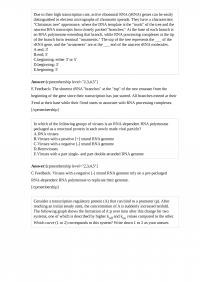
Due to their high transcription rate, active ribosomal RNA (rRNA) genes can be easily distinguished in electron micrographs of chromatin spreads. They have a characteristic “Christmas tree” appearance, where the DNA template is the “trunk” of the tree and the […]
BISC 113 Midterm 2
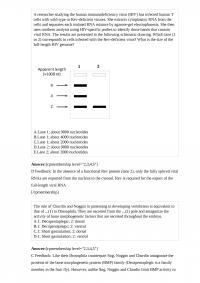
A researcher studying the human immunodeficiency virus (HIV) has infected human T cells with wild-type or Rev-deficient viruses. She extracts cytoplasmic RNA from the cells and separates each isolated RNA mixture by agarose-gel electrophoresis. She then uses northern analysis using […]
BIOL 411
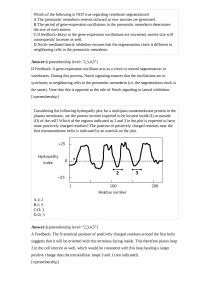
Which of the following is NOT true regarding vertebrate segmentation? A.The presomitic mesoderm retreats tailward as new somites are generated. B.The period of gene-expression oscillations in the presomitic mesoderm determines the size of each somite. C.If feedback delays in the […]
CAS BI 648 Midterm 2
What do all -barrel transmembrane proteins have in common? A.The number of strands. B.The diameter of the barrel. C.The number of negative peaks in their hydropathy plots. D.The general function, i.e. membrane transport. E.The structural rigidity compared to -helical transmembrane […]
Biology 271 Quiz 2
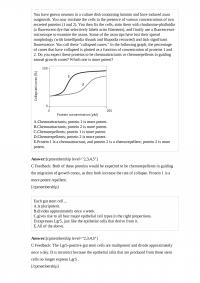
You have grown neurons in a culture dish containing laminin and have induced axon outgrowth. You now incubate the cells in the presence of various concentrations of two secreted proteins (1 and 2). You then fix the cells, stain them […]
BIOL 596
In assembling a nucleosome, normally the ___(1) histone dimers first combine to form a tetramer, which then further combines with two ___ (2) histone dimers to form the octamer. A.1: H1-H3; 2: H2A-H2B B.1: H3-H4; 2: H2A-H2B C.1: H2A-H2B; 2: […]
CAS BI 384 Midterm 1
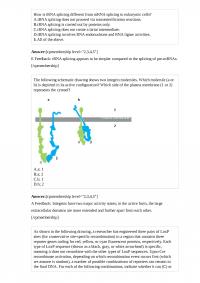
How is tRNA splicing different from mRNA splicing in eukaryotic cells? A.tRNA splicing does not proceed via transesterification reactions. B.tRNA splicing is carried out by proteins only. C.tRNA splicing does not create a lariat intermediate. D.tRNA splicing involves RNA endonuclease […]
BISC 198 Test 1
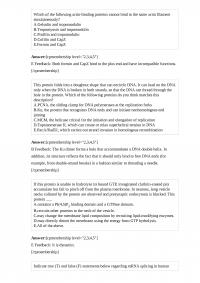
Which of the following actin-binding proteins cannot bind to the same actin filament simultaneously? A.Gelsolin and tropomodulin B.Tropomyosin and tropomodulin C.Profilin and tropomodulin D.Cofilin and CapZ E.Formin and CapZ This protein folds into a doughnut shape that can encircle DNA. […]
BI 422 Homework
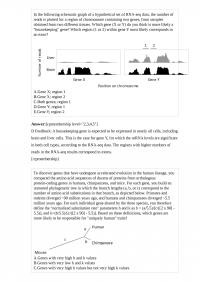
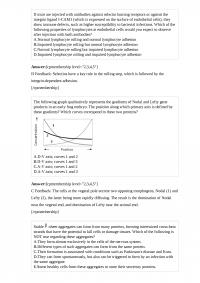
In the following schematic graph of a hypothetical set of RNA-seq data, the number of reads is plotted for a region of chromosome containing two genes, from samples obtained from two different tissues. Which gene (X or Y) do you […]
BIO 166 Quiz 2
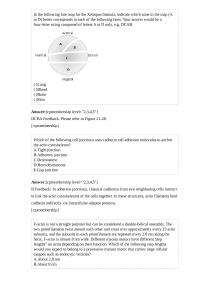
In the following fate map for the Xenopus blastula, indicate which zone in the map (A to D) better corresponds to each of the following fates. Your answer would be a four-letter string composed of letters A to D only, […]
BI 775
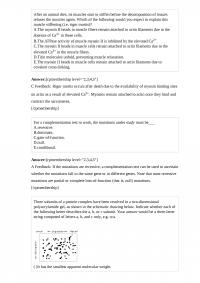
After an animal dies, its muscles start to stiffen before the decomposition of tissues relaxes the muscles again. Which of the following would you expect to explain this muscle stiffening (i.e. rigor mortis)? A.The myosin II heads in muscle fibers […]
BI 212 Quiz 1
What determines the time and place that a certain gene is transcribed in the cell? A.The type of cis-regulatory sequences associated with it B.The relative position of cis-regulatory sequences associated with it C.The arrangement of various cis-regulatory sequences associated with […]
BIOL 883 Quiz 3
Cyclin B1, a key cell cycle regulatory protein in vertebrates, is mostly cytosolic before mitosis. Early in mitosis, however, the protein is phosphorylated by certain protein kinases and consequently accumulates in the nucleus. How can phosphorylation bring about nuclear accumulation […]
BIOL 450
This family of ATPases is structurally related to the turbine-like pumps that acidify lysosomes and vesicles; however, they usually function in reverse, generating ATP from ADP and Pi using proton gradients across membranes. What are they called? A.P-type pumps B.ABC […]
CAS BI 258
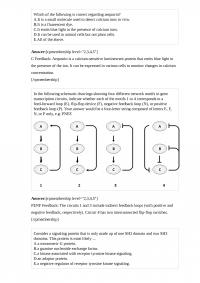
The duty ratio for a motor protein is defined as the fraction of time in each cycle of activity of the motor in which the head is bound with high affinity to its cytoskeletal track. Which of the following is […]
BIO 588
Which of the following is correct regarding aequorin? A.It is a small molecule used to detect calcium ions in vivo. B.It is a fluorescent dye. C.It emits blue light in the presence of calcium ions. D.It can be used in […]
CAS BI 136 Final
If an average globular protein was of the size of a tennis ball, a typical animal cell would be as large as ___ A.a cubicle. B.a room. C.a tennis court. D.a stadium. E.a city. Indicate whether each of the following […]
Biology 881 Midterm
Formin nucleates the growth of parallel actin bundles in the cell. Additionally, myosin motor activity is positively regulated by phosphorylation. The monomeric G protein RhoA is important in cytokinesis, because it directly or indirectly … A.activates formins and inactivates myosin […]
BI 489 Final
If mice are injected with antibodies against selectin homing receptors or against the integrin ligand I-CAM1 (which is expressed on the surface of endothelial cells), they show immune defects, such as higher susceptibility to bacterial infections. Which of the following […]
BIOL 587 Final
Nucleosomes that are positioned like beads on a string over a region of DNA can interact to form higher orders of chromatin structure. Which of the following factors can contribute to the formation of the 30-nm chromatin fiber from these […]
BIO 851 Final
Carcinoma cells that have acquired malignancy and started local invasiveness to begin metastasis … A.decrease the expression of E-cadherin and undergo mesenchymal-epithelial transition. B.increase the expression of E-cadherin and undergo mesenchymal-epithelial transition. C.decrease the expression of E-cadherin and undergo epithelial-mesenchymal […]
BI 622 Quiz 2
After release into the synaptic cleft, the neurotransmitter dopamine is actively taken up by the cells via specific dopamine transporters. The drug cocaine interferes with this process and is therefore called a reuptake inhibitor. The inhibition of the transporter at […]
BIO 388 Final
Consider a cis-regulatory enhancer sequence in the Escherichia coli chromosome that is located thousands of nucleotide pairs upstream of the gene that it regulates. If the regulatory sequence is mutated to become nonfunctional, the introduction of the wild-type enhancer on […]
BISC 153 Final
The chemical compound PMA is a potent stimulator of the epithelial-mesenchymal transition in epithelial cells. The activity of two of the following types of proteins is typically up-regulated in epithelial cells treated with PMA, while that of the other two […]
BI 599 Final
These proteins are found in the budding yeast Saccharomyces cerevisiae; they form “neck filaments” between a mother cell and its growing bud, and help polarize protein distribution between the two. These proteins … A.can polymerize to form filaments and sheets. […]
BI 167
Under anaerobic conditions, glycolysis provides most of the ATP that the cell needs. In animal cells, pyruvate, the end product of glycolysis, is converted to lactic acid by lactate dehydrogenase, as shown below: CH3(CO)COO– + X –>CH3(CHOH)COO–+ Y What is […]
BIOL 331
For the bacterial transcription machinery, which of the following mRNA sequences would you expect to constitute a potent transcriptional termination signal? Note that the two underlined regions in each sequence are complementary to each other. A.5’___ UGGCCCAGUCGGAAGACUGGGCCUUUUGUUUU___3′ B.5’___ UGGCCCAGUCGGAAGACUGGGCCCGCGGAGCU___3′ C.5’___ […]
Biology 788 Midterm 2
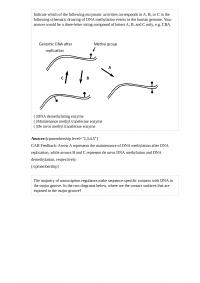
Indicate which of the following enzymatic activities corresponds to A, B, or C in the following schematic drawing of DNA methylation events in the human genome. Your answer would be a three-letter string composed of letters A, B, and C […]
BIO 824 Midterm 2
Among the following cancers, one is currently leading to the most number of deaths in the United States and in the rest of the world. In the United States, it contributes to cancer mortality more than the next three killing […]
BI 163 Quiz 3
Everything else being equal, if the mean lifetime of a protein is doubled, its concentration at steady state would ___ A.increase approximately twofold. B.increase less than twofold. C.increase over twofold. D.decrease approximately twofold. E.decrease less than twofold. A virus ___ […]
CAS BI 784
The marking of a protein by polyubiquitylation to signify degradation ___ A.requires the hydrolysis of one ATP molecule to ADP per polyubiquitin chain. B.involves covalent attachment of the target protein to the E1 enzyme. C.is carried out by the proteasome […]
BISC 843 Test
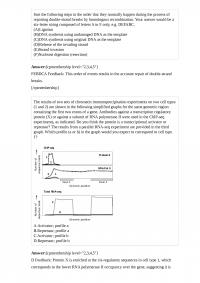
Sort the following steps in the order that they normally happen during the process of repairing double-strand breaks by homologous recombination. Your answer would be a six-letter string composed of letters A to F only, e.g. DEFABC. (A)Ligation (B)DNA synthesis […]
Biology 833 Quiz 3
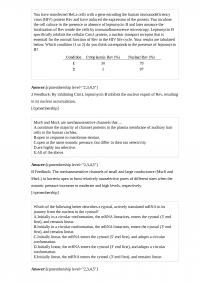
You have transfected HeLa cells with a gene encoding the human immunodeficiency virus (HIV) protein Rev and have induced the expression of the protein. You incubate the cell culture in the presence or absence of leptomycin B and later measure […]
BIO 290 Midterm
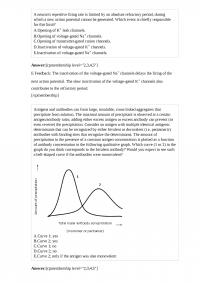
A neuron’s repetitive firing rate is limited by an absolute refractory period, during which a new action potential cannot be generated. Which event is chiefly responsible for this limit? A.Opening of K+ leak channels. B.Opening of voltage-gated Na+ channels. C.Opening […]
BI 299
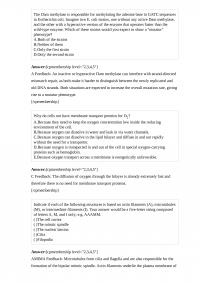
The Dam methylase is responsible for methylating the adenine base in GATC sequences in Escherichia coli. Imagine two E. coli strains, one without any active Dam methylase, and the other with a hyperactive version of the enzyme that operates faster […]
BIOL 679 Lampbrush chromosomes
Lampbrush chromosomes ___ A.are transcriptionally inactive. B.are readily observed in the oocytes of humans and insects. C.have thousands of duplicated DNA molecules arranged side by side. D.are mitotic chromosomes with two sister chromatids attached together only at the centromere. E.are […]
BIO 892 Midterm 2
An amino acid residue that is not part of the active site of an enzyme and does not interact with the ligand is nevertheless critical for ligand binding and is highly conserved. How can this be explained? A.This residue is […]