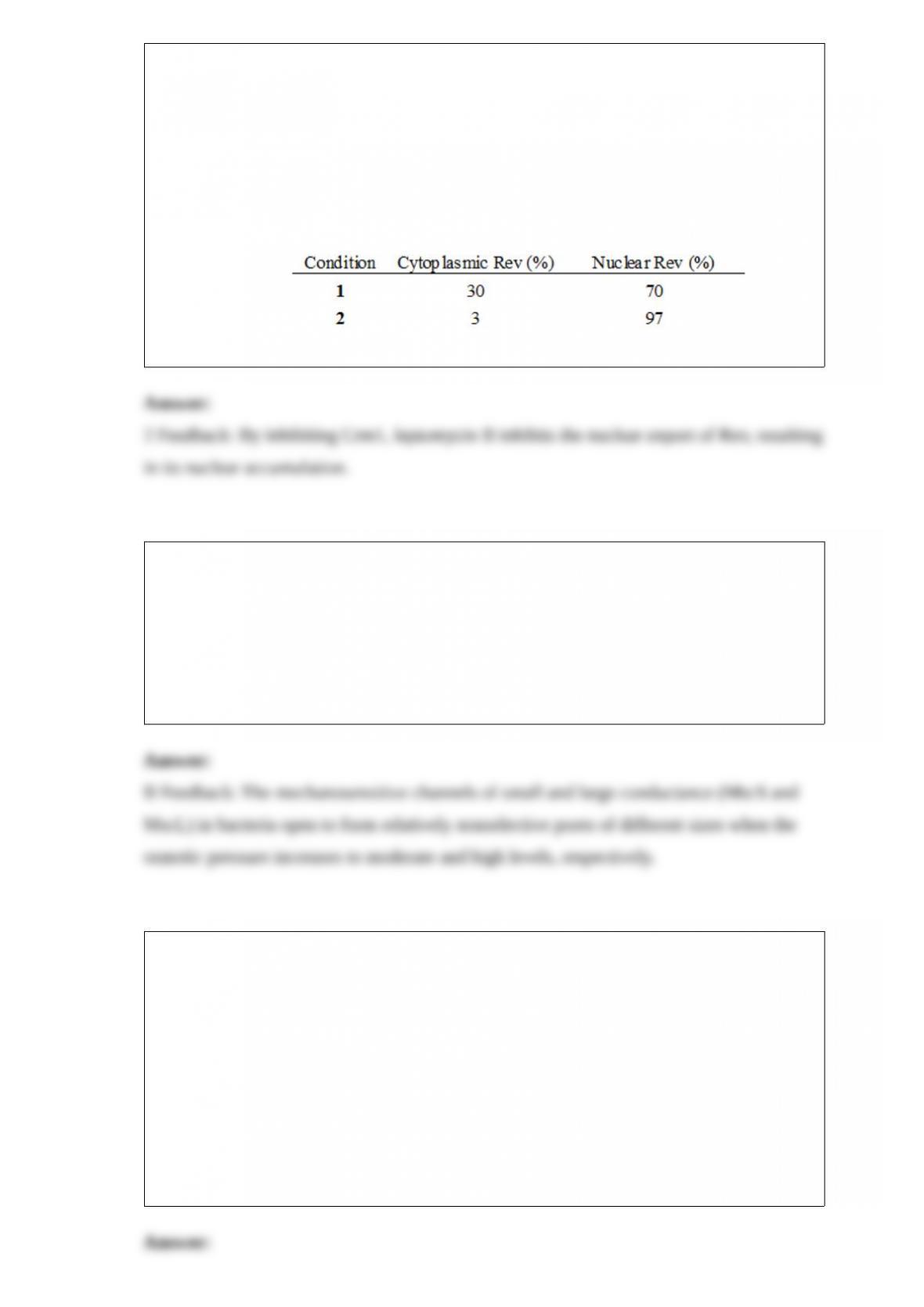
You have transfected HeLa cells with a gene encoding the human immunodeficiency
virus (HIV) protein Rev and have induced the expression of the protein. You incubate
the cell culture in the presence or absence of leptomycin B and later measure the
localization of Rev inside the cells by immunofluorescence microscopy. Leptomycin B
specifically inhibits the cellular Crm1 protein, a nuclear transport receptor that is
essential for the normal function of Rev in the HIV life cycle. Your results are tabulated
below. Which condition (1 or 2) do you think corresponds to the presence of leptomycin
B?
MscS and MscL are mechanosensitive channels that …
A.constitute the majority of channel proteins in the plasma membrane of auditory hair
cells in the human cochlea.
B.open in response to membrane tension.
C.open at the same osmotic pressure, but differ in their ion selectivity.
D.are highly ion selective.
E.All of the above.
Which of the following better describes a typical, actively translated mRNA in its
journey from the nucleus to the cytosol?
A.Initially in a circular conformation, the mRNA linearizes, enters the cytosol (5′ end
first), and remains linear.
B.Initially in a circular conformation, the mRNA linearizes, enters the cytosol (3′ end
first), and remains linear.
C.Initially linear, the mRNA enters the cytosol (5′ end first), and adopts a circular
conformation.
D.Initially linear, the mRNA enters the cytosol (3′ end first), and adopts a circular
conformation.
E.Initially linear, the mRNA enters the cytosol (3′ end first), and remains linear.
How can the formation of tubular structures, as opposed to spherical vesicles, in the
early endosomes facilitate recycling of membrane proteins such as cell-surface
receptors?
A.By increasing surface area-to-volume ratio
B.By decreasing surface area-to-volume ratio
C.By enhancing the formation of intralumenal vesicles
D.By preventing the formation of intralumenal vesicles
Which of the following lipids do you expect to be a canonical scramblase substrate in
the plasma membrane?
A.Ganglioside GM1
B.Cholesterol
C.Glycosylphosphatidylinositol
D.Phosphatidylethanolamine
E.Galactocerebroside
If the extracellular concentration of sodium ions is artificially decreased for a neuron,
___
A.both the resting potential and the peak of the action potential rise significantly.
B.the resting potential increases but the action potential peak does not.
C.the resting potential hardly changes but the action potential peak is raised.
D.the resting potential decreases but the action potential peak is raised.
E.the resting potential hardly changes but the action potential peak is lowered.
Consider a healthy adult animal in which 1015 cell divisions have taken place since
birth. Spontaneous mutations can occur at a rate of approximately one nucleotide out of
about ten billion nucleotides every time DNA is replicated. The animal has a diploid
genome size of about 2 billion nucleotide pairs. Assuming that only about 5% of
mutations occur within genes or gene regulatory sequences, and further assuming that
about 0.1% of those may cause cancer, how many potential cancer-causing mutations
has the animal been able to successfully suppress (i.e. has been able to survive) during
its lifetime?
A.Ten thousand
B.One hundred thousand
C.Ten million
D.One billion
E.Ten billion
You have carried out a genetic screen in a species of fish, and have identified a new
gene in this organism. You have cloned and sequenced the gene, but do not know
anything about the biochemical function of the gene product. Which of the following is
the most sensible next step in order to get clues about the function?
A.Purifying the protein product and determining its structure by x-ray diffraction
B.Screening for small molecules that perturb gene function
C.Using the BLAST algorithm to scan sequence databases for similar sequences
D.Using MS/MS to sequence the gene product without the need for purification
E.Mutating the gene and performing reverse genetics
The size distribution of exons coding for collagen helical domains in various
vertebrates reveals a unique pattern. This pattern provides clues to the evolutionary
history of the genes encoding fibrillar collagen ± chains. What is this pattern?
A.The length of most exons is a multiple of 100 nucleotides.
B.Most exons code for 54, or a multiple of 54, Gly-X-Y repeats.
C.The length of most exons is a multiple of 30 nucleotides.
D.Most exons code for 6, or a multiple of 6, Gly-X-Y repeats.
E.None of the above.
What is the order of the following evolutionary landmarks (A to D), from the oldest to
the most recent? Your answer would be a four-letter string composed of letters A to D,
with the oldest event on the left.
A.Divergence of human and bird lineages
B.Divergence of human and chimpanzee lineages
C.Divergence of A. thaliana lineage from the conifers lineage
D.Divergence of fish and insect lineages
Switch proteins that bind and hydrolyze GTP are ubiquitous cell regulators in a wide
variety of molecular processes. Which of the following statements is NOT true
regarding these proteins?
A.EF-Tu is an example of such proteins.
B.GTP hydrolysis by the GTPase generally renders it inactive.
C.Activation of the GTPase involves addition of a phosphate group to its bound
guanine nucleotide.
D.Guanine nucleotide exchange factors generally activate the GTPases.
E.Guanine nucleotide exchange factors accelerate the release of bound GDP from the
GTPases.
A mitochondrion has just been engulfed by a cup-shaped isolation membrane as it
undergoes mitophagy. Before lysosomal fusion, how many membranes separate the
cytosol from the matrix of the engulfed mitochondrion?
A.2
B.3
C.4
D.5
Two copies of the gene A exist in a diploid mammal. However, only one copy is
expressed in every somatic cell. Different somatic cells in the body of each organism
have inactivated one or the other allele in a seemingly random fashion, but when they
divide, the daughter cells inherit the choice of the inactive allele faithfully. This is an
example of ___
A.X-inactivation
B.Genomic imprinting
C.Loss of heterozygosity
D.Monoallelic gene expression
E.Alternative gene splicing
Consider the two feed-forward loops below containing three transcription regulators A,
B, and C, where A receives the input signal and C generates the output. In the so-called
coherent loop (left), A activates C both directly and indirectly, whereas in an incoherent
loop (right), A activates C via one route and inactivates it via the other. Answer the
following question(s) based on these network motifs.
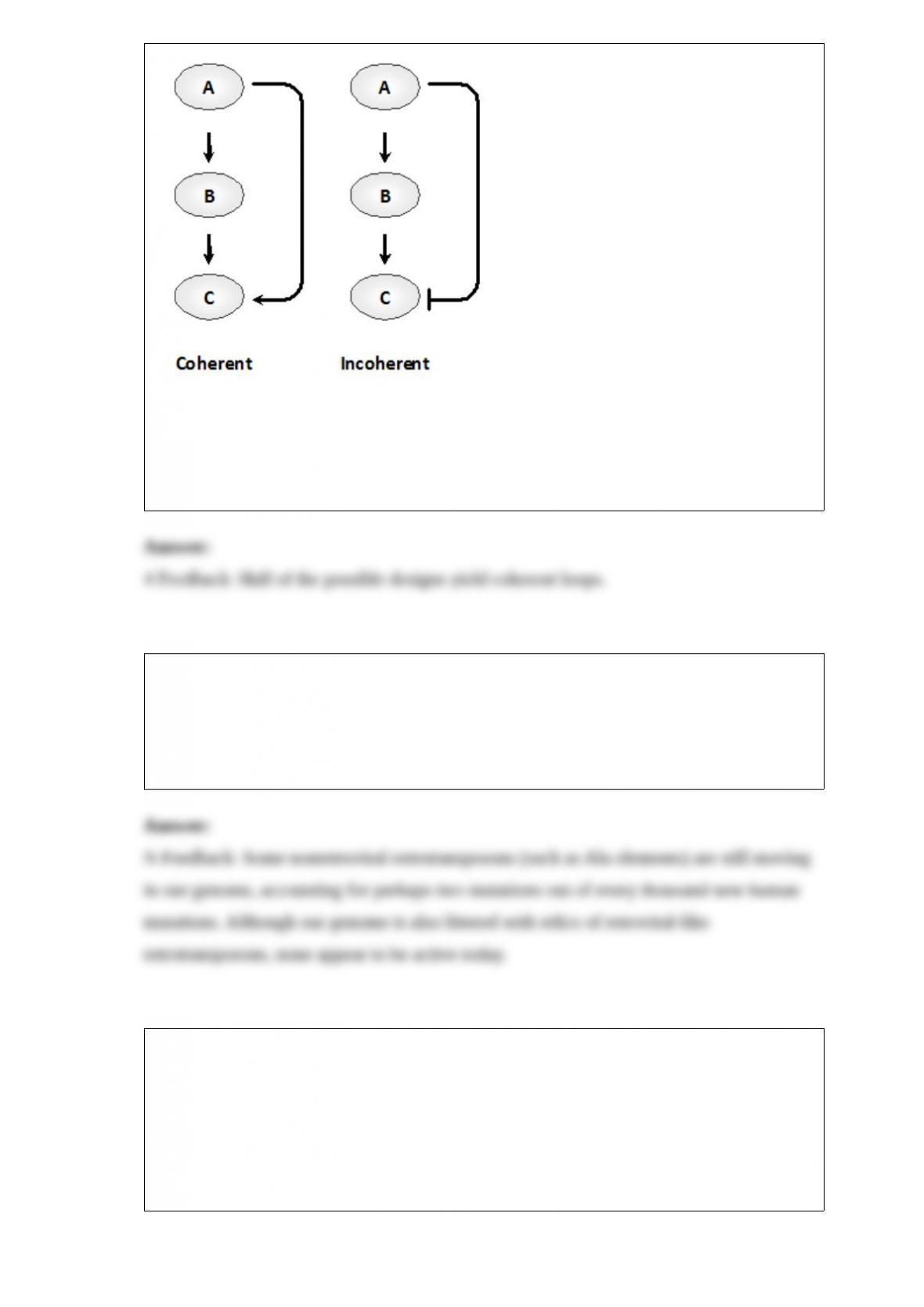
Considering coherent and incoherent feed-forward loops, eight different designs are
possible using three components and involving activation (positive) and inhibition
(negative) regulation only. In all such loops, A would regulate both B and C, and B
would regulate only C. How many of these designs constitute a coherent loop? Write
down your answer as a number, e.g. 7.
Consider three types of mobile genetic elements that are found in our genome: the
DNA-only transposons (D), the retroviral-like retrotransposons (R), and the
nonretroviral retrotransposons (N). Which type appears to still be active and move in
our genome, accounting for a detectable fraction of human mutations? Write down your
answer as D, R, or N.
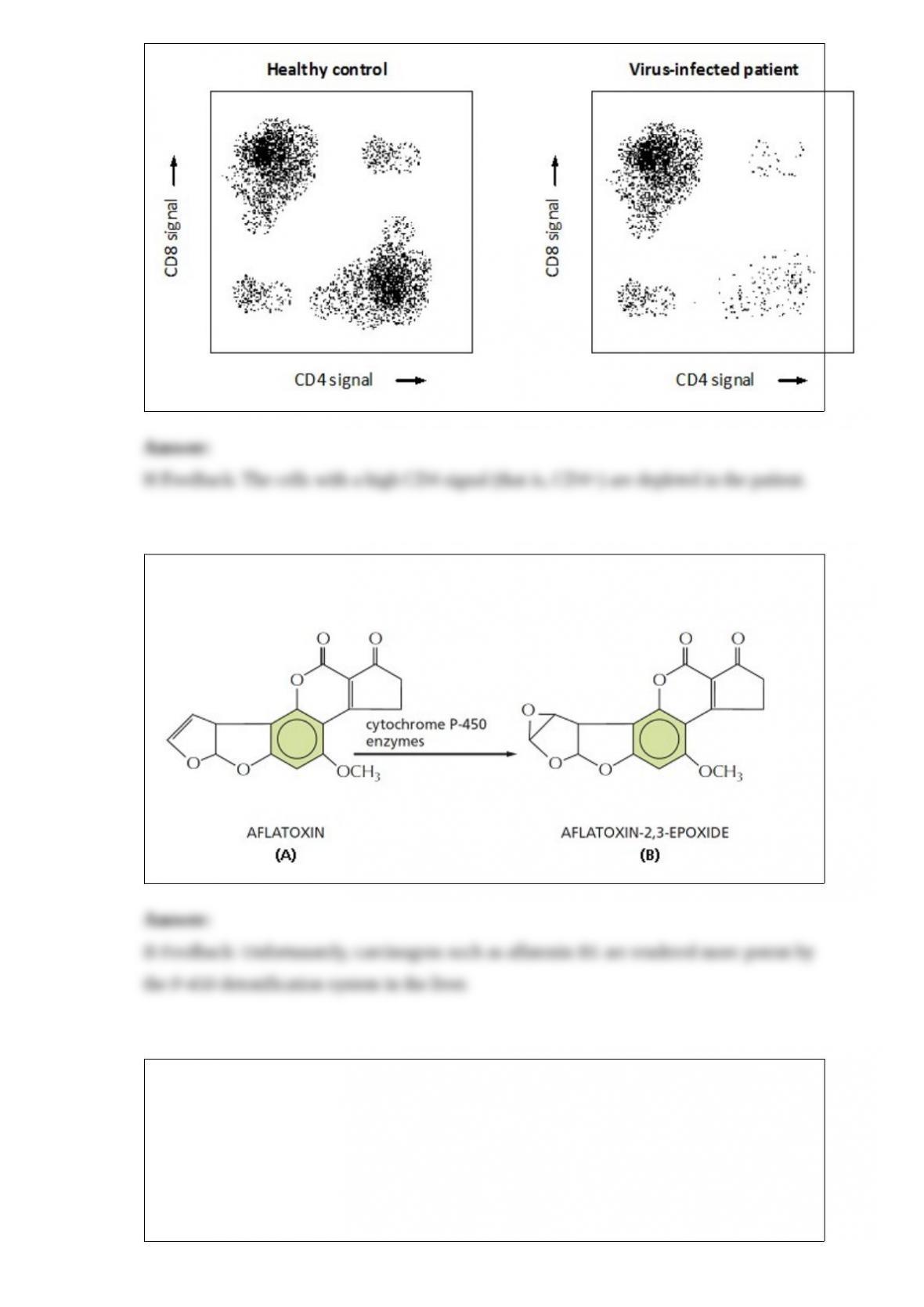
You have used fluorescence-activated cell sorting to separate blood T lymphocytes from
a healthy person and a patient infected with a virus. To sort the cells, you used
antibodies against two cell-surface receptors, CD4 and CD8, each conjugated to a
different fluorescent dye. Based on the results below, which cell type do you think is
depleted by the viral infection: CD4+ helper T cells (H) or CD8+ cytotoxic T cells (C)?
In these dot plots, each cell is represented by a dot whose coordinates are the intensities
of CD4 and CD8 signals. Write down H or C as your answer.
Which of the molecules (A or B) in the following drawing is a more potent mutagen?
Write down A or B as your answer.
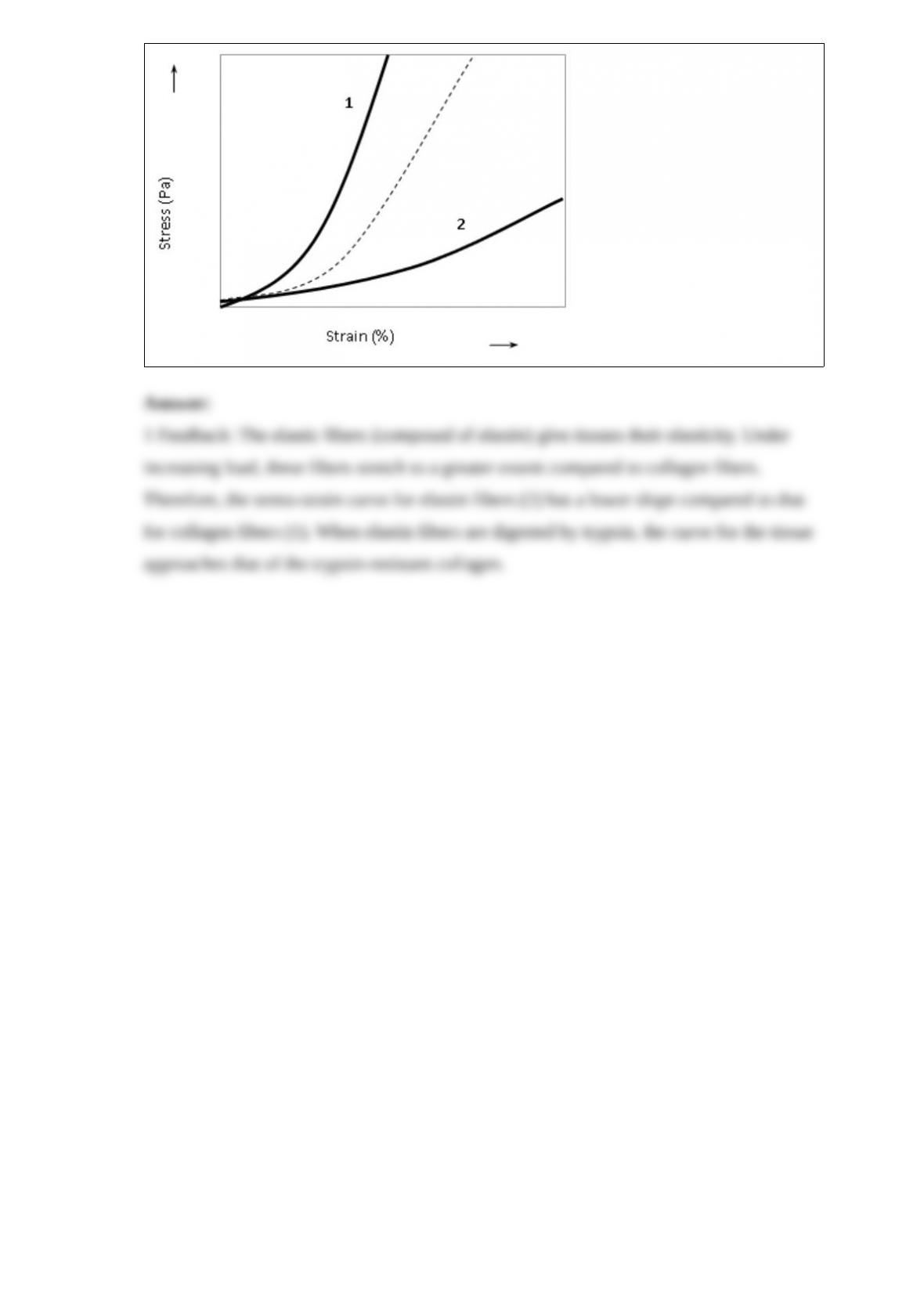
The elasticity of the components of the extracellular matrix can be visualized in a
stress-strain curve, in which the tensile stress (corresponding to load) applied to a tissue
sample is plotted against the strain (corresponding to deformation) measured in the
tissue. In the following stress-strain graph, the elasticity of an intact connective tissue is
represented by a dashed curve. The other two curves correspond to the same tissue that
has been treated with either formic acid (to digest collagen) or trypsin (to digest
elastin). Which curve (1 or 2) do you think corresponds to trypsin treatment?