Everything else being equal, if the mean lifetime of a protein is doubled, its
concentration at steady state would ___
A.increase approximately twofold.
B.increase less than twofold.
C.increase over twofold.
D.decrease approximately twofold.
E.decrease less than twofold.
A virus ___
A.is a type of cell.
B.has genetic material made of proteins.
C.can only infect a single host species.
D.can act as a vector for gene transfer.
E.cannot persist in its host for more than one cell generation.
Plasmodesmata in plant cells are functionally similar to animal cells’ …
A.adherens junctions.
B.desmosomes.
C.gap junctions.
D.hemidesmosomes.
E.tight junctions.
Which of the following DNA-binding motifs uses ² sheets to recognize DNA bases?
A.The helix-turn-helix motif
B.The leucine zipper
C.The zinc finger motif
D.The helix-loop-helix motif
E.None of the above
Which of the following pairs of amino acid residues would you expect to form ionic
bonds?
A.Glutamic acid and glutamine
B.Arginine and lysine
C.Lysine and glutamic acid
D.Tryptophan and tyrosine
E.Tyrosine and glutamine
Consider a promoter sequence with n binding sites for an activator protein. Which Hill
coefficient (h) describes noncooperative binding, i.e. independent, noninteracting
binding sites?
A.h = n
B.h = 1
C.h = 0
D.h = n – 1
E.h < 0
Indicate whether each of the following descriptions better applies to adherens junctions
(A), desmosomes (D), gap junctions (G), or tight junctions (T). Your answer would be a
four-letter string composed of letters A, D, G, and T only, e.g. AAAD.
( )They play a direct role in structural polarization of epithelial cells.
( )They couple cells both electrically and metabolically.
( )They are formed from hexameric hemichannels that can assemble into heterotypic
complexes.
( )They create semipermeable paracellular pores.
Different mice have different allelic variants of class I MHC genes. Therefore,
cytotoxic T cell (TC cell) clones can be generated by culturing lymphocytes harboring
MHC allele A in the presence of nondividing nucleated cells harboring MHC allele B
(and vice versa). These T cells can normally kill cells harboring allele B by inducing
them to undergo apoptosis. Imagine two strains of mice with MHC allele A that are
either wild type (WT) for the gene encoding perforin (A1) or are mutant and lack the
gene (A2). Also imagine two strains of mice with MHC allele B that are either WT for
the gene encoding Fas (B1) or are mutant and lack the gene (B2). Cytotoxic T cells
derived from the A1 strain can induce apoptosis in both B1 and B2 cells. However,
those derived from the A2 strain are only able to induce apoptosis in B1 cells and not
B2 cells. Indicate whether each of the following statements is (Y) or is not (N)
consistent with these observations. Your answer would be a four-letter string composed
of letters Y and N only, e.g. NYNY.
( )The perforin-granzyme pathway is the only way through which TC cells induce
apoptosis in mouse target cells.
( )The activation of the Fas-FasL pathway is sufficient to induce apoptosis by TC cells.
( )There are other major pathways (not dependent on perforin or Fas) through which TC
cells induce apoptosis in mouse target cells.
( )Both pathways (Fas-FasL and perforin-granzyme) are required simultaneously for the
induction of apoptosis by TC cells in mouse target cells.
Susceptibility to drug and alcohol addiction is partially genetic. For example, the
human dopamine receptor DRD2 is associated with cocaine and alcohol abuse;
individuals carrying an A nucleotide, instead of the more common C nucleotide, at a
certain position within the sixth intron of the DRD2 gene are at a significantly increased
risk of abuse. This variation in sequence is an example of ___
A.a SNP.
B.a CNV.
C.an indel.
D.epistasis.
E.None of the above.
Which of the following mechanisms is NOT employed by I-Smads to negatively
regulate Smad signaling?
A.Competing with R-Smads for binding sites on the receptor, decreasing R-Smad
phosphorylation.
B.Recruiting the ubiquitin ligase Smurf, leading to receptor degradation.
C.Binding to caveolin, inhibiting the formation of caveolae.
D.Binding to the co-Smad, Smad4, inhibiting it.
E.Recruiting protein phosphatases, leading to receptor inactivation.
This general transcription factor recognizes the TATA box in RNA polymerase II
promoters. It is___
A.the only single-subunit general transcription factor.
B.able to introduce a rather sharp kink in the double helix upon binding to DNA.
C.responsible for the phosphorylation of the RNA polymerase CTD during transcription
initiation.
D.also responsible for the recognition of the BRE element in the promoter.
E.All of the above.
Sort the following cell types from high to low abundance in the blood (number of cells
per unit volume) in a healthy individual. Your answer would be a four-letter string
composed of letters A to D only, e.g. BADC.
(A)Erythrocytes
(B)Neutrophils
(C)Basophils
(D)T lymphocytes
In an enzymatic reaction involving NADH or NADPH, reduction of a substrate
accompanies the oxidation of these carrier molecules to NAD+ or NADP+, respectively.
What else typically happens in such a reaction?
A.A molecule of water is released to the solution upon completion of the reaction.
B.A proton is released during the oxidation of the carriers.
C.A proton is taken up by the substrate that is being reduced.
D.A proton is taken up by the carrier molecule that is being oxidized.
E.A phosphate group is transferred to the substrate.
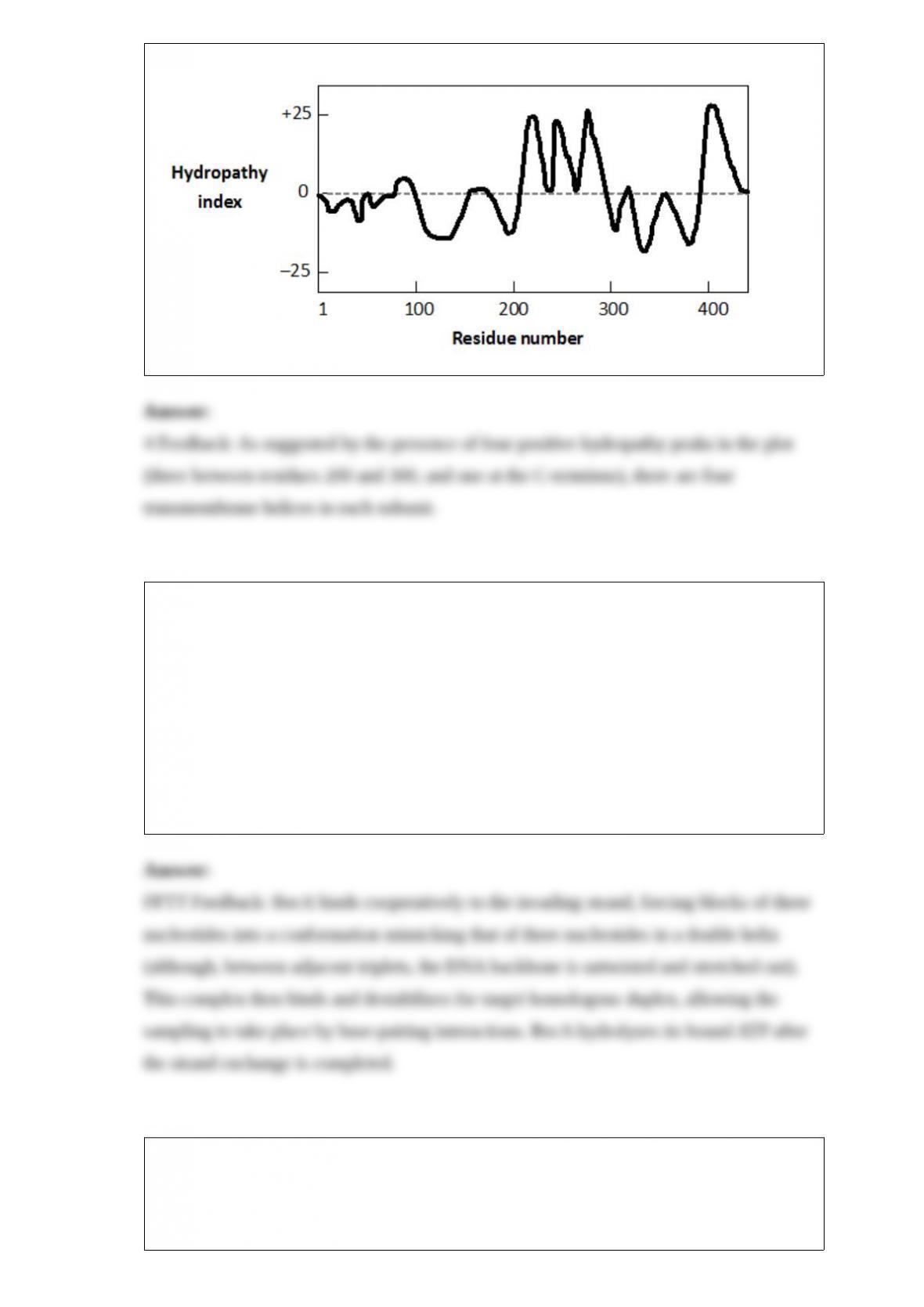
The nicotinic acetylcholine receptor is a cation channel in the plasma membrane of
some neurons. It is composed of five subunits, each of which is a transmembrane
protein. The hydropathy plot for each mature subunit is qualitatively represented in the
following diagram. How many membrane-spanning alpha helices do you expect to exist
in each subunit?
The RecA/Rad51 protein carries out strand exchange during homologous
recombination. Indicate true (T) and false (F) statements about this process below. Your
answer would be a four-letter string composed of letters T and F only, e.g. FFFF.
( )RecA hydrolyzes ATP upon binding to the invading DNA strand.
( )RecA forces the invading strand into a conformation that fully mimics the geometry
of a long DNA double helix.
( )Sampling of the homologous duplex by the invading strand is likely to occur in triplet
nucleotide blocks.
( )RecA-bound, invading, single-stranded DNA binds and destabilizes the homologous
duplex to allow the sampling of its sequence by base-pairing.
Indicate whether each of the following is located (or takes place) in the large (L) or the
small (S) ribosomal subunit. Your answer would be a four-letter string composed of
letters L and S only, e.g. LLLS.
( )Peptide bond formation
( )Codon-anticodon interaction
( )The path of the mRNA
( )The polypeptide exit tunnel
Indicate whether each of the following descriptions better applies to
glycosaminoglycans (G), fibrous proteins (F), or glycoproteins (P) of the extracellular
matrix in animal cells. Your answer would be a six-letter string composed of letters G,
F, and P only, e.g. GFPGFP.
( )They include laminin and fibronectin.
( )They primarily include collagens.
( )They include hyaluronan.
( )They are found in proteoglycans.
( )They occupy large volumes and form hydrated gels.
( )They constitute the major proteins of the matrix.
Indicate whether each of the following descriptions applies to cilia (C), flagella (F), or
both (B). Your answer would be a four-letter string composed of letters C, F, and B
only, e.g. CCFB.
( )They are short and present at high numbers per cell.
( )They have a whiplike motion that resembles breaststroke in swimming.
( )They are based on the axoneme structure.
( )They are found in the epithelial cells of the human respiratory tract.
Indicate true (T) and false (F) statements below regarding cancer incidence and cancer
prevention. Your answer would be a four-letter string composed of letters T and F only,
e.g. TFFF.
( )Over half of all cancers are preventable by lifestyle changes.
( )The age-adjusted cancer death rates have increased steadily since 1900, mostly due to
the industrial way of life.
( )Currently, more than half of all cancer patients survive at least five years
post-diagnosis.
( )About half of all cancers are thought to arise by infection with viruses, bacteria, or
parasites.