Archives: Quiz
BISC 512 Homework
Indicate if each of the following descriptions matches actin filaments (A), microtubules (M), or intermediate filaments (I). Your answer would be a four-letter string composed of letters A, M, and I only; e.g. AAMM. ( )They form hollow structures with […]
BIO 761 Midterm 1
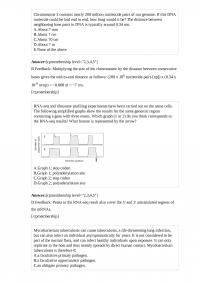
Chromosome 3 contains nearly 200 million nucleotide pairs of our genome. If this DNA molecule could be laid end to end, how long would it be? The distance between neighboring base pairs in DNA is typically around 0.34 nm. A.About […]
BISC 155
Which of the following can be a function for intrinsically disordered protein sequences? A.High-specificity binding to other proteins B.Cell signaling through covalent modification of the protein sequence C.Tethering to hold interacting proteins in close proximity D.Formation of a diffusion barrier […]
BIO 305
Type IV collagen molecules can interact at their C-termini to form dimers and at their N-termini to form tetramers. What category do you think this type of collagen belongs to? A.Fibrillar B.Fibril-associated C.Network-forming D.Proteoglycan core E.Anchorage fibril Carcinoma of the […]
BI 127 Test
Treatment of dividing cells with a low dose of the antifungal drug benomyl, which destabilizes microtubules, slows down correct spindle assembly. But at such doses, the spindle is eventually formed and the cells survive. However, mutations in some genes confer […]
BIO 707 Midterm
Skeletal muscle cells consume enormous amounts of ATP. From the following list, choose the two proteins that directly hydrolyze most of this ATP. Your answer would be a two-letter string composed of letters A to F only, in alphabetical order, […]
BI 346 Midterm 2
Actin filaments that are held together by the cross-linking protein fimbrin are not contractile. This is probably because … A.the very weak cross-linking by this protein cannot convert myosin II activity into a coherent contraction. B.fimbrin arranges the actin filaments […]
Biology 139 Test 1
Using Cre recombination, the gene encoding stem cell factor (SCF) can be deleted in specific cell types in adult mice. Deletion of this gene in which of the following cells would you expect to lead to the most significant depletion […]
Biology 790 Midterm
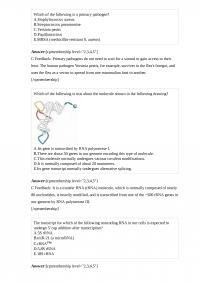
Which of the following is a primary pathogen? A.Staphylococcus aureus B.Streptococcus pneumoniae C.Yersinia pestis D.Papillomavirus E.MRSA (methicillin-resistant S. aureus) Which of the following is true about the molecule shown in the following drawing? A.Its gene is transcribed by RNA polymerase […]
CAS BI 626 Quiz 3
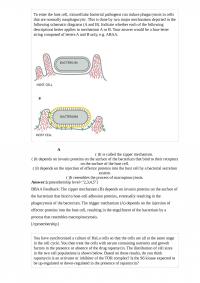
To enter the host cell, intracellular bacterial pathogens can induce phagocytosis in cells that are normally nonphagocytic. This is done by two major mechanisms depicted in the following schematic diagrams (A and B). Indicate whether each of the following descriptions […]
BIOL 457 Test 1
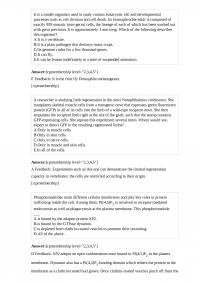
It is a model organism used to study various eukaryotic cell and developmental processes such as cell division and cell death. Its hermaphrodite adult is composed of exactly 959 somatic (non-germ) cells, the lineage of each of which has been […]
CAS BI 433 Why do liposomes not
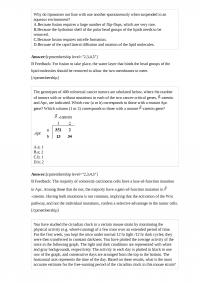
Why do liposomes not fuse with one another spontaneously when suspended in an aqueous environment? A.Because fusion requires a large number of flip-flops, which are very rare. B.Because the hydration shell of the polar head groups of the lipids needs […]
CAS BI 433
Why do liposomes not fuse with one another spontaneously when suspended in an aqueous environment? A.Because fusion requires a large number of flip-flops, which are very rare. B.Because the hydration shell of the polar head groups of the lipids needs […]
CAS BI 370
Gene duplication can give rise to homologous genes that are part of gene families. For example, there are six actin genes in the genome of most mammalian species. In humans, the ACTB gene, which encodes a cytoskeletal actin, is expressed […]
BISC 492 Final
You ________ your mandible when you grasp your upper lip with your lower teeth. A) rotate B) extend C) pivot D) protract E) pronate Which statement is true regarding the somatic nervous system as compared to the autonomic nervous system? […]
CAS BI 304
The hormone that stimulates spermatogenesis in males is A) PTH. B) FSH. C) LH. D) GH. E) MSH. ________ will raise blood pH. A) Strenuous exercise B) Hyperventilation C) Diabetes mellitis D) Stomach ulcers E) Smoking Answer: B The pancreas […]
BISC 613 Test 1
Homeostatic mechanisms that monitor and adjust the composition of body fluids respond to changes in the ________ fluid. A) lymphatic B) intracellular C) plasma D) extracellular E) cerebrospinal A person whose platelet count is 40,000/µl is suffering from A) thrombocytosis. […]
Biology 286 Quiz
A general term for pain and stiffness that affects the skeletal or muscular system is A) rheumatism. B) atherosclerosis. C) bursitis. D) bunions. E) arthritis. The ongoing process of tearing down and rebuilding bone matrix is called A) restoration. B) […]
CAS BI 228 Test 2
Anatomy uses a special language, called ________ terminology, which involves the use of word roots, prefixes, suffixes, and combining forms to construct terms related to the body in health and disease. A) clinical B) pathological C) medical D) anatomical E) […]
BIOL 335 Final
The condition in which distortions of the skull occur due to the premature closure of fontanelles is called A) anencephaly. B) microcephaly. C) craniostenosis. D) membranitis. E) epicranial block. ________ results from the activities of the nervous or endocrine system. […]
Biology 178 Test
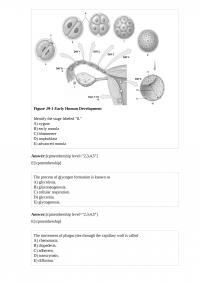
Figure 29-1 Early Human Development Identify the stage labeled “8.” A) zygote B) early morula C) blastomere D) trophoblast E) advanced morula The process of glycogen formation is known as A) glycolysis. B) gluconeogenesis. C) cellular respiration. D) glycemia. E) […]
BIOL 841 Quiz 1
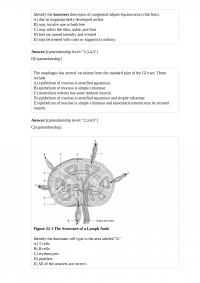
Identify the incorrect descriptor of congenital talipes equinovarus (club foot). A) due to inappropriately developed arches B) may involve one or both feet C) may affect the tibia, ankle, and foot D) feet are turned laterally and everted E) may […]
BISC 431 Quiz 3
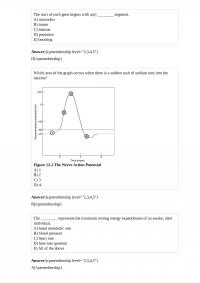
The start of each gene begins with a(n) ________ segment. A) neocodon B) intron C) histone D) promotor E) boosting Which area of the graph occurs when there is a sudden rush of sodium ions into the neuron? Figure 12-2 […]
BIO 316
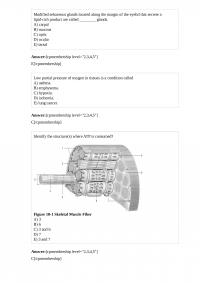
Modified sebaceous glands located along the margin of the eyelid that secrete a lipid-rich product are called ________ glands. A) carpal B) mucous C) optic D) ocular E) tarsal Low partial pressure of oxygen in tissues is a condition called […]
Biology 103 Test 1
The hydrolysis of ATP yields ADP, phosphate ion, and A) AMP. B) H2O. C) energy. D) adenosine E) nuclease. The term ________ refers to certain amino acids, which can have both a positive charge and a negative charge. A) anion […]
BIOL 303 Test 1
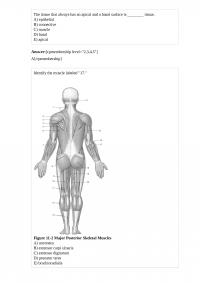
The tissue that always has an apical and a basal surface is ________ tissue. A) epithelial B) connective C) muscle D) basal E) apical Identify the muscle labeled “17.” Figure 11-2 Major Posterior Skeletal Muscles A) anconeus B) extensor carpi […]
BIOL 540 Test 2
A(n) ________ acid is an acid that cannot leave solution and enter the atmosphere. A) fixed B) volatile C) respiratory D) organic E) inorganic The complex structures of DNA and protein found in the cell nucleus are A) nucleoplasm. B) […]
CAS BI 811
The three categories of connective tissues are A) connective tissue proper, fluid connective tissue, and supporting connective tissue. B) epithelial connective tissue, muscle connective tissue, and neural connective tissue. C) glandular connective tissue, exocrine connective tissue, and endocrine connective tissue. […]
CAS BI 745 Homework
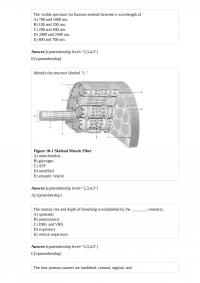
The visible spectrum for humans extends between a wavelength of A) 700 and 1000 nm. B) 100 and 200 nm. C) 200 and 400 nm. D) 2000 and 2500 nm. E) 400 and 700 nm. Identify the structure labeled “1.” […]
BI 738
When calcium ion binds to troponin, A) tropomyosin rolls away from the active site. B) active sites on the myosin are exposed. C) actin heads will bind to myosin. D) muscle relaxation occurs. E) myosin shortens. The cardioacceleratory center activates […]
Biology 380
The cell of the retina that produces an action potential that goes to the brain is a(n) A) bipolar cell. B) photoreceptor. C) ganglion cell. D) amacrine cell. E) horizontal cell. Circular folds are A) ridges in the wall of […]
BIO 283
The ________ is the part of the sperm that contains the DNA. A) head B) neck C) acrosome D) zona pellucida E) corona radiata The blood vessel that carries oxygenated blood away from the placenta is the A) umbilical vein. […]
BIO 574 Final
The movement of rotating a limb outward is called ________ rotation. A) lateral B) internal C) medial D) superficial E) abductive In a ________ fracture one side of the shaft is split and the other side is bent. A) comminuted […]
CAS BI 176 Final
Successive vertebrae articulate at facets on the inferior articular processes of the superior vertebra and facets on the ________ of the adjacent inferior vertebrae. A) dens B) pedicles C) lamellae D) transverse processes E) superior articular processes The enzyme ________ […]
BI 557
Interneurons are organized into functional groups called A) neuronal pools. B) plexi. C) rami. D) spindles. E) perineuria. The amount of blood remaining in the ventricle when the semilunar valve closes is the A) ejection fraction. B) end-diastole volume. C) […]
BIO 413 Midterm 2
Stem cells that can differentiate into osteoblasts are called ________ cells. A) osteopropagator B) osteoforming C) osteocreator D) osteotrophic E) psteoprogenitor The period of gestation that is characterized by rapid fetal growth and fat deposition is the ________ trimester. A) […]
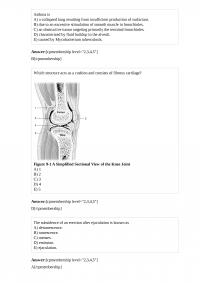
Biology 250 Test 1
Asthma is A) a collapsed lung resulting from insufficient production of surfactant. B) due to an excessive stimulation of smooth muscle in bronchioles. C) an obstructive tumor targeting primarily the terminal bronchioles. D) characterized by fluid buildup in the alveoli. […]
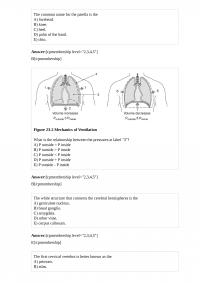
BIO 535 Final
The common name for the patella is the A) forehead. B) knee. C) heel. D) palm of the hand. E) chin. Figure 23-2 Mechanics of Ventilation What is the relationship between the pressures at label “3”? A) P outside = […]
Biology 618 Homework
During ________ sleep, dreaming occurs. A) REM B) deep C) beta D) stage 1 E) stage 2 Chambers within the brain that contain cerebrospinal fluid are called A) plexuses. B) ganglia. C) sinuses. D) aqueducts. E) ventricles. Answer: E The […]
CAS BI 248
Menstruation is the process of sloughing off the old functional layer of the A) perimetrium. B) endometrium. C) epimetrium. D) myometrium. E) exometrium. Give the clinical term for the condition in which the vertebral laminae fail to unite during development. […]
BI 199 Quiz 1
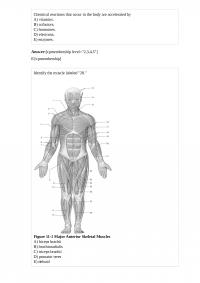
Chemical reactions that occur in the body are accelerated by A) vitamins. B) cofactors. C) hormones. D) electrons. E) enzymes. Identify the muscle labeled “20.” Figure 11-1 Major Anterior Skeletal Muscles A) biceps brachii B) brachioradialis C) triceps brachii D) […]
CAS BI 146 Final
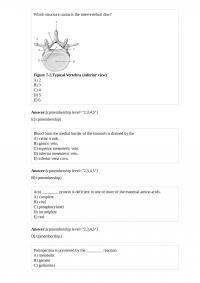
Which structure contacts the intervertebral disc? Figure 7-2 Typical Vertebra (inferior view) A) 2 B) 3 C) 4 D) 5 E) 6 Blood from the medial border of the stomach is drained by the A) celiac trunk. B) gastric vein. […]
BIO 659 Quiz
The coronary sinus drains the ________ into the ________. A) coronary arteries; left ventricle B) cardiac veins; right atrium C) interventricular artery; left ventricle D) right atrium; right ventricle E) cardiac vein; right ventricle The end of a muscle that […]
CAS BI 295 Quiz 1
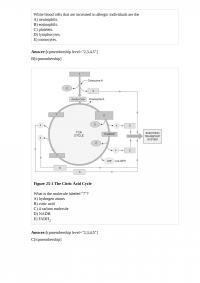
White blood cells that are increased in allergic individuals are the A) neutrophils. B) eosinophils. C) platelets. D) lymphocytes. E) monocytes. Figure 25-1 The Citric Acid Cycle What is the molecule labeled “7”? A) hydrogen atoms B) citric acid C) […]
CAS BI 468 Final
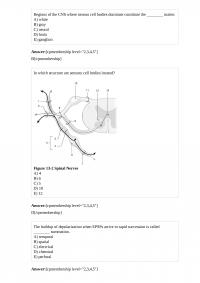
Regions of the CNS where neuron cell bodies dominate constitute the ________ matter. A) white B) gray C) neural D) brain E) ganglion In which structure are sensory cell bodies located? Figure 13-2 Spinal Nerves A) 4 B) 6 C) […]
BISC 102
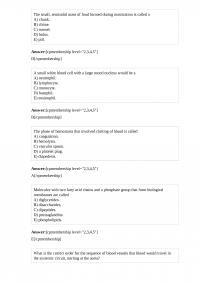
The small, semisolid mass of food formed during mastication is called a A) chunk. B) chime. C) morsel. D) bolus. E) pill. A small white blood cell with a large round nucleus would be a A) neutrophil. B) lymphocyte. C) […]
CAS BI 813 Quiz 1
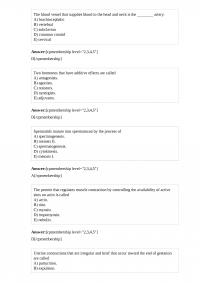
The blood vessel that supplies blood to the head and neck is the ________ artery. A) brachiocephalic B) vertebral C) subclavian D) common carotid E) cervical Two hormones that have additive effects are called A) antagonists. B) agonists. C) resistors. […]
CAS BI 268 Test 1
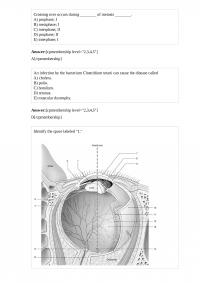
Crossing over occurs during ________ of meiosis ________. A) prophase; I B) metaphase; I C) interphase; II D) prophase; II E) interphase; I An infection by the bacterium Clostridium tetani can cause the disease called A) cholera. B) polio. C) […]
BIOL 190
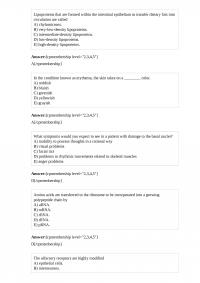
Lipoproteins that are formed within the intestinal epithelium to transfer dietary fats into circulation are called A) chylomicrons. B) very-low-density lipoproteins. C) intermediate-density lipoproteins. D) low-density lipoproteins. E) high-density lipoproteins. In the condition known as erythema, the skin takes on […]
BISC 140
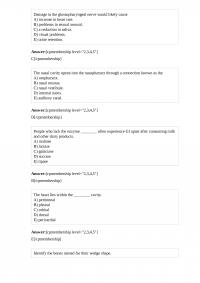
Damage to the glossopharyngeal nerve would likely cause A) increase in heart rate. B) problems in sexual arousal. C) a reduction in saliva. D) visual problems. E) urine retention. The nasal cavity opens into the nasopharynx through a connection known […]