Treatment of dividing cells with a low dose of the antifungal drug benomyl, which
destabilizes microtubules, slows down correct spindle assembly. But at such doses, the
spindle is eventually formed and the cells survive. However, mutations in some genes
confer benomyl sensitivity: the mutant cells die because they fail to arrest the cell cycle
in the presence of unattached kinetochores and progress through anaphase, with
disastrous consequences. Which of the following would you expect to be a
benomyl-sensitive mutant?
A.A loss-of-function mutant in the gene encoding Mad2.
B.A mutation causing the overexpression of Cdc20.
C.A loss-of-function mutation in the gene encoding a kinase that inhibits
Cdc20-APC/C.
D.A loss-of-function mutation in the gene encoding a tubulin subunit.
E.All of the above.
In Drosophila melanogaster, the expression of genes Ultrabithorax and Antennapedia
can normally be observed in the third thoracic segment which bears a pair of legs as
well as a pair of halteres. Homeotic mutations associated with these two genes can give
rise to remarkable disturbances in the organization of the adult fly: two pairs of wings
in the case of Ultrabithorax, and legs in the place of antennae in the case of
Antennapedia. Would you expect these to be gain-of-function or loss-of-function
mutations?
A.Loss-of-function for both genes
B.Loss-of-function for Ultrabithorax and gain-of-function for Antennapedia
C.Gain-of-function for Ultrabithorax and loss-of-function for Antennapedia
D.Gain-of-function for both genes
Which of the following can limit the use of RNA interference in studying gene
expression and function?
A.RNAi does not efficiently inactivate all genes.
B.Certain tissues are resistant to the action of RNAi.
C.Off-target effects are common in RNAi treatments.
D.All of the above.
From an immortalized human HeLa cell line with wild-type p53 genes, you have
derived a line that lacks both copies of the gene. You then treat the original and derived
cells with the anticancer drug doxorubicin, which can activate the p53 pathway in the
cell by stalling DNA replication forks and inducing double-strand breaks in DNA. You
measure cell proliferation in the presence of different doses of the drug in each of the
two cell lines, and plot the results as shown in the graph below. Which cell line (A or B)
do you expect to be the original HeLa line? Write down A or B as your answer.
Indicate true (T) and false (F) statements below regarding transcription regulators. Your
answer would be a four-letter string composed of letters T and F only, e.g. TTTF.
( )About 10% of the protein-coding genes in most organisms encode transcription
regulators.
( )The packaging of eukaryotic DNA into chromatin dampens the effect of cooperative
binding of transcription regulators.
( )Some DNA-binding proteins can induce bends or kinks in their target DNA.
( )Dimerization of transcription regulators increases the chance of binding to
nonspecific sequences.
The nucleolus is a dynamic subcompartment within the nucleus and its size varies
depending on the circumstances. In which of the following cells would you NOT expect
to see the nucleoli?
A.A yeast cell undergoing DNA replication
B.A human neuron in a quiescent (G0) state
C.A human macrophage active in phagocytosis
D.A fruit fly embryonic nucleus in the G2 phase of the cell cycle
E.A mouse embryonic cell in the metaphase stage of mitosis
Indicate whether each of the following descriptions better matches the ATF6 (A), the
IRE1 (I), or the PERK (P) branch of the ER unfolded protein response. Your answer
would be a four-letter string composed of letters A, I, and P only, e.g. APII.
( )It involves a noncanonical cytoplasmic splicing process.
( )Its sensor is a latent transcription regulator.
( )It involves regulated proteolysis of the sensor protein in the Golgi apparatus.
( )Its sensor bears both kinase and endoribonuclease activities.
Mammals produce five major classes of immunoglobulins. Indicate whether each of the
following descriptions better applies to the immunoglobulin A, D, E, G, or M class.
Your answer would be a five-letter string composed of letters A, D, E, G, and M only,
e.g. GMADE.
( )It binds to cells that secrete histamine.
( )It is the major antibody in secretions such as saliva.
( )It is the major antibody circulating in the blood.
( )It is found on the surface of ntive B cells along with IgM.
( )It forms wheel-like pentamers involved in the primary immune response.
Gcn4 is a protein kinase that can phosphorylate and inactivate the initiation factor eIF2.
The Gcn4 mRNA contains several short upstream open reading frames (uORFs) that
negatively regulate its translation initiation. The phosphorylation of eIF2 by Gcn4,
therefore, can control Gcn4 expression ___
A.in a negative feedback loop.
B.in a positive feedback loop.
C.in a feed-forward loop.
In the following graph of actin elongation rates under different subunit concentrations,
which of the following corresponds to the slope of the line?
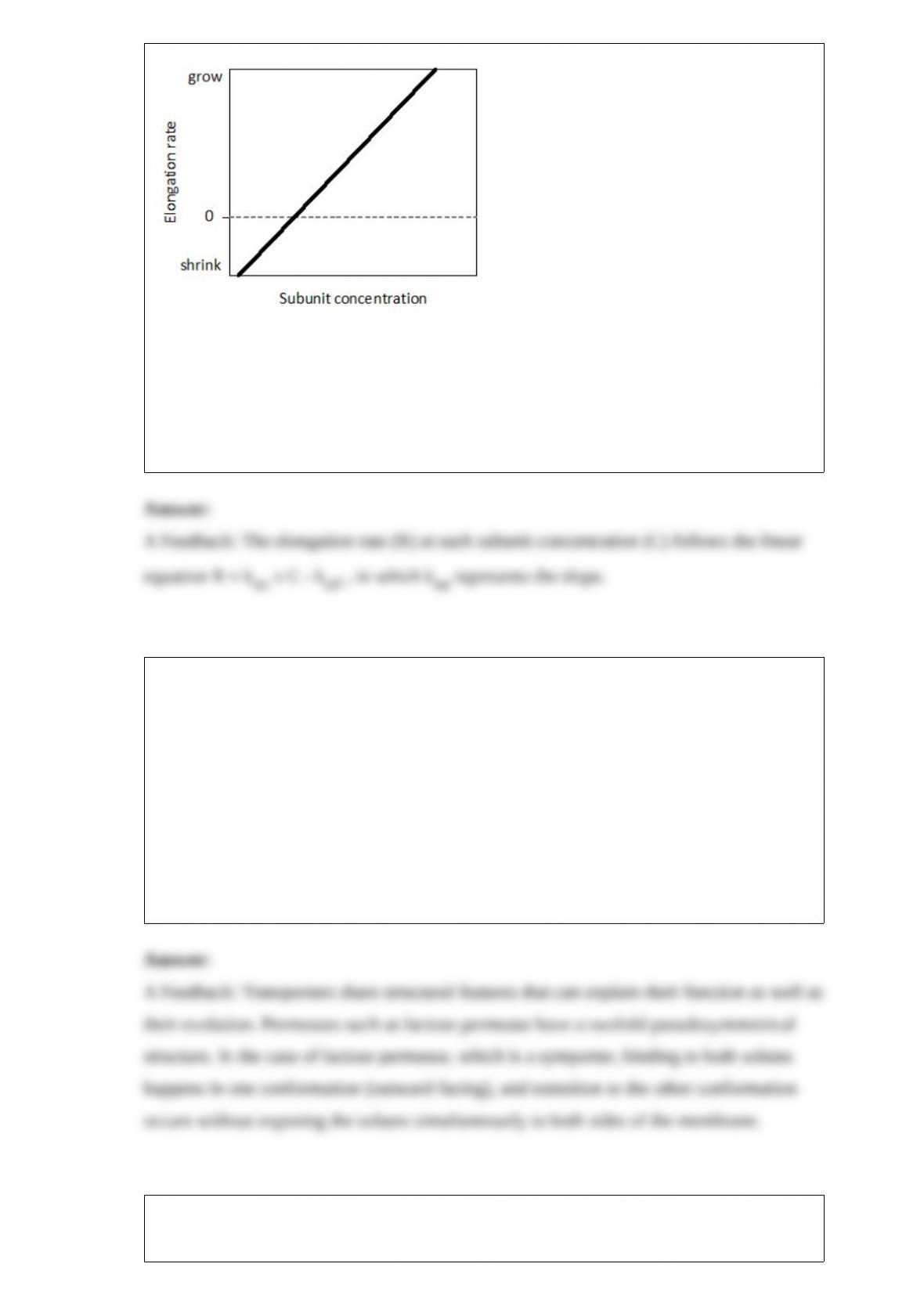
A.kon
B.koff
C.kon/koff
D.koff/kon
E.kon – koff
The lactose permease in Escherichia coli is an H+-lactose symporter that mediates the
inward active transport of lactose if this sugar is present in the environment instead of
glucose. Which of the following is true about this transporter?
A.It has a twofold pseudosymmetrical structure.
B.Lactose and H+ bind to two different conformations of the transporter.
C.The transporter goes through an intermediate state in which the bound lactose is open
to both sides of the membrane.
D.If lactose and H+ concentrations are changed sufficiently, the transporter can act as an
H+-lactose antiporter.
E.All of the above.
Protein subunits that interact specifically with DNA sequences ___
A.typically recognize sequences of two to three nucleotide pairs in length.
B.do so via hydrogen bonds, ionic bonds, and hydrophobic interactions.
C.typically form about five weak interactions at the protein-DNA interface.
D.often bind loosely to DNA.
E.All of the above.
Which of the following is a pump that hydrolyzes two ATP molecules per transport
cycle?
A.The cystic fibrosis transmembrane conductance regulator protein
B.The multidrug resistance protein
C.The Na+-K+ pump
D.The Ca2+-pump
E.The V-type ATPase
Which of the following events normally activates a GTP-binding protein?
A.GTP hydrolysis by the protein
B.Activation of an upstream GTPase-activating protein
C.Activation of an upstream guanine nucleotide exchange factor
D.Phosphorylation of a bound GDP molecule by an upstream phosphorylase
E.Pi release after GTP hydrolysis
Which of the following is an actin homolog?
A.Arp2
B.Arp3
C.MreB
D.ParM
E.All of the above
Indicate true (T) and false (F) statements below regarding riboswitches. Your answer
would be a four-letter string composed of letters T and F only, e.g. TTTF.
( )A riboswitch permits transcription elongation only when bound to its small-molecule
ligand.
( )Riboswitches appear to be a modern evolutionary invention.
( )Riboswitches are often located near the 3′ end of mRNAs, and therefore fold after the
rest of the mRNA.
( )Riboswitches are exclusively found in prokaryotes.
In the following diagram showing the distribution of thermal energy in a population of
substrate molecules, the energy thresholds indicated by numbers represent …
A.the activation energy at high and low temperature.
B.the reaction rate at high and low pH.
C.the activation energy with and without an enzyme.
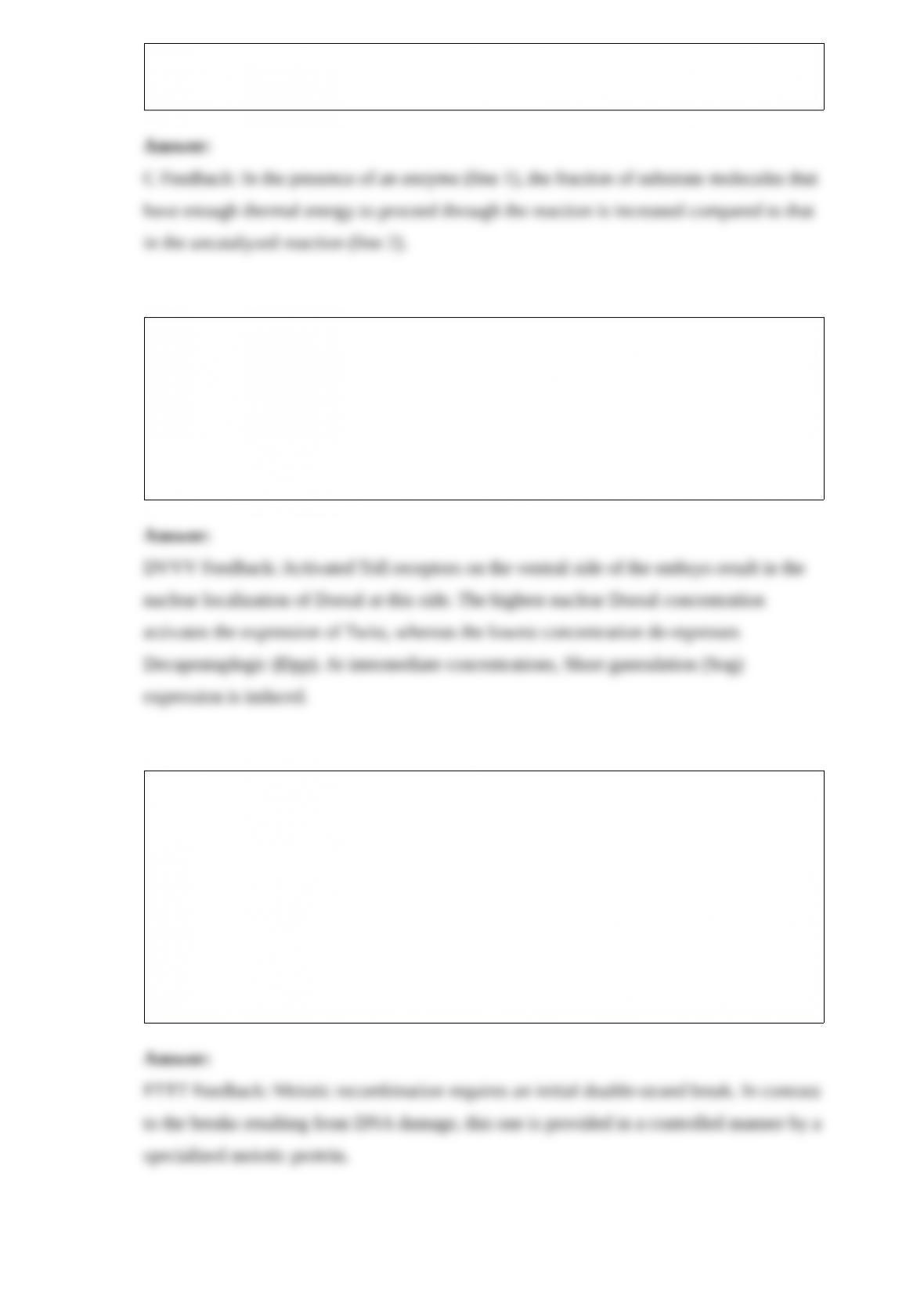
D.the reaction rate at high and low substrate concentrations.
E.the activation energy at high and low substrate concentrations.
Indicate whether each of the following proteins is most concentrated near the dorsal (D)
or ventral (V) side of the Drosophila embryo. Your answer would be a four-letter string
composed of letters D and V only, e.g. DDDV.
( )Decapentaplegic
( )Dorsal (nuclear fraction)
( )Toll (active form)
( )Twist
Indicate true (T) and false (F) statements below regarding the use of homologous
recombination in meiosis. Your answer would be a four-letter string composed of letters
T and F only, e.g. FFFF.
( )Meiotic recombination starts with a double-strand break caused by errors in DNA
replication.
( )Meiotic recombination occurs preferentially between DNA from maternal and
paternal chromosome pairs.
( )Holliday junctions can form during meiotic recombination, sometimes in pairs.
( )During meiotic recombination in human cells, the majority of the invading strands
are released, leading to no crossover.
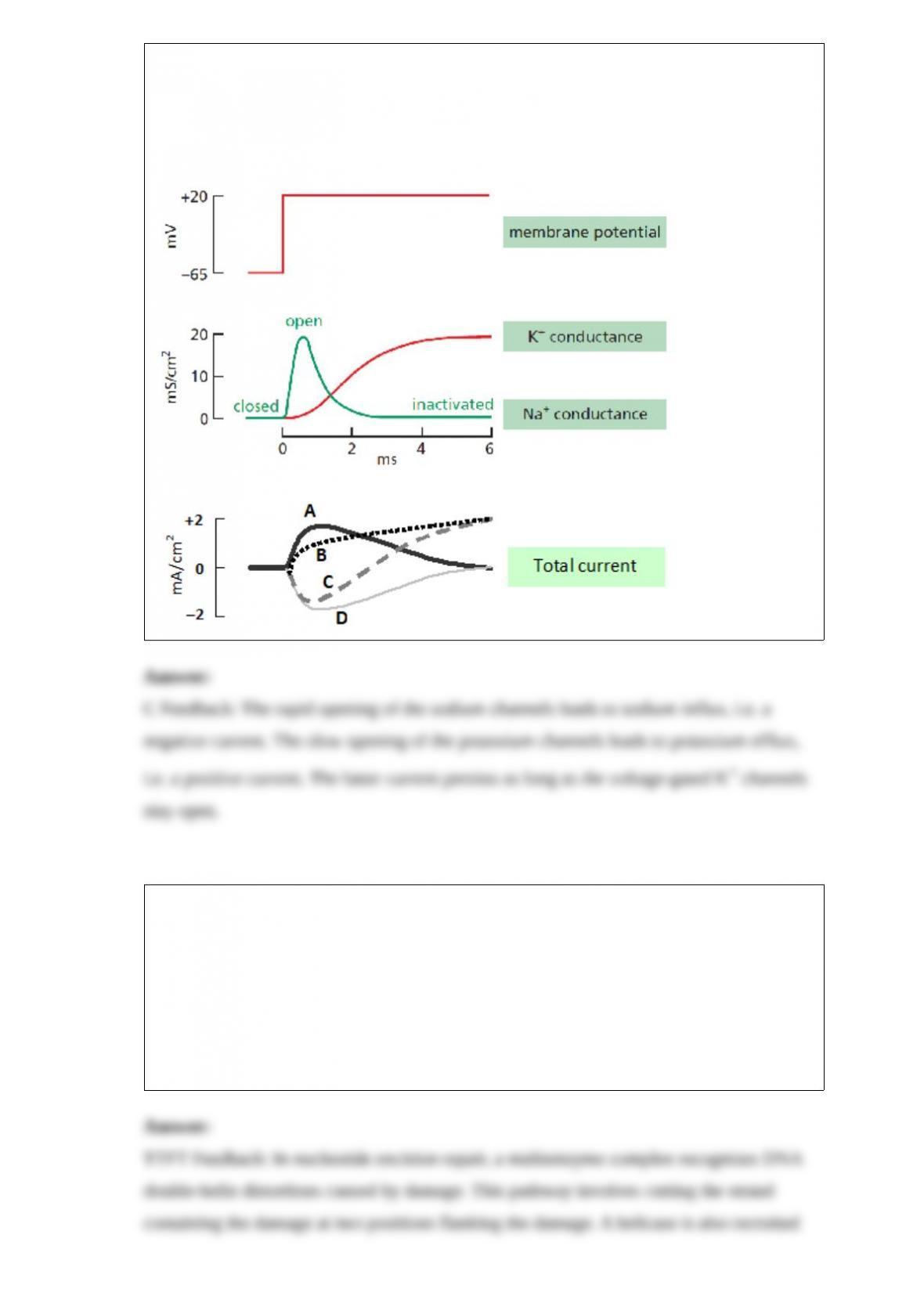
In a voltage-clamp experiment on a squid giant axon, the membrane potential is
clamped at +20 mV, as shown below. Within the same time frame, which of the curves
A to D better show qualitatively how the total membrane current changes? A positive
value of the current represents an outward flow of cations.
Indicate true (T) and false (F) descriptions below regarding the nucleotide excision
repair pathway. Your answer would be a four-letter string composed of letters T and F
only, e.g. FFFF.
( )It involves recognition of distortions in the DNA double helix rather than specific
base changes.
( )It involves endonucleolytic cleavage and helicase-mediated strand removal.
( )It involves cleavage by the AP endonuclease.
( )It is coupled to the DNA transcription machinery of the cell.
Indicate whether each of the following descriptions better applies to cardiac (C),
skeletal (K), myoepithelial (M), or smooth (O) muscle cells. Your answer would be a
four-letter string composed of letters C, K, M, and O only, e.g. MMKC.
( )They are derived from the ectoderm layer, similar to epithelial cells.
( )They form the lining of cavities such as the urinary bladder.
( )They are responsible for most voluntary muscle movements.
( )They form multinucleated and exceptionally long muscle fibers.