It is a model organism used to study various eukaryotic cell and developmental
processes such as cell division and cell death. Its hermaphrodite adult is composed of
exactly 959 somatic (non-germ) cells, the lineage of each of which has been worked out
with great precision. It is approximately 1 mm long. Which of the following describes
this organism?
A.It is a vertebrate.
B.It is a plant pathogen that destroys many crops.
C.Its genome codes for a few thousand genes.
D.It can fly.
E.It can be frozen indefinitely in a state of suspended animation.
A researcher is studying limb regeneration in the newt Notophthalmus viridescens. She
transplants skeletal muscle cells from a transgenic newt that expresses green fluorescent
protein (GFP) in all of its cells into the limb of a wild-type recipient newt. She then
amputates the recipient limb right at the site of the graft, such that the stump contains
GFP-expressing cells. She repeats this experiment several times. Where would you
expect to detect GFP in the resulting regenerated limbs?
A.Only in muscle cells.
B.Only in skin cells.
C.Only in nerve cells.
D.Only in muscle and skin cells.
E.In all of the cells.
Phosphoinositides mark different cellular membranes and play key roles in protein
trafficking inside the cell. Among them, PI(4,5)P2 is involved in receptor-mediated
endocytosis as well as phagocytosis at the plasma membrane. This phosphoinositide
___
A.is bound by the adaptor protein AP2.
B.is bound by the GTPase dynamin.
C.is depleted from clathrin-coated vesicles to promote their uncoating.
D.All of the above.
Mitochondrial hsp70 is to matrix protein import what ___ is to post-translational ER
protein import.
A.Ribosome
B.Sec61
C.Sec63
D.BiP
E.PDI
How does a eukaryotic cell deal with the superhelical tension in its genomic DNA
resulting from the activity of RNA polymerases?
A.DNA gyrase introduces negative supercoils, keeping the DNA under constant tension.
B.The RNA polymerases are allowed to rotate freely around their templates during
transcription, leading to the relaxation of the tension.
C.DNA topoisomerases rapidly remove the superhelical tension caused by transcription.
D.The nucleosomes adjust the tension by binding to positively supercoiled regions
behind a moving RNA polymerase.
E.All of the above.
How is hyaluronic acid different from other glycosaminoglycans of the extracellular
matrix?
A.It lacks sulfate groups.
B.It is generally not covalently linked to proteins.
C.It is not assembled in the Golgi apparatus.
D.It can be several megadaltons in mass.
E.All of the above.
Imagine a chromosome translocation event that brings a gene encoding a histone acetyl
transferase enzyme from its original chromosomal location to a new one near
heterochromatin. Which of the following scenarios is definitely NOT going to happen?
A.The gene gets silenced due to heterochromatin expansion, leading to the
misregulation of gene expression for a number of critical genes.
B.The translocation event also brings along a chromatin barrier that can prevent
heterochromatin expansion into the gene, and there is no phenotypic anomaly.
C.Since the gene encodes a histone acetyl transferase, it resists heterochromatin
expansion by acetylating its own histones.
D.The level of the gene product decreases due to a position effect, leading to an
imbalance in the chromatin state of the cell that results in the activation of programmed
cell death.
Many cells store lipids in droplets of varying sizes. These droplets ___
A.are enclosed by a phospholipid monolayer (instead of a bilayer).
B.mostly store cholesterol and phospholipids.
C.are produced by and released from the Golgi apparatus.
D.have mostly protein-free bilayer membranes.
E.are composed primarily of charged amphiphilic lipids.
Indicate whether each of the following descriptions better applies to the clonal anergy
(A), clonal deletion (D), receptor editing (E), or clonal suppression (S) mechanism of
immunological self-tolerance. Your answer would be a five-letter string composed of
letters A, D, E, and S only, e.g. SADSS.
( )It involves apoptosis of self-reactive cells.
( )It is mostly limited to B cells.
( )It involves regulatory T (Treg) cells.
( )It involves DNA recombination.
( )It is limited to central tolerance processes.
Which of the following is estimated to be the leading cause of death from cancer in the
United States?
A.UV light
B.Obesity
C.Smoking
D.Alcohol consumption
E.Sedentary lifestyle
Which of the following extracellular matrix components contains a transmembrane
protein?
A.Type I collagen
B.Perlecan
C.Aggrecan
D.Syndecan
E.Decorin
What are the molecules that normally supply carbon and oxygen atoms, respectively,
for the citric acid cycle?
A.Oxaloacetate, oxaloacetate
B.Acetyl CoA, O2
C.Oxaloacetate, O2
D.Acetyl CoA, H2O
E.Pyruvate, pyruvate
Each aminoacyl-tRNA synthetase activates a certain amino acid by attaching it to its
corresponding tRNA(s) through a high-energy linkage___
A.between the amino group of the amino acid and the 3′ hydroxyl group of the tRNA.
B.between the amino group of the amino acid and the 5′ hydroxyl group of the tRNA.
C.between the carboxyl group of the amino acid and the 3′ or 2′ hydroxyl group of the
tRNA.
D.between the carboxyl group of the amino acid and the 5′ hydroxyl group of the tRNA.
E.between the amino group of the amino acid and the 3′ or 2′ hydroxyl group of the
tRNA.
Sort the following events to reflect the order in which they occur during the formation
of vesicles from the ER destined for the Golgi apparatus. Your answer would be a
four-letter string composed of letters A to D only, e.g. DACB.
(A)Sar1 GTP hydrolysis
(B)Sar1 GTP binding
(C)Sar1-Sec23 binding
(D)Sar1 membrane association
The motion of lipid molecules in a synthetic bilayer can be studied by various
techniques. Which of the following has been observed in these systems?
A.Phospholipids diffuse rapidly within and between the two leaflets of a bilayer.
B.An average lipid molecule can diffuse the length of about 2 micrometers in a fraction
of a millisecond.
C.The flip-flops are very rare for phospholipids but cholesterol molecules flip-flop
more often.
D.Within a bilayer, lipid molecules rarely rotate about their long axis, but diffuse
laterally at very high rates.
E.All of the above.
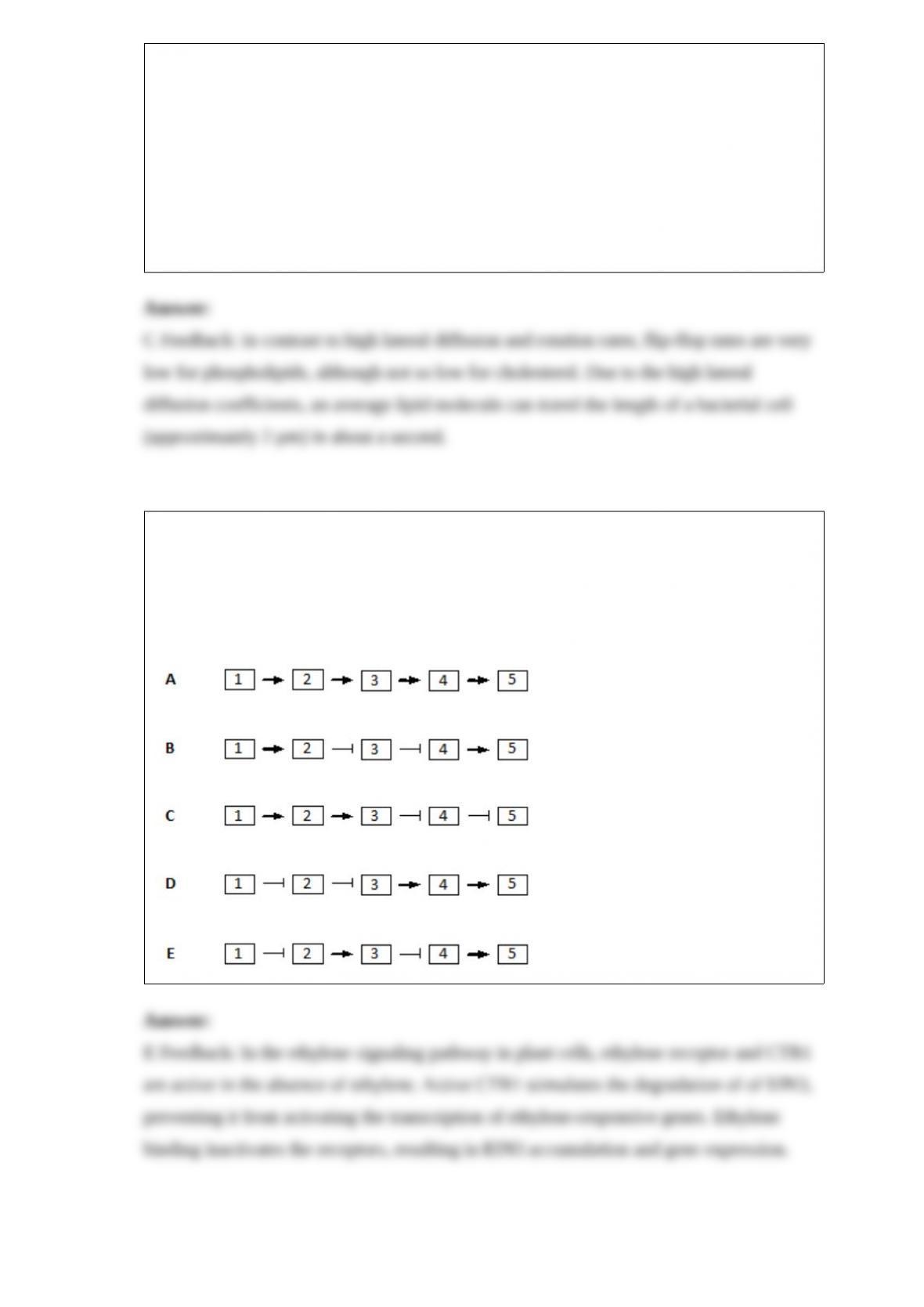
In the following schematic diagrams of ethylene signaling in plants, 1 denotes ethylene,
2 denotes ethylene receptor, 3 denotes CTR1, 4 denotes EIN3, and 5 represents the
expression of ethylene-responsive genes. Which diagram better depicts the signaling
pathway? Activation and inhibition are indicated as normal and blunt arrows,
respectively.
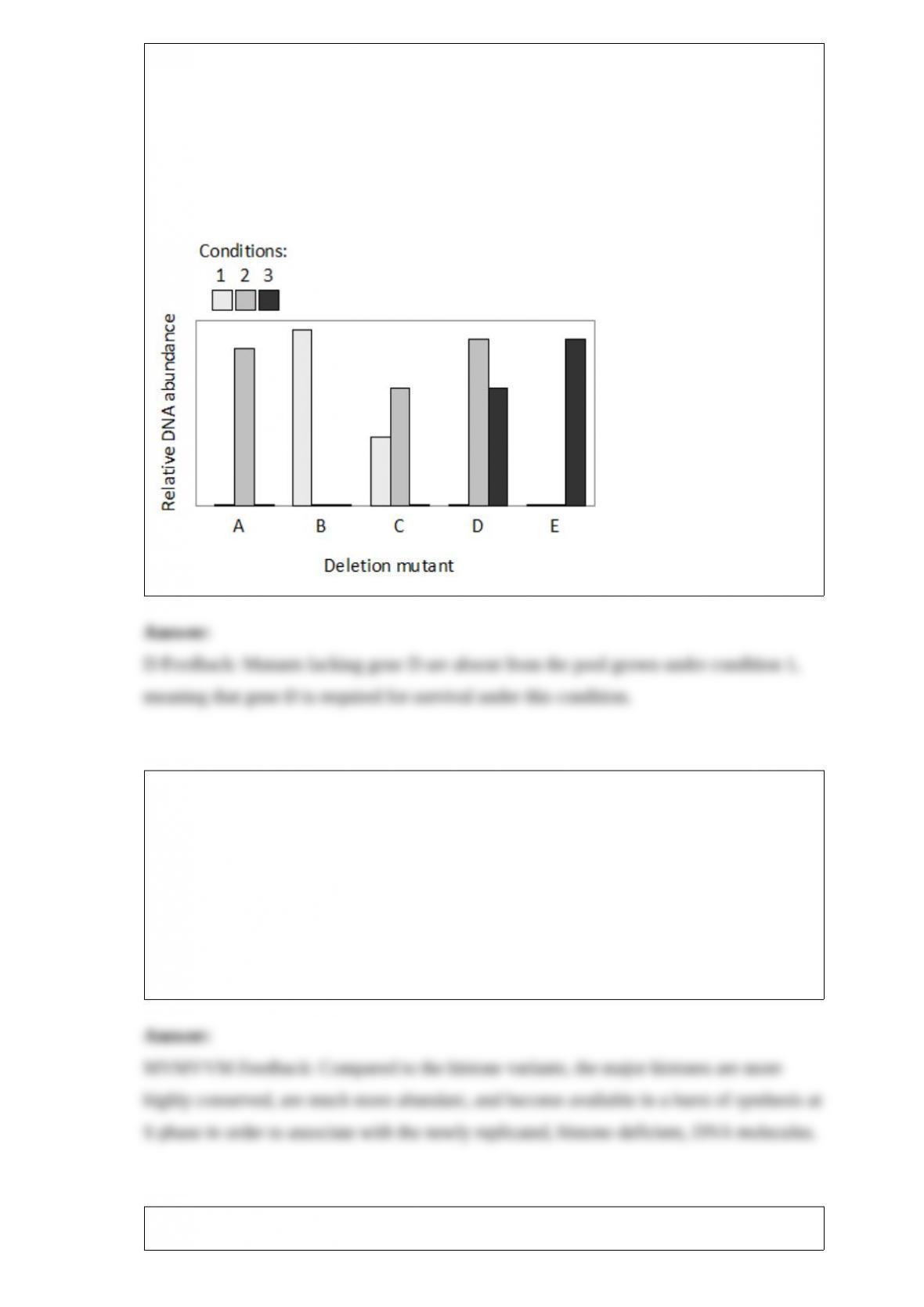
A pool of five barcoded yeast mutants, each deleted for a different gene (genes A to E),
has been grown under three different conditions (1 to 3). After the growth phase was
completed, genomic DNA was isolated from the entire pool and the relative amount of
each mutant was determined by quantifying the amount of DNA containing each
barcode. The results are presented in the following graph. Which gene (A to E) is
essential under condition 1 but not under conditions 2 or 3?
Indicate whether each of the following descriptions better matches the major histones
(M) or the histone variants (V). Your answer would be a six-letter string composed of
letters M and V only, e.g. VVMVMV.
( )They are more highly conserved over long evolutionary time scales.
( )They are present in much smaller amounts in the cell.
( )They are synthesized primarily during the S phase of the cell cycle.
( )Their incorporation often requires histone exchange.
( )They are often inserted into already-formed chromatin.
( )They are assembled into nucleosomes just behind the replication fork.
The structural formulas for the 20 naturally occurring amino acid residues are shown in
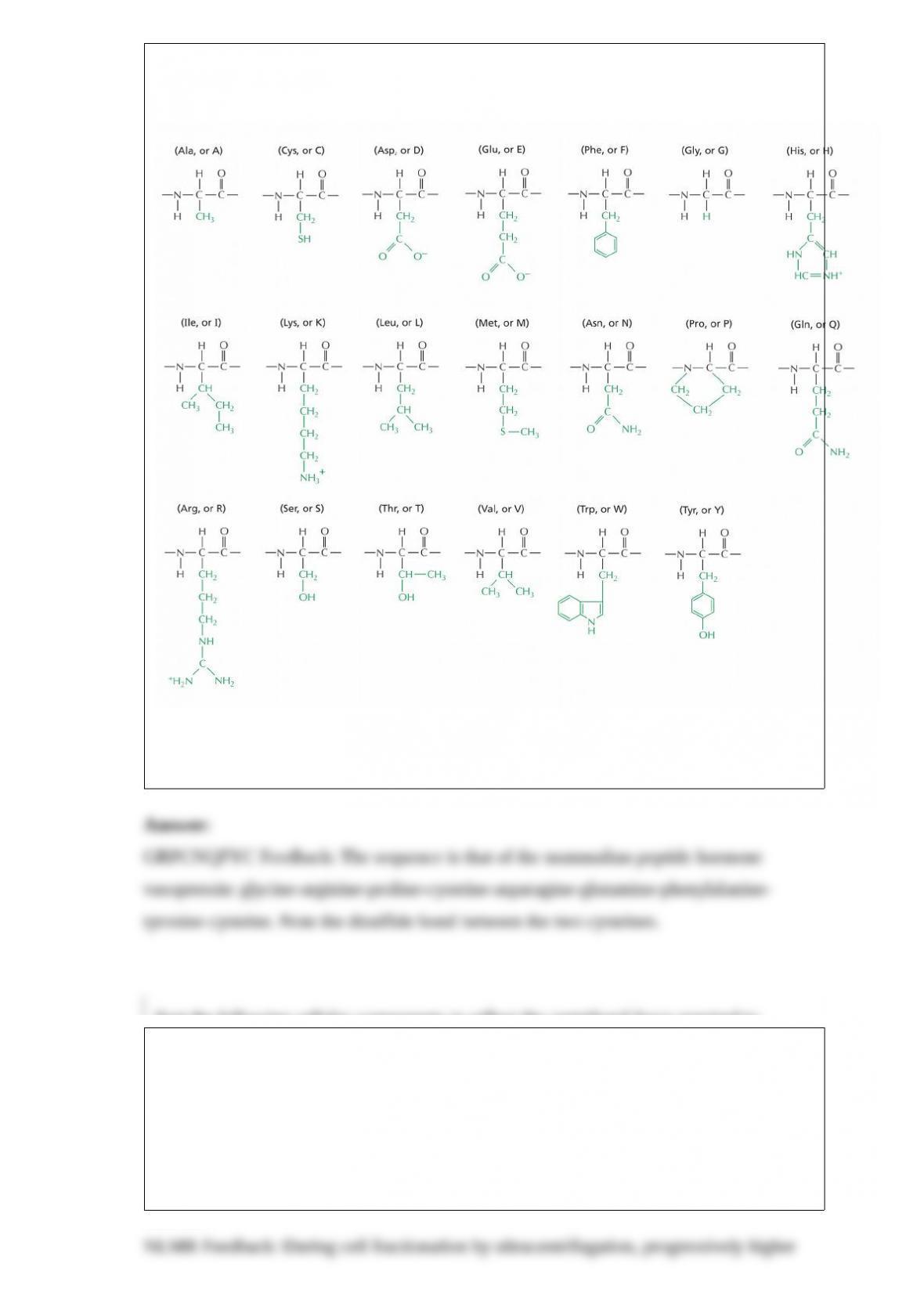
the panel below. Answer the following question(s) with the help of this panel.
What is the amino acid sequence of the peptide depicted below? Write down the
sequence from the N- to the C-terminus, and use only the one-letter abbreviations, e.g.
AGCNT.
Sort the following cellular components to reflect the centrifugal force required to
sediment them by preparative ultracentrifugation, from low to high force required. Your
answer would be a four-letter string composed of letters R, M, L, and N, e.g. LRNM.
(L)Lysosomes
(M) Microsomes
(N)Nuclei
(R)Ribosomes (free cytosolic)
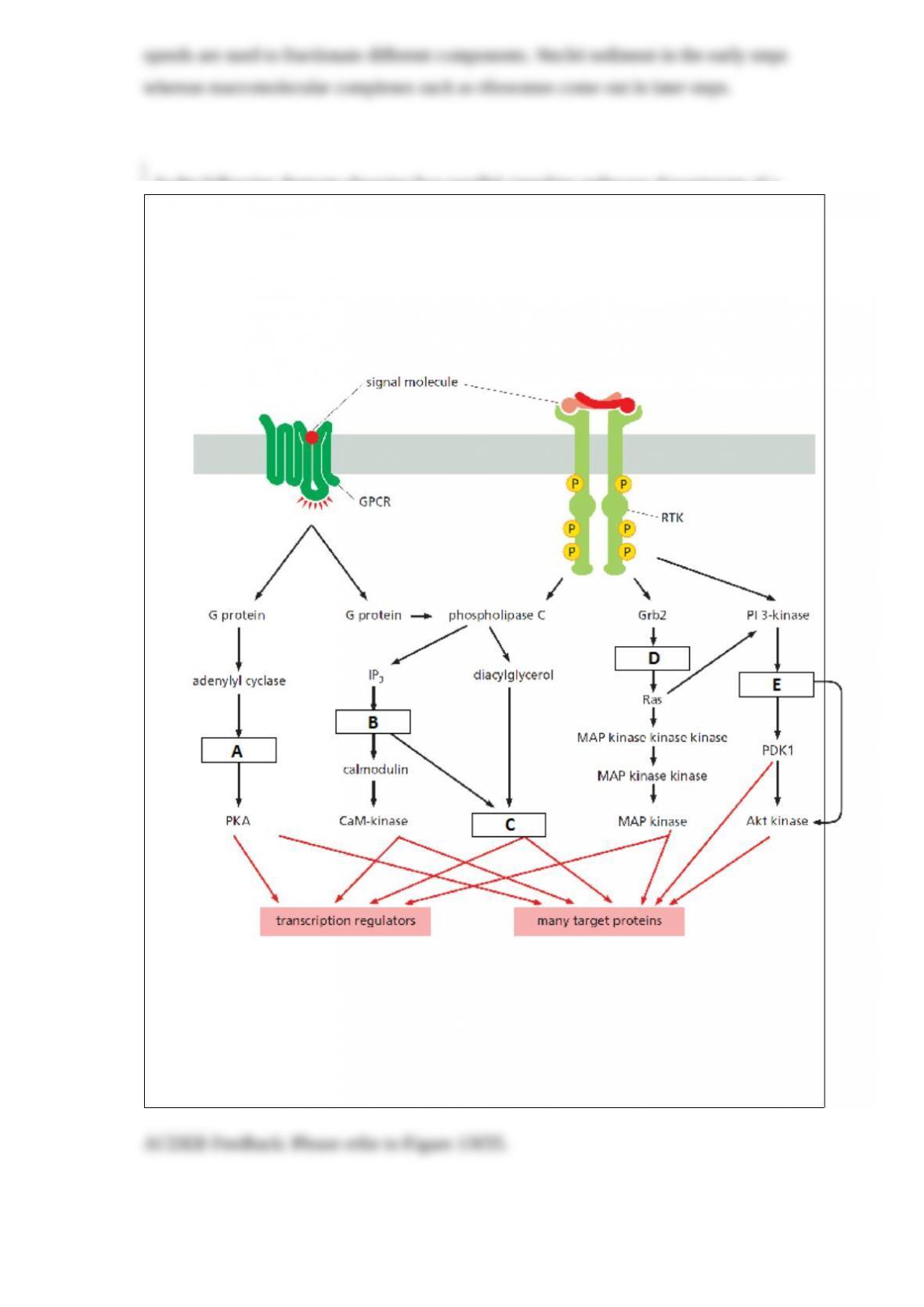
In the following diagram showing five parallel signaling pathways downstream of a
receptor tyrosine kinase (RTK) and a G-protein-coupled receptor (GPCR), indicate
which boxes (A to E) correspond to the following proteins. Your answer would be a
five-letter string composed of letters A to E only, e.g. CDBAE.
( )Cyclic AMP
( )Protein kinase C
( )Sos
( )PI(3,4,5)P3
( )Ca2+