Indicate if each of the following descriptions matches actin filaments (A), microtubules
(M), or intermediate filaments (I). Your answer would be a four-letter string composed
of letters A, M, and I only; e.g. AAMM.
( )They form hollow structures with multiple lateral interactions.
( )They form strong structures that are more resilient than the other two cytoskeletal
filaments.
( )Their subunits bind GTP and hydrolyze it.
( )They form coiled-coil interactions between the subunits.
Indicate true (T) and false (F) statements below regarding the primary cilia. Your
answer would be a four-letter string composed of letters T and F only, e.g. TFFF.
( )Primary cilia are found on the surface of almost all cell types in our bodies.
( )Primary cilia are motile.
( )Primary cilia are made in interphase at basal bodies.
( )Primary cilia are thought to function in sensing and responding to external signals.
An elongating ribosome is bound to appropriate tRNAs in both the A and the P sites and
is ready for peptidyl transfer. What happens next?
A.The carboxyl end of the polypeptide chain is released from the P-site tRNA and
joined to the free amino group of the amino acid linked to the A-site tRNA.
B.The amino end of the polypeptide chain is released from the P-site tRNA and joined
to the free carboxyl group of the amino acid linked to the A-site tRNA.
C.The carboxyl end of the amino acid is released from the A-site tRNA and joined to
the free amino group of the polypeptide chain linked to the P-site tRNA.
D.The amino end of the amino acid is released from the A-site tRNA and joined to the
free carboxyl group of the polypeptide chain linked to the P-site tRNA.
Cells of the inner cell mass in an early mammalian embryo can be isolated and grown
in culture. Which of the following is NOT true regarding these cells?
A.They are totipotent.
B.They can be introduced into another developing embryo where their progeny become
incorporated into the resulting adult animal, even into its germ line.
C.They are stem cells.
D.They can be manipulated in culture to give rise to almost any type of differentiated
cell.
Polysomes___
A.are large cytoplasmic assemblies made of several ribosomes each translating their
exclusive mRNA.
B.are only found in the eukaryotic cytoplasm.
C.can take advantage of the circularization of eukaryotic mRNA (by interactions
between the 5′ and 3′ ends of the mRNA) to further speed up the rate of protein
synthesis.
D.are mostly translationally inactive and are normally used by the cell to store the
ribosomes and their associated mRNAs for future use.
E.All of the above.
Which collagens are the most common in our body?
A.Fibrillar
B.Fibril-associated
C.Network-forming
D.Proteoglycan core
E.Anchorage fibril
Normally, cytotoxic and helper T cells interact for the first time with foreign
antigens presented by dendritic cells in €¦
A.the thymus.
B.the bloodstream.
C.peripheral lymphoid organs.
D.the bone marrow.
E.inflamed tissues.
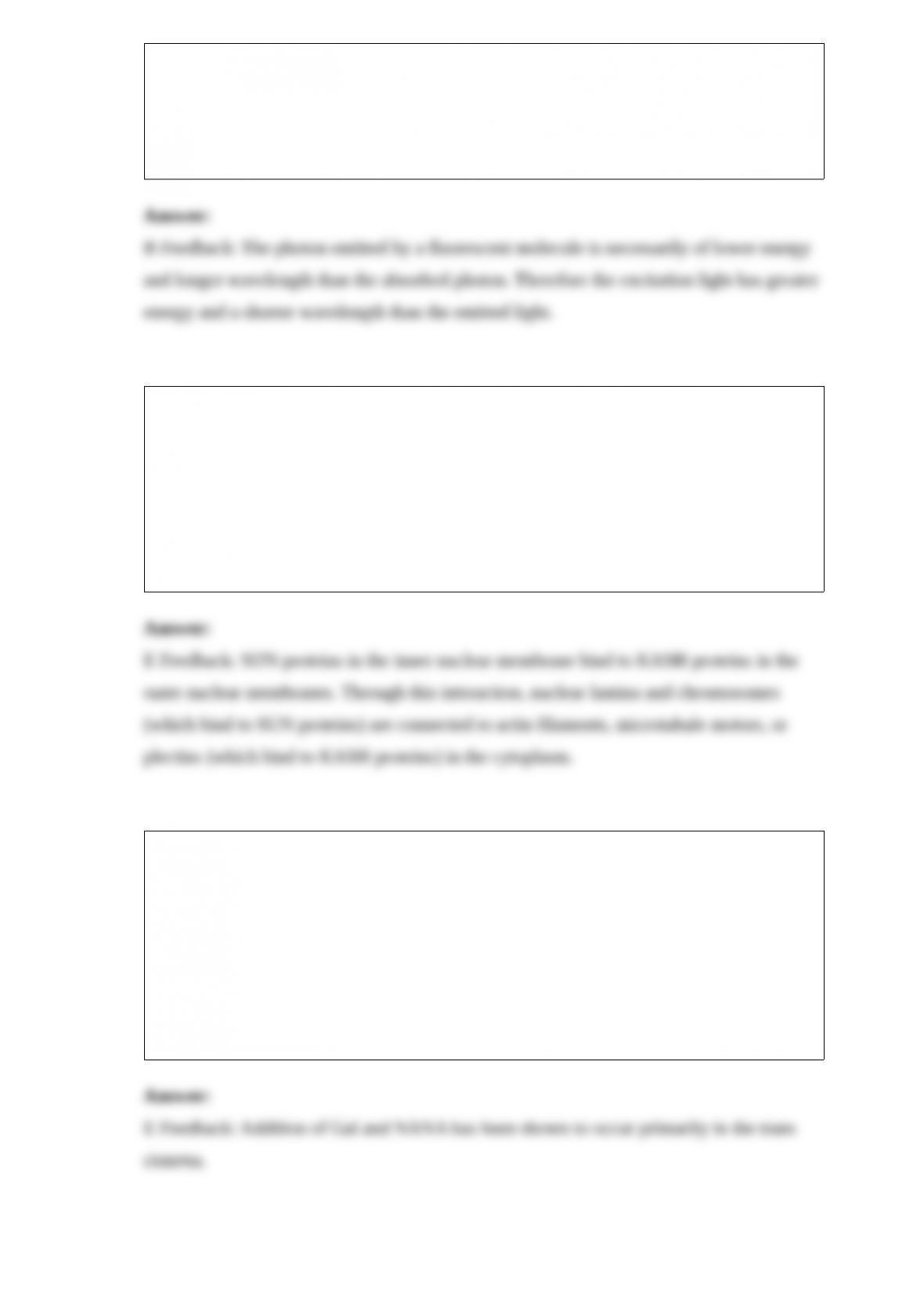
What enzyme is depicted in the following schematic drawing?
A.DNA polymerase
B.RNA polymerase
C.Ribosome
D.Reverse transcriptase
E.Topoisomerase
The light used to excite a fluorescent molecule carries ___ energy and has a ___
wavelength compared to the light that is then emitted from the molecule.
A.greater; longer
B.greater; shorter
C.the same amount of; shorter
D.less; longer
E.less; shorter
SUN and KASH proteins embedded in the nuclear envelope provide connections
between the organization of the nucleus and the cytoplasm. Which of the following
pairs of proteins DO NOT bind directly to each other in these connections?
A.Nuclear lamina and SUN proteins
B.Plectins and KASH proteins
C.KASH proteins and microfilaments
D.KASH proteins and SUN proteins
E.SUN proteins and cytoplasmic intermediate filaments.
The Golgi apparatus is made up of an ordered series of compartments. To process
N-linked oligosaccharides, different Golgi compartments carry different enzymes that
alter the sugar chains sequentially. Which Golgi cisternae are normally responsible for
the addition of galactose and sialic acid, respectively, in complex oligosaccharides?
A.cis cisterna; medial cisterna
B.cis cisterna; trans cisterna
C.medial cisterna; trans cisterna
D.medial cisterna; medial cisterna
E.trans cisterna; trans cisterna
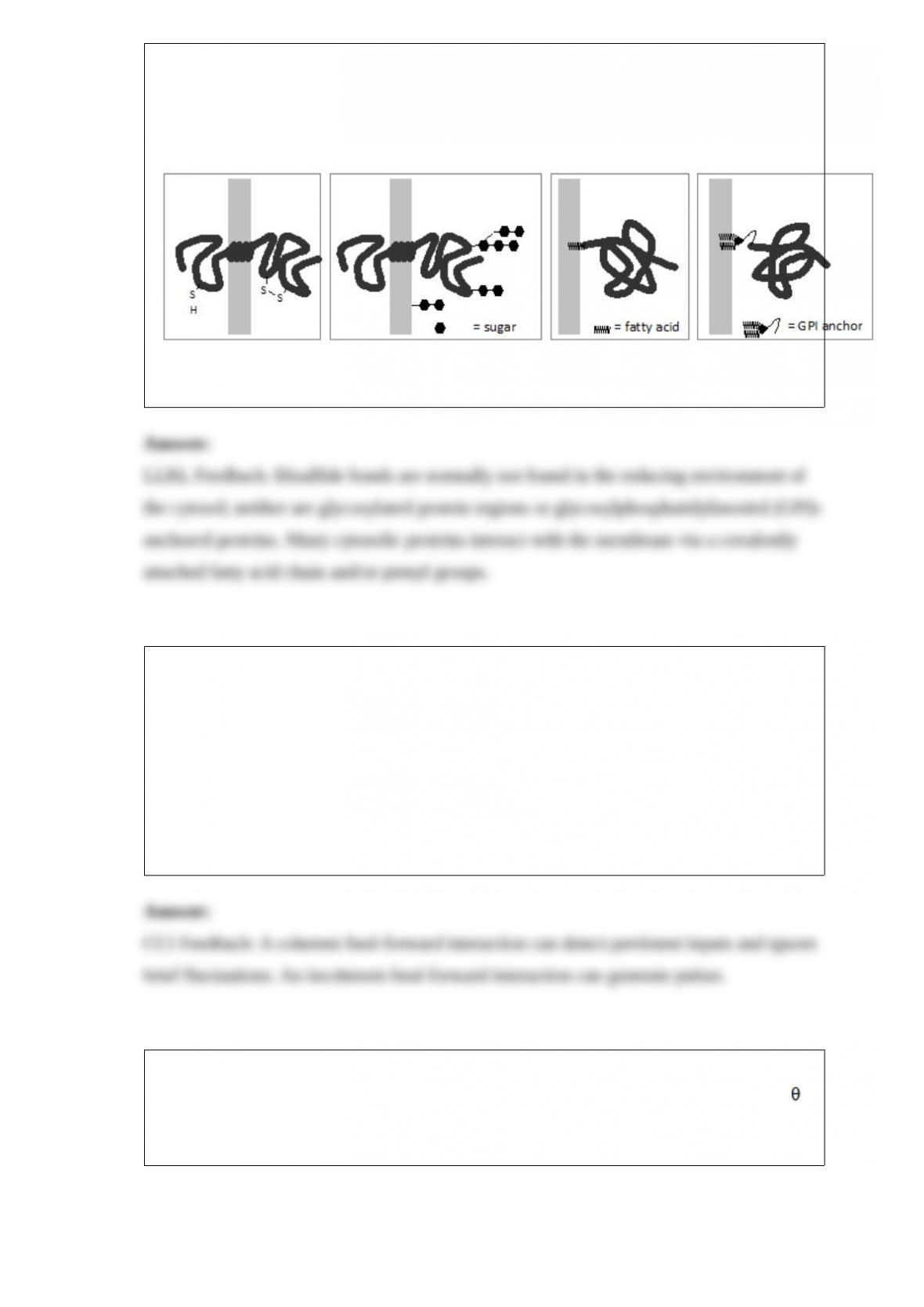
For each membrane protein in the following schematic drawings, indicate whether the
cytoplasmic side of the membrane is more likely to be on the left (L) or on the right (R).
Your answer would be a four-letter string composed of letters L and R only, e.g. RRRR.
Indicate whether each of the following better applies to a coherent (C) or incoherent (I)
feed-forward motif. Your answer would be a three-letter string composed of letters C
and I only, e.g. CCC.
( )It can provide cellular responses with robustness despite perturbations in the input
signal.
( )A cellular pathway with such a motif generally requires a sustained (long) input
signal to generate a full response.
( ) A cellular pathway with such a motif can generate a brief pulse of response in the
presence of a sustained input signal.
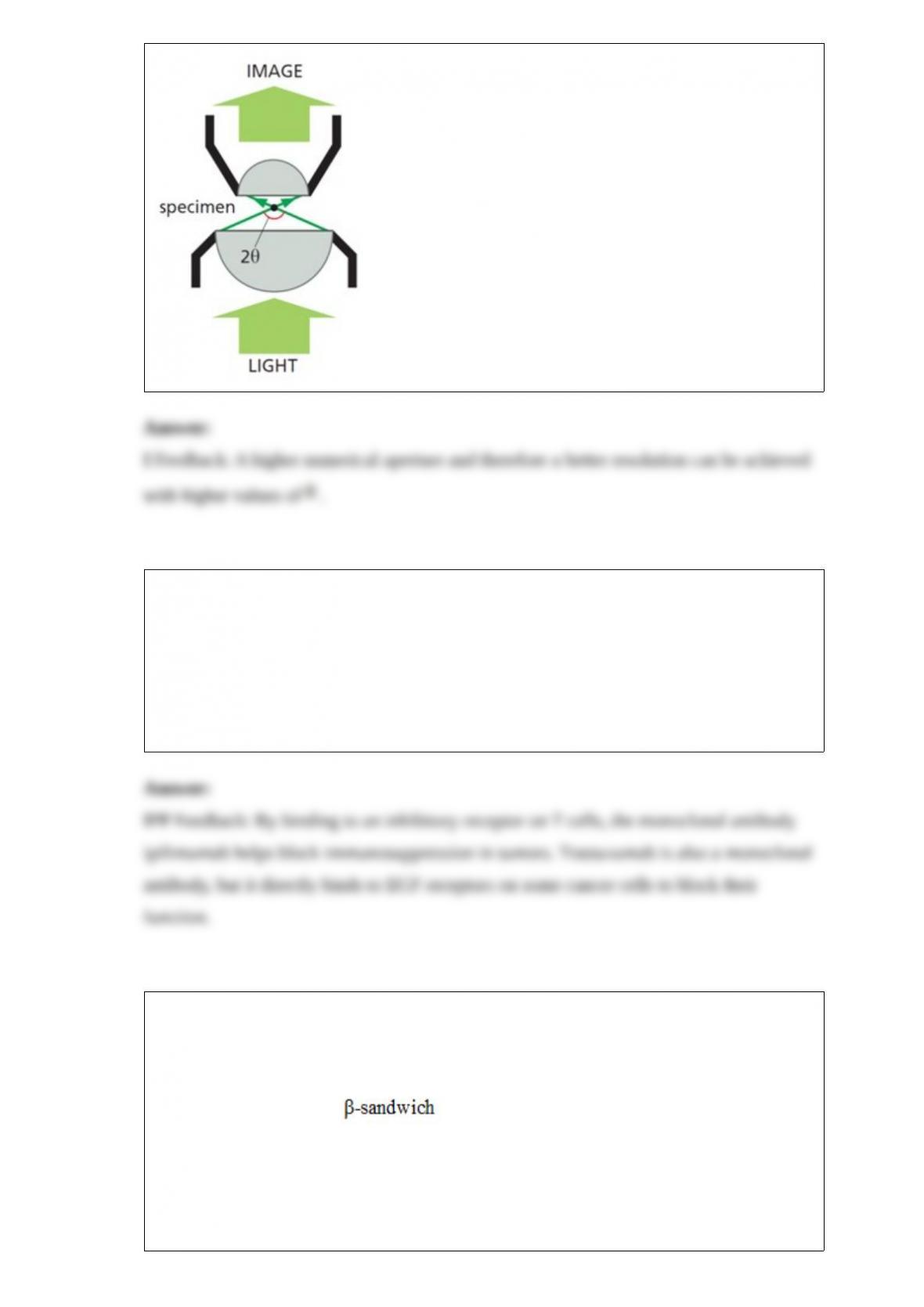
The following schematic diagram shows the path of light rays passing through in a light
microscope. If the angular width of the cone of rays collected by the objective lens (2 )
is increased, would the resolution improve (I; i.e. the resolution limit decreases) or
deteriorate (D)? Write down I or D as your answer.
Indicate whether each of the following descriptions better applies to trastuzumab (T)
which targets Her2, imatinib (I) which targets Bcr-Abl, or ipilimumab (P) which targets
the CTLA4 protein. Your answer would be a three-letter string composed of letters T, I,
and P only, e.g. TTP.
( )It is NOT an antibody.
( )It counters the immunosuppressive microenvironment of tumors.
( )It does not bind to a cancer cell component.
Indicate true (T) and false (F) statements below regarding the proteins of our adaptive
immune system. Your answer would be a four-letter string composed of letters T and F
only, e.g. TTFT.
( )Both B cell receptors and T cell receptors have domains with an immunoglobulin
fold, which consists of a and an intrachain disulfide bond.
( )MHC proteins are the most polymorphic among human proteins.
( )MHC proteins and CD4 and CD8 co-receptors are all members of the Ig superfamily.
( )Both B cell receptors and T cell receptors are stably associated with invariant
transmembrane protein chains that are required for activating intracellular signaling
pathways.
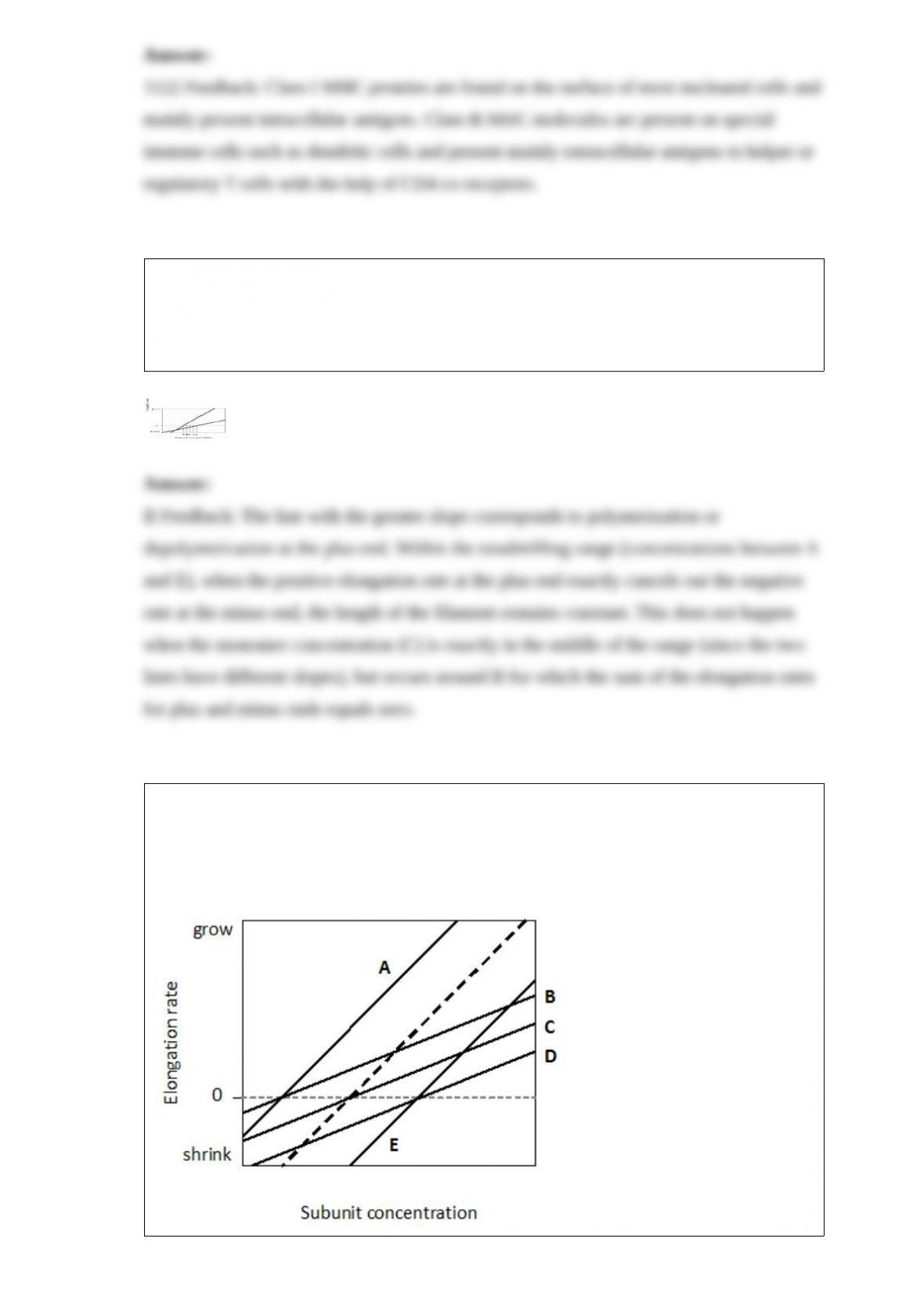
According to the following graph, which shows the elongation rate at the plus and
minus ends of actin filaments as a function of actin subunit concentration, at what
concentration (A to E) does the total length of the filament remain more or less constant
with time (i.e. steady-state treadmilling occurs)?
In the following graph, the elongation rate of pure actin filaments as a function of actin
subunit concentration is shown as a dashed line. Which one of the other five lines (A to
E) would you think better shows what happens when a plus-end capping protein such as
CapZ is present?