A general term for pain and stiffness that affects the skeletal or muscular system is
A) rheumatism.
B) atherosclerosis.
C) bursitis.
D) bunions.
E) arthritis.
The ongoing process of tearing down and rebuilding bone matrix is called
A) restoration.
B) osteolysis.
C) resorption.
D) ossification.
E) remodeling.
Gluconeogenesis is the synthesis of ________ from noncarbohydrate precursors, such
as lactate, glycerol, or amino acids.
A) glycerides
B) glucagon
C) glycogen
D) glucose
Olfactory organs are located in the nasal cavity inferior to the perforated bony structure
known as the
A) cribriform plate.
B) sphenoid bone.
C) sella turcica.
D) vomer.
E) zygomatic process.
The potential difference across the cell membrane is known as
A) the membrane potential.
B) the membrane difference.
C) the cellular potential.

D) the cellular difference.
E) both membrane potential and cellular difference.
The relaxation phase of the cardiac cycle is called
A) depolarization.
B) systole.
C) diastole.
D) hyperpolarization.
E) asystole.
The surgical removal of the prepuce is called
A) circumcision.
B) orchidectomy.
C) tubectomy.
D) vasectomy.
E) pupectomy.
Lymphocyte production and maturation involves
A) bone marrow.
B) thymus tissue.
C) peripheral lymphatic tissues.
D) stem cells.
E) All of the answers are correct.
The expanded, initial segment of the uterine tube is called the
A) fimbra.
B) infundibulum.
C) tunnel.
D) ampulla.
E) os.
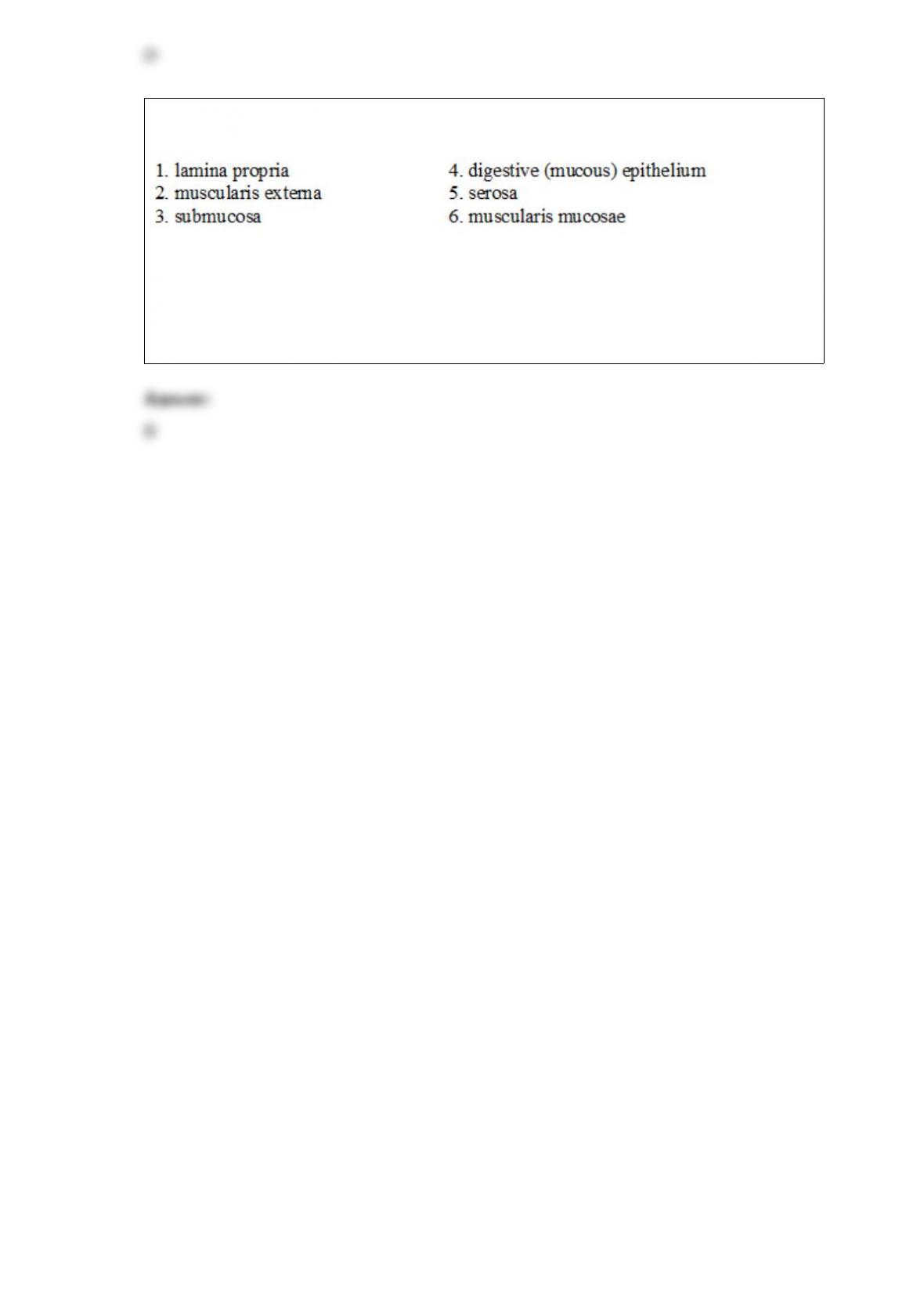
Put the following layers of the digestive tract wall in order from the lumen to the
deepest layer.
A) 5, 2, 3, 6, 1, 4
B) 4, 1, 6, 3, 2, 5
C) 4, 6, 3, 1, 2, 5
D) 5, 4, 2, 6, 1, 3
E) 1, 4, 3, 6, 2, 5