Among the following cancers, one is currently leading to the most number of deaths in
the United States and in the rest of the world. In the United States, it contributes to
cancer mortality more than the next three killing cancers combined. Worldwide, it
claims more than 1.5 million lives every year. Which cancer is this?
A.Lung cancer
B.Breast cancer
C.Colon cancer
D.Pancreatic cancer
E.Stomach cancer
The SH2 domain of STAT proteins plays a key role in cytokine receptor signaling. This
domain can bind to phosphotyrosine …
A.on an activated receptor molecule, or (intramolecularly) on the same STAT molecule.
B.on a Janus kinase molecule, or (intramolecularly) on the same STAT molecule.
C.on an activated receptor molecule, or on another STAT molecule in a dimer.
D.on a Janus kinase molecule, or on another STAT molecule in a dimer.
E.on the same STAT molecule or on another STAT molecule in a dimer.
Weak noncovalent attractions in the cell can be very strong in a nonaqueous
environment. Some of these attractions are as strong as covalent interactions in a
vacuum (their bond energy is approximately 340 kJ/mole), but become more than
twenty-five times weaker (their bond energy becomes approximately 13 kJ/mole) in
water. What type of attraction shows this phenomenon?
A.Electrostatic attractions
B.Hydrogen bonds
C.van der Waals attractions
D.Hydrophobic force
E.All of the above

Findings from a number of experiments on human chromatin have suggested that the
DNA in our chromosomes is organized into loops of various lengths. Approximately
how long is a typical loop (in nucleotide pairs of DNA)?
A.50
B.2000
C.100,000
D.10 million
E.50 million
What is the pH of a 10-8 M solution of hydrochloric acid? Round the pH value to the
nearest integer, e.g. 10
A.8
B.7
C.6
D.5
E.4
Activation of an amino acid by an aminoacyl-tRNA synthetase involves the covalent
linkage of___
A.AMP to the amino acid.
B.ADP to the amino acid.
C.AMP to the tRNA.
D.ADP to the tRNA.
E.ADP to the enzyme.

What is the cellular function of plant vacuoles?
A.They store nutrients and waste products.
B.They help increase cell size and maintain turgor pressure.
C.They are used for degradation of cytoplasmic components.
D.They help maintain cytosolic pH.
E.All of the above.
Enzymes are the cell’s catalyst crew. They make the life of the cell possible by carrying
out various reactions with astounding performance. Which of the following is NOT true
regarding cellular enzymes?
A.Enzymes lower the activation energy of the reactions that they catalyze.
B.Enzymes can specifically drive substrate along certain reaction pathways.
C.Enzymes can push energetically unfavorable reactions forward by coupling them to
energetically favorable reactions.
D.Enzymes are proteins, but RNA catalysts, called ribozymes, also exist.
E.Enzymes can change the equilibrium point for reactions that they catalyze.
Consider a protein composed of only 21 amino acids encoded by a short ORF that is
located between two known genes in a mammalian genome. Due to its length, the ORF
had not been annotated as a gene. Which of the following methods can demonstrate that
it is indeed a gene that is actively translated to protein?
A.RNA-seq
B.RT-PCR
C.DNA microarray analysis
D.ChIP-seq
E.Ribosome profiling
Sort the following events into the order that they take place in phototransduction in
response to a flash of light. Your answer would be a four-letter string composed of
letters A to E, e.g. BCDEA.
(A)The cGMP level drops.
(B)The cGMP level rises.
(C)The Ca2+ level drops.
(D)Retinal isomerizes to an all-trans configuration.
(E)Gt exchanges its bound nucleotide.
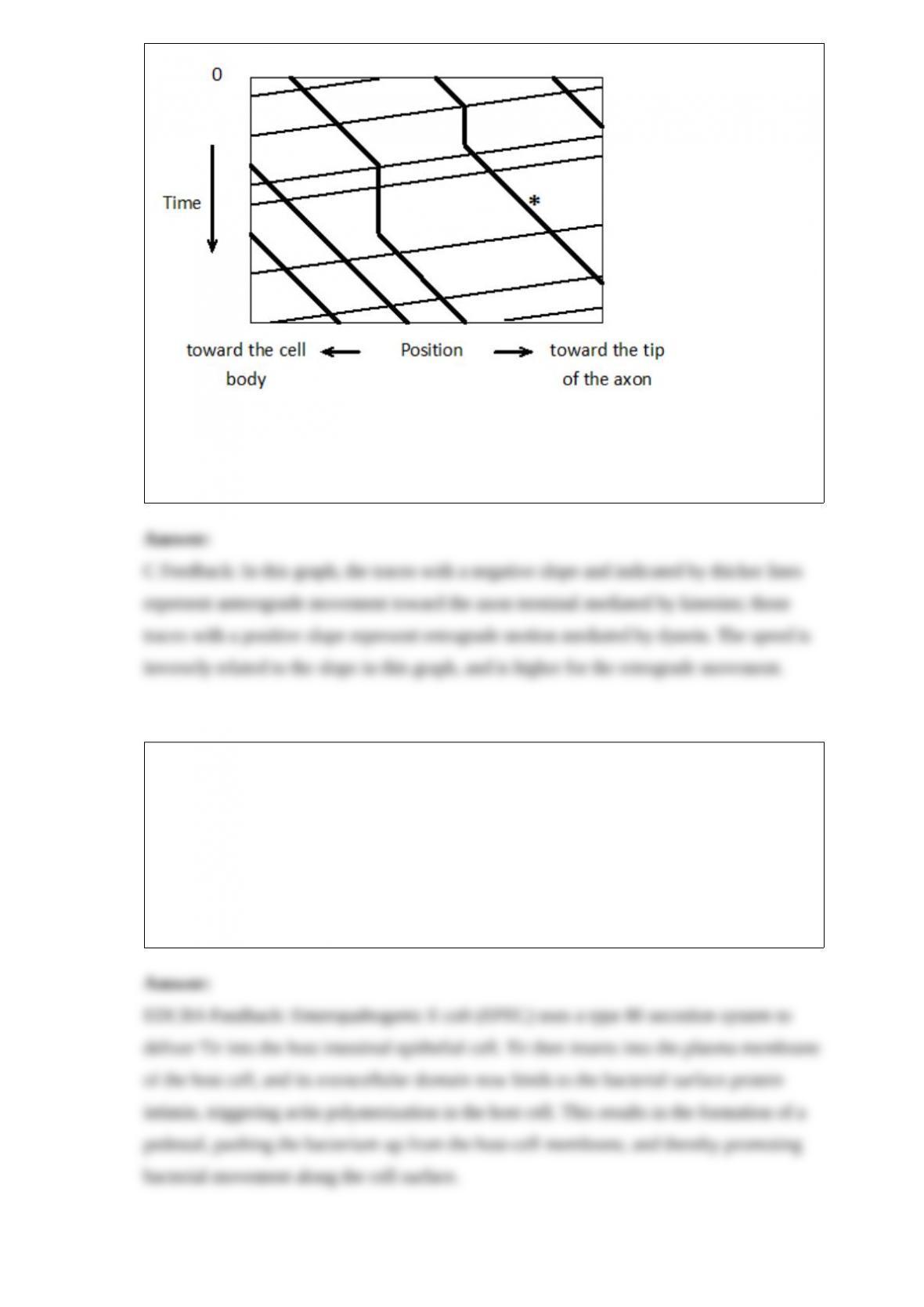
Using time-lapse fluorescence microscopy, you have recorded the transport of
fluorescently labeled mitochondria in a region of an axon in a fruit-fly larva; you have
plotted the results in the following graph, in which the vertical axis is time (from the top
to the bottom), the horizontal axis is the position along the axon, and each trace
represents one mitochondrion. Is the retrograde transport or the anterograde transport of
mitochondria faster in these axons? Does the trace indicated by an asterisk correspond
to a mitochondrion that was transported by a dynein or a kinesin?
A.Anterograde; kinesin
B.Anterograde; dynein
C.Retrograde; kinesin
D.Retrograde; dynein
Sort the following events to reflect the order in which they take place during the
infection of intestinal epithelium by enteropathogenic E. coli. Your answer would be a
five-letter string composed of letters A to E only, e.g. BCDAE.
(A)Actin polymerization and pedestal formation
(B)Binding of intimin to Tir
(C)Folding of Tir in the plasma membrane
(D)Insertion of Tir into the epithelial cell
(E)Assembly of type III secretion system
Due to friction with molecules of the surrounding solution, sedimenting particles in a
mixture reach a terminal velocity when subjected to ultracentrifugation. The
sedimentation coefficient (S) for a particle is defined as the ratio of terminal velocity
(vt) to the centrifugal acceleration applied to the particle (ac).
S = vt/ ac
If each Svedberg unit (S value) is defined as 10-13 seconds, approximately how long
would it take for a free 50S ribosomal subunit to travel the length of a 9 cm
ultracentrifuge tube subjected to a centrifugal force of 50,000 times gravity (g)? Recall
that g is approximately 10 m/s2.
A.1 min
B.10 min
C.50 min
D.5 h
E.10 h
Didinium nasutum is a single-celled eukaryote that can hunt and feed on other living
cells. It has an elaborate anatomy with beating cilia, a “mouth opening,” an “anal
aperture,” and a set of contractile bundles; it can also shoot “darts” to paralyze its prey.
What group of living cells does D. nasutum represent?
A.Protozoa
B.Yeasts
C.Algae
D.Animals
E.It can belong to any of the above
How many hypervariable loops are there in a bivalent IgG antibody? Write down your
answer in digits, e.g. 5

Intracellular Ca2+ oscillations, initiated by the activation of IP3 receptors and
orchestrated via intricate positive and negative feedback loops, can be subject to
frequency modulation, an example of which is the increase in oscillation frequency with
increasing stimulus strength. Caffeine is known to bind to and sensitize the ryanodine
receptors, resulting in their opening in response to lower calcium ion concentrations.
Do you think caffeine would tend to increase (I) or decrease (D) the frequency of
calcium ion oscillations in stimulated cells? Write down I or D as your answer.
Indicate true (T) and false (F) statements below regarding the folding of proteins upon
their synthesis. Your answer would be a five-letter string composed of letters T and F
only, e.g. TFFFF.
( )A globular protein can fold to its native form while still within the ribosome.
( )A protein can begin to fold and to bind to other proteins while still being synthesized
on the ribosome.
( )A protein may undergo several cycles of hsp70 binding and release while still being
synthesized on the ribosome.
( )A molten globule can form only after the synthesis of the protein is complete.
( ) A protein typically undergoes hsp60-assisted folding while still being synthesized.
Indicate whether each of the following descriptions better applies to B cell receptors (B)
or T cell receptors (T). Your answer would be a four-letter string composed of letters B
and T only, e.g. BTTT.
( )They can also be produced as secreted antibodies with the same antigen specificity.
( )They diversify by class switching and somatic hypermutation.
( )They often exist as heterodimers.
( )They have a relatively low antigen-binding affinity.
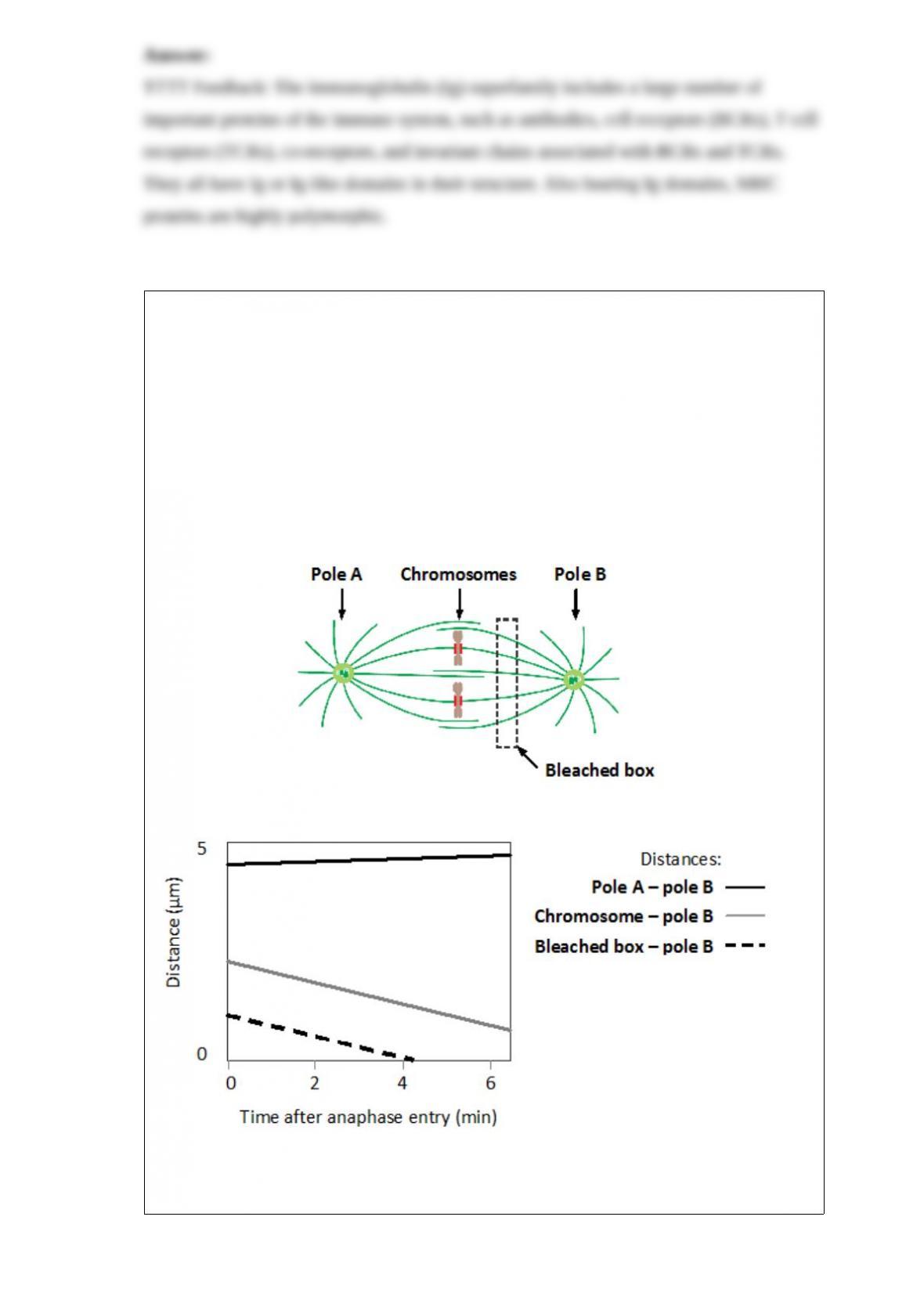
Reference: Chromosome Movement in Anaphase
To study chromosome movement during anaphase in mammals, you have injected
fluorescently labeled tubulin subunits into cells such that microtubules can be seen
under a fluorescence microscope. You then use a relatively strong laser beam to bleach
the fluorescent dyes in a limited area of a metaphase cell, as indicated in the schematic
diagram below, and follow the progression of mitosis under the microscope by
time-lapse imaging. You then use the images to measure the change in distance between
various components, and plot the results in the graph below. Answer the following
question(s) based on these results.
Based on the results from your experiment, which force is dominant in chromosome
movement in this cell: polar ejection force (E), microtubule flux (F), or kinetochore
microtubule plus-end depolymerization (P)? Write down E, F, or P as your answer.
Indicate whether each of the following mobile elements in Drosophila is a DNA-only
transposon (D), a retroviral-like retrotransposon (R), or a nonretroviral retrotransposon
(N). Your answer would be a four-letter string composed of letters D, R, and N only,
e.g. RRRR.
( )P elements; these have inverted terminal repeats and move with the help of a
transposase enzyme.
( )Copia elements; these have directly repeated long terminal repeats and move with the
help of a reverse transcriptase and an integrase.
( )F elements; these are long interspersed nuclear elements (LINEs).
( )Mariner elements; these move via a DNA intermediate.
Indicate true (T) and false (F) statements below regarding bone and bone remodeling.
Your answer would be a four-letter string composed of letters T and F only, e.g. FFFF.
( )Cells that demolish old bone matrix are related to macrophages of the immune
system.
( )Bone is over 99% nonliving material.
( )A blood capillary can form as bone is excavated during remodeling.
( )Tunnels made by osteoclasts are immediately and fully refilled by osteoblasts.
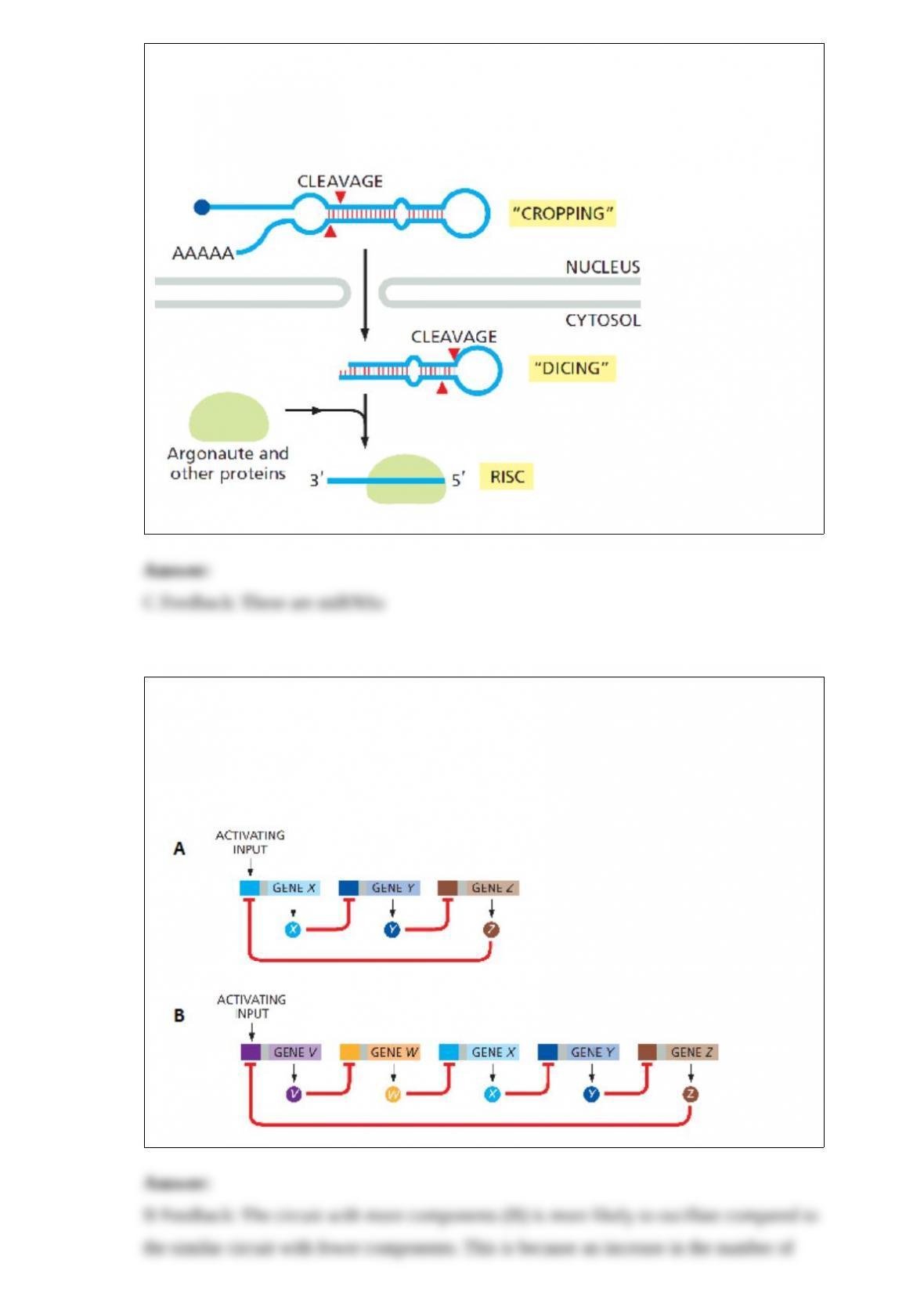
The schematic diagram below shows the processing of a class of small RNAs that are
involved in RNA interference (RNAi). Which of the following is true regarding these
RNAs?
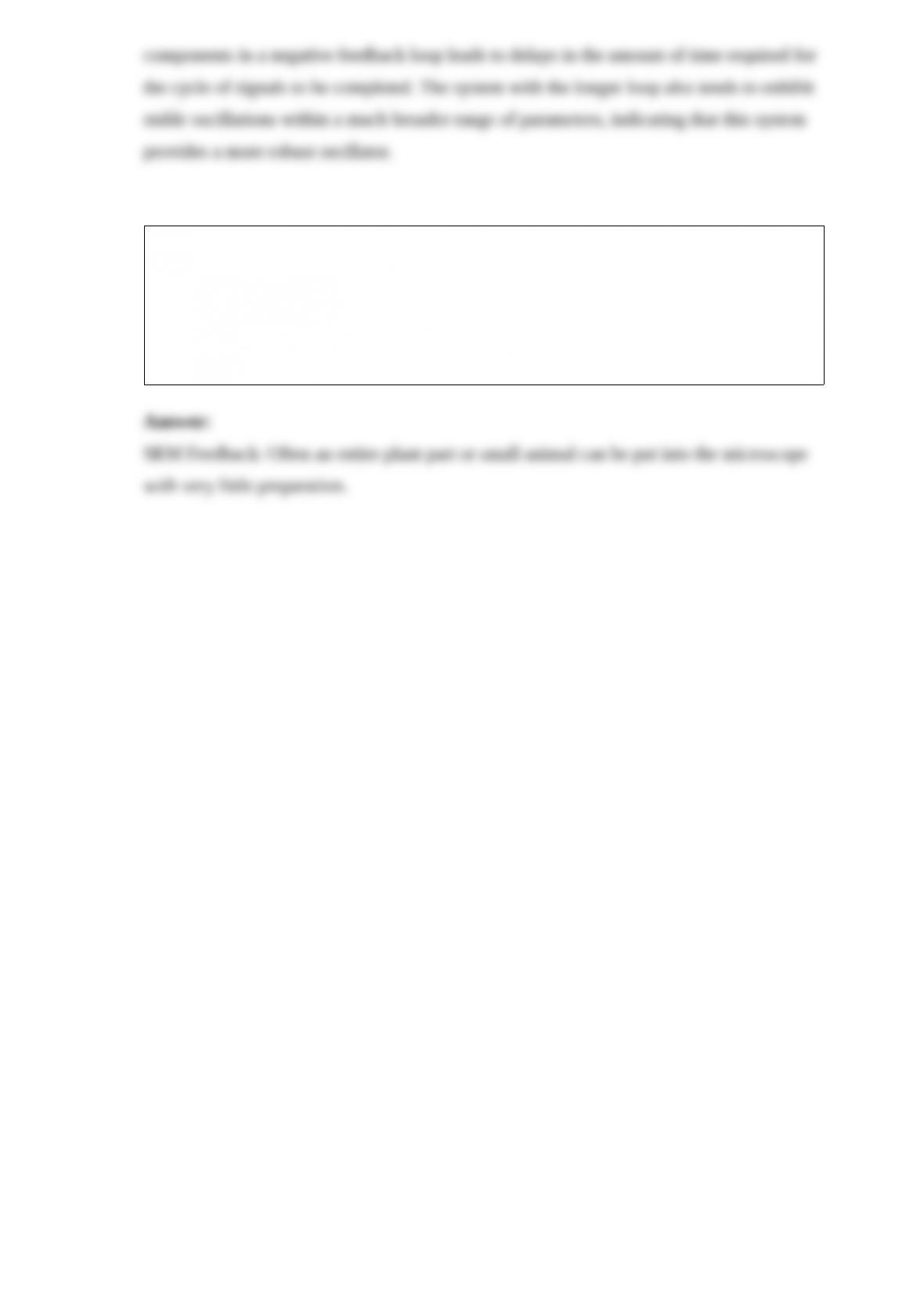
Consider the transcriptional circuits depicted in the following schematic drawings.
These circuits share identical kinetic parameters but have a different number of stages.
Which circuit (A or B) creates more robust oscillations? Write down A or B as your
answer.
You have generated strains of Drosophila melanogaster that are expected to show
interesting developmental phenotypes such as misplaced organs in the adult fly.
However, some of these phenotypes are not readily seen with light microscopy. You
therefore fix each mutant fly, dry it, coat it with a thin layer of gold, and place the entire
fly into an electron microscope for viewing. What type of microscope are you using?
Write down SEM or TEM as your answer.