Archives: Quiz
SSCI 49530
Karl Marx argued that capitalists increased their wealth by extracting the surplus labor value from which of the following? a. factories b. natural resources c. industries d. workers e. products In late nineteenth-century debates on American immigration, many scholars and […]
SOC 44144
Most groups of people have tales about where they came from and when, which unite them as a group. These tales are known as: a. creation stories. b. folk tales. c. histories. d. origin myths. e. tall tales. Karl Marx […]
ANT 35641
The experience of the African American community of Corona, New York, who prevented developers from degrading their neighborhoods with an elevated train, is an example of: a. institutional racism. b. personal racism. c. racial ideology. d. resisting racism. e. reverse […]
CGS SS 68286
________ is the cornerstone of the research conducted by contemporary cultural anthropologists. a. Participant observation b. Archival research c. Statistical analysis d. Synchronic study e. Unilineal evolution The author attributes the increased popularity of Tibetan medicine in recent decades to: […]
SOC 69438
Among other changes that occur with the transition to intensive agriculture: a. population sizes tend to decrease. b. peasants’ surpluses are transferred to the dominant elite. c. a more egalitarian lifestyle emerges. d. populations became less sedentary. e. trade tends […]
SOC 31261
Malaysians divide people into three “biological” groups, Brazilians have more than three hundred, and Americans divide people into three, four, or even five of these groups called: a. clines. b. ethnicities. c. phylogenies. d. biomes. e. races. Societies in which […]
SSCI 75860
According to contemporary cultural anthropologists, humans in most cultures engage in sexual activity: a. both for procreation and fun. b. for procreation only. c. for fun only. d. as a form of economic exchange. e. very seldom. Pierre Bourdieu worked […]
ANT 62559
Which of the following is NOT a motivation that cultural anthropologist Denise Brennan lists for young, rural, poor Dominican women to migrate to towns like Sosua? a. to make money b. to have a vacation c. to marry a tourist […]
SOC 16371
A story that is told about the founding and history of a particular group to reinforce a common sense of identity is called a: a. creation story. b. folk tale. c. history. d. “just so” story. e. origin myth. The […]
CGS SS 69460
The Homo floresiensis specimen: a. had a small brain due to a pathology. b. lived about 20,000 yBP. c. is the result of genetic drift. d. fits Allen’s rule in body proportions. Human populations living in areas of endemic malaria […]
ANT 37916
If fossil species A is consistently recovered from geological deposits beneath layers containing fossil species B, then A is considered older than B. This relative dating technique is based on the principle of: a. superposition. b. paleomagnetism. c. fluorine analysis. […]
CGS SS 93930
In class your professor shows you an MRI scan of a primate brain. The professor points out the relatively large size of the olfactory bulb beneath the frontal lobe. This suggests to you that: a. this primate exhibits a derived […]
SSCI 77380
Bone comparisons from hunter-gatherers to later agriculturalists to modern peoples show: a. an increase in size. b. greater robusticity of the long arm bones only. c. a decline in size. d. a stasis in bone density. Hox genes: a. appear […]
CGS SS 30544
The arboreal hypothesis proposes that defining primate characteristics were adaptations to life in the trees, such as: a. grasping hands and feet, developed vision, and greater intelligence. b. grasping hands, tails, and intelligence. c. developed vision, greater sense of smell, […]
CGS SS 67213
Along with other distinct traits robust australopithecines had __________ adapted for grinding food. a. large premolars and molars b. large temporalis muscles and a sagittal crest c. large front teeth and small back teeth d. both a. and b. Male […]
SSCI 29442
In certain species of nonhuman primates there are groups where only one dominant female has access to mates. The other females must wait until the opportunity to gain mate access presents itself. This will have direct impacts on ” fitness,” […]
SSCI 43904
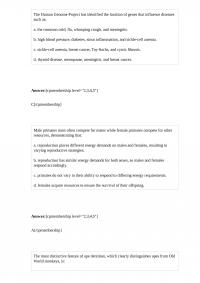
The Human Genome Project has identified the location of genes that influence diseases such as: a. the common cold, flu, whooping cough, and meningitis. b. high blood pressure, diabetes, sinus inflammation, and sickle-cell anemia. c. sickle-cell anemia, breast cancer, Tay-Sachs, […]
SSCI 22957
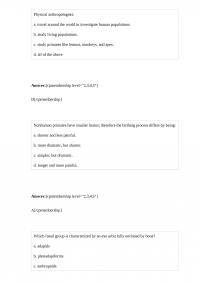
Physical anthropologists: a. travel around the world to investigate human populations. b. study living populations. c. study primates like lemurs, monkeys, and apes. d. all of the above Nonhuman primates have smaller brains; therefore the birthing process differs by being: […]
SOC 99805
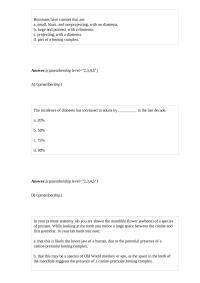
Hominins have canines that are: a. small, blunt, and nonprojecting, with no diastema. b. large and pointed, with a diastema. c. projecting, with a diastema. d. part of a honing complex. The incidence of diabetes has increased in adults by […]
CGS SS 36802
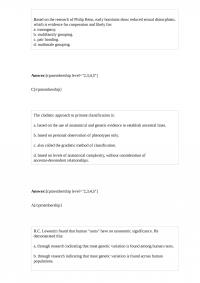
Based on the research of Philip Reno, early hominins show reduced sexual dimorphism, which is evidence for cooperation and likely for: a. monogamy. b. multifamily grouping. c. pair bonding. d. multimale grouping. The cladistic approach to primate classification is: a. […]
ANT 44778
The discovery of Kenyanthropus platyopswas important mainly because: a. it had a small brain like an ape’s. b. it was discovered in Kenya. c. it showed diversity in the hominin fossil record 3.5 mya. d. it probably lived in woodlands. […]
ANT 45347
Chromosome number is reduced during: a. mitosis. b. recombination. c. translation. d. meiosis. Children living at high altitudes develop a larger chest cavity by adulthood than children living at lower altitudes. This is an example of: a. environmental adaptations that […]
ANT 50615
Infancy ends: a. at about 36 months. b. before deciduous dentition has completely erupted. c. with completion of brain growth. d. with weaning, which occurs at the same time across cultures. Chororapithecus is considered the: a. oldest fossil in Africa. […]
SOC 67412
Polyandrous residence patterns represent: a. a social grouping that includes multiple adult males and females. b. common observations in prosimians and Old World monkeys. c. a social grouping in which males cooperate in parenting activities. d. a social grouping that […]
ANT The Last Neandertals Date To Ybp
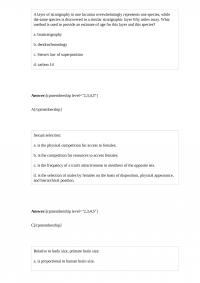
A layer of stratigraphy in one location overwhelmingly represents one species, while the same species is discovered in a similar stratigraphic layer fifty miles away. What method is used to provide an estimate of age for this layer and this […]
SSCI 94055
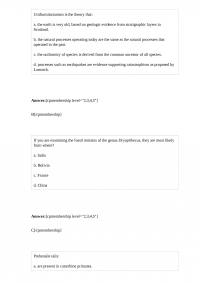
Uniformitarianism is the theory that: a. the earth is very old, based on geologic evidence from stratigraphic layers in Scotland. b. the natural processes operating today are the same as the natural processes that operated in the past. c. the […]
ANT 53194
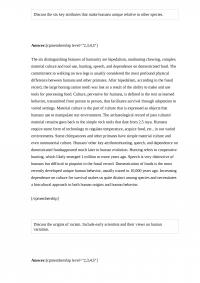
Discuss the six key attributes that make humans unique relative to other species. Discuss the origins of racism. Include early scientists and their views on human variation. Answer: Answer: The six distinguishing features of humanity are bipedalism, nonhoning chewing, complex […]
ANT 31970
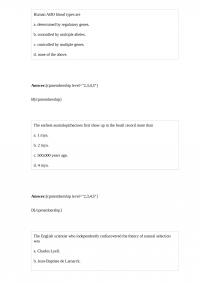
Human ABO blood types are a. determined by regulatory genes. b. controlled by multiple alleles. c. controlled by multiple genes. d. none of the above. The earliest australopithecines first show up in the fossil record more than a. 1 mya. […]
SSCI 56587
The earliest known South American primate is a 26-million-year-old monkey from Bolivia called a. Theropithecus. b. Branisella. c. Proconsul. d. Afropithecus. Greater reduction in jaw size relative to tooth size during the Holocene has led to greater incidence of a. […]
SOC 57117
Proteins consist of a. genes. b. RNA plus mRNA. c. chains of DNA nucleotides. d. chains of amino acids. Wolff’s law a. is the principle that the lengths of limb bones are related to environmental conditions. b. applies to the […]
CGS SS 82915
Cereal grains such as rice that make up a significant portion of human diet today are known as a. good-for-you foods. b. high-energy foods. c. superfoods. d. genetically modified foods. Infancy ends a. at 36 months. b. before deciduous dentition […]
CGS SS 86899
Chimpanzees in the wild have been observed to a. use two rocks as a hammer and anvil to crack open nuts. b. teach their offspring how to flake stone tools. c. use stick tools to scoop termites from nests. d. […]
CGS SS 88248
Fossil and living apes exhibit a distinctive cusp pattern on the chewing surfaces of their molar teeth known as a. Y-5 b. Y-6 c. silodont d. Carabelli’s cusp The earliest australopithecines probably lived in which kind of environment? a. dense […]
CGS SS 64059
Race is not a valid biological concept because a. races account for only a small amount of biological variation. b. the distribution of biological traits follow a cline. c. traits do not agree with their frequency and distribution. d. all […]
CGS SS 51446
Gametes are a. diploid. b. haploid. c. produced during mitosis. d. none of the above. Using direct radiometric dating of ________ provides very accurate ages for many East African Rift Valley hominid sites. a. volcanic rocks b. trees c. pottery […]
CGS SS 42677
Primates’ enhanced sense of vision stems from a. eyes rotated forward. b. tendency toward nocturnality. c. color vision. d. both a and c. Homo erectus fossils date to a. 3″1 mya. b. 2.5 mya”500,000 yBP. c. 1.8 mya”300,000 yBP. d. […]
ANT 87807
The Paleoindian skull from Kennewick, in Washington State, a. was recovered from an elaborate burial. b. represents an early Eskimo population. c. looks quite different from modern Native Americans’ skulls. d. is about 3,000 years old. The ratio of C3 […]
ANT 75547
Relative to other primates, prosimian adaptations include a. an enlarged olfactory bulb and enlarged scent glands. b. larger brains. c. reduced number of teeth. d. smaller eye orbits. Which of the following is not one of the main methods for […]
SOC 27404
During the Miocene epoch of the Cenozoic era, there was an adaptive radiation of which kind of primate? a. prosimians b. monkeys c. apes d. humans The following are complementary bases in DNA a. adenine and thymine. b. adenine and […]
SSCI 32150
You are walking through a forest in the Central African Republic and you notice a twig that has had its bark removed and is stuck in a hole in a termite mound. The twig is an example of a. material […]
CGS SS 31945
In his work on pea plants, Mendel found that plant height was inherited independently of the type or color of the seed coat. This finding a. applies to genes on the same chromosome. b. applies to the law of independent […]
CGS SS 33228
When geneticists talk about the gene pool, they refer specifically to variation at a genetic a. chromosome. b. nucleus. c. address. d. locus. Solitary primates and those in small groups suffer higher rates of predation by what predator compared to […]
SSCI 72383
Analysis of Homo erectus teeth found at Zhoukoudian suggests that controlled use of fire allowed this species to a. ward off predators. b. expand into more temperate environments. c. make foods easier to chew. d. none of the above. Modern […]
SSCI 42372
The shift from the Miocene, which had greater diversity of ape species and fewer monkey species, to a living assemblage with greater diversity of monkey species and fewer ape species may be the result of a. global climate changes that […]
SOC 22942
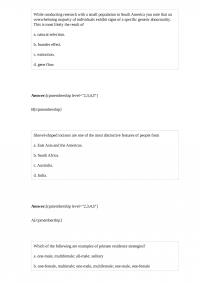
While conducting research with a small population in South America you note that an overwhelming majority of individuals exhibit signs of a specific genetic abnormality. This is most likely the result of a. natural selection. b. founder effect. c. extinction. […]
ANT 84615
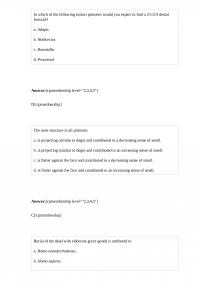
In which of the following extinct primates would you expect to find a 2/1/2/3 dental formula? a. Adapis b. Notharctus c. Branisella d. Proconsul The nose structure in all primates a. is projecting (similar to dogs) and contributed to a […]
CGS SS 83708
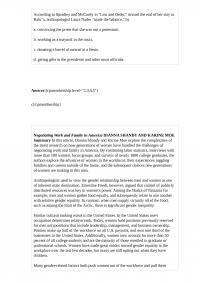
According to Spradley and McCurdy in “Law and Order,” toward the end of her stay in Ralu”a, anthropologist Laura Nader “made the balance,” by a. convincing the priest that she was not a protestant. b. working as a mayoral in […]
CGS SS 53561
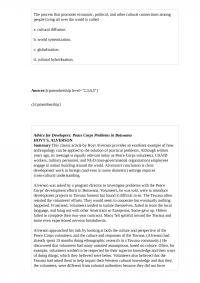
The process that promotes economic, political, and other cultural connections among people living all over the world is called a. cultural diffusion. b. world systemization. c. globalization. d. cultural hybridization. Advice for Developers: Peace Corps Problems in Botswana HOYT S. […]
ANT 40696
According to Reed’s “Forest Development the Indian Way,” until the recent incursion of colonos (colonists, such as ranchers and farmers), Guaran villagers a. had no contact with people in other parts of South America. b. traded with outsiders for machetes, […]
ANT 18615 Reciprocity And The Power Of Giving Lee Cronk Summary
Motorcycles, Membership, and Belonging DAVID W. McCURDY Summary In his article entitled “Motorcycles, Membership, and Belonging,” David McCurdy discusses the ways humans form groups, identifying the more common ways for Americans and drawing a comparison between the traditional kinship group […]