Archives
CAS HI 16247
Why did Andrew Johnson resist the Civil Rights Act of 1866 and the Fourteenth Amendment? A) Johnson felt that these laws did not grant equal rights to African Americans, and thus pushed for further legislation. B) Johnson strongly supported states’ […]
CAS HI 17585
Why did the new colonists of Georgia demand slaves? A) Farmers were given so many acres of land that they felt they could not farm efficiently without slaves. B) The main crop of Georgiatobaccocould be cultivated only with slave labor. […]
CAS HI 29621
The greatest inventor of late nineteenth- and early twentieth-century America was ________. A) Cyrus Field B) Thomas A. Edison C) Henry Bessemer D) J. P. Morgan E) Eli Whitney Why was the Republican-controlled Congress elected in 1890 notable? A) It […]
CAS HI 35800
Whose activities were essential to the establishment of a colonial alliance with the French? A) Thomas Paine B) John Adams C) John Dickinson D) Thomas Jefferson E) Benjamin Franklin What was one reason why Reagan won the 1980 presidential election? […]
CAS HI 57657
Which was most common in determining whether a state supported the North or the South in the Civil War? A) ideology about slavery B) opinions about Lincoln’s presidency and whether he was a legitimate leader C) views on whether or […]
CAS HI 60600
The most profitable commodity bought and sold in the upper tier of the southern states was ________. A) tobacco B) cotton C) slaves D) wheat E) corn Andrew Johnson was impeached by the House for his violation of the _______. […]
CAS HI 83171
Which correctly describes the attitudes of southern yeoman farmers? A) They were staunch supporters of abolitionism even though they owned slaves. B) They listened sympathetically to abolitionist ideas but remained neutral. C) They paid little attention to the slave system […]
HI 12511
Lord Baltimore’s settlement in Maryland ________. A) became a successful feudal outpost in America B) declared war on Virginia in 1639 C) never succeeded in becoming a feudal society D) became a haven for persecuted Protestants E) successfully put into […]
HI 15782
The disarmament plan that the Truman administration proposed to the United Nations after World War II was called _______. A) the Potsdam Summit B) the Baruch Plan C) the Manhattan Project D) the Cold War Treaty E) containment For many […]
HI 34149
Why did the Sedition Act distress many Americans? A) It threatened their political right to disagree with and speak out against the government. B) It gave the Federalists too much power and reduced the Republicans’ power. C) It suspended free […]
HI 52413
The lives of Roger Williams and Anne Hutchinson provide strong evidence that ________. A) Puritans seldom disagreed on matters of theology B) Massachusetts Bay officials insisted on freedom of religious thought and expression C) Massachusetts Bay faced difficulties in creating […]
HI 70423
The Supreme Court’s decision in the Northern Securities case _____. A) paved the way for several other antitrust actions B) had little effect on the problem of trusts overall C) was opposed by Roosevelt himself D) affected only the smaller […]
HI 81964
How were American railroads different from European railroads? A) American railroads connected only major cities, whereas older European railroads connected small towns as well. B) European railroads employed workers from the upper class, whereas American railroad workers were from the […]
HI 86220
By 1960, the most racially integrated institution in American society was _______. A) the public high school system B) the private university system C) corporate America D) the armed forces E) Protestant churches Which of the following adjectives best describes […]
HI 87519
What was the most important responsibility facing the Second Continental Congress? A) to convince the colonists of the necessity for war B) to win loyalty from the Indians C) to organize the colonies for war D) to find a strong […]
HIS 10970
________ came to symbolize the triumph of democracy in the 1820s. A) Henry Clay B) John C. Calhoun C) Daniel Webster D) Martin Van Buren E) Andrew Jackson Which of the following places events in the correct chronological order? A) […]
HIS 12104
During the nineteenth century, the center of cotton production ________. A) moved westward B) moved eastward C) moved northward D) remained in the Southeast E) remained in the upper South How did the geography of the United States encourage isolationism […]
HIS 16968
Because of its policy of religious toleration, ________ attracted unusual numbers of independent-minded people. A) Maryland B) Connecticut C) Pennsylvania D) New York E) Rhode Island What do supply-side economists believe? A) that the economy will recover without changing tax […]
HIS 32661
In December 1775, Parliament passed the ________, which cut America off from international commerce. A) Declaratory Act B) Prohibitory Act C) Commerce Act D) Tea Act E) Trade Act The president most closely identified with the Era of Good Feeling […]
HIS 39341
African-American soldiers did all of the following during the Civil War EXCEPT ________. A) serve in segregated units under white officers B) make a vital contribution to the North’s victory C) serve in integrated units under black officers D) participate […]
HIS 45154
Why was “America” named after Amerigo Vespucci? A) Vespucci published a falsified travel account that convinced mapmakers that he had been the first European to reach the continent. B) Vespucci had been on Columbus’s last voyage, but unlike Columbus realized […]
HIS 45952
The character of the first English settlements in the New World ________. A) remained remarkably similar throughout the seventeenth century B) differed from colony to colony because of government rules C) differed substantially from colony to colony from the very […]
HIS 69437
The economic revolution in the United States between 1810 and 1840 was one of ________. A) design B) technology C) handwork D) production E) distribution Which issue led directly to Bacon’s Rebellion? A) the inability of the governor to take […]
HIS 69478
Which of the following movements of the nineteenth century had the greatest influence on the development of the abolitionist movement? A) Cult of Domesticity B) extension of public education C) women’s rights movement D) temperance movement E) Second Great Awakening […]
HIS 70851
American industrial growth was concentrated in the ________. A) Southwest B) Northeast C) Pacific D) Southeast E) Midwest How did Roger Williams’ religious ideas clash with those of the Puritans? A) Williams believed that settlers in the Massachusetts Bay Colony […]
HIS 76745
How did the Missouri Compromise impact the future of North-South relations in the U.S.? A) It put off major conflict to a future time. B) It resolved major North-South conflicts about slavery. C) It increased North-South conflict about slavery. D) […]
HIS 81178
Public schools in the 1870s and the 1880s ________. A) placed greater value on educating females B) vigorously stressed discipline and routine C) ignored moral, religious education D) emphasized egalitarianism between students and teachers E) were considered better than factories […]
HIST 16666
Why were slave families in the upper South so often headed by women? A) They were following African traditions. B) Husbands often worked elsewhere. C) Mortality rates were unusually high there. D) Women tended to work inside the house. E) […]
HIST 19242
In the 1880s and 1890s, the common-law doctrine of femme couverte ________. A) was revised to adapt to the changes of the period B) provided women with freedom in their marriages C) brought women new political rights D) was strongly […]
HIST 23075
How did the advent of mass production change the lives of many Americans in the early twentieth century? A) Americans attained the highest standard of living in the world. B) There was an increase in racial harmony among U.S. workers. […]
HIST 42141
In addition to reading, writing, and arithmetic, mid-nineteenth-century public schools taught ________. A) abolitionist ideals B) the Protestant ethic C) Catholicism D) the evils of industrialization E) the merits of science over religion In the 1580s, the English attempted to […]
HIST 42544
Why did the Colored Farmers’ National Alliance end? A) A posse of white Southerners lynched fifteen strikers. B) The price of cotton increased significantly. C) Southern planters used strike breakers in the cotton fields. D) The Farmers’ Alliance expelled all […]
HIST 50880
The election of 1796 was complicated by ________. A) changes in the nation’s voting laws B) interference from British diplomats C) behind-the-scenes manipulations by Alexander Hamilton D) Washington’s refusal to stay out of politics E) confusion over the differences between […]
HIST 51318
What did Henry George propose as a solution to poverty in the modern society? A) to let nature take its evolutionary course B) to replace all taxes with a ‘single tax” on land C) a socialist utopia in which the […]
HIST 69857
The ________ set new standards for mass production in the early twentieth century. A) Colt .45 revolver B) McCormick reaper C) Ford Model T D) General Electric oscillating fan E) phonograph What was the intent of many northerners who went […]
HIST 75425
How did President Johnson antagonize Republicans in Congress? A) He called for an extension of the Freedmen’s Bureau. B) He supported a civil rights bill to guarantee equality for African Americans. C) He urged confiscation and redistribution of southern land. […]
HIST 89489
Which identifies an important effect of the violent slave rebellion of 1831? A) White Southerners became more committed to quashing antislavery ideas. B) Many slaves were freed because their masters were afraid to remain part of the system. C) Organized, […]
HIST 97978
What did the League of Nations do after the Italian invasion of Ethiopia? A) It protected the southern half of the country from Mussolini’s army. B) It halted Mussolini’s forces just before they crossed the Ethiopian border. C) It authorized […]
HIST 98644
The Confederate 1863 victory at Chancellorsville cost the Confederacy the life of ________. A) Jefferson Davis B) “Stonewall” Jackson C) Robert E. Lee D) William Tecumseh Sherman E) Ulysses S. Grant Which was NOT a reason why Scandinavian outposts in […]
HIST 99471
Which of the following best characterizes U.S.-Soviet relations during the war? A) especially close and trusting B) especially hostile, almost to the point of warfare C) strained by significant ideological differences D) hurt by the United States’ refusal to recognize […]
HS 48868
Actions in which area helped Truman win the 1948 election? A) the Cold War B) labor issues C) civil rights D) his handling of the Korean War E) New Deal reforms After General MacArthur’s victory at Inchon, Korea, Truman _______. […]
HS 69743
Which religiously liberal group of the early nineteenth century denied the doctrine of the Trinity? A) Presbyterians B) Congregationalists C) Unitarians D) Methodists E) Mormons What eventually solved the economic problems of seventeenth-century Virginia? A) the cultivation of tobacco B) […]
HS 83716
The boycott movement against the Stamp Act ________. A) had little effect on Great Britain B) mobilized colonial women to action C) ultimately hurt American businessmen more than British D) was opposed by New England businessmen E) was badly organized […]
HST 20742
Which of the following statements about the Whiskey Rebellion is FALSE? A) It took place in western Pennsylvania. B) It lent credence to fears of political violence against the government. C) It involved an attempt to prohibit the consumption of […]
HST 43422
Which statement best characterizes Sherman’s march through Georgia? A) Sherman defied Lincoln by refusing to implement a scorched-earth policy. B) Sherman destroyed almost anything of military or economic value in his path. C) Sherman destroyed cities, but was careful to […]

HST 55995
Which prohibited colonial settlement west of the Appalachian Mountains? A) Navigation Act of 1772 B) Proclamation of 1763 C) Stamp Act of 1765 D) Townshend Acts of 1767 E) Settlement Act of 1765 Progressive reformers of the cities believed that […]
HST 65217
What is the significance of the adoption of a standard gauge for all railroads? A) It allowed all rails to be built of steel instead of inferior quality metal. B) It allowed trains to travel on all tracks, thus integrating […]
HST 80824
The typical way for most slaves to express discontent was ________. A) political protest B) open, armed rebellion C) passive resistance D) participation in conspiracies E) organizing boycotts Which is the best description of the most important message Richard Hakluyt’s […]
HST 86099
According to the authors, inequalities based on race were exacerbated by inequalities based on ________. A) gender B) religion C) country of origin D) distribution of resources E) education To what does the term “Iron Curtain” refer? A) the border […]
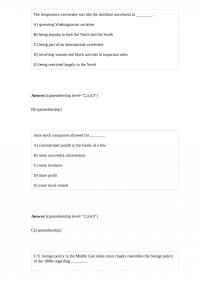
HST 87117
The temperance movement was like the abolition movement in ________. A) spawning Washingtonian societies B) being popular in both the North and the South C) being part of an international movement D) involving women and black activists in important roles […]