Archives: Quiz
978-1305958098 Test Bank Chapter 01 Test B
Name: Class: Date: Chapter 01 Test B Copyright Cengage Learning. Powered by Cognero. Page 1 INSTRUCTIONS: The following selections relate to distinguishing arguments from nonarguments and identifying conclusions. Select the best answer for each. 1. Authoritarian states are characterized by […]
Chapter 17 Pathos refers to stories or examples that appeal to an audience’s needs and feelings
Page 1 1. “To coerce” is an example of an effective specific purpose statement for a persuasive speech. A) True B) False 2. A presentation advocating for stricter gun control laws is an example of a proposition of policy. A) […]
Chapter 17 What specific speech purpose of a persuasive speech would be most appropriate at a rally for supporters of a political candidate?
Page 1 1. Which of the following is NOT a purpose of persuasive speaking? A) reinforcing listeners’ attitudes B) motivating action C) using coercion D) changing beliefs E) changing attitudes 2. Developing a persuasive presentation asserting that your audience should […]
Chapter 17 Asking your audience to agree to a small action in order to gain their compliance over time
Page 1 1. Presentations designed to change an audience’s attitudes or beliefs. _______ 2. Presentations that argue whether something is true or not. _______ 3. A presentation that imposes a judgment on a topic. _______ 4. A presentation that argues […]
Chapter 17 Identify three guidelines to keep in mind when preparing a persuasive presentation
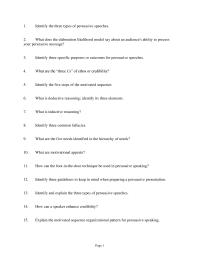
Page 1 1. Identify the three types of persuasive speeches. 2. What does the elaboration likelihood model say about an audience’s ability to process your persuasive message? 3. Identify three specific purposes or outcomes for persuasive speeches. 4. What are […]
Chapter 16 By providing repetition, internal summaries can increase a listener’s ability to recall information later
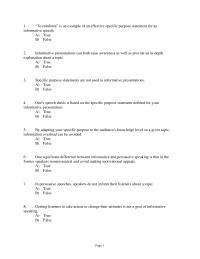
Page 1 1. “To reinforce” is an example of an effective specific purpose statement for an informative speech. A) True B) False 2. Informative presentations can both raise awareness as well as provide an in-depth explanation about a topic. A) […]
Chapter 16 Narrative presentations are best suited for what type of organizational pattern?
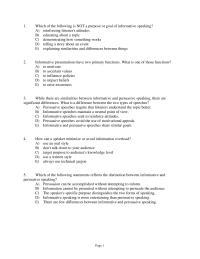
Page 1 1. Which of the following is NOT a purpose or goal of informative speaking? A) reinforcing listener’s attitudes B) educating about a topic C) demonstrating how something works D) telling a story about an event E) explaining similarities […]
Chapter 16 A presentation that imposes a judgment on a topic
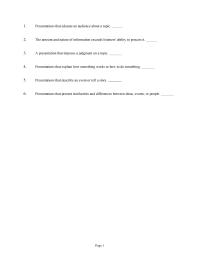
Page 1 1. Presentations that educate an audience about a topic. ______ 2. The amount and nature of information exceeds listeners’ ability to process it. ______ 3. A presentation that imposes a judgment on a topic. _______ 4. Presentations that […]
Chapter 16 What word meanings do your authors suggest using in informative presentations?
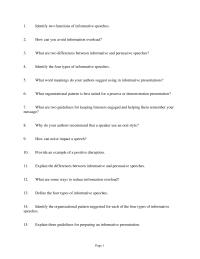
Page 1 1. Identify two functions of informative speeches. 2. How can you avoid information overload? 3. What are two differences between informative and persuasive speeches? 4. Identify the four types of informative speeches. 5. What word meanings do your […]
Chapter 15 A written language style often stems from composing and reading a manuscript speech
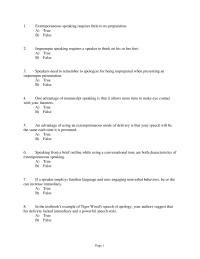
Page 1 1. Extemporaneous speaking requires little to no preparation. A) True B) False 2. Impromptu speaking requires a speaker to think on his or her feet. A) True B) False 3. Speakers need to remember to apologize for being […]
978-1319043520 Test Bank Chapter 15 The degree of closeness an audience feels toward a speaker Language usage that is similar to how people talk
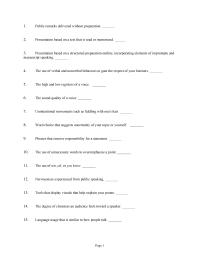
Page 1 1. Public remarks delivered without preparation. _______ 2. Presentation based on a text that is read or memorized. ______ 3. Presentation based on a structured preparation outline, incorporating elements of impromptu and manuscript speaking. _______ 4. The use […]
Chapter 15 Identify three guidelines to follow when giving feedback
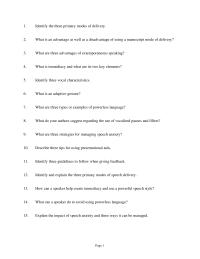
Page 1 1. Identify the three primary modes of delivery. 2. What is an advantage as well as a disadvantage of using a manuscript mode of delivery? 3. What are three advantages of extemporaneous speaking? 4. What is immediacy and […]
Chapter 15 If your friend asked you how to help them manage the speech anxiety they feared for an upcoming final oral presentation, what advice would you NOT offer them
Page 1 1. Which of the following is NOT a primary mode of delivery? A) extemporaneous speaking B) manuscript speaking C) memorized speaking D) impromptu speaking E) all of the choices are correct 2. Kris is researching another culture in […]
Chapter 14 Your conclusion is a good place to include information that you did not yet cover in the body of your
Page 1 1. If a speaker defines a specific purpose, a speech thesis is not needed. A) True B) False 2. While the specific purpose is stated explicitly in the introduction, a speech thesis guides one’s research. A) True B) […]
Chapter 14 Fill In The Blank A detail of your presentation’s overall structure
Page 1 1. Process of determining your speech thesis, main points, and arranging them. _______ 2. Complete sentence identifying the central idea of your presentation. _______ 3. Key statements or principles that support your speech thesis. _______ 4. The breakdown […]
Chapter 14 Explain the difference between a specific purpose and speech thesis as well as the requirements of the latter
Page 1 1. What is one difference between a specific purpose statement and speech thesis? 2. Identify two guidelines for defining main points. 3. List three types of supporting materials, 4. What are three suggestions to keep in mind when […]
Chapter 14 In comparing a specific purpose to a speech thesis, what statement most accurately distinguishes the two types of statements?
Page 1 1. Which of the following is an effective speech thesis? A) To inform my audience on why an Android-based phone is preferable to an Apple IOS-based phone. B) To inform my audience on guns and the violence they […]
Chapter 13 Students in your class are considered to be a voluntary audience as they chose to enroll in the course
Page 1 1. “To entertain” is an example of an effective specific purpose statement. A) True B) False 2. Effective speakers only use the cooperative principle when delivering a persuasive presentation. A) True B) False 3. General purpose statements are […]
Chapter 13 If you adapt your speech to the gender and educational level of your audience, you are considering what factor of audience analysis
Page 1 1. Which of the following is an effective specific purpose statement? A) To inform my audience on three reasons to buy a laptop and the four best statistical programs available for laptop computers. B) Informing on guns, violence, […]
Chapter 13 A creative problem-solving strategy that generates topical ideas
Page 1 1. Process of preparing and delivering a message to an audience. _______ 2. Consideration of your audience and speech topic. _______ 3. Researching references for preparing a speech. _______ 4. Process of planning your outline and visual aids. […]
Chapter 13 Describe the elements of a successful research strategy
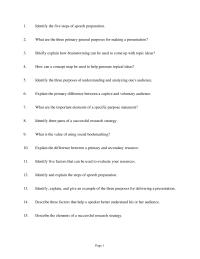
Page 1 1. Identify the five steps of speech preparation. 2. What are the three primary general purposes for making a presentation? 3. Briefly explain how brainstorming can be used to come up with topic ideas? 4. How can a […]
Chapter 12 According to Hersey and Blanchard, member readiness refers to the extent that members have experience, knowledge
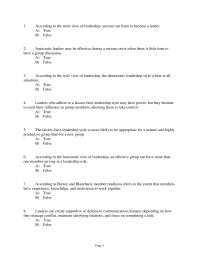
Page 1 1. According to the traits view of leadership, anyone can learn to become a leader. A) True B) False 2. Autocratic leaders may be effective during a serious crisis when there is little time to have a group […]
Chapter 12 According to Hersey-Blanchard’s Model of Situational Leadership, as a group matures, leaders move through four leadership styles
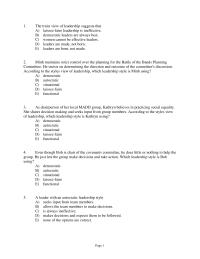
Page 1 1. The traits view of leadership suggests that A) laissez-faire leadership is ineffective. B) democratic leaders are always best. C) women cannot be effective leaders. D) leaders are made, not born. E) leaders are born, not made. 2. […]
Chapter 12 Teams collect information on the nature and scope of the problem facing them, then systematically search for
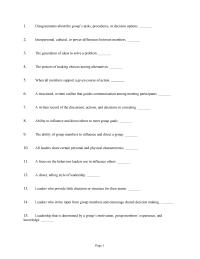
Page 1 1. Disagreements about the group’s tasks, procedures, or decision options. _______ 2. Interpersonal, cultural, or power differences between members. _______ 3. The generation of ideas to solve a problem. _______ 4. The process of making choices among alternatives. […]
Chapter 12 Explain the situational view of leadership and its four styles
Page 1 1. What does shared leadership suggest about a group and its leader? 2. According to the situational view of leadership, what are the four types of leadership that can be used? 3. What is the key characteristic of […]
Chapter 11 Being highly argumentative is similar to being verbally aggressive, and both are considered to have a negative impact on groups
Page 1 1. A small group is two or more interdependent people who communicate to achieve a common goal. A) True B) False 2. A handful of friends waiting for a yoga class to start are considered to be a […]
Chapter 11 According to Tuckman’s group development research, in which phase do members resolve conflicts and begin to work together as a cohesive team?
Page 1 1. Which of the following situations best depicts small group communication as defined in your text? A) people talking in an elevator B) bystanders at an accident scene C) congregation listening to a sermon D) jury members deliberating […]
Chapter 11 An initial phase where group members come to know one another and the tasks
Page 1 1. Three or more interdependent persons who share a common identity and communicate to achieve a common goal. ______ 2. A team of individuals working together to achieve a common goal who communicate primarily through technology. ______ 3. […]
Chapter 11 Explain the difference between primary and secondary groups and provide an example of each
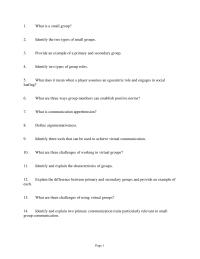
Page 1 1. What is a small group? 2. Identify the two types of small groups. 3. Provide an example of a primary and secondary group. 4. Identify two types of group roles. 5. What does it mean when a […]
Chapter 10 Studies suggest that both women and men alike prefer disclosing to women more so than to men
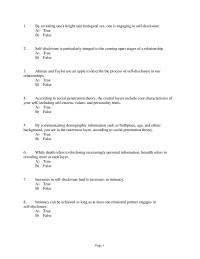
Page 1 1. By revealing one’s height and biological sex, one is engaging in self-disclosure. A) True B) False 2. Self-disclosure is particularly integral to the coming apart stages of a relationship. A) True B) False 3. Altman and Taylor […]
Chapter 10 The authors suggest several ways in which we can enhance our self-disclosure skills
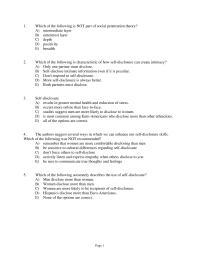
Page 1 1. Which of the following is NOT part of social penetration theory? A) intermediate layer B) outermost layer C) depth D) positivity E) breadth 2. Which of the following is characteristic of how self-disclosure can create intimacy? A) […]
Chapter 10 A theory that uses an onion as a metaphor to explain self-disclosure in personal relationships
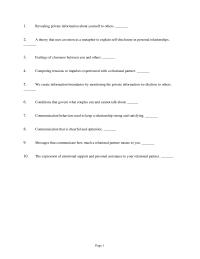
Page 1 1. Revealing private information about yourself to others. _______ 2. A theory that uses an onion as a metaphor to explain self-disclosure in personal relationships. _______ 3. Feelings of closeness between you and others. _______ 4. Competing tensions […]
Chapter 10 What are three strategies relational partners can use to help maintain their relationship?
Page 1 1. What is self-disclosure? 2. Identify the three layers and two other factors of social penetration theory. 3. What are three ways in which self-disclosure can lead to intimacy? 4. Identify three ways to enhance self-disclosure skills. 5. […]
Appendix N Paraphrasing is an important listening skill that requires a listener to state back exactly word for word what a person said
Page 1 1. The interviewee assumes a passive role in an interview. A) True B) False 2. All interviews are dyadic, involving two people. A) True B) False 3. Interviews must occur in a face-to-face setting. A) True B) False […]
Appendix I If in preparing for an employment selection interview, a job applicant focused his or her skills and experiences to a specific job, what step is
Page 1 1. Which of the following is NOT a characteristic of an interview? A) Effective interviews follow an interview protocol. B) Interviews are planned and structured. C) Interviews only occur in dyads. D) Interviews can occur between two or […]
Appendix E What strategies can one employ to be an active listener during an interview?
Page 1 1. Identify three ways in which an interview can occur. 2. Identify the two primary types of interviews. 3. What are the three types of employment interviews? 4. Define and differentiate between an open and a closed question. […]
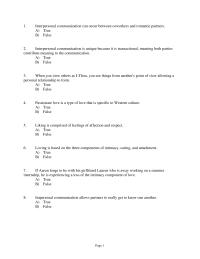
Chapter 9 If we find out that someone whom we like also likes us in return, our relational attraction increases
Page 1 1. Interpersonal communication can occur between coworkers and romantic partners. A) True B) False 2. Interpersonal communication is unique because it is transactional, meaning both parties contribute meaning to the communication. A) True B) False 3. When you […]
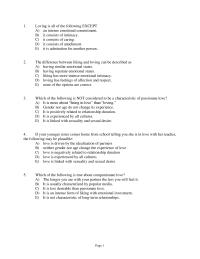
Chapter 9 If your younger sister comes home from school telling you she is in love with her teacher, the following may be plausible
Page 1 1. Loving is all of the following EXCEPT A) an intense emotional commitment. B) it consists of intimacy. C) it consists of caring. D) it consists of attachment. E) it is admiration for another person. 2. The difference […]
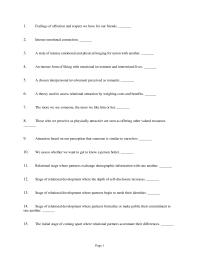
Chapter 9 The initial stage of coming apart where relational partners accentuate their differences
Page 1 1. Feelings of affection and respect we have for our friends. _______ 2. Intense emotional connection. _______ 3. A state of intense emotional and physical longing for union with another. _______ 4. An intense form of liking with […]
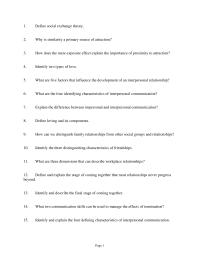
Chapter 9 Define and explain the stage of coming together that most relationships never progress beyond
Page 1 1. Define social exchange theory. 2. Why is similarity a primary source of attraction? 3. How does the mere exposure effect explain the importance of proximity to attraction? 4. Identify two types of love. 5. What are five […]
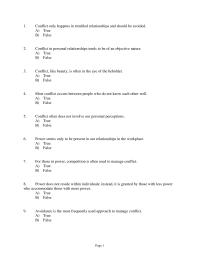
Chapter 8 Cumulative annoyance can result when relationship partners engage in avoidance as a conflict strategy
Page 1 1. Conflict only happens in troubled relationships and should be avoided. A) True B) False 2. Conflict in personal relationships tends to be of an objective nature. A) True B) False 3. Conflict, like beauty, is often in […]
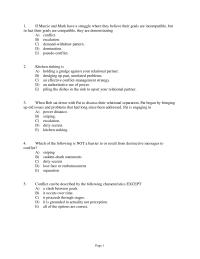
Chapter 8 Frank influences his partner Alicia and seems to always get her to comply with his needs and wishes
Page 1 1. If Marcie and Mark have a struggle where they believe their goals are incompatible, but in fact their goals are compatible, they are demonstrating A) conflict. B) escalation. C) demand-withdraw pattern. D) domination. E) pseudo-conflict. 2. Kitchen […]
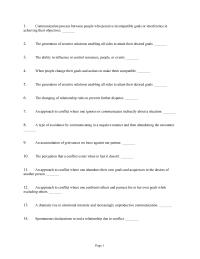
Chapter 8 A type of avoidance by communicating in a negative manner and then abandoning the encounter
Page 1 1. Communication process between people who perceive incompatible goals or interference in achieving their objectives. _______ 2. The generation of creative solutions enabling all sides to attain their desired goals. _______ 3. The ability to influence or control […]
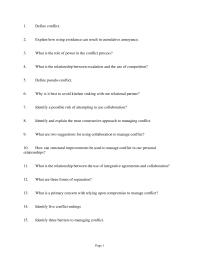
Chapter 8 How can structural improvements be used to manage conflict in our personal relationships?
Page 1 1. Define conflict. 2. Explain how using avoidance can result in cumulative annoyance. 3. What is the role of power in the conflict process? 4. What is the relationship between escalation and the use of competition? 5. Define […]
Chapter 7 While men tend to be action- or task-oriented listeners, women tend to favor people-oriented or relational listening
Page 1 1. Listening is a passive activity. A) True B) False 2. We spend more time listening than any other type of communication activity. A) True B) False 3. Many people take listening for granted, believing it just happens. […]
Chapter 7 Listeners who prefer to be intellectually challenged and seek to evaluate messages
Page 1 1. Hearing, understanding, responding to, interpreting, evaluating, and remembering information. _______ 2. The first step in the listening process. _______ 3. The process of identifying connotative meanings. _______ 4. The process of recognizing denotative meanings. _______ 5. The […]
Chapter 7 What style of listening is typical of a person from a collectivistic culture?
Page 1 1. Identify the six stages of listening. 2. What is the difference between hearing and listening? 3. What is the difference between positive and negative feedback? 4. How can mnemonics help increase our ability to remember or recall […]
Chapter 7 If your friend Sheila is a very animated communicator and active listener, when she listens to you give a recounting of your day she often responds
Page 1 1. Janis listens to country music on her iTunes playlist purely for pleasure. Which function of listening is she illustrating? A) listening to analyze B) listening to provide support C) listening to discern D) listening to comprehend E) […]
Chapter 6 Physical characteristics and appearance play a minimal role in nonverbal communication
Page 1 1. Verbal communication conveys more meaning than nonverbal communication. A) True B) False 2. Nonverbal communication tends to be more credible than verbal communication. A) True B) False 3. Communication tends to be multichanneled. A) True B) False […]
Chapter 6 If your track coach wraps your ankle with an Ace bandage after you twisted your ankle, what type of touch is your coach using
Page 1 1. In comparing nonverbal communication to verbal, our nonverbal communication is A) more clear. B) single-channeled. C) more intentional. D) less credible. E) more credible. 2. If your boyfriend tells you he loves you while staring aimlessly at […]