Archives: Quiz
Chapter 6 Culture that prefers frequent touching, shared gaze, close physical proximity, and direct indirect body orientation
Page 1 1. Transmission of meaning through nonspoken physical and behavioral cues. _______ 2. Verbal and nonverbal behaviors that have contradictory meanings. _______ 3. Communication tends to be multichanneled. _______ 4. Guidelines that govern the appropriate use and expression of […]
Chapter 6 What are three ways to communicate dominance
Page 1 1. What is an emblem? Provide an example. 2. What is an illustrator? Provide an example. 3. What is a regulator? Provide an example. 4. What is an adaptor? Provide an example. 5. What is vocalics? Provide an […]
Chapter 5 If you and a friend are discussing the nuances of an abstract word such as white and she types in the word on dictionary
Page 1 1. Connotative meaning when compared to denotative meaning is A) more literal. B) more serious. C) used more in close, personal relationships. D) is probably found on dictionary.com. E) less emotional and personal. 2. According to the text, […]
Chapter 5 Your authors suggest the use of face-to-face communication over e-mail or text messaging for important or potentially controversial messages
Page 1 1. Verbal communication involves choice because we use symbols to communicate meaning. A) True B) False 2. Symbols can have multiple meanings, which can lead to misunderstanding. A) True B) False 3. Constitutive rules govern how we use […]
Chapter 5 Habitually attacking a person using the Internet, interactive, or digital technologies
Page 1 1. The exchange of spoken or written language. _______ 2. Using words to represent people, objects, events, and ideas. _______ 3. Defines with words represent which objects. _______ 4. Governs how language is used. _______ 5. Variations in […]
978-13Chapter 5 Provide two strategies you can use to manage a verbally aggressive individual
Page 1 1. Identify four fundamental features of language. 2. What are two rules that govern our language usage? 3. Identify two types of meaning that language can convey. 4. How do symbols work in verbal communication? 5. Identify the […]
Chapter 4 Which statement is false regarding ingroup versus outgroup distinctions we make?
Page 1 1. Culture is influenced by all of the following EXCEPT A) sexual orientation. B) gender. C) religion. D) age. E) education. 2. Culture can be A) learned. B) communicated. C) layered. D) lived. E) all of the options […]
Chapter 4 In a low-uncertainty-avoidance culture, members prefer structured work with clear delineation of power and authority
Page 1 1. According to co-cultural communication theory, Euro-Americans are the dominant culture in the United States and, therefore, have more power. A) True B) False 2. Co-cultures do not include gender, age, or sexual orientation. A) True B) False […]
Chapter 4 A view of time that is more flexible, valuing harmonious interaction over being on time
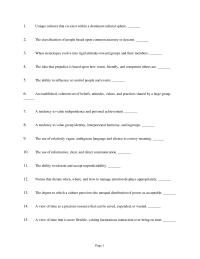
Page 1 1. Unique cultures that co-exist within a dominant cultural sphere. _______ 2. The classification of people based upon common ancestry or descent. _______ 3. When stereotypes evolve into rigid attitudes toward groups and their members. _______ 4. The […]
Chapter 4 Explain how attributional complexity can improve intercultural competence
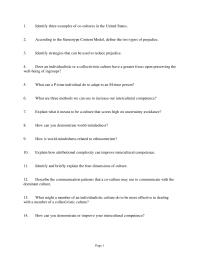
Page 1 1. Identify three examples of co-cultures in the United States. 2. According to the Stereotype Content Model, define the two types of prejudice. 3. Identify strategies that can be used to reduce prejudice. 4. Does an individualistic or […]
Chapter 3 If you use social media to find information or make reservations you are meeting instrumental goals of communication
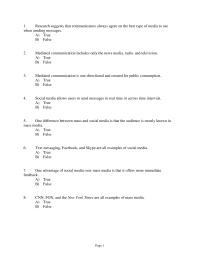
Page 1 1. Research suggests that communicators always agree on the best type of media to use when sending messages. A) True B) False 2. Mediated communication includes only the news media, radio, and television. A) True B) False 3. […]
Chapter 3 You post that you are the best personal trainer on a social networking site
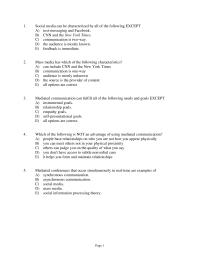
Page 1 1. Social media can be characterized by all of the following EXCEPT A) text-messaging and Facebook. B) CNN and the New York Times. C) communication is two-way. D) the audience is mostly known. E) feedback is immediate. 2. […]
Chapter 3 Using social media in a community-based fashion includes heightening public awareness of
Page 1 1. Communication that is mediated by a technological device. _______ 2. The sending of messages to large, anonymous audiences. _______ 3. Allowing messages to be directly sent and received between communicators. _______ 4. The exchange of messages in […]
Chapter 3 Explain what social information processing theory suggests about how personal mediated messages are
Page 1 1. Identify three examples of mass media. 2. Identify three examples of social media. 3. What are two unique goals that can be fulfilled through the use of mediated communication? 4. Explain the difference between synchronous and asynchronous […]
Chapter 2 According to Self-Discrepancy Theory, the greater the discrepancy between your ideal self and your ought self, the higher your self-esteem
Page 1 1. Your self is formed at infancy and remains fairly static over time and life experience. A) True B) False 2. The process of social comparison can result in positive or negative self-esteem, depending on whether you compare […]
Chapter 2 Which of the following statements reflect the notion that your self-concept is influenced by the labels that others have of you?
Page 1 1. Your learned evaluative appraisals about yourself and others (whether positive or negative) are called A) attitudes. B) values. C) beliefs. D) personal constructs. E) self-verifications. 2. What is a mental construct that expresses enduring principles of what […]
Chapter 2 The tendency to dismiss the significance of negative behavior based on your positive Gestalt
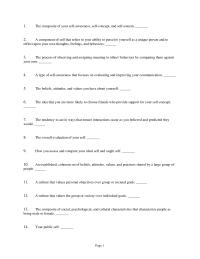
Page 1 1. The composite of your self-awareness, self-concept, and self-esteem. _______ 2. A component of self that refers to your ability to perceive yourself as a unique person and to reflect upon your own thoughts, feelings, and behaviors. ______ […]
Chapter 2 Explain the two types of attributions and why they are often inaccurate
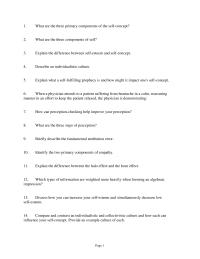
1. What are the three primary components of the self-concept? 2. What are the three components of self? 3. Explain the difference between self-esteem and self-concept. 4. Describe an individualistic culture. 5. Explain what a self-fulfilling prophecy is and how […]
Chapter 1 While the four types of communication differ in their purpose and nature, they are all connected to one another in history and practice
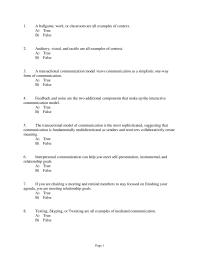
Page 1 1. A ballgame, work, or classroom are all examples of context. A) True B) False 2. Auditory, visual, and tactile are all examples of context. A) True B) False 3. A transactional communication model views communication as a […]
Chapter 1 Chris is trying to arrange a meeting with his partner of five years to discuss how he can terminate their relationship
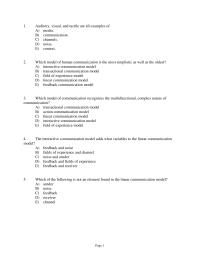
Page 1 1. Auditory, visual, and tactile are all examples of A) media. B) communication. C) channels. D) noise. E) context. 2. Which model of human communication is the most simplistic as well as the oldest? A) interactive communication model […]
Chapter 1 Communication between two people in which messages exchanged significantly influence their relationship
Page 1 1. Process through which people use messages to generate meanings within and across contexts, cultures, channels, and media. ________ 2. Package of information. ______ 3. An exchange or series of messages. ______ 4. A variety of situations. ______ […]
Chapter 1 How does the interactive communication model build upon the linear communication model?
Page 1 1. Define communication. 2. Identify three types of goals that communication can meet. 3. How does the interactive communication model build upon the linear communication model? 4. What are three examples of media? 5. Identify four types of […]
978-1319059415 Test Bank Chapter 24
Page 1 1. How does persuasive speaking ability contribute to a healthy democracy? 2. Explain the difference between informative and persuasive speeches. 3. Explain the persuasive speaker’s objective of limiting the audience’s alternatives. 4. Describe two ways in which a […]
978-1319059415 Test Bank Chapter 23 The Informative Speech MC
Page 1 1. The goal of informative speaking is to convince an audience to change attitudes, beliefs, or values. A) True B) False 2. With information available today in so many forms, electronic and otherwise, we have little need for […]
978-1319059415 Test Bank Chapter 23 The Informative Speech FIB
Page 1 1. To ______ is to communicate knowledge. 2. The informative speech seeks to enlighten, whereas the ______ speech seeks to advocate. 3. Speeches about ______ focus on noteworthy occurrences, both past and present. 4. Speeches about ______ refer […]
978-1319059415 Test Bank Chapter 23
Page 1 1. List three ways a speaker can focus on sharing knowledge with an audience. 2. List the six categories of informative speeches. 3. List and define three types of definition. 4. How is explaining information different from describing […]
978-1319059415 Test Bank Chapter 22 Using Presentation Software MC
Page 1 1. Various presentation software programs offer public speakers powerful tools for creating and displaying high-quality visual aids. A) True B) False 2. When a speaker uses presentation aids, the presentation media should take center stage. A) True B) […]
978-1319059415 Test Bank Chapter 22 Using Presentation Software FIB
Page 1 1. Speakers who rely on electronic presentations risk performance difficulties due to ______ errors. 2. Speakers should check that the operating system of the _______ they will use during their speech is compatible with the operating system used […]
978-1319059415 Test Bank Chapter 22
Page 1 1. Explain the common risks associated with using presentation software during a speech. 2. How can speakers avoid presentation software technical glitches? 3. Identify the three presentation platform options for displaying your slides. 4. List three objects that […]
978-1319059415 Test Bank Chapter 21 Designing Presentation Aids MC
Page 1 1. Simple presentation aids may appear condescending to an audience. A) True B) False 2. Presentation aids that contain too much information will detract from your message. A) True B) False 3. Speakers should present at least three […]
978-1319059415 Test Bank Chapter 21 Designing Presentation Aids FIB
Page 1 1. A speaker should plan on presenting one major idea per slide when striving for ______. 2. A presentation aid with words should have no more than ______ words per line. 3. Speakers should word their slide text […]
978-1319059415 Test Bank Chapter 21
Page 1 1. Explain the principle of simplicity, and give an example. 2. What is the difference between serif and sans serif typefaces? 3. Give three tips for using typefaces and fonts effectively in a presentation aid. 4. Discuss how […]
978-1319059415 Test Bank Chapter 20 Speaking With Presentation Aids MC
Page 1 1. Presentation aid is synonymous with visual aid. A) True B) False 2. Objects, models, pictures, graphs, charts, video, audio, and multimedia can all be used as presentation aids. A) True B) False 3. The two purposes of […]
978-1319059415 Test Bank Chapter 20 Speaking With Presentation Aids FIB
Page 1 1. ______ aids include objects, models, pictures, graphs, charts, video, audio, and multimedia. 2. A(n) ______ is a three-dimensional, scale-size representation of something. 3. A(n) ______ represents relationships among two or more things. 4. A(n) ______ graph uses […]
978-1319059415 Test Bank Chapter 20
Page 1 1. Why should presentation aids complement or enhance the speech rather than serve as the main source of the speaker’s ideas? 2. How can the audience be affected by the use or misuse of presentation aids? 3. Choose […]
978-1319059415 Test Bank Chapter 19 The BodyIn Delivery MC
Page 1 1. Beyond the spoken words, audiences receive information from a speech through aural and visual channels. A) True B) False 2. Paralanguage refers to what is said, not to how something is said. A) True B) False 3. […]
978-1319059415 Test Bank Chapter 19 The Body In Delivery FIB
Page 1 1. _______ refers to how something is said, not to what is said. 2. _______ is an effective nonverbal tool for building rapport with an audience. 3. _______ is probably the most important physical action in public speaking. […]
978-1319059415 Test Bank Chapter 19
Page 1 1. Identify and explain the two nonverbal channels of communication from which audiences receive information during a speech. 2. How does effective use of nonverbal behavior establish relationships between the speaker and the audience? 3. List two tips […]
978-1319059415 Test Bank Chapter 18 The Voice In Delivery MC
Page 1 1. Pitch is the relative loudness of a speaker’s voice while giving a speech. A) True B) False 2. The proper volume for delivering a speech is somewhat louder than that of normal conversation. A) True B) False […]
978-1319059415 Test Bank Chapter 18 The Voice In Delivery FIB
Page 1 1. The proper volume for delivering a speech is somewhat louder than that of normal ___. 2. A handheld or fixed microphone should be positioned slightly below and about six inches away from a speaker’s mouth to prevent […]
978-1319059415 Test Bank Chapter 18
Page 1 1. Explain how a speaker can learn to adjust his or her speaking volume. 2. List two of the three factors that determine how loudly a speaker will have to speak. 3. Identify three tips for using a […]
978-1319059415 Test Bank Chapter 17 Methods Of Delivery MC
Page 1 1. During the elocutionary movement, speechmaking was regarded as a type of performance, much like acting. A) True B) False 2. Today the content or message of a speech, rather than the delivery, is seen as being most […]
978-1319059415 Test Bank Chapter 17 Methods Of Delivery FIB
Page 1 1. Speaking from ______ is advisable or necessary when the speaker must convey a very precise message. 2. Speaking from ______ requires the speaker to recall exact words, which can lead to disaster if the speaker has a […]
978-1319059415 Test Bank Chapter 17
Page 1 1. What are the four qualities of effective delivery? 2. Explain why a speaker should strive for natural rather than theatrical delivery. 3. Identify two ways in which speakers can make a delivery seem more natural when they […]
978-1319059415 Test Bank Chapter 16 Using Language To Style The Speech MC
Page 1 1. The style of the words you use in your speech consists of word choices and rhetorical devices. A) True B) False 2. Speeches make less frequent use of repetition than do most forms of written communication. A) […]
978-1319059415 Test Bank Chapter 16 Using Language To Style The Speech FIB
Page 1 1. Speeches make much more frequent use of repetition and transitions than do most forms of ______ communication. 2. The specialized “insider” language of a given profession is called ______. 3. ______ language is specific, tangible, and definite. […]
978-1319059415 Test Bank Chapter 16
Page 1 1. List three ways in which spoken and written language differ. 2. When is it appropriate for a speaker to use jargon, and why? 3. How can a speaker create vivid imagery for the audience? 4. Explain the […]
978-1319059415 Test Bank Chapter 15 Developing The Conclusion MC
Page 1 1. Unlike introductions, which have a number of elements, conclusions have only one. A) True B) False 2. If you rehearse enough, you will not need to include your conclusion in your speaking outline. A) True B) False […]
978-1319059415 Test Bank Chapter 15 Developing The Conclusion FIB
Page 1 1. The ______ provides the speaker a final opportunity to leave the desired impression and further build a relationship with the audience. 2. Speakers should reiterate both the topic and the ______ to imprint it on the audience’s […]
978-1319059415 Test Bank Chapter 15
Page 1 1. List three functions of a conclusion. 2. Name three guidelines for preparing a conclusion. 3. How can a speaker signal the close of a speech and provide closure? 4. Explain how a challenge issued during a conclusion […]