Page 1
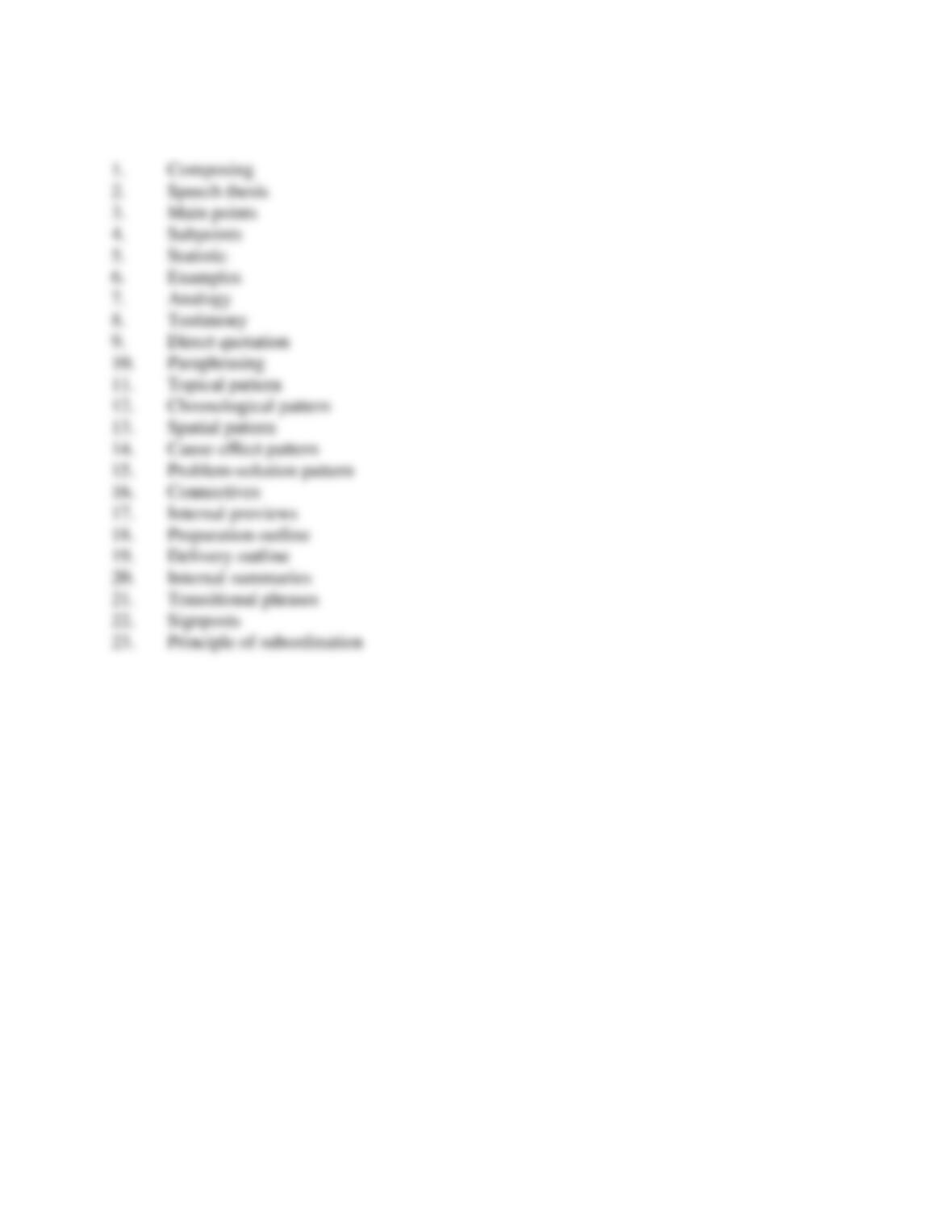
1. Process of determining your speech thesis, main points, and arranging them. _______
2. Complete sentence identifying the central idea of your presentation. _______
3. Key statements or principles that support your speech thesis. _______
4. The breakdown of main points. _______
5. A number that summarizes a formal observation about a phenomenon. _______
6. Specific references that illustrate ideas. _______
7. A type of example that compares something known to something unknown. _______
8. Relying on the words or experience of others. _______
9. Using the exact words of a person to make a point. _______
10. A summary of another’s words or experiences. _______
11. When main points are organized into categories or subtopics. _______
12. An organizational pattern used for presentations that show how to do or make something.
_______
13. Shows how things are related within a physical space. _______
14. Shows how events lead to specific outcomes. _______
15. Describes a problem and presents a solution. _______
Page 2
16. Words or phrases that link ideas together. _______
17. Statements that tell an audience what you are going to tell them. _______
18. A detail of your presentation’s overall structure. _______
19. An outline used while actually presenting your speech to an audience. _______
20. A connective that provides a short review of information you’ve discussed within a
section of the speech. _______
21. A verbal signal used to indicate that you’re shifting to another point or idea. _______
22. Brief words or numbers that quickly introduce a new idea. _______
23. A practice that ensures that you’re making valid arguments and that your claims are well
supported and logical. _______
Page 3
Answer Key