Archives
978-1305501393 Chapter 1 Lecture Note
PART ONE – INTRODUCTION TO ORGANIZATIONAL BEHAVIOR Chapter One – An Overview of Organizational Behavior Overview Managers strive to make their organizations as effective and successful as possible. To do this they rely on assets such as financial reserves and […]
978-1305501393 Chapter 1 Solution Manual
DISCUSSION QUESTIONS 1. What do you think are the most important things a manager does? Is how a manager does these things also important? Why or why not? The ability to understand what people think and feel, knowing how to […]
978-1305501393 Chapter 10 Lecture Note
PART THREE – SOCIAL AND GROUP PROCESSES IN ORGANIZATIONS Chapter Ten – Managing Conflict and Negotiating Chapter Overview Conflict is an inevitable result of interdependencies among people, workgroups, and organizations. Given that all organizations are interdependent systems, organizations without conflict […]
978-1305501393 Chapter 10 Solution Manual
DISCUSSION QUESTIONS 1. Have you ever experienced a constructive conflict? What happened? How was the disagreement resolved? Students can share their experiences. I serve on the organizing committee for a chorale. We were to perform Beethoven’s Ninth Symphony in partnership […]
978-1305501393 Chapter 11 Lecture Note
PART FOUR – LEADERSHIP AND INFLUENCE PROCESSES IN ORGANIZATIONS Chapter Eleven – Traditional Leadership Approaches Chapter Overview Recall that our underlying question in this book is what makes managers and organizations effective and how effectiveness is influenced by performance behaviors, […]
978-1305501393 Chapter 11 Solution Manual
DISCUSSION QUESTIONS 1. How would you define “leadership”? Compare and contrast your definition with the one given in this chapter. The text defines leadership as both a process and a property. A simple definition is that leadership is the process […]
978-1305501393 Chapter 12 Lecture Note
PART FOUR – LEADERSHIP AND INFLUENCE PROCESSES IN ORGANIZATIONS Chapter Twelve – Contemporary Views of Leadership in Organizations Chapter Overview The three major situational theories of leadership discussed in Chapter 11 altered everyone’s thinking about leadership. No longer did people […]
978-1305501393 Chapter 12 Solution Manual
DISCUSSION QUESTIONS 1. Compare and contrast the leader-member exchange and the Hersey and Blanchard models of leadership. Leader-Member Exchange theory suggests that leaders form unique independent relationships with 2. Are you now or have you ever been a member of […]
978-1305501393 Chapter 13 Lecture Note
PART FOUR – LEADERSHIP AND INFLUENCE PROCESSES IN ORGANIZATIONS Chapter Thirteen – Power, Influence, and Politics Chapter Overview The word power often conjures up a variety of thoughts, both good and bad. When used effectively, power and influence are essential […]
978-1305501393 Chapter 13 Solution Manual
DISCUSSION QUESTIONS 1. What power(s) does your instructor have? An instructor has legitimate power, expert power, referent power, coercive power, reward power, and persuasive power. An instructor has been hired by the university (legitimate power), knows the 2. What influence […]
978-1305501393 Chapter 14 Lecture Note Part 1
PART FIVE – ORGANIZATIONAL PROCESSES AND CHARACTERISTICS Chapter Fourteen – Organizational Structure and Design Chapter Overview In Part 4 we continued to learn about how managers can enhance the performance behaviors, organizational commitment, and engagement of their employees in order […]
978-1305501393 Chapter 14 Lecture Note Part 2
III. TYPES OF ORGANIZATIONAL STRUCTURES In new or young organizations, the entrepreneur or founding group makes the decisions, and most communication is one-on-one because of the small organization size. This type of early organizational structure is called prebureaucratic and is […]
978-1305501393 Chapter 14 Solution Manual
DISCUSSION QUESTIONS 1. How do you think your career path might differ in a hierarchical versus a flat organization? In a hierarchical organization with formal authority, chain of command, and rules, an employee’s 2. Why do you think companies are […]
978-1305501393 Chapter 15 Lecture Note
PART FIVE – ORGANIZATIONAL PROCESSES AND CHARACTERISTICS Chapter Fifteen – Organizational Culture Chapter Overview Organizational culture is essential to organizational performance. Not only does it influence the decisions and behaviors of employees, but it also explains what is happening in […]
978-1305501393 Chapter 15 Solution Manual
DISCUSSION QUESTIONS 1. Describe three different types of organizational cultures. When would each be most and least effective for a research and development company dependent on employee innovation? Dominating conflict cultures have open confrontations are accepted as well as heated […]
978-1305501393 Chapter 16 Lecture Note Part 1
PART FIVE – ORGANIZATIONAL PROCESSES AND CHARACTERISTICS Chapter Sixteen – Organization Change and Change Management Chapter Overview Companies that change appropriately can continue as viable businesses. Those that do not make the right changes, like Kodak, lose their ability to […]
978-1305501393 Chapter 16 Lecture Note Part 2
III. ORGANIZATION DEVELOPMENT On one level, organization development is simply the way organizations change and evolve. Thus, in the broadest sense, organization development means organization change. The term as used here, however, means something more specific. Our definition of organization […]
978-1305501393 Chapter 16 Solution Manual
DISCUSSION QUESTIONS 1. Is most organization change forced on the organization by external factors or fostered from within? Explain. Organization change is caused by both external and internal factors. However, most organization 2. What broad category of pressures for organization […]
978-1305501393 Chapter 2 Lecture Note Part 1
PART ONE – INTRODUCTION TO ORGANIZATIONAL BEHAVIOR Chapter Two – The Changing Environment of Organizations Overview The environment of all organizations is changing at an unprecedented rate. People work in different ways and places than in the past, the workplace […]
978-1305501393 Chapter 2 Lecture Note Part 2
IV. TECHNOLOGY AND BUSINESS Technology refers to the methods used to create products, including both physical goods and intangible services. Three specific areas of technology worth noting here are: (1) the shift toward a service-based economy, (2) the growing use […]
978-1305501393 Chapter 2 Solution Manual
DISCUSSION QUESTIONS 1. Which do you think is more important to team performance, surface-level or deep-level diversity? Why? Surface-level diversity refers to observable differences in people, including race, age, ethnicity, 2. How can diversity create a competitive advantage for a […]
978-1305501393 Chapter 3 Lecture Note Part 1
PART TWO – INDIVIDUAL BEHAVIORS AND PROCESSES IN ORGANIZATIONS Chapter Three – Individual Characteristics Overview Chapter 1 showed how managers strive to enhance performance behaviors, enhance commitment and engagement, promote citizenship behaviors, and minimize dysfunctional behaviors by their employees. Chapter […]
978-1305501393 Chapter 3 Lecture Note Part 2
Global Issues: How Others See Americans Summary: This chapter’s Global Issues feature is from a Newsweek survey reporting the characteristics foreigners most and least often associate with them. It may give you some insight into how you might be perceived […]
978-1305501393 Chapter 3 Solution Manual
DISCUSSION QUESTIONS 1. What is a psychological contract? Why is it important? What psychological contracts do you currently have? A psychological contract is the overall set of expectations held by an individual with respect to what 2. What individual differences […]
978-1305501393 Chapter 4 Lecture Note Part 1
PART TWO- INDIVIDUAL BEHAVIORS AND PROCESSES IN ORGANIZATIONS Chapter Four – Individual Values, Perceptions, and Reactions Overview Chapter 3 introduced the concept of individual differences and explored personality, intelligence, and learning styles. This chapter continues our focus on individual behavior […]
978-1305501393 Chapter 4 Lecture Note Part 2
Global Issues: How Culture Can Influence Attributions Summary: In intercultural interactions, the interpretations of behaviors are often more important than the actual behaviors. Because Western cultures emphasize individualism, people prefer dispositional explanations, whereas people from collectivist cultures prefer situational explanations. […]
978-1305501393 Chapter 4 Solution Manual
DISCUSSION QUESTIONS 1. If your boss was not sure it would be worth the investment to change the company’s hiring practices to include an evaluation of applicants’ attitudes, what would you tell him or her? Students may point out that […]
978-1305501393 Chapter 5 Lecture Note Part 1
PART TWO – INDIVIDUAL BEHAVIORS AND PROCESSES IN ORGANIZATIONS Chapter Five – Motivating Behavior Overview Given the complex array of individual differences discussed in Chapter 3 (and extended later in this chapter), it should be obvious that people work for […]
978-1305501393 Chapter 5 Lecture Note Part 2
III. PROCESS-BASED PERSPECTIVES ON MOTIVATION Process-based perspectives focuses on why people choose certain behavioral options to satisfy their needs and how they evaluate their satisfaction after they have attained these goals. Two useful process perspectives on motivation are the equity […]
978-1305501393 Chapter 5 Solution Manual
DISCUSSION QUESTIONS 1. When has your level of performance been directly affected by your motivation? By your ability? By the environment? Students may describe how motivation, ability, and environment affected their level of performance in previous courses. For example, a […]
978-1305501393 Chapter 6 Lecture Note Part 1
PART TWO – INDIVIDUAL BEHAVIORS AND PROCESSES IN ORGANIZATIONS Chapter Six – Motivating Behavior with Work and Rewards Overview Chapter 5 described a variety of perspectives on motivation. But no single theory or model completely explains motivation—each covers only some […]
978-1305501393 Chapter 6 Lecture Note Part 2
V. PERFORMANCE MANAGEMENT Managers can do a variety of things to enhance employee motivation and performance, including designing jobs, allowing greater participation and promoting empowerment, considering alternative work arrangements, and setting goals. However, they may also fail to do things […]
978-1305501393 Chapter 6 Solution Manual
DISCUSSION QUESTIONS 1. What are the primary similarities and differences between job enrichment and the approach proposed by job characteristics theory? Both job enrichment and the job characteristics theory focus on changing objective characteristics of 2. What are the motivational […]
978-1305501393 Chapter 7 Lecture Note Part 1
PART THREE – SOCIAL AND GROUP PROCESSES IN ORGANIZATIONS Chapter Seven – Groups and Teams Chapter Overview In Chapter 1 we noted the pervasiveness of human behavior in organizations and the importance of interactions among people as critical to achieving […]
978-1305501393 Chapter 7 Lecture Note Part 2
C. The Implementation Process Implementing teams across an organization is not easy; it takes a lot of hard work, time, training, and patience. Changing from a traditional organizational structure to a team-based structure is a major organizational change and calls […]
978-1305501393 Chapter 7 Solution Manual
DISCUSSION QUESTIONS 1. Identify several different groups that you belong to and classify them as one of the group types discussed in this chapter. 2. Think about an effective team you have been on. What made it effective? Think about […]
978-1305501393 Chapter 8 Lecture Note Part 1
PART THREE – SOCIAL AND GROUP PROCESSES IN ORGANIZATIONS Chapter Eight – Decision Making and Problem Solving Chapter Overview Managers routinely make both tough and easy decisions. Regardless of which decisions are made, though, it is almost certain that some […]
978-1305501393 Chapter 8 Lecture Note Part 2
Global Issues: Culture and Nationality Influences on Ethical Awareness Summary: Research has found that both culture and nationality influence the recognition of ethical issues. One study found that Taiwanese sales agents perceived ethical issues associated with their companies’ or competitors’ […]
978-1305501393 Chapter 8 Solution Manual
DISCUSSION QUESTIONS 1. Some have argued that people, not organizations, make decisions and that the study of “organizational” decision making is therefore pointless. Do you agree with this argument? Why or why not? Students may or may not agree that […]
978-1305501393 Chapter 9 Lecture Note Part 1
PART THREE – SOCIAL AND GROUP PROCESSES IN ORGANIZATIONS Chapter Nine – Communication Chapter Overview Communication, a form of social interaction, is the glue that holds organizations together—it is not an understatement to say that if communication within an organization […]
978-1305501393 Chapter 9 Lecture Note Part 2
III. COMMUNICATION MEDIA Managers can choose from a variety of communication media. Some of the most popular are the internet, collaboration software, intranets, and oral communication. Media richness is an important factor for each form. A. The Internet The Internet […]
978-1305501393 Chapter 9 Solution Manual
DISCUSSION QUESTIONS 1. What are your preferred methods of receiving information? Does your answer differ depending on the type of information being sent? 2. What are the implications of organizational diversity on the communication media the company should use? Words […]
Management Chapter 1 Most people are born and educated in organizations
Name: Class: Date: Chapter 01—An Overview of Organizational Behavior True / False 1. Organizational behavior is the study of human behavior in organizational settings, the interface between human behavior and the organization, and the organizational itself. a. True b. False […]
Management Chapter 1 She has devised a process by which her company
Name: Class: Date: Chapter 01—An Overview of Organizational Behavior 66. After World War I, attention shifted away from scientific management to understanding the role of _____________ in organizations. a. managerial corruption b. law and politics c. gender and sexual harassment […]
Management Chapter 10 The conflict between these two groups is a result of
Name: Class: Date: Chapter 10—Managing Conflict and Negotiating True / False 1. Conflict is a common occurrence in organizations. a. True b. False ANSWER: True 2. Either too much or too little conflict may result in low performance. a. True […]
Management Chapter 10 What is the term for someone who investigates complaints
Name: Class: Date: Chapter 10—Managing Conflict and Negotiating a. documenting b. perspective taking c. smoothing d. reaching out e. focusing on interests rather than positions ANSWER: c 66. Which conflict resolution behavior entails contacting the other party, making the first […]
Management Chapter 11 One Conclusion The University Michigan Studies
Name: Class: Date: Chapter 11—Traditional Leadership Approaches True / False 1. Leadership is a set of characteristics an individual actually possesses or is perceived to possess. a. True b. False ANSWER: True 2. Leadership usually involves some form of force […]
Management Chapter 11 Which The Following More Closely Associated With
Name: Class: Date: Chapter 11—Traditional Leadership Approaches b. consideration behavior. c. initiating-structure behavior. d. employee-centered leader behavior. e. job-centered leader behavior. ANSWER: d 68. One conclusion of the Ohio State studies was that a leader who clearly defines the leader-subordinate […]
Management Chapter 12 Faith in top leaders has been shaken due to recent
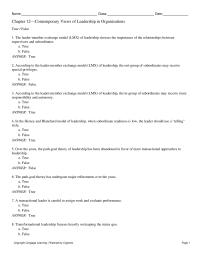
Name: Class: Date: Chapter 12—Contemporary Views of Leadership in Organizations True / False 1. The leader-member exchange model (LMX) of leadership stresses the importance of the relationships between supervisors and subordinates. a. True b. False ANSWER: True 2. According to […]
Management Chapter 13 Leadership Least Effective The Degree That Followers
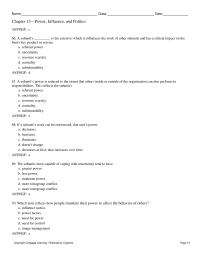
Name: Class: Date: Chapter 13—Power, Influence, and Politics ANSWER: c 66. A subunit’s _________ is the extent to which it influences the work of other subunits and has a critical impact on the firm’s key product or service. a. referent […]
Management Chapter 13 Making Resources More Scarce Causes Power
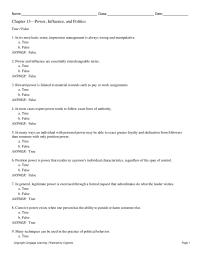
Name: Class: Date: Chapter 13—Power, Influence, and Politics True / False 1. In its most basic sense, impression management is always wrong and manipulative. a. True b. False ANSWER: False 2. Power and influence are essentially interchangeable terms. a. True […]
Management Chapter 14 Pams Organization The Span Control Rather Narrow
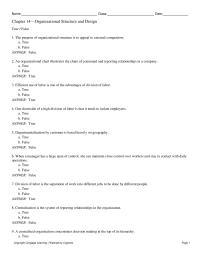
Name: Class: Date: Chapter 14—Organizational Structure and Design True / False 1. The purpose of organizational structure is to appeal to external competitors. a. True b. False ANSWER: False 2. An organizational chart illustrates the chain of command and reporting […]
Management Chapter 14 When Organizational Restructuring Results Fewer Employees Which
Name: Class: Date: Chapter 14—Organizational Structure and Design c. network organization d. matrix e. bureaucracy ANSWER: a 67. A _________ is a collection of autonomous units or firms that act as a single larger entity, using social mechanisms for coordination […]
Management Chapter 15 Because Workgroups Develop Their Own Subcultures
Name: Class: Date: Chapter 15—Organizational Culture True / False 1. The values that make up an organization’s culture are often taken for granted. a. True b. False ANSWER: True 2. Myths may be part of an organization’s culture. a. True […]
Management Chapter 16 Because of perceptual limitations such as lack
Name: Class: Date: Chapter 16—Organization Change and Change Management True / False 1. The median age in the United States has gradually increased over the last several decades. a. True b. False ANSWER: True 2. The four areas in which […]
Management Chapter 2 Valuing Diversity Means Appreciating The Varying Ideas
Name: Class: Date: Chapter 02—The Changing Environment of Organizations True / False 1. In 2014, the volume of international trade in current dollars was more than 50 times greater than the amount in 1960. a. True b. False ANSWER: True […]
Management Chapter 3 Circumstances becomes more important the more
Name: Class: Date: Chapter 03—Individual Differences True / False 1. Person-job fit is the extent to which the contributions made by the individual match the inducements offered by the organization. a. True b. False ANSWER: True 2. Individual differences are […]
Management Chapter 3 What term refers to the fit between an individual
Name: Class: Date: Chapter 03—Individual Differences a. Intuitive b. Sensing c. Extroverted d. Introverted e. Judging ANSWER: b 65. _________ value fairness, and decide things impersonally based on objective criteria and logic. a. Perceivers b. Feelers c. Thinkers d. Extroverts […]
Management Chapter 4 But after graduation the only job offer you receive
Name: Class: Date: Chapter 04—Individual Values, Perceptions, and Reactions True / False 1. Cognitive dissonance occurs when there is congruence among attitudes, perceptions, and behaviors. a. True b. False ANSWER: False 2. Basic perceptual processes include selective perception and stereotyping. […]
Management Chapter 4 What Term Refers The Perceived Fairness The
Name: Class: Date: Chapter 04—Individual Values, Perceptions, and Reactions c. the work itself d. alma mater e. attitudes ANSWER: d 68. As a manager, if you want to increase your subordinates’ job satisfaction, focus first on __________________. a. improving their […]
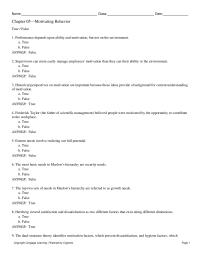
Management Chapter 5 Which Type Reinforcement Schedule Effective Motivating Desirable
Name: Class: Date: Chapter 05—Motivating Behavior True / False 1. Performance depends upon ability and motivation, but not on the environment. a. True b. False ANSWER: False 2. Supervisors can more easily manage employees’ motivation than they can their ability […]
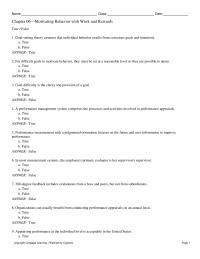
Management Chapter 6 Which The Following The Primary Problem Associated
Name: Class: Date: Chapter 06—Motivating Behavior with Work and Rewards True / False 1. Goal-setting theory assumes that individual behavior results from conscious goals and intentions. a. True b. False ANSWER: True 2. For difficult goals to motivate behavior, they […]
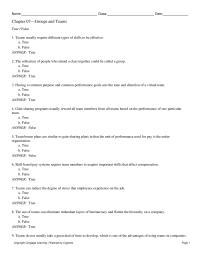
Management Chapter 7 The Two Essential Issues That Must Not
Name: Class: Date: Chapter 07—Groups and Teams True / False 1. Teams usually require different types of skills to be effective. a. True b. False ANSWER: True 2. The collection of people who attend a class together could be called […]
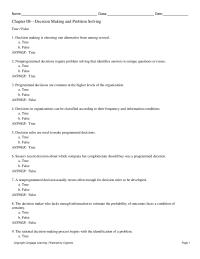
Management Chapter 8 Excepta Group Members Could Take Extreme View
Name: Class: Date: Chapter 08—Decision Making and Problem Solving True / False 1. Decision making is choosing one alternative from among several. a. True b. False ANSWER: True 2. Nonprogrammed decisions require problem solving that identifies answers to unique questions […]
Management Chapter 9 Employees checking their cell phones and whispering
Name: Class: Date: Chapter 09—Communication Copyright Cengage Learning. Powered by Cognero. Page 12 65. Which technology began as an informal communication channel but has since evolved into a primary and formal means of business correspondence for many organizations? a. voice […]
Management Chapter 9 Which of the following statements about the
Name: Class: Date: Chapter 09—Communication True / False 1. Expressing feelings and emotions can facilitate coordinated action when communicating. a. True b. False ANSWER: True 2. One of the key purposes of organizational communication is to share information with members […]