Archives: Quiz
Management Chapter 17 They Area Authentication And Authorization And
ANS: F PTS: 1 REF: 730 Chapter 17: Managing Information TRUE/FALSE 1. Raw data contain useful information that communicate a clear and readily understandable message to the person for which the data were gathered. 2. DSS programs can replace managerial […]
Management Chapter 17 3 Refer to City of London. Because information
City of London For over a century, the city of London, England, has had the worst traffic in Europe. Drivers spend half of their time not moving in their vehicles, and the average speed is 9 mph, down from 12 […]
Management Chapter 17 2 Management 89 Snyders Hanover The Worlds Second Biggest
59. __________ is the process of ensuring that data are reliably and consistently retrievable in a usable format for authorized users, but no one else. a. Decryption b. Roadblocking c. Data insulation d. Protecting information e. Cookie manipulation ANS: D […]
Management Chapter 17 1 According to the “Doing the Right Thing” box
Chapter 17: Managing Information TRUE/FALSE 1. Moore’s law accounts for the rapid increase in power and reduction in both size and price of computer equipment over the past 40 years. 2. Moore’s law refers to the prediction that about every […]
Management Chapter 16 The is the most important reason for calculating
ANS: F Unlike many kinds of financial controls, EVA doesn’t specify what should or should not be done to improve performance. PTS: 1 REF: 685 Chapter 16: Control TRUE/FALSE 1. Benchmarking is the process of setting corporate norms. 2. One […]
Management Chapter 16 Normative controls should be used when
ANS: F Unlike many kinds of financial controls, EVA doesn’t specify what should or should not be done to improve performance. PTS: 1 REF: 685 ANS: F Quality is typically defined and measured in terms of excellence, value, and conformance […]
Management Chapter 16 3 This occurred during which step of the control process?
Walgreens Despite thirty straight years of increased revenues and profits, Walgreens found itself facing intense competition from Costco, Wal-Mart, and CVS. However, the biggest and newest threat to Walgreens’ business was mail-order prescription sales managed by pharmacy benefit managers (PBMs), […]
Management Chapter 16 2 The U.S.Chemical Safety and Hazard Investigation Board
e. organizational culture, values, and beliefs are strong 55. ____ control is associated with autonomous work groups. a. Objective b. Normative c. Behavior d. Concertive e. Output ANS: D PTS: 1 DIF: Moderate REF: 677 TOP: AACSB Technology KEY: Operations […]
Management Chapter 16 1 The Chain Stores Was Able Set This
Chapter 16: Control TRUE/FALSE 1. Control is achieved when behavior and work procedures conform to standards, and company goals are accomplished. 2. The control process begins when managers set goals. ANS: T PTS: 1 DIF: Easy REF: 667 TOP: AACSB […]
Management Chapter 15 One of the best ways for top managers to hear
Chapter 15: Managing Communication MULTIPLE CHOICE 1. The steps in the basic perception process include all of the following EXCEPT: a. attention b. organization c. analysis d. interpretation e. retention 2. __________ is the tendency to overestimate our value by […]
Management Chapter 15 when messages are emotion ladend
ANS: T The self-serving bias is the tendency to overestimate our value by attributing successes to ourselves (internal causes) and attributing failures to others or the environment (external causes). PTS: 1 REF: 624 ANS: T PTS: 1 REF: 637 ANS: […]
Management Chapter 15 3 While this was a violation of company spending guidelines
c. Attitudinal derivation d. Conceptual decoding e. Motivational instrumentality 129. Refer to Urban Legends. The angry P&G consumer who started the rumor about Febreeze would have used ____ to create the initial email message. a. physical stimuli b. intranets c. […]
Management Chapter 15 2 Refer Urban Legends Personality Psychology
57. On a November episode of Law & Order, the District Attorney described the judicial building in which he works as a “kudzu grapevine.” (Kudzu can grow up to 12 inches per 24-hour period.) What other term could he have […]
Management Chapter 15 1 Customers Assumed Was Derelict Those Who Recognized
Chapter 15: Managing Communication TRUE/FALSE 1. Across all industries, poor communication skill is the single most important reason why people do not advance in their chosen career. 2. Communication is the process of transmitting information from one person or place […]
Management Chapter 14 Transactional leaders: a. reward followers for good behavior
ANS: T PTS: 1 REF: 595 Chapter 14: Leadership TRUE/FALSE 1. One of the differences between managers and leaders is that managers focus on visions, missions, goals, and objectives, and leaders focus solely on productivity and efficiency. 2. According to […]
Management Chapter 14 Which of the following leadership theories is most
ANS: F While this position has been historically accepted, more recent evidence shows that successful leaders are not like other people, and that leaders differ from nonleaders on the following traits: drive, the desire to lead, honesty/integrity, self-confidence, emotional stability, […]
Management Chapter 14 3 Leadership Neutralizers Are Subordinate Task Or organizational Characteristics
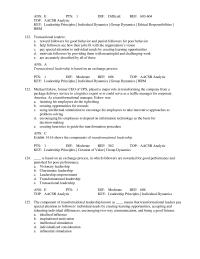
122. Transactional leaders: a. reward followers for good behavior and punish followers for poor behavior b. help followers see how their jobs fit with the organization’s vision c. pay special attention to individual needs by creating learning opportunities d. motivate […]
Management Chapter 14 2 Which The Following One The Steps
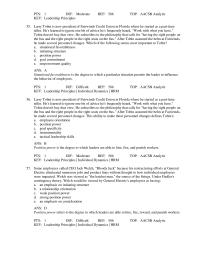
55. Larry Tobin is now president of Fairwinds Credit Union in Florida where he started as a part-time teller. He’s learned to ignore one bit of advice he’s frequently heard, “Work with what you have.” Tobin doesn’t buy that view. […]
Management Chapter 14 1 As a leader behavior, initiating structure is the degree to which
Chapter 14: Leadership TRUE/FALSE 1. Leadership is the process of influencing others to achieve group or organizational goals. 2. One of the differences between managers and leaders is that managers focus on visions, missions, goals, and objectives, and leaders focus […]
Management Chapter 13 Workers do not have to truly accept organizational
ANS: F This is the definition of procedural justice. Distributive justice refers to the perceived degree to which outcomes and rewards are fairly distributed or allocated. PTS: 1 REF: 544 Chapter 13: Motivation TRUE/FALSE 1. In general, extrinsic rewards are […]
Management Chapter 13 According The Expectancy Theory
ANS: T PTS: 1 REF: 534 ANS: F In theory, overreward causes inequity, but in practice, such inequity occurs infrequently. PTS: 1 REF: 541 ANS: F Negative reinforcement is also called avoidance learning, because workers perform a behavior to avoid […]
Management Chapter 13 3 Moderate Ref 558 key Motivation Concepts Individual Dynamic stop
122. Refer to Wegmans. Wegmans’ scholarship bonuses for part-time workers indicate the company is using: a. over-rewarding b. positive reinforcement c. positive extinction d. under-rewarding e. an expectancy contingency ANS: B Positive reinforcement is defined as reinforcement that strengthens behavior […]
Management Chapter 13 2 According to reinforcement theory, Australian officials are using
61. ____ is the process of changing behavior by changing the consequences that follow behavior. a. Consequential modification b. Behavioral substantiation c. Valence manipulation d. Expectancy feedback e. Reinforcement ANS: E PTS: 1 DIF: Easy REF: 550 TOP: AACSB Analytic […]
Management Chapter 13 1 Reinforcement Theory Says Behavior Function Of
Chapter 13: Motivation TRUE/FALSE 1. Motivation is the set of forces that initiates, directs, and makes people persist in their efforts to accomplish a goal. 2. According to some industrial psychologists, Job Performance = Motivation Ability. ANS: F According […]
Management Chapter 12 Which of the following is a paradigm for managing diversity?
ANS: F Performance does not decline with age, regardless of the type of job. PTS: 1 REF: 494 Chapter 12: Managing Individuals and a Diverse Workforce TRUE/FALSE 1. Affirmative action is required by law for all private employers, and diversity […]
Management Chapter 12 Unfortunately, they have not eliminated glass ceilings
ANS: F Performance does not decline with age, regardless of the type of job. PTS: 1 REF: 494 ANS: F The Big Five personality dimensions are extraversion, emotional stability, agreeableness, conscientiousness, and openness to experience PTS: 1 REF: 501 Chapter […]
Management Chapter 12 3 Consequently Affirmative Action Basically Punitive approach This Time
c. its external environments d. its shareholders/investors e. all of these 117. Refer to PepsiCo. PepsiCo has _____ because it is an organization where there is a variety of demographic, cultural, and personal differences among the people who work there […]
Management Chapter 12 2 Refer PepsiCo Order For PepsiCo Achieve
57. Which of the following is one of the Big Five personality dimensions? a. Machiavellian tendencies b. self-monitoring c. emotional stability d. positive/negative affectivity e. empathy 58. The term __________ refers to the degree to which someone is cooperative, polite, […]
Management Chapter 12 1 The Strategy Used Defend Organization Against Charges
Chapter 12: Managing Individuals and a Diverse Workforce TRUE/FALSE 1. The fastest-growing racial group in the United States is Hispanics. 2. Diversity exists in organizations when there is a variety of demographic, cultural, and personal differences among the customers who […]
Management Chapter 11 Cognitive Ability Tests Measure The Extent Which
ANS: T PTS: 1 REF: 444-445 ANS: F The three employee benefits mandated by law are Social Security, worker’s compensation, and unemployment insurance. PTS: 1 REF: 466 Chapter 11: Managing Human Resource Systems TRUE/FALSE 1. Human resource management (HRM) is […]
Management Chapter 11 Which of the following is an example of a subjective
ANS: F The most common work force forecasting method is direct managerial input PTS: 1 REF: 428 ANS: T PTS: 1 REF: 432-433 ANS: F The three employee benefits mandated by law are Social Security, worker’s compensation, and unemployment insurance. […]
Management Chapter 11 3 Internal Recruiting Finding Qualified Job applicants From Inside
113. Refer to Trends in Hiring Practices. When an Amy’s job applicant returns with whatever he or she decided to make from the brown paper bag, the store manager conducts a brief __________ interview. The questions asked by the manager […]
Management Chapter 11 2 The more common assessment center exercises include:
56. Estimates of losses in the HAZMAT driver workforce could vary from 2 percent to 20 percent as a result of new federal regulations requiring that all drivers be fingerprinted and those fingerprints checked to see if the driver has […]
Management Chapter 11 1 A job specification summarizes the basic tasks, duties,
Chapter 11: Managing Human Resource Systems TRUE/FALSE 1. Human resource management (HRM) is the process of finding, developing, and keeping the right people to form a qualified work force. 2. Training and performance appraisal are basic activities in the final […]
Management Chapter 10 What Can Management Promote Group Cohesiveness a Have
ANS: T PTS: 1 REF: 405 Chapter 10: Managing Teams TRUE/FALSE 1. In the decision-making process, teams can do a much better job than individuals in defining the problem and generating alternative solutions. 2. Structural accommodation means giving teams the […]
Management Chapter 10 Which The Following Kinds Team Defined Permanent
ANS: T PTS: 1 REF: 405 ANS: F Teams are a means to an end, not an end in themselves. They should be used only under certain specific circumstances. PTS: 1 REF: 387-389 Chapter 10: Managing Teams TRUE/FALSE 1. In […]
Management Chapter 10 3 List The Stages That Teams Pass Through
Dudley Experiment The National Health Service (NHS) in Great Britain is overhauling how it conducts business. One of its experiments is being conducted in Dudley, where the Russells Hall Hospital is a gleaming modern medical facility. The hospital presented the […]
Management Chapter 10 2 Which of the following is NOT one of the recommendations
55. ____ is the extent to which team members are attracted to a team and motivated to remain in it. a. Accommodation b. Synergy c. Autonomy d. Cohesiveness e. Empathy ANS: D PTS: 1 DIF: Easy REF: 397 TOP: AACSB […]
Management Chapter 10 1 According The What Really Works Cohesion
Chapter 10: Managing Teams TRUE/FALSE 1. A work team consists of a small number of people who have been assigned responsibility for pursuing a common purpose, achieving performance goals, and improving interdependent work processes. 2. Companies are making greater use […]
Management Chapter 9 Except for the core business activities that
Chapter 9: Designing Adaptive Organizations MULTIPLE CHOICE 1. __________ is the vertical and horizontal configuration of departments, authority, and jobs within a company. a. Departmental mapping b. Organizational charting c. Organizational structure d. Organizational configuration e. Functionalization 2. __________ is […]
Management Chapter 9 The Core Philosophy Upon Which The Job
ANS: T PTS: 1 REF: 343-344 ANS: F Specialized jobs are highly efficient but can be tedious unless managers use job rotation, job enlargement, and job enrichment to make them more interesting. PTS: 1 REF: 354 ANS: F While job […]
Management Chapter 9 3 Reengineering Changes Organizations Orientation From Vertical To horizontal
Royal Dutch/Shell Royal Dutch/Shell operates in 130 countries around the world and controls every aspect of oil production from the ground to the gas pump. This large international company is also an insular company, saddled with introverted control freaks, a […]
Management Chapter 9 2 A pooled Interdependence Means That The Task Was
b. task specialization c. job enrichment d. task standardization e. job rotation 58. The job design approach associated with ____ involves increasing the number of different tasks that a worker performs within one particular job and giving workers the authority […]
Management Chapter 9 1 Matrix departmentalization is a hybrid structure
Chapter 9: Designing Adaptive Organizations TRUE/FALSE 1. Organizational structure is the vertical and horizontal configuration of departments, authority, and jobs within a company. 2. While organizational structure emphasizes the activities through which work gets done in the organization, organizational process […]
Management Chapter 8 Global Management multiple Choice1 Global Business a The
Chapter 8: Global Management MULTIPLE CHOICE 1. Global business: a. is the buying and selling of goods and services to people from different countries b. includes any sale of goods and services c. only involves companies with more than 50 […]
Management Chapter 8 Country Region That Has
ANS: F More than any other regional trade agreement, NAFTA (the North American Free Trade Agreement) liberalizes trade between countries so that businesses can plan for one market, North America, rather than for three separate markets, the United States, Canada, […]
Management Chapter 8 2 In 2006, a car bomb near a Chinese-owned oil refinery
57. According to the ASEAN trade agreement, Malaysia was supposed to eliminate nearly all tariff barriers protecting its car market by 2008. With this act, the Malaysian government would: a. stop using nontax methods to increase the volume of imported […]
Management Chapter 8 1 Dif Moderate Key Environmental Influence Ref 300
Chapter 8: Global Management TRUE/FALSE 1. In the same way that business is defined as the buying and selling of goods and services, global business is defined as the buying and selling of goods and services by people from different […]
Management Chapter 7 Patterns of innovation over time that can create sustainable
ANS: F Resistance to change results from personal factors, such as self-interest, misunderstanding and distrust, and a general intolerance for change. PTS: 1 REF: 274-275 Chapter 7: Innovation and Change TRUE/FALSE 1. The same techniques for managing innovation work equally […]
Management Chapter 7 Organizational decline is typically reversible at any of
ANS: F It’s important to note that technology cycles and technological innovation are not limited to “high technology.” PTS: 1 REF: 255-257 ANS: F Decline is typically reversible only at each of the first four stages; by the time the […]