Archives
978-1305949546 Appendix B
Name: Class: Date: Appendix B: Interviewing Copyright Cengage Learning. Powered by Cognero. Page 1 1. Interviews are different from many other kinds of communication because of which of the following characteristics? a. Intensity b. Informality c. Formality d. Question and […]
978-1305949546 Chapter 1
Name: Class: Date: Chapter 01: The World of Communication Copyright Cengage Learning. Powered by Cognero. Page 1 1. Which of the following statements about communication is accurate? a. Studying communication only has academic benefits. b. People who study communication are […]
978-1305949546 Chapter 10
Name: Class: Date: Chapter 10: Communication and Culture Copyright Cengage Learning. Powered by Cognero. Page 1 1. Which dimension of cultural variation refers to the extent to which a culture values aggressiveness, competitiveness, looking out for yourself, and dominating others […]
978-1305949546 Chapter 11
Name: Class: Date: Chapter 11: Media and Media Literacy Copyright Cengage Learning. Powered by Cognero. Page 1 1. All of the following are examples of mass media EXCEPT a. television. b. instagrams. c. magazines. d. radio. e. the Web. ANSWER: […]
978-1305949546 Chapter 12
Name: Class: Date: Chapter 12: Planning Public Speaking Copyright Cengage Learning. Powered by Cognero. Page 1 1. Which of these is a guideline for choosing a speech topic? a. Select a topic that is brand new to you. b. Wait […]
978-1305949546 Chapter 13
Name: Class: Date: Chapter 13: Researching and Developing Support for Public Speeches Copyright Cengage Learning. Powered by Cognero. Page 1 1. Interviews allow a speaker to a. gather information. b. check the accuracy of ideas. c. understand the perspective of […]
978-1305949546 Chapter 14
Name: Class: Date: Chapter 14: Organizing and Presenting Public Speeches Copyright Cengage Learning. Powered by Cognero. Page 1 1. “Today I will explain to you how humans have evolved from apes to Neanderthals to the human form we have today.” […]
978-1305949546 Chapter 15
Name: Class: Date: Chapter 15: Informative Speaking Copyright Cengage Learning. Powered by Cognero. Page 1 1. The presentation that has the goal of increasing others’ knowledge, understanding, or abilities is referred to as what type of public message? a. Impromptu […]
978-1305949546 Chapter 16
Name: Class: Date: Chapter 16: Persuasive Speaking Copyright Cengage Learning. Powered by Cognero. Page 1 1. When Jeremy begins his speech, the audience doesn’t know him and has no basis for assuming he is competent. During his speech, however, Jeremy […]
978-1305949546 Chapter 2
Name: Class: Date: Chapter 02: Perception and Communication Copyright Cengage Learning. Powered by Cognero. Page 1 1. Elijah goes into the library to find his friend Aimee who went there to study. He walks through the library until he sees […]
978-1305949546 Chapter 3
Name: Class: Date: Chapter 03: Communication and Personal Identity Copyright Cengage Learning. Powered by Cognero. Page 1 1. “You are an excellent athlete,” Kevin tells his daughter. Kevin’s statement is an example of a. indirect definition. b. direct definition. c. […]
978-1305949546 Chapter 4
Name: Class: Date: Chapter 04: Listening Effectively Copyright Cengage Learning. Powered by Cognero. Page 1 1. Only eight hours after physically receiving a message, most people remember only about what amount of the message? a. 25 percent b. 75 percent […]
978-1305949546 Chapter 5
Name: Class: Date: Chapter 05: The Verbal Dimension of Communication Copyright Cengage Learning. Powered by Cognero. Page 1 1. Which of the following is a regulative communication rule? a. Hugging is a way to show care and friendship. b. Making […]
978-1305949546 Chapter 6
Name: Class: Date: Chapter 06: The Nonverbal Dimension of Communication Copyright Cengage Learning. Powered by Cognero. Page 1 1. Scholars estimate that nonverbal communication accounts for what percentage of the total meaning in interpersonal communication? a. less than 25% b. […]
978-1305949546 Chapter 7
Name: Class: Date: Chapter 07: Communication in Personal Relationships Copyright Cengage Learning. Powered by Cognero. Page 1 1. Chris says he loves Betsy but he’s not sure they have a future together. Chris’s feelings toward Betsy indicate a. he loves […]
978-1305949546 Chapter 8
Name: Class: Date: Chapter 08: Communication in Groups and Teams Copyright Cengage Learning. Powered by Cognero. Page 1 1. The two most significant potential disadvantages of group discussion are a. the time required and excessive cohesion. b. the time required […]
978-1305949546 Chapter 9
Name: Class: Date: Chapter 09: Communication in Organizations Copyright Cengage Learning. Powered by Cognero. Page 1 1. The term used to describe the ways of thinking, acting, and understanding work that are shared by members of an organization and reflect […]
Speech Appendix B Appendix Interviewing Outline Interviews Are Communication Transactions That Emphasize Questions And Answers
APPENDIX B: Interviewing OUTLINE I. Interviews are communication transactions that emphasize questions and answers. A. Eleven distinct types (purposes) of interviews have been identified. 2. Information-getting interviews are used to gain information from people. 3. Persuasive interviews are used to […]
Speech Appendix B Loaded Questions Are Sometimes Good Ask Because They Can Reveal The True
19. Loaded questions are sometimes good to ask because they can reveal the true viewpoints of the interviewee. a. True b. False 20. The question, “You believe in teamwork, don’t you?” is an example of a probing question. a. True […]
Speech Chapter 1 Communication With Others Helps Shape Which Areas Our Lives Culture And Professional
10. Communication with others helps to shape which area(s) of our lives? a. culture and professional b. professional and social/civic c. personal, cultural, and professional d. personal and professional e. cultural, professional, social/civic, and personal 11. What name does philosopher […]
Speech Chapter 1 The World Communication Learning Objectives After Studying The Topics This
CHAPTER 1: The World of Communication LEARNING OBJECTIVES After studying the topics in this chapter, students should be able to: 1. Identify the key features that define communication. 3. Identify the value of studying communication to four aspects of your […]
Speech Chapter 10 Communication And Culture Learning Objectives After Studying The Topics This
CHAPTER 10: Communication and Culture LEARNING OBJECTIVES After studying the topics in this chapter, students should be able to: 1. Give examples to illustrate the premise that cultures are systems. 3. Reflect on a social community or coculture to which […]
Speech Chapter 10 Which These Example Being Multilingual Nadia Who Spanish Speaks French Spanish And
16. Which of these is an example of being multilingual? a. Nadia, who is Spanish, speaks French, Spanish, and English. b. Carlos, who is gay, understands the slang of gay communities and straight communities. c. Eloise, a Canadian woman living […]
Speech Chapter 11 False Cultivation Theory Looks The Cumulative Effect Television Rather Than The Effects
b. False 25. Cultivation theory looks at the cumulative effect of television rather than the effects of individual messages. a. True b. False 26. The high incidence of violence in news programming reflects in part the fact that the abnormal […]
Speech Chapter 11 Media And Media Literacy Learning Objectives After Studying The Topics This
CHAPTER 11: Media and Media Literacy LEARNING OBJECTIVES After studying the topics in this chapter, students should be able to: 2. Discuss three theories of mass media: uses and gratification, agenda setting, and cultivation. 3. Provide examples of media acting […]
Speech Chapter 12 Effective Public Speaking Much Like The Speaker Needs Select Topic That Appropriate
37. Effective public speaking is much like ____________________. 38. The speaker needs to select a topic that is appropriate to the speaking ____________________. 39. After you have decided on a general purpose for your speech you need to write a(n) […]
Speech Chapter 12 Planning Public Speaking Learning Objectives After Studying The Topics This
CHAPTER 12: Planning Public Speaking LEARNING OBJECTIVES After studying the topics in this chapter, students should be able to: 1. Explain ways in which public speaking is similar to everyday conversation. 3. Distinguish between a speech’s general purpose and its […]
Speech Chapter 13 Researching And Developing Support For Public Speeches Learning Objectives After Studying
CHAPTER 13: Researching and Developing Support for Public Speeches LEARNING OBJECTIVES After studying the topics in this chapter, students should be able to: 2. List five kinds of evidence used by effective public speakers. 3. Identify three kinds of examples […]
Speech Chapter 13 The Word Plagiarize Means Kidnap True False You Dont Have Real Example
28. The word plagiarize means “to kidnap.” a. True b. False 29. If you don’t have a real example, it is fine to make one up as long as you tell your audience it is a hypothetical example. a. True […]
Speech Chapter 14 Jennifer Going Give Informative Speech About The Parts The Pentagon Which Pattern
16. Jennifer is going to give an informative speech about the parts of the Pentagon. Which pattern of organization should she use? a. topical b. temporal c. comparative d. star e. spatial 17. Which organizational pattern argues that there is […]
Speech Chapter 14 Organizing And Presenting Public Speeches Learning Objectives After Studying The Topics
CHAPTER 14: Organizing and Presenting Public Speeches LEARNING OBJECTIVES After studying the topics in this chapter, students should be able to: 1. List and explain the three ways in which oral communication differs from written communication. 3. Identify seven common […]
Speech Chapter 15 Informative Speaking Learning Objectives After Studying The Topics This Students
CHAPTER 15: Informative Speaking 1. Explain four ways in which informative speaking differs from persuasive speaking. 2. List eight guidelines for effective informative speaking. 3. Recall five strategies for informative speaking that will enhance listeners’ retention. 4. Provide an example […]
Speech Chapter 16 Persuasive Speaking Learning Objectives After Studying The Topics This Students
CHAPTER 16: Persuasive Speaking LEARNING OBJECTIVES After studying the topics in this chapter, students should be able to: 2. Summarize the nature of each of the three pillars of persuasion. 3. Define and provide an example for each of the […]
Speech Chapter 16 The Statement You Cant Possibly Trust What Margaret Said About College Life
17. The statement “You can’t possibly trust what Margaret said about college life because she has never gone to college!” is an example of a. ad hominem. b. post hoc, ergo propter hoc. c. slippery slope. d. hasty generalization. e. […]
Speech Chapter 2 Claims That Culture Includes Number Social Communities And Each One Distinctively Shapes
11. ____ claims that a culture includes a number of social communities, and each one distinctively shapes the perceptions, identities, and opportunities of its members. a. Social exchange theory b. Uncertainty reduction theory c. Constructivism d. Attribution theory e. Standpoint […]
Speech Chapter 2 Perception And Communication Learning Objectives After Studying The Topics This
CHAPTER 2: Perception and Communication LEARNING OBJECTIVES After studying the topics in this chapter, students should be able to: 1. Recognize that perception is made up of a series of steps in which we select, organize, and interpret information to […]
Speech Chapter 3 Communication And Personal Identity Learning Objectives After Studying The Topics This
CHAPTER 3: Communication and Personal Identity LEARNING OBJECTIVES After studying the topics in this chapter, students should be able to: 1. Provide examples of a direct definition, a reflected appraisal, and a social comparison that have shaped your self-concept. 3. […]
Speech Chapter 3 Western Culture Recognizes Multiple Sexesgenders While Many Countries Such New Zealand And
25. Western culture recognizes multiple sexes/genders, while many countries, such as New Zealand and Nepal, recognize only two. a. True b. False 26. We internalize the generalized other‘s perspective. a. True b. False 27. As soon as we are born, […]
Speech Chapter 4 Cognitive Psychologists Have Found That Email Alerts Ims And Notifications Text Messages
21. Cognitive psychologists have found that email alerts, IMs, and notifications of text messages do not undermine the ability to listen mindfully for those who are accustomed to multitasking. a. True b. False 22. Ambushing involves listening carefully. a. True […]
Speech Chapter 4 Listening Effectively Learning Objectives After Studying The Topics This Students
CHAPTER 4: Listening Effectively LEARNING OBJECTIVES After studying the topics in this chapter, students should be able to: 1. Identify the key features that define communication. 3. Identify the value of studying communication to four aspects of your life: personal, […]
Speech Chapter 5 The Verbal Dimension Communication Learning Objectives After Studying The Topics This
CHAPTER 5: The Verbal Dimension of Communication LEARNING OBJECTIVES After studying the topics in this chapter, students should be able to: 1. Explain why ambiguous or abstract words can lead to misunderstandings. 3. Provide an example of how words can […]
Speech Chapter 5 Web Links Website Description Url Learn More About Gender And Media Visit
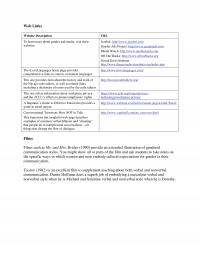
Web Links Website Description URL To learn more about gender and media, visit these websites. Jezebel: http://www.jezebel.com Gender Ads Project: http://www.genderads.com Media Watch: http://www.mediawatch.com Off Our Backs: http://www.offourbacks.org Geena Davis Institute: http://www.thegeenadavisinstitute.org/index.php The iLoveLanguages home page provides comprehensive links to […]
Speech Chapter 6 The Nonverbal Dimension Communication Learning Objectives After Studying The Topics This
CHAPTER 6: The Nonverbal Dimension of Communication LEARNING OBJECTIVES After studying the topics in this chapter, students should be able to: 1. Explain why ambiguous or abstract words can lead to misunderstandings. 3. Provide an example of how words can […]
Speech Chapter 6 Which The Following Accurate Statement About Nonverbal Communication Nonverbal Communication Does Not
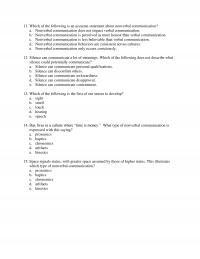
11. Which of the following is an accurate statement about nonverbal communication? a. Nonverbal communication does not impact verbal communication. b. Nonverbal communication is perceived as more honest than verbal communication. c. Nonverbal communication is less believable than verbal communication. […]
Speech Chapter 7 Communication Personal Relationships Learning Objectives After Studying The Topics This
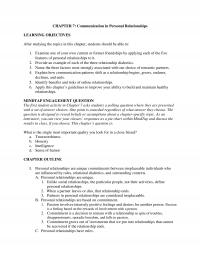
CHAPTER 7: Communication in Personal Relationships LEARNING OBJECTIVES After studying the topics in this chapter, students should be able to: 1. Examine one of your own current or former friendships by applying each of the five features of personal relationships […]
Speech Chapter 7 What Escalates Intimacy Physical Attractiveness Selfconcept Selfdisclosure Similarity Proximity Which Style Loving
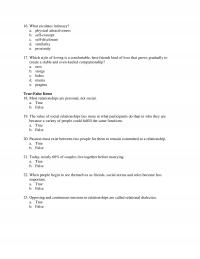
16. What escalates intimacy? a. physical attractiveness b. self-concept c. self-disclosure d. similarity e. proximity 17. Which style of loving is a comfortable, best-friends kind of love that grows gradually to create a stable and even-keeled companionship? a. eros b. […]
Speech Chapter 8 All Groups Are Teams But Not All Teams Are Groups True False
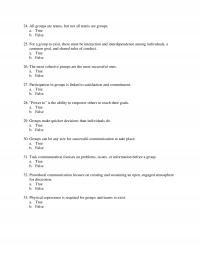
24. All groups are teams, but not all teams are groups. a. True b. False 25. For a group to exist, there must be interaction and interdependence among individuals, a common goal, and shared rules of conduct. a. True b. […]
Speech Chapter 8 Communication Groups And Teams Learning Objectives After Studying The Topics This
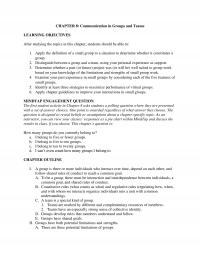
CHAPTER 8: Communication in Groups and Teams LEARNING OBJECTIVES After studying the topics in this chapter, students should be able to: 2. Distinguish between a group and a team, using your personal experience as support. 3. Determine whether a past […]
Speech Chapter 9 Communication Organizations Learning Objectives After Studying The Topics This Students
CHAPTER 9: Communication in Organizations LEARNING OBJECTIVES After studying the topics in this chapter, students should be able to: 2. Explain the reciprocal relationship between an organization’s communication and its culture. 3. Examine an organization’s website for evidence of its […]
Speech Section I Class Business Final Suggestion For Building Strong Sense Community What Julia Wood
Class Business. A final suggestion for building a strong sense of community is what Julia Wood calls “class business.” This is a span of time set aside at the beginning of each class meeting for discussion of observations, experiences, news […]
Speech Section I Section Basic Considerations For Teaching The Introductory Course Communication Introductory Course Communication
SECTION I BASIC CONSIDERATIONS FOR TEACHING THE INTRODUCTORY COURSE IN COMMUNICATION An introductory course in communication provides a rich and dynamic laboratory for students to develop knowledge, motivation, and skill in communication. The communication discipline has potential to touch students […]
Speech Section II Section Digital Resources Communication Our Lives Designed Support Diverse Instructional Approaches The
SECTION II DIGITAL RESOURCES Communication in Our Lives is designed to support diverse instructional approaches to the basic course in speech communication. This section is designed to help you identify, use, and incorporate multimedia resources and new technologies into your […]
Speech Section III Persuasive Speech Assignment Your General Goal This Speech Persuade Specifically You Are
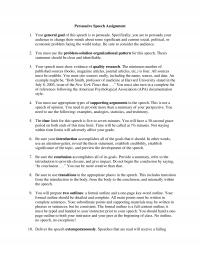
Persuasive Speech Assignment 1. Your general goal of this speech is to persuade. Specifically, you are to persuade your 2. You must use the problem-solution organizational pattern for this speech. Thesis statement should be clear and identifiable. 3. Your speech […]
Speech Section III Section Iii Communication Critical Thinking And Public Speaking This Section Briefly Considers
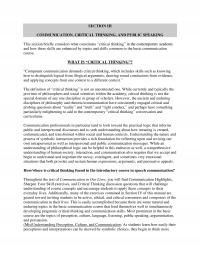
SECTION III COMMUNICATION, CRITICAL THINKING, AND PUBLIC SPEAKING This section briefly considers what constitutes “critical thinking” in the contemporary academy and how these skills are enhanced by topics and skills common to the basic communication course. WHAT IS “CRITICAL THINKING”? […]
Speech Section IV Section By Resources This Section The Instructors Resource Manual Provides Resources
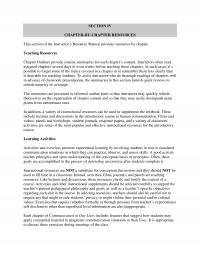
SECTION IV CHAPTER-BY-CHAPTER RESOURCES This section of the Instructor’s Resource Manual provides resources by chapter. Teaching Resources Chapter Outlines provide concise summaries for each chapter’s content. Instructors often read assigned chapters several days or even weeks before teaching those chapters. […]