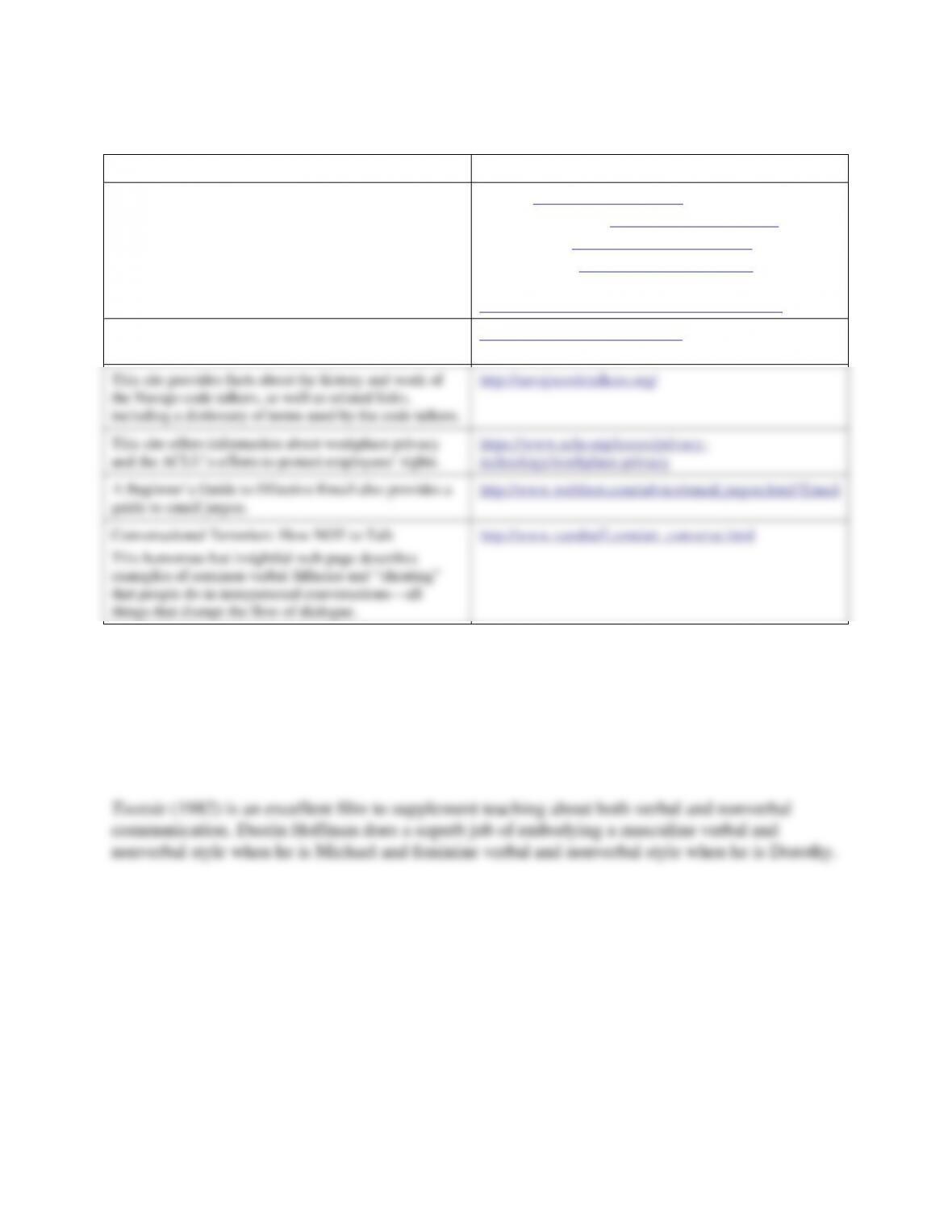
Web Links
Website Description
URL
To learn more about gender and media, visit these
websites.
Jezebel: http://www.jezebel.com
Gender Ads Project: http://www.genderads.com
Media Watch: http://www.mediawatch.com
Off Our Backs: http://www.offourbacks.org
Geena Davis Institute:
http://www.thegeenadavisinstitute.org/index.php
The iLoveLanguages home page provides
comprehensive links to sources on human languages.
http://www.ilovelanguages.com/
This site provides facts about the history and work of
the Navajo code talkers, as well as related links,
including a dictionary of terms used by the code talkers.
http://navajocodetalkers.org/
This site offers information about workplace privacy
and the ACLU’s efforts to protect employees’ rights.
https://www.aclu.org/issues/privacy–
technology/workplace-privacy
A Beginner’s Guide to Effective Email also provides a
guide to email jargon.
http://www.webfoot.com/advice/email.jargon.html?Email
Conversational Terrorism: How NOT to Talk
This humorous but insightful web page describes
examples of common verbal fallacies and “cheating”
that people do in interpersonal conversations—all
things that disrupt the flow of dialogue.
http://www.vandruff.com/art_converse.html
Films
Films such as Mr. and Mrs. Bridge (1990) provide an extended illustration of gendered
communication styles. You might show all or parts of the film and ask students to take notes on
the specific ways in which women and men embody cultural expectations for gender in their
communication.
TEST ITEMS
Multiple Choice Items
1. Which of the following is a regulative communication rule?
a. Hugging is a way to show care and friendship.
b. Making eye contact and nodding are ways to show interest and respect.
c. To demonstrate romantic interest, stand close to the other person, touch him or her
gently, and laugh at his or her jokes.
d. Ignoring someone shows anger or dislike.
e. Do not argue at the dinner table.
2. When you state that symbols are not intrinsically connected to what they represent, you are
asserting which of the following statements?
a. Symbols are powerful.
b. Symbols are arbitrary.
c. Symbols are ambiguous.
d. Symbols create meaning.
e. Symbols have multiple interpretations.
3. Which is the most abstract term in the following words?
a. animal
b. Bessie, our cow
c. farm animal
d. bovine
e. large animal
4. Roger was sitting in class listening to his broadcasting professor talk about blogs, wikis, and
memes. Roger was diligently taking notes and providing feedback. Roger’s participation
could be viewed as respectful based on a
a. regulative rule.
b. constitutive rule.
c. stereotype.
d. personal construct.
e. hypothetical thought.
5. The ability to recognize another person’s perspective as well as your own is called
a. dual perspective.
b. empathy.
c. abstraction.
d. self-reflection.
e. owning your own feelings.
6. Our ability to manage how we appear is referred to as
a. facework.
b. punctuation.
c. perspective.
d. perception.
e. indexing.
7. “One day I won’t have to worry about money. One day I’ll make a great salary.” These
statements illustrate
a. arbitrary thought.
b. loaded language.
c. hypothetical thought.
d. symbolic organization.
e. symbolic evaluation.
8. Because of the arbitrary nature of symbols, we can
a. create private communication codes, words, and terms.
b. create symbols based on a range of meanings in a culture.
c. create explanations of why misunderstandings occur and then work to punctuate
correctly.
d. create shared understandings of what communication means and what kinds of
communication are and are not appropriate.
e. All of these answers are correct.
9. “I felt really embarrassed when Delice told my secret.” This is an example of using
a. you-language to place blame for your feelings.
b. abstraction to place blame for your feelings.
c. dual perspective to assess your feelings.
d. hypothetical language to explain your feelings.
e. I-language to own your feelings.
10. Jackson says, “Erica is irrational.” This statement is an example of
a. totalizing.
b. static evaluation.
c. a euphemism.
d. indexing.
e. hypothetical thought.
11. Olivia says to Ellen, “Do you know Adam?” Ellen replies, “Oh yeah, he’s that gay guy from
our dorm, right?” By calling Adam, “that gay guy,” Ellen is ____ Adam.
a. totalizing
b. using loaded language to refer to
c. using a euphemism about
d. engaging in doublespeak about
e. indexing
12. All of the following are true about symbolic abilities EXCEPT
a. symbols define.
b. symbols evaluate.
c. symbols organize perceptions.
d. symbols allow hypothetical thought.
e. symbols are neutral.
13. Which of the following is a suggestion for enhancing effectiveness in verbal communication?
a. Use the most complex language you know so that you sound informed.
b. Own your feelings and thoughts.
c. Seek to talk more than your conversational partner.
d. Use abstract language as often as possible.
e. Engage about evenly in I language and you language.
14. Which of the following is the single most important guideline for effective verbal
communication?
a. Engage in the dual perspective.
b. Own your feelings and thoughts.
c. Respect what others say about their feelings and ideas.
d. Strive for accuracy and clarity.
e. Engage about evenly in I language and you language.
15. Which of the following is a constitutive communication rule?
a. Smiling shows respect and friendliness.
b. Do not address elders by their first names.
c. Do not talk in church.
d. Avoid talking about finances or politics when meeting new people.
e. Do not raise your voice when angry.
16. Marcia called the man who cut in front of her in line an old geezer. “Old geezer” is a term
which would be considered
a. ambiguous language
b. totalizing language
c. prescriptive language
d. loaded language
e. indexing language
True-False Items
17. We follow communication rules even when we are not consciously aware of them.
a. True
b. False
18. When we use I-language, we give control of our emotions to others.
a. True
b. False
19. Mental indexing reminds us that we and others are able to change in remarkable ways.
a. True
b. False
20. Hypothetical thought, which allows you to contemplate a future with your partner, also
sustains intimacy.
a. True
b. False
21. When we label people, we focus attention on particular aspects of them.
a. True
b. False
22. When we totalize others, we are recognizing all aspects of who they are.
a. True
b. False
23. Social interactions tend to adhere to rules that are widely shared in a specific society.
a. True
b. False
24. A common instance of conflicting punctuation is the demand-attack pattern.
a. True
b. False
25. Because symbols organize thought, they allow us to think about abstract concepts which can
then in turn lead to distorted thinking.
a. True
b. False
26. Loaded language consists of words that strongly slant perceptions and thus meanings.
a. True
b. False
27. Engaging in the dual perspective is the single most important guideline for effective verbal
communication.
a. True
b. False
28. For effective communication, one should evenly engage in I-language and you-language.
a. True
b. False
29. Symbols are intrinsically connected to their meaning.
a. True
b. False
30. Symbols are ambiguous, which means their meanings aren’t fixed in an absolute way.
a. True
b. False
31. An example of a regulative rule would be an answer to the question: “When is it appropriate
to interrupt others?”
a. True
b. False
32. Mrs. Sounders faces her students and puts her hands on her hips to signal that class has
begun. This is an example of punctuation.
a. True
b. False
33. Indexing refers to a technique that allows us to note that our statements reflect only specific
times and circumstances.
a. True
b. False
Fill-in-the-Blank Items
34. Because symbols are ____________________ they are subject to more than one
interpretation.
35. ____________________ specify when, how, where, and with whom to talk about certain
things.
36. ____________________ are shared understandings of what communication means and what
kinds of communication are and are not appropriate in various situations.
37. ____________________ is the mental mark of the beginnings and endings of particular
interactions.
38. The ____________________ involves taking another person’s point of view into account as
you communicate.
39. _______________ stand for ideas, people, events, and objects, but they are not the things
they represent.
40. The statement, “You hurt me,” is an example of ____________________ language.
41. ____________________ is the use of a single label to represent the whole person.
42. ____________________ consists of words that strongly slant perceptions and meanings.
43. Darlene says, “Mitch is so selfish! It’s just who he IS!” Darlene is using a(n)
____________________.
44. ____________________ is a technique to note that statements reflect only specific times and
circumstances.
45. We could agree to assign a different meaning to a symbol or to assign a different symbol to
what it represents; this shows that symbols are __________________.
Essay Items
46. What are the three fundamental properties of symbols?
47. Define dual perspective. What are the benefits of engaging in dual perspective?
48. We learn regulative and constitutive rules from our families, and they may differ between
families. What are two communication rules that you learned from your family? How did
you learn each rule? How did learning that rule as a child affect your communication as an
adult.

TEST ITEMS ANSWER KEY
Multiple Choice Items
1. Which of the following is a regulative communication rule?
2. When you state that symbols are not intrinsically connected to what they represent, you are
asserting which of the following statements?
3. Which is the most abstract term in the following words?
4. Roger was sitting in class listening to his broadcasting professor talk about blogs, wikis, and
memes. Roger was diligently taking notes and providing feedback. Roger’s participation
could be viewed as respectful based on a
5. The ability to recognize another person’s perspective as well as your own is called
6. Our ability to manage how we appear is referred to as

7. “One day I won’t have to worry about money. One day I’ll make a great salary.” These
statements illustrate
8. Because of the arbitrary nature of symbols, we can
9. “I felt really embarrassed when Delice told my secret.” This is an example of using
10. Jackson says, “Erica is irrational.” This statement is an example of
11. Olivia says to Ellen, “Do you know Adam?” Ellen replies, “Oh yeah, he’s that gay guy from
our dorm, right?” By calling Adam, “that gay guy,” Ellen is ____ Adam.
12. All of the following are true about symbolic abilities EXCEPT
13. Which of the following is a suggestion for enhancing effectiveness in verbal communication?
14. Which of the following is the single most important guideline for effective verbal
communication?

15. Which of the following is a constitutive communication rule?
16. Marcia called the man who cut in front of her in line an old geezer. “Old geezer” is a term
which would be considered
True-False Items
17. We follow communication rules even when we are not consciously aware of them.
18. When we use I-language, we give control of our emotions to others.
19. Mental indexing reminds us that we and others are able to change in remarkable ways.

20. Hypothetical thought, which allows you to contemplate a future with your partner, also
sustains intimacy.
21. When we label people, we focus attention on particular aspects of them.
22. When we totalize others, we are recognizing all aspects of who they are.
23. Social interactions tend to adhere to rules that are widely shared in a specific society.
24. A common instance of conflicting punctuation is the demand-attack pattern.
25. Because symbols organize thought, they allow us to think about abstract concepts which can
then in turn lead to distorted thinking.
26. Loaded language consists of words that strongly slant perceptions and thus meanings.
27. Engaging in the dual perspective is the single most important guideline for effective verbal
communication.

28. For effective communication, one should evenly engage in I-language and you-language.
29. Symbols are intrinsically connected to their meaning.
30. Symbols are ambiguous, which means their meanings aren’t fixed in an absolute way.
31. An example of a regulative rule would be an answer to the question: “When is it appropriate
to interrupt others?”
32. Mrs. Sounders faces her students and puts her hands on her hips to signal that class has
begun. This is an example of punctuation.

33. Indexing refers to a technique that allows us to note that our statements reflect only specific
times and circumstances.
Fill-in-the-Blank Items
34. Because symbols are ____________________ they are subject to more than one
interpretation.
35. ____________________ specify when, how, where, and with whom to talk about certain
things.
36. ____________________ are shared understandings of what communication means and what
kinds of communication are and are not appropriate in various situations.
37. ____________________ is the mental mark of the beginnings and endings of particular
interactions.
38. The ____________________ involves taking another person’s point of view into account as
you communicate.
39. _______________ stand for ideas, people, events, and objects, but they are not the things
they represent.

40. The statement, “You hurt me,” is an example of ____________________ language.
41. ____________________ is the use of a single label to represent the whole person.
42. ____________________ consists of words that strongly slant perceptions and meanings.
43. Darlene says, “Mitch is so selfish! It’s just who he IS!” Darlene is using a(n)
____________________.
44. ____________________ is a technique to note that statements reflect only specific times and
circumstances.

45. We could agree to assign a different meaning to a symbol or to assign a different symbol to
what it represents; this shows that symbols are __________________.
Essay Items
46. What are the three fundamental properties of symbols?
47. Define dual perspective. What are the benefits of engaging in dual perspective?
48. We learn regulative and constitutive rules from our families, and they may differ between
families. What are two communication rules that you learned from your family? How did
you learn each rule? How did learning that rule as a child affect your communication as an
adult.