CHAPTER 13: Researching and Developing Support for Public Speeches
LEARNING OBJECTIVES
After studying the topics in this chapter, students should be able to:
2. List five kinds of evidence used by effective public speakers.
4. Analyze a quotation to see if it meets the three criteria for ethical use in a speech.
6. Use the checklist at the end of this chapter to validate their research for an upcoming
speech.
MINDTAP ENGAGEMENT QUESTION
The first student activity in Chapter 13 asks students a polling question where they are presented
with a set of answer choices. One point is awarded regardless of what answer they choose. The
question is designed to reveal beliefs or assumptions about a chapter-specific topic. As an
instructor, you can view your classes’ responses as a pie chart within MindTap and discuss the
results in class, if you choose. This chapter’s question is:
What type of evidence do you find most compelling?
a. Statistics
CHAPTER OUTLINE
I. Research is essential to a sound informative or persuasive speech.
A. Online Research
1. Online search engines such as Google are often the first step in researching a
topic. They are fast and convenient and often provide a wealth of material.
3. Online research should not be the sole or primary means of gathering sound
information about a topic.
B. Library Research
1. Libraries contain a wealth of information that can help develop and support the
ideas in a speech.
2. Begin library research by paying a visit to the reference librarian. Describe the
3. Libraries have an online catalogue (which lists holdings by author, title, and
C. Interviews are another source of information in the process of researching a speech.
2. When referring to interviews in a speech, a speaker should identify the
interviewee and describe her or his expertise.
D. Survey research is a means of gathering information about people’s opinions, actions,
beliefs, preferences, and so forth.
1. Surveys are useful when there is little or no published information on a topic.
2. Surveys are useful when a speaker wants to find out what specific listeners know,
believe, and think about a topic.
II. Evidence is material used to support claims a speaker makes. These claims should be
supported with sound, ethical evidence. Five forms of support are widely recognized.
A. Statistics are numbers that summarize many individual cases or that demonstrate
relationships among phenomena.
B. Examples are single instances that are used to make a point, dramatize an idea, or
personalize information.
2. Detailed examples provide more in-depth descriptions of instances.
C. Hypothetical examples are created instances and should be realistic illustrations of
what a speaker wants to exemplify, if no real examples adequately make the point.
Comparisons are associations between two things that are similar in some important
way or ways.
D. Quotations, or testimony, are statements made by others.
1. Quotations should be from sources who listeners know and respect or who they
will respect once the source’s credentials are identified. Quotations should be
3. Quotations should come from unbiased sources.
E. Visual aids are charts, graphs, photographs, transparencies, computer graphics, and
physical objects. They provide supporting information that visually reinforces or
supplement verbal presentations and enhance listener interest because they add
variety to presentations.
1. There are several guidelines for using visual aids.
2. Although visual aids can be effective, it’s possible to have too many.
3. To effectively use visual aids, remove or cover them before and after you use
4. Evidence discovered while researching a speech should be organized.
III. Digital Media and Researching and Developing Speeches
A. Online search engines and databases provide a treasure trove of material on topics.
B. Online search engines and databases present credentials of sources, but remember to
critically evaluate any material found online.
C. Interviews and surveys may be conducted using digital media.
2. Surveys can be emailed to respondents.
You can also search for these terms directly in MindTap to find them in the Reader. Students can
use flashcards in MindTap to study key concepts.
KEY TERMS PAGE IN TEXT
ACTIVITIES
1. Conducting Research
2. Surveying Your Audience
This assignment should be given in advance so the students can make a copy for each member of
the class. After students have picked their topic, ask them to write four to five questions to pass
3. Evaluating Research in Public Communication
Assign students to attend a public lecture on your campus. Instruct students to keep notes of the
types of evidence the speaker uses and the effectiveness of that evidence. In the class following
4. Where’s the Support?
5. Adapting Supporting Material to Audiences
(2) members of a civic group such as Kiwanis or a garden club, and (3) residents in an assisted
living community.
6. Using Support and Visuals
This exercise will provide an opportunity for students to apply some of the principles in this
chapter for using support and identifying visual aids that could be included in their speeches.
This exercise can be done with the speech groups already in place, or you can divide the class
7. Bringing Statistics to Life
This exercise gives students experience in making statistics interesting and clear. Have students
complete this exercise individually or with their public speaking groups.
Instructions:
Below you will find statistics that are dry, cluttered, or otherwise ineffective for use in a
Statistic Translated Statistic
Of the 20,000 students at this university, 1 in 4 of the students at our school
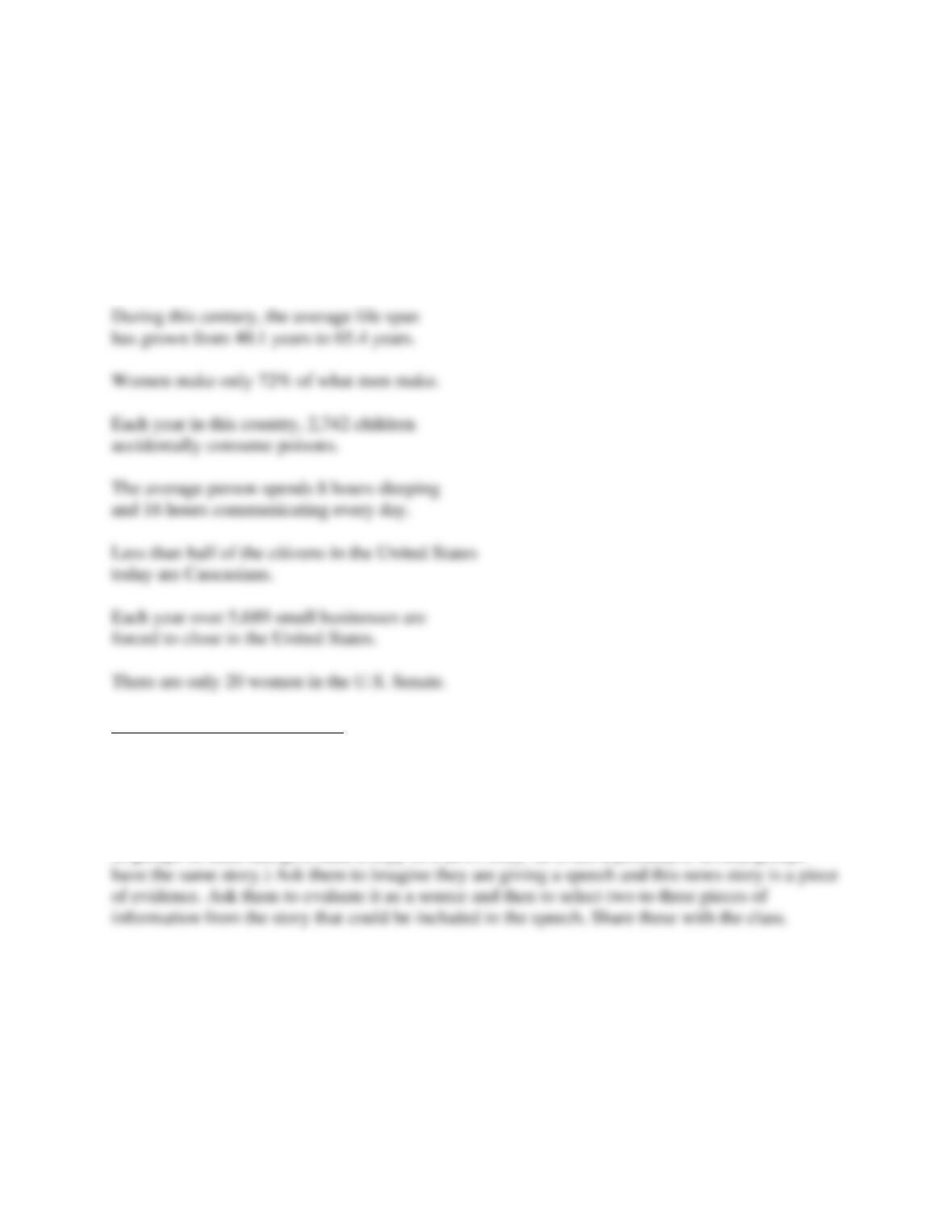
5,000 will not have jobs waiting when will not have a job on graduation
they graduate. day.
3,678,921 cars were recalled last year.
We spend $100 million annually on
offensive weapons and less than $1 million
on job training.
8. Using Research Effectively
No matter how strong speech evidence is, it will not be effective unless the speaker uses it well.
Select two or three short news articles from a popular news source such as a local or campus
newspaper or an online news source such as CNN.com or NYT.com. Most articles will work,
including serious ones, entertainment news stories, and other news stories. Place students in pairs
or groups of three and give each a copy of a news story. (It is not a problem if several groups
JOURNAL IDEAS
• Think about a speech that you found particularly effective. Describe and evaluate the
evidence used by the speaker.
• Choose four websites to analyze for effective use of evidence. Do the sites contain author and
date information? How reliable do you judge the information on the sites? Why? Has the
website been reviewed by those having expertise in the content? In your journal, respond to
these questions and create a list of requirements for Internet source credibility.
• Describe the evidence the author of your textbook uses to support claims and advice on
communication. Evaluate the adequacy and effectiveness of the evidence she uses.
TECHNOLOGY RESOURCES
There are additional student resources in MindTap. If you have a networked computer in your
classroom and a projection system for viewing the computer screen, you can easily introduce
your students by walking them through the process for accessing the website. If you don’t have
this projection and computer equipment in your classroom, you can share the resources in this
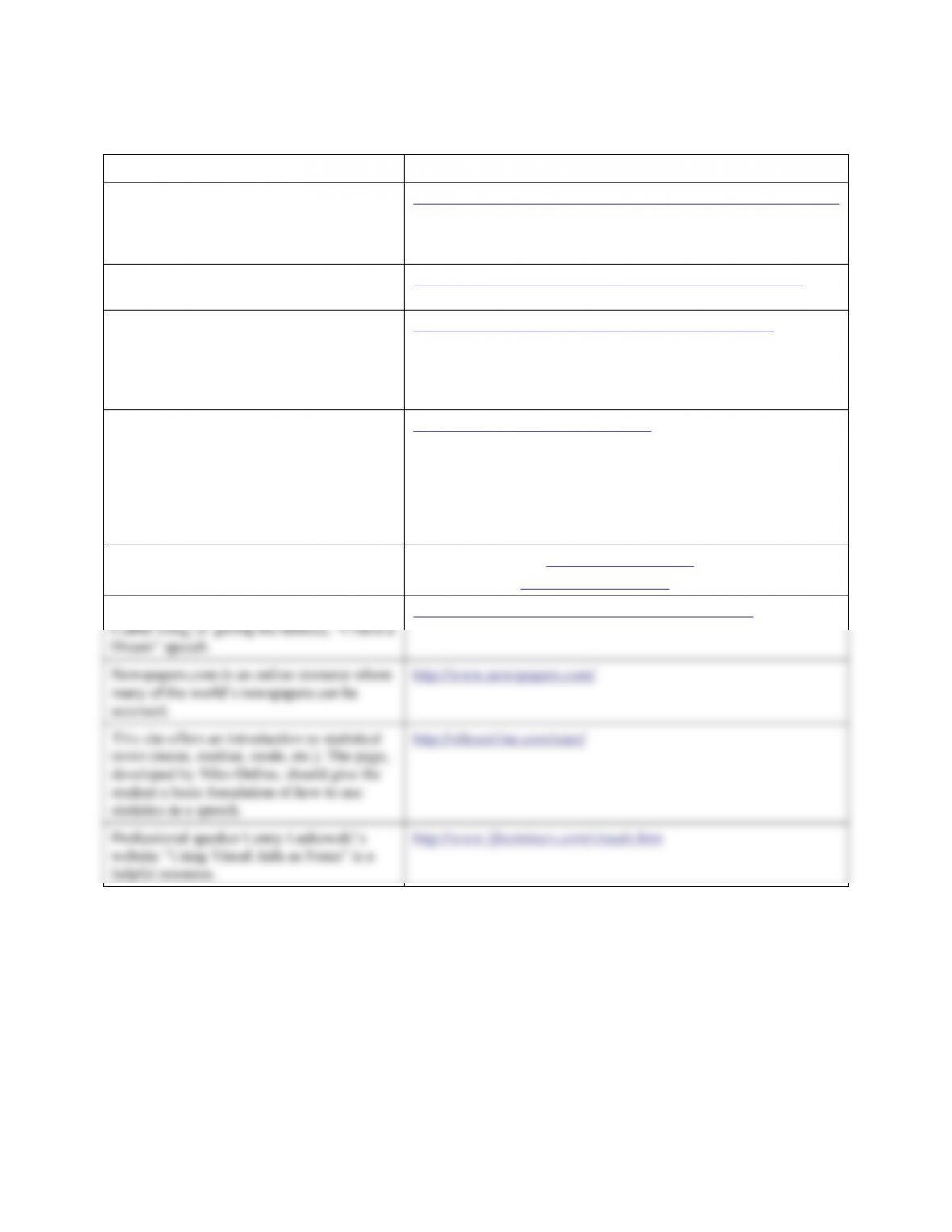
Web Links
Website Description
URL
Visit this site to read about basic principles
for evaluating material found on the Web and
for links to multiple sites that discuss the
credibility of Web information.
http://www.umuc.edu/library/libhow/websiteevaluation_tutorial.cfm
Visit this site to learn more about what
plagiarism is and how to avoid it.
http://www.plagiarism.org/plagiarism–101/what-is-plagiarism/
This link provides tips for utilizing various
visual aid sources in speaking presentations
(i.e., overhead projectors, flipcharts and
posters, video and audio tapes, books and
handouts, and microphones).
http://www.hawaii.edu/mauispeech/html/visual_aids.html
Have students each share a favorite quotation
with the class. Encourage students to plan
how they could use these quotations in their
speeches or trade with other class members.
You can also direct students to numerous
websites that offer famous and motivational
quotations.
http://www.coolquotescollection.com/
Statistical sources online
U.S. Census Bureau: http://www.census.gov/
The Gallup Poll: http://www.gallup.com/
Go to this site for a YouTube video of Martin
Luther King, Jr. giving his famous, “I Have a
Dream” speech.
https://www.youtube.com/watch?v=3vDWWy4CMhE
Newspapers.com is an online resource where
many of the world’s newspapers can be
accessed.
http://www.newspapers.com/
This site offers an introduction to statistical
terms (mean, median, mode, etc.). The page,
developed by Niles Online, should give the
student a basic foundation of how to use
statistics in a speech.
http://nilesonline.com/stats/
Professional speaker Lenny Laskowski’s
website “Using Visual Aids as Notes” is a
helpful resource.
http://www.ljlseminars.com/visuals.htm
TEST ITEMS
Multiple Choice Items
1. Interviews allow a speaker to
a. gather information.
b. check the accuracy of ideas.
c. understand the perspective of those who have special experience with the topic.
d. understand the perspective of people who are experts.
e. do all of these.
2. Jill is having difficulty finding credible sources on her topic of misperceptions of university
faculty. Since very little published research exists on this topic, Jill decides to poll her
student colleagues and some faculty members on their attitudes, opinions, and preferences
about faculty. Jill’s efforts to conduct research are an example of which of the following
sources of information?
a. library research
b. database research
c. survey research
d. visual aids
e. statistics
3. Evidence serves which of the following functions?
a. to make ideas more clear and compelling
b. to make ideas more interesting
c. to fortify a speaker’s opinion
d. to heighten a speaker’s credibility
e. all of these
4. Which of the following is (are) a simile(s)?
a. Lawyers are orchestra conductors.
b. College is a journey.
c. Life is like a box of chocolates.
d. Death is a passage from life.
e. All of these answers are similes.
5. All of these are guidelines for the effective use of statistics EXCEPT
a. limit the number of statistics used in a speech.
b. round off numbers so listeners can understand and retain them.
c. select current statistics.
d. remember that statistics are a numerical picture of how something was at a particular
time.
e. use as many statistics as possible to impress the audience.
6. Putting another person’s ideas in your own words is
a. being deceptive.
b. plagiarizing.
c. paraphrasing.
d. promoting.
e. attributing.
7. All of the following are guidelines for constructing surveys EXCEPT
a. Questions should be worded to avoid bias.
b. Each question should focus on only one issue.
c. Questions should allow for all possible responses.
d. Questions should rely on language that will be clear to respondents.
e. Questions should be constructed with negative language so as to avoid confusion.
8. Which of the following resources for research is likely the most convenient but the least
reliable?
a. Internet
b. library
c. surveys
d. interviews
e. none of these; they are equally reliable
9. Conducting a survey is useful when
a. you have an abundance of published research on something important to your speech.
b. you already know the attitudes of your audience members.
c. you want to gather data that support your beliefs about a topic.
d. you want to gather more information to support existing data.
e. there is no published research on something important to your speech and you need to
find out what listeners know.
10. Evidence is more effective when
a. the number of statistics used is limited.
b. a large number of statistics are given.
c. older data is provided.
d. actual numbers are used instead of approximations.
e. None of these make evidence more effective.
11. The assumption that an expert in one area is also an expert in another area is known as
a. intensification.
b. the sleeper effect.
c. the halo effect.
d. the credibility factor.
e. the credibility effect.
12. Which of the following criteria must be met for effective and ethical quotation use?
a. Sources should be people whom listeners know and respect.
b. Sources should be people whom listeners will respect once the speaker identifies the
source’s credentials.
c. Quotations should come from someone who is qualified to speak on an issue.
d. Ethical quotations should meet the criterion of accuracy and come from unbiased sources.
e. All of the these criteria must be met.
13. All of the following are ways visual aids add support to a presentation EXCEPT
a. visual aids increase listeners’ understanding and retention of ideas presented in a speech.
b. visual aids increase listeners’ interest because they add variety.
c. visual aids help speakers relay their speech quickly and efficiently.
d. All of these are ways visuals add support to a presentation.
14. Which of the following is NOT a form of evidence?
a. statistics
b. examples
c. comparisons
d. quotations
e. indexes
15. The statement, “Life is a grand adventure” is an example of
a. a simile.
b. a metaphor.
c. an example.
d. a narrative.
e. a quotation.
16. A pie chart is a good way to show
a. trends.
b. contrasts and proportions.
c. complex concepts.
d. unfamiliar topics.
e. a verbal message.
17. Using photographs as a visual aid is a good way to show
a. trends.
b. contrasts and proportions.
c. complex concepts.
d. unfamiliar topics.
e. a verbal message.
True-False Items
18. Handouts to support a speech should be given out after a speaker has finished speaking.
a. True
b. False
19. The more complex a visual aid, the greater its impact.
a. True
b. False
20. Research is essential to a sound informative or persuasive speech.
a. True
b. False
21. Surveys are useful when there is no published research on something important to your
speech.
a. True
b. False
22. Statistics do not enhance speaker credibility.
a. True
b. False
23. Detailed examples are useful when listeners aren’t familiar with an idea.
a. True
b. False
24. Speakers often tell a story because they don’t like using other types of support.
a. True
b. False
25. Anecdotes are a type of detailed example.
a. True
b. False
26. If you use a hypothetical example, you have an ethical responsibility to inform listeners that
it is not a factual example.
a. True
b. False
27. It is possible to have too many visual aids.
a. True
b. False