APPENDIX B: Interviewing
OUTLINE
I. Interviews are communication transactions that emphasize questions and answers.
A. Eleven distinct types (purposes) of interviews have been identified.
2. Information-getting interviews are used to gain information from people.
4. Problem-solving interviews function to solve a problem collaboratively.
6. Employment interviews allow job candidates and employers to assess each other
and the fit between them.
8. Performance reviews are used to provide feedback to individuals on their
9. Reprimand interviews aim to identify problems in performance, determine causes
of the problems, and generate a plan of improvement.
11. Exit interviews have the goal of gaining information, insights, and feedback about
a place of work or education from a person who is leaving the organization.
B. Interviews generally have a three-part structure.
1. The opening stage functions to create a good climate for the interview, clarify the
purpose of the interview, and preview what will be covered.
2. The substantive stage focuses on exchanging information about issues relevant to
3. The closing stage should summarize what has been communicated and state what
follow-up, if any, will occur.
C. Interviewing styles vary in formality and distribution of power between interviewer
and interviewee.
2. Distributive interviews feature a relatively equal balance of power between
interviewer and interviewee.
4. Stress interviews (a form of authoritarian interview) not only give the interviewer
primary control, but also aim to create anxiety for the interviewee.
D. Eight forms of questions are common in interviews.
1. Open questions are general queries that invite expansive responses.

3. Mirror questions reflect off previous communication.
5. Probing questions go beneath the surface of a response to dig for more
information.
7. Loaded questions are worded to reflect the emotions or judgment of the person
asking the question.
8. Summary questions cover what has been discussed and allow the respondent to
correct or amplify the summary.
II. Guidelines for communicating effectively in interviews.
A. Preparing for interviews is essential for effectiveness.
2. Being well informed enhances credibility.
4. Practicing responding allows interviewees to refine their answers and styles of
communicating.
B. Managing illegal questions is a challenge in some interviews.
1. Both interviewers and interviewees should be aware of laws and more specific
policies that regulate what can and cannot be asked during interviews.
2. Respond deliberately to illegal questions. One effective way to respond to
unlawful questions is to provide only information that may be sought legally.
You can also search for these terms directly in MindTap to find them in the Reader. Students can
use flashcards in MindTap to study key concepts.
KEY TERMS PAGE IN TEXT
Authoritarian interviews 354
Complaint interviews 350
Counseling interviews 350
Distributive interviews 354
Employment interviews 350
Exit interviews 351
Funnel sequence 352
ACTIVITIES
1. The New Millennium Screening Technique
This exercise takes some time to set up, but it is an important skill for students to develop. It is
based on my daughter’s recent job search. Recently, my daughter (who has a degree in
Communications) sought to relocate to the Midwest after spending two years with a company in
Florida. She embarked on a four-month search for the “perfect” position. Her search was
predominately based online. What she discovered after posting her résumé online was that she
became involved in a screening technique known as the “telephone interview.” She landed the
“perfect” position for a large company in Chicago. After her first day on the job, her new
employer told her that she “beat out the competition” (over 50 applicants) because of her
2. It’s a Matter of Style
This activity allows students to apply what they have read about different interviewing styles and
to see how each style shapes what happens in interviews.
3. Forms of Questions
This activity allows students to become familiar with different forms of questions and to
appreciate how each is constructed.
4. TV Interviews
Record a news interview segment from a TV news program such as 60 Minutes. Have the class
QUESTION FORM
For each of the following three topics, develop the kinds of question specified.
1. You want to know why an applicant to your school is interested in enrolling.
A. Open question: __________________________________________
_______________________________________________________________
B. Closed question: __________________________________________
2. You want to help the interviewee think through whether he/she would enjoy
belonging to a Greek organization on campus.
3. You need to tell the interviewee that her or his performance on a job has been
unsatisfactory and explore how to improve her or his performance.
A. Closed question: __________________________________________
_______________________________________________________________
B. Leading question: __________________________________________
_______________________________________________________________
C. Probing question: __________________________________________
_______________________________________________________________
D. Summary question: __________________________________________
_______________________________________________________________
JOURNAL IDEAS

• Make an appointment to interview someone who interests you. It might be a professor whose
teaching engages you or a professional in a career that interests you. Prepare for the interview
by writing out questions of different types. Some of your questions should be open, some
closed, some leading, and so forth. During the interview, note how the type of question you
pose affects the length and content of response.
• Go to the career or placement center at your school. Conduct research on one company or
graduate school that interests you. What did you learn about the company or school that you
didn’t know before your research? What information can you add by browsing online?
WORKSHOP IDEA
Invite one or more members of staff at the campus placement center to speak with your class.
Ask the individual(s) to prepare a one-class period workshop on how to interview effectively.
Encourage the speaker(s) to involve the students in role plays and other activities that allow them
to practice skills.
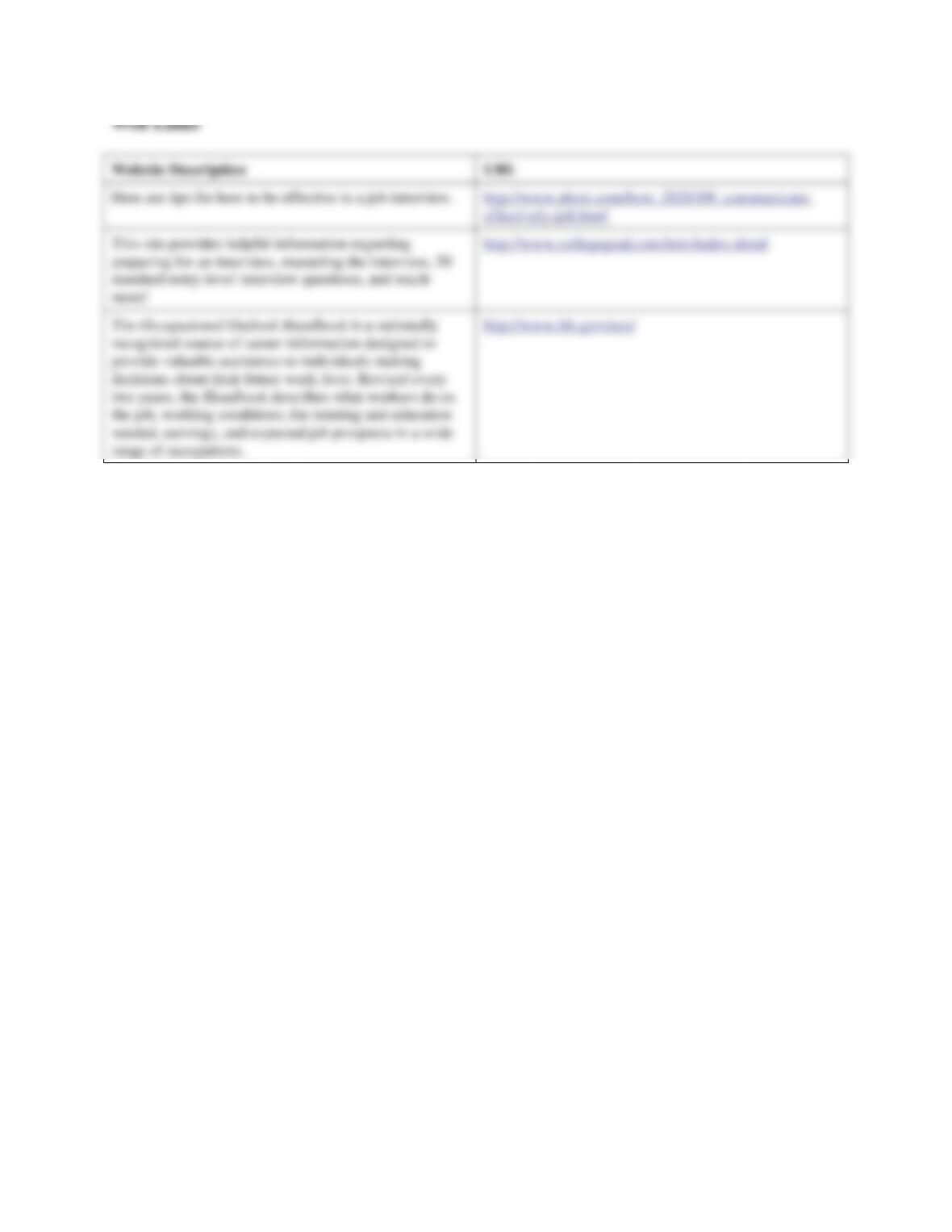
TECHNOLOGY RESOURCES
There are additional student resources in MindTap. If you have a networked computer in your
classroom, and a projection system for viewing the computer screen, you can easily introduce
your students by walking them through the process for accessing the website. If you don’t have
this projection and computer equipment in your classroom, you can share the resources in this
TEST ITEMS
Multiple Choice Items
1. Interviews are different from many other kinds of communication because of which of the
following characteristics?
a. Intensity
b. Informality
c. Formality
d. Question and answer format
e. Intensity and formality
2. A supervisor calls in a subordinate to discuss the subordinate’s recurring tardiness. This is an
example of a(n)
a. counseling interview.
b. exit interview.
c. reprimand interview.
d. persuasive interview.
e. information getting interview.
3. An employee from the retention department of the university asks a student not returning the
following semester to discuss why she made the decision to leave the university. This is an
example of a(n)
a. counseling interview.
b. exit interview.
c. reprimand interview.
d. persuasive interview.
e. information getting interview.
4. Bianca went to the doctor because she wasn’t feeling well. The nurse asked her several
questions to try and determine what ailed her. This is an example of a(n)
a. counseling interview.
b. exit interview.
c. reprimand interview.
d. persuasive interview.
e. information-getting interview.
5. The interview style in which control is most evenly balanced between interviewer and
interviewee is
a. mirror.
b. distributive.
c. authoritarian.
d. stress.
e. problem-solving.
6. Tyronne opens an interview by asking, “Could you tell me a bit about your background in
marketing?” Next, Tyronne asks, “So how long did you work at Zylex?” and “What is the
largest account you’ve ever managed?” Still pursuing the same topic, Tyronne asks, “Could
you go into more detail about your responsibilities for dealing with clients?” and “Did you
ever have a client you couldn’t handle effectively?” The progression of Tyronne’s questions
exemplifies
a. the funnel sequence.
b. a stress style of interviewing.
c. an authoritarian style of interviewing.
d. a counseling interview.
e. an inversion progression.
7. The interview style in which interviewees have the greatest potential control is
a. mirror.
b. distributive.
c. authoritarian.
d. stress.
e. problem solving.
8. “Can you tell me a little about yourself?” is an example of a(n)
a. open question.
b. closed question.
c. mirror question.
d. summary question.
e. leading question.
9. “Did you attend a private college?” is an example of a(n)
a. open question.
b. closed question.
c. mirror question.
d. summary question.
e. leading question.
10. “You never failed a course, did you?” is an example of a(n)
a. open question.
b. closed question.
c. mirror question.
d. summary question.
e. leading question.
11. Questions that are illegal in most circumstances are legal if they pertain to
a. an employer’s management philosophy.
b. bona fide job qualifications.
c. concerns for safety.
d. an employer’s religious values.
e. an employer’s management philosophy and concerns for safety.
12. Interviews that focus on problems are called
a. exit interviews.
b. counseling interviews.
c. complaint interviews.
d. stress interviews.
e. information-getting interviews.
13. General questions that are used by interviewers to initiate a new topic are called
a. closed questions.
b. open-ended questions.
c. open questions.
d. hypothetical questions.
e. leading questions.
True-False Items
14. Persuasive interviews can sell more than products.
a. True
b. False
15. In a counseling interview, the problem is mutual.
a. True
b. False
16. In employment interviews, there are periods of information giving and information getting.
a. True
b. False
17. The closing stage of an interview should preview the content of questions.
a. True
b. False
18. Stress interviews are designed to create anxiety in respondents or interviewees.
a. True
b. False