24. All groups are teams, but not all teams are groups.
a. True
b. False
25. For a group to exist, there must be interaction and interdependence among individuals, a
common goal, and shared rules of conduct.
a. True
b. False
26. The most cohesive groups are the most successful ones.
a. True
b. False
27. Participation in groups is linked to satisfaction and commitment.
a. True
b. False
28. “Power to” is the ability to empower others to reach their goals.
a. True
b. False
29. Groups make quicker decisions than individuals do.
a. True
b. False
30. Groups can be any size for successful communication to take place.
a. True
b. False
31. Task communication focuses on problems, issues, or information before a group.
a. True
b. False
32. Procedural communication focuses on creating and sustaining an open, engaged atmosphere
for discussion.
a. True
b. False
33. Physical copresence is required for groups and teams to exist.
a. True
b. False
34. “Power over” can be a negative or a positive influence.
a. True
b. False
Fill-in-the-Blank Items
35. _______________ is a set of communication functions that establishes a good working
climate, organizes group processes, and ensures that discussion is substantive.
36. The degree of closeness among members is referred to as ____________________.
37. ____________________ exists when members cease to think critically and independently
about ideas generated in groups or teams.
38. A(n) ____________________ power structure exists when all members of a team have
relatively equal power.
39. An individual whose power in a group results from his or her organizational role such, as
manager or CEO, has ____________________ power.
40. Group ____________________ are the standardized guidelines that regulate how members
act and how they interact with each other.
41. The ability to influence others is called ____________________.
42. The attempt to increase personal status in a group by winning the approval of high-status
members is called _______________.
43. Another name for dysfunctional communication is _______________.
44. ____________________ communication focuses on the problems, issues, or information
before a group.
45. ____________________ is used to block others or to call attention to oneself in a group.
Essay Items
46. Name four best practices/strategies for meeting the key challenges of virtual groups.
47. Compare and contrast the “power over” and “power to” ways of influencing others.
48. Of the four types of communication in groups, which type is the least productive and why?
TEST ITEMS ANSWER KEY
Multiple Choice Items
1. The two most significant potential disadvantages of group discussion are
2. In which of the following ways is a team distinct from a group?
3. Cohesion and participation are related to each other in which of the following ways?
4. Per Lumsden & Lumsden, the ideal size for a small group seems to be
5. In describing how she sees her work as a team leader, Janet says that her goal is to help
members reach their goals and accomplish objectives that advance them. Janet is expressing
which orientation to power?
6. Four students standing in line at the coffee shop are a
7. Holly says, “Let’s discuss the donors to the benefit concert and then discuss who will be
performing.” Holly made which type of contribution to discussion?
8. In response to a suggestion made by Juan, Melanie says, “I agree with Juan’s suggestion
about how we should proceed. Thanks for keeping us on track, Juan.” Melanie made which
type of contribution?
9. David is leading his workgroup and he reports on the research he has been doing on his part
of the project. David’s comment is what type of contribution?
10. ___________________ power is the ability to influence based on personal charisma and
personality.
11. Deondra is part of a social group on campus. Even though the group sets specific meeting
times, everyone in the group knows that it is acceptable to be 10-15 minutes late without
needing to call and check in. This unspoken expectation is an example of ____.
12. For people to be considered a “group,” the members must see themselves experiencing which
of the following?
13. Three or more people who are characterized by different and complimentary resources of
members and a strong sense of collective identity are known as
14. The attempt to increase personal status in a group by winning the approval of high-status
members is known as
15. All of the following are potential strengths of groups EXCEPT
16. Which term is used to describe members of a group who exert less effort than they would if
they had worked alone?
17. After listening to an idea given by another group member, Jim says, “Let me elaborate on
that idea.” Jim’s comment is an example of
True-False Items
18. A small group can exist without interaction among members.
19. Groups and teams consist of individuals who have a common goal.
20. An individual’s participation in team discussions tends to heighten the individual’s
commitment to team decisions.
21. In effective groups, all members conform to the same point of view.
22. Norms exist in some, but not all, groups.
23. Teams tend to develop greater interdependence and a stronger sense of collective identity
than other groups.
24. All groups are teams, but not all teams are groups.
25. For a group to exist, there must be interaction and interdependence among individuals, a
common goal, and shared rules of conduct.
26. The most cohesive groups are the most successful ones.
27. Participation in groups is linked to satisfaction and commitment.
28. “Power to” is the ability to empower others to reach their goals.
29. Groups make quicker decisions than individuals do.
30. Groups can be any size for successful communication to take place.
31. Task communication focuses on problems, issues, or information before a group.
32. Procedural communication focuses on creating and sustaining an open, engaged atmosphere
for discussion.
33. Physical copresence is required for groups and teams to exist.
34. “Power over” can be a negative or a positive influence.
Fill-in-the-Blank Items
35. _______________ is a set of communication functions that establishes a good working
climate, organizes group processes, and ensures that discussion is substantive.
36. The degree of closeness among members is referred to as ____________________.
37. ____________________ exists when members cease to think critically and independently
about ideas generated in groups or teams.
38. A(n) ____________________ power structure exists when all members of a team have
relatively equal power.
39. An individual whose power in a group results from his or her organizational role such, as
manager or CEO, has ____________________ power.
40. Group ____________________ are the standardized guidelines that regulate how members
act and how they interact with each other.
41. The ability to influence others is called ____________________.
42. The attempt to increase personal status in a group by winning the approval of high-status
members is called _______________.
43. Another name for dysfunctional communication is _______________.
44. ____________________ communication focuses on the problems, issues, or information
before a group.
45. ____________________ is used to block others or to call attention to oneself in a group.
Essay Items
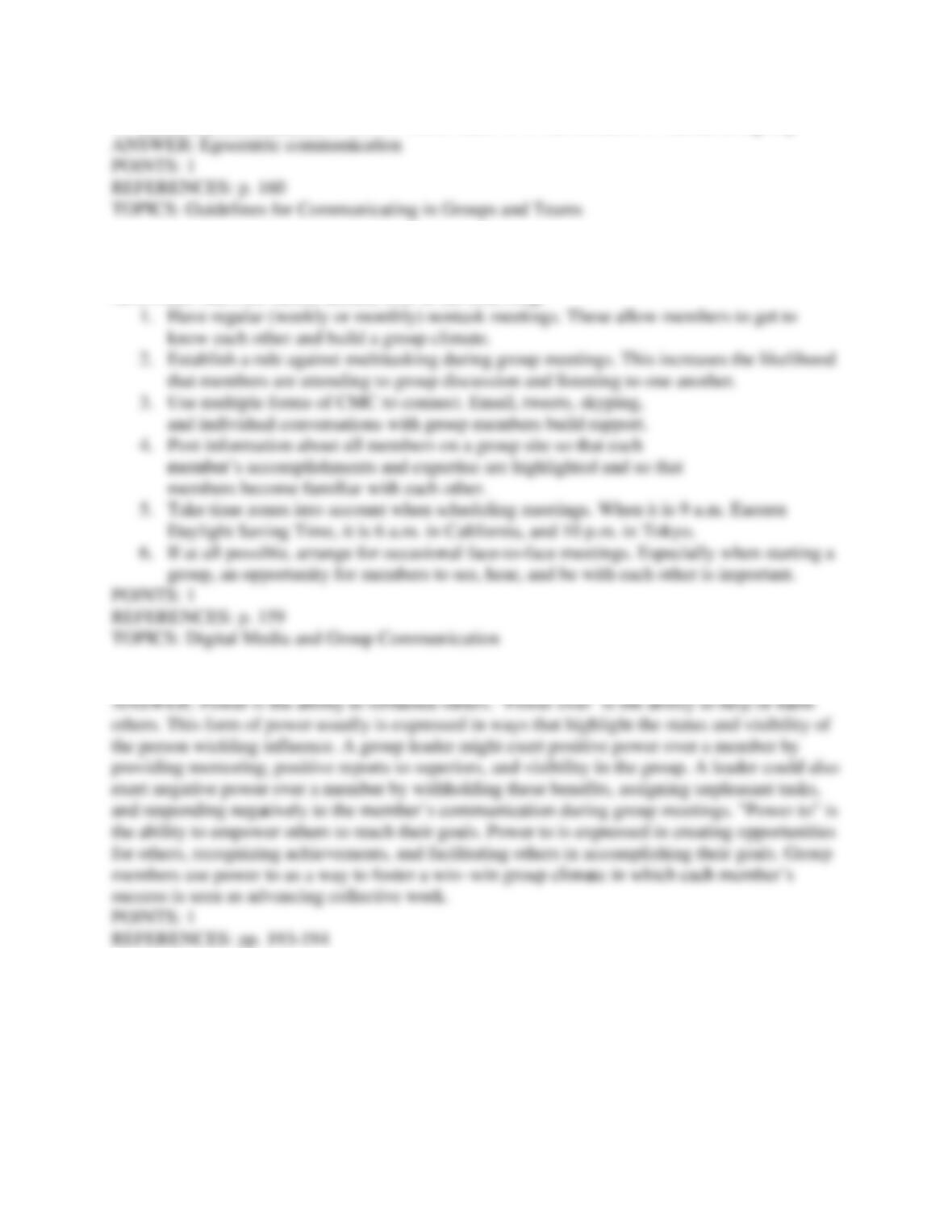
46. Name four best practices/strategies for meeting the key challenges of virtual groups.
ANSWER: Answers should include four of the following:
47. Compare and contrast the “power over” and “power to” ways of influencing others.
48. Of the four types of communication in groups, which type is the least productive and why?