CHAPTER 1: The World of Communication
LEARNING OBJECTIVES
After studying the topics in this chapter, students should be able to:
1. Identify the key features that define communication.
3. Identify the value of studying communication to four aspects of your life: personal,
relationship, professional, and cultural.
5. List the four themes that unify the field of communication.
6. Explain how the definition of communication applies to social media and online
communication.
MINDTAP ENGAGEMENT QUESTION
The first student activity in Chapter 1 asks students a polling question where they are presented
with a set of answer choices. One point is awarded regardless of what answer they choose. The
question is designed to reveal beliefs or assumptions about a chapter-specific topic. As an
instructor, you can view your classes’ responses as a pie chart within MindTap and discuss the
results in class, if you choose. This chapter’s question is:
How does communication affect your life the most?
a. How I communicate affects my relationships with others.
CHAPTER OUTLINE
I. Why Study Communication?
II. Defining Communication—A systemic process in which people interact with and through
symbols to create and interpret meanings.
A. Communication is a process because it is ongoing and always in motion, moving ever
forward and changing continually.
III. Values of Communication—Communication shapes our personal, professional, civic, and
social lives as well as the culture in which we live.
A. Personal identity and health
1. How we see ourselves reflects the views of us that others communicate.
3. Communication with others directly influences our physical and emotional well–
being.
B. Relationship values
1. A major distinction between relationships that endure and those that collapse is
effective communication.
2. “Everyday or small talk” weaves our lives together.
C. Professional values
D. Cultural values
1. Communication skills are important to the health of our ever diversifying society.
2. Citizens in a democracy must be able to express ideas and evaluate the ideas of
others.
3. Civic and social life depends on our ability to listen thoughtfully to a range of
perceptions and to communicate in a variety of ways.
IV. Models of Communication—A number of models reflect increasingly sophisticated
understandings of the communication process.
A. Linear models of communication
B. Interactive models of communication
1. Includes feedback, responses to messages, as part of the model.
2. Communicators create and interpret communication within personal fields of
experience. The more communicators’ fields of experience overlap, the better
they understand each other.
C. Transactional models of communication
1. Recognizes that everyone involved in communication both sends and receives
messages, often simultaneously.
2. Communication changes over time as a result of what happens between people.
V. The Breadth of the Communication Field—The communication discipline dates back
more than 2,000 years and was originally focused on public communication. The modern
field, however, includes seven major areas of research and teaching:
A. Interpersonal communication deals with communication between people.
B. Group communication includes therapeutic and social groups, decision-making
committees, and work teams.
VI. Unifying Themes in the Field—Four themes underlie research and teaching in different
branches of the field.
A. Symbolic activities
1. Symbols are the basis of language, thinking, and much nonverbal behavior.
B. Meaning
1. The human world is one of meaning; we imbue every aspect of our lives with
meaning.
C. Critical thinking
1. To be a competent communicator, one must be able to think critically.
D. Ethics and communication
1. All forms of communication involve ethical issues.
2. Ethics involves both communication and interpretation of others’ communication.
VII. Careers in Communication—Communication skills are essential to most fields.
A. Research
1. Academic research is a vital and growing field of work.
B. Education
1. Teachers are needed for communication classes and often whole curricula.
C. Media production, analysis, and criticism
1. There are many career paths in media production for those interested in mass
communication and new technologies of communication.
D. Training and consulting
1. Communication specialists often join organizations to design and teach courses or
workshops that enhance employees’ communication skills.
E. Human relations and management
2. Communication degrees also open doors to careers in management.
VIII. Digital Media and Communication—Online and digital communication have rapidly
evolved.
A. We rely on social media to maintain personal relationships and to form relationships.
You can also search for these terms directly in MindTap to find them in the Reader. Students can
use flashcards in MindTap to study key concepts.
KEY TERMS PAGE IN TEXT
Communication 3
Content level of meaning 4
Critical thinking 15
Feedback 9
Interpersonal communication 11
Noise 8
Organizational culture 12
Process 3
Relationship level of meaning 4
Symbol 4
System 3
ACTIVITIES
1. First Ideas about Communication
This exercise has both substantive and process value. It is an enjoyable activity that allows
students to continue getting acquainted and becoming comfortable in the course. Thus, it is an
effective exercise to set the right tone for learning. Substantively, the exercise serves to preview
many of the topics in the course and to whet students’ interest in what is to come.
Hand out to students the “Individual Responses/Group Responses” sheet on the next page.
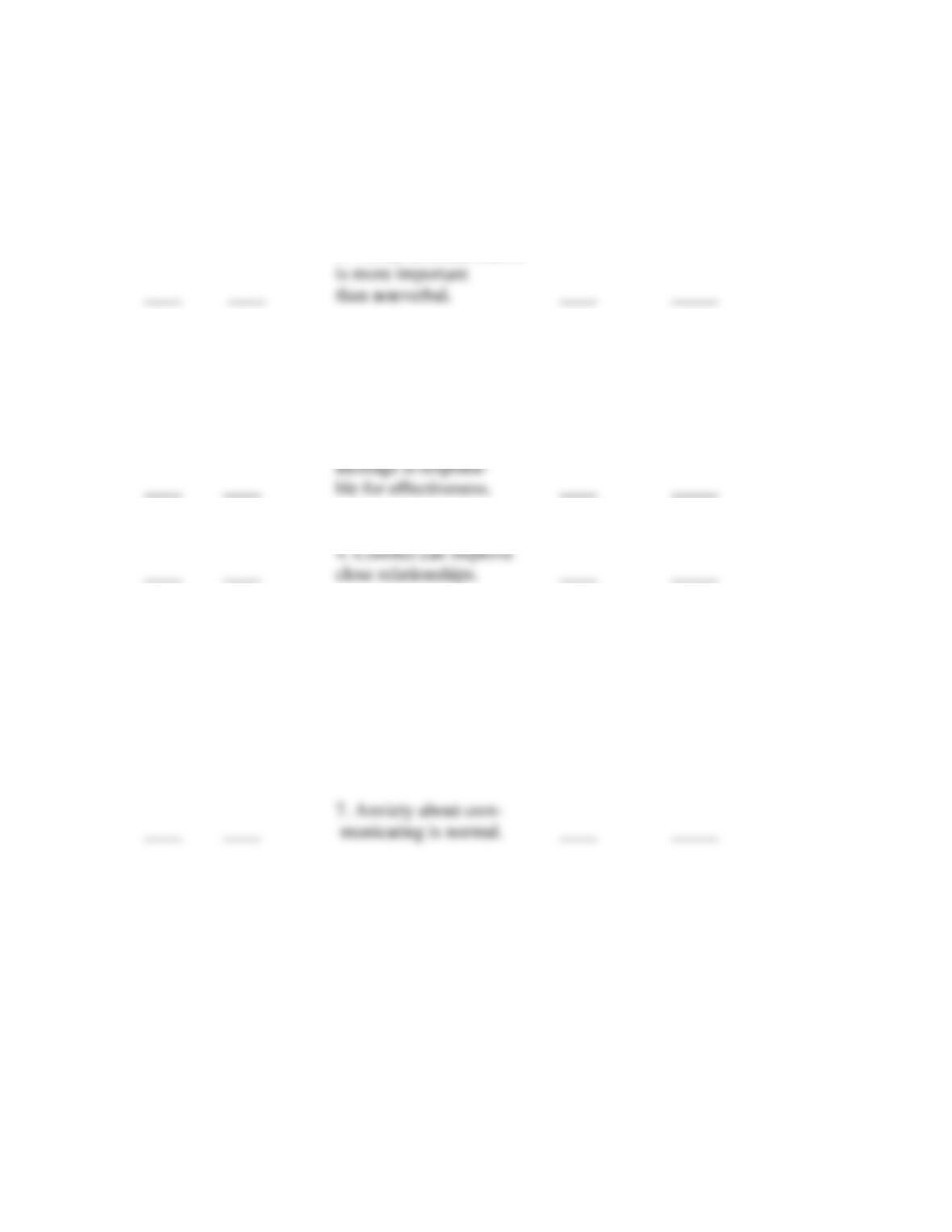
INDIVIDUAL RESPONSES GROUP RESPONSES
Basically Basically Basically Basically
true false true false
1. Verbal communication
2. Women and men speak
____ ____ different languages. ____ _____
3. The sender of a
5. Racial classifica-
____ ____ tions are subjective. ____ _____
6. It is impossible
____ ____ not to communicate. ____ _____
8. Effective teams
____ ____ require single leaders. ____ _____
2. Discussion Forum Activity
This classroom discussion should be based around the text’s treatment of the models of
communication. Begin by asking students to review the evolution from the linear to the
interactive to the transactional models of communication presented in the textbook. Encourage
students to discuss the models by comparing them to the games of bowling, tennis, and chess.
Ask students to compare the parts of the communication process to the components or rules of
each game. Which game provides the best analogy for the most effective type of
communication?
You might follow up this discussion of models and contexts of communication by focusing
specifically on challenges presented by the channel of communication. For example, what
challenges do new technologies present for communication at different levels? How do texting
3. Classroom Code of Ethics
This exercise is designed to encourage students to think about communication from an ethical
perspective. The National Communication Association (NCA) adopted a code of ethics that can
be found at the following web address: http://www.natcom.org/Tertiary.aspx?id=2119
After developing a classroom code, distribute a copy to the students. You might discuss with
students the idea that enforcement of most ethical codes is left to the individual. Therefore, ask
your students what can be done to cultivate an ethical sensibility in individuals. Ask students to
4. Communication Field Trip/Ethnography
This is an inductive learning activity useful as a springboard for helping students to become
more critically aware of their perceptual and interpretive processes and their role in creating
Have students form groups of four to six and hand out the assignment that follows titled
“Communication Field Trip: The World of Communication.” Let them use the class period to
For example, most students will notice some differences between how men and women
communicate—prompt them to interpret this finding in light of the discussion of personal
relations and gendered communication in organizations. Typically, students also note how much
small talk is part of their daily routines—point out the text discussion of how crucial this taken-
If students identify relational pairings (such as “friends,” “fraternity brothers,” “couples,”
“teacher and student”), probe them to see what behaviors or cues led them to these conclusions—
how are relational meanings interpreted from simply watching others interact? What do these
cues and their relational meanings tell us about the culture or context?
Critical Thinking Note: Be prepared to probe silences or superficial explanations about
communication and culture(s) in the students’ accounts. Either during their debriefing in class or
after you have had time to read their written essays, ask them about their observations and
interactions between diverse social groups. Does social segregation happen on your campus?
Why or why not? What seems to divide social groups? What would it take to bring them
together? Would that be useful? What are the implications of your findings for thinking about
communication and cultural diversity in “the real world”? Are people likely to associate with
those who are perceived or experienced as significantly different from them? Why or why not?
Communication Field Trip: The World of Communication
Your mission: Today you are going to be amateur communication researchers and practice a
simplified version of the research method of ethnography. “Ethno” comes from the Greek for people
and “graph-y” comes from words meaning to write or (re)present. Thus, put simply, you go into a
Tools: A notebook and pen or your laptop/tablet/smartphone, your good humor, and your keen
powers of observation.
Process: Take your notebook/electronic device and find a place to sit and observe other people at the
Student Center or some other public place. Spend 25 minutes describing and writing whatever features
Reflection Questions (Group Discussion):
• What got your attention? Why? What had the most significance for you in your observations
(e.g., volume, gestures, relationship, size of group, individuals, culture)? What noise was
present?
• What elements of the transactional communication model were apparent in your observations?
Which ones didn’t you think about? Did you interpret both content and relational levels of
meaning?
Written Assignment: After completing the observation and group discussion portion of this
assignment, please write (type) an individual description of your experience as an amateur
cultural anthropologist—what do you understand about your culture, human beings, and human
5. Tied into Communication
This exercise is based on a presentation by Kathleen Galvin at the 1993 meeting of the Speech
Communication Association. It gives students concrete understanding of how communication
systems function and of the principles that describe and explain systems.
Ask (or select) a male and female student to volunteer for a class demonstration. Announce that
the two of them are in love and getting married. Tie them together with a rope or other material
that connects them, but only loosely. (Be sure to use rope that doesn’t knot too tightly.) Ask them
to interact, letting both go to work and both engage each other at home. Select a third and fourth
person and designate them the wife’s and the husband’s demanding bosses. Tie the bosses to the
woman and man, respectively, with separate pieces of rope. Instruct each boss to apply pressure
to the employee and demand that more work be done, using the rope to apply pressure. Point out
This activity demonstrates many properties of communication systems. Julia finds it most
effective to comment on the system principles being illustrated as the exercise transpires and
6. What Went Wrong
This exercise is designed to help students think through the communication process by analyzing
7. Defining Communication
This activity asks students to explore their perceptions about the definition(s) of communication.
It is most effective to begin this activity before students read the section in the text that defines
communication; however, it can be done at any point during the chapter.
JOURNAL IDEAS
• Review the discussion of ethics from Chapter 1. What are the major concerns facing
communicators regarding ethics? Identify and discuss two instances in which you have faced
ethical challenges when communicating. How did you handle the situations?
TECHNOLOGY RESOURCES
There are additional student resources in MindTap. If you have a networked computer in your
classroom and a projection system for viewing the computer screen, you can easily introduce
Web Links
Website Description
URL
Diverse groups and their impact on the
United States
http://answers.yahoo.com/question/index?qid=20080902172859AAtITCZ
Foundation for Critical Thinking
website
http://www.criticalthinking.org/
National Communication Association
(NCA)
http://www.natcom.org/
International Communication
Association (ICA)
http://www.icahdq.org/
ICA’s Statement on Ethics
http://www.icahdq.org/about_ica/ethics.asp
NCA’s “Communicating Common
Ground”
http://www.natcom.org
National Communication Association’s
online magazine, Communication
Currents
http://www.communicationcurrents.com
TEST ITEMS
Multiple Choice Items
1. Which of the following statements about communication is accurate?
a. Studying communication only has academic benefits.
b. People who study communication are no less likely to communicate clearly than those
who do not study it.
c. Studying communication can improve your communication skills.
d. Studying communication is less popular now than it was 15 years ago.
e. Studying communication is very difficult and should be pursued only by those seeking a
doctoral degree.
2. You did not do very well during the spring semester at school. When your parents see your
grades, your mother says to you, “You’re going to need to take some classes this summer.”
What is the content level of meaning of this statement?
a. Your mom is upset that you didn’t do well in the spring semester.
b. Your mom thinks that taking summer classes may make up for your poor performance
during the spring semester.
c. Your mom thinks you will need to take courses during the summer.
d. Even though you are an adult, your parents still have some control over your life and can
demand that you take summer courses.
e. All of these choices represent the content level of meaning of the statement.
3. What does it mean to say that communication is a process?
a. Communication is ongoing and always in motion.
b. It’s hard to tell when communication starts and stops.
c. Communication evolves in clearly defined stages.
d. Communication is ongoing, always in motion, and evolves in clearly defined stages.
e. Communication is ongoing, always in motion, and it’s hard to tell when it starts and
stops.
4. What did George Herbert Mead mean when he stated that people are “talked into” humanity?
a. We gain personal identity as we communicate with others.
b. We first see ourselves through the eyes of others.
c. Other people’s messages form important foundations for our self-concepts.
d. Family members help to tell us who we are.
e. All of these answers are correct.
5. One of the first models of communication (Laswell) described communication as linear.
Which of these five questions did NOT help to describe how communication worked in this
early model?
a. Who?
b. Says who?
c. In what channel?
d. With what effect?
e. Says what?
6. If Jacob, Bobby’s supervisor, tells Bobby to “get lost,” why would Bobby feel as though his
supervisor may see him as inferior and dislike his work?
a. The content level of meaning indicates that Jacob probably isn’t serious.
b. The relationship level of meaning probably indicates that Jacob isn’t joking when he says
“get lost.”
c. “Get lost” is a phrase that people use but don’t really mean.
d. There is no reason for Bobby to get offended.
e. The content level of meaning indicates that Jacob is mean.
7. Erin tries to concentrate during a class lecture, but she can’t get her mind off a personal
problem. Erin’s preoccupation with her personal problem is an example of
a. noise.
b. feedback.
c. transaction.
d. social diversity.
e. noise and transaction.
8. To study communication is to study
a. what we should believe.
b. how friendships help our lives become more meaningful.
c. the arbitrary nature of the world.
d. how we use symbols to create meaning in our lives.
e. the content level of meaning in phrases we hear.
9. Which of the following is/are considered unifying themes in the field of communication?
a. ethics
b. symbols
c. critical thinking
d. meaning
e. All of these are common themes.