CHAPTER 16: Persuasive Speaking
LEARNING OBJECTIVES
After studying the topics in this chapter, students should be able to:
2. Summarize the nature of each of the three pillars of persuasion.
4. Recall three criteria to consider when deciding whether a persuasive speech should be
one-sided or two-sided.
6. Apply chapter guidelines to prepare an effective persuasive speech.
MINDTAP ENGAGEMENT QUESTION
The first student activity in Chapter 16 asks students a polling question where they are presented
with a set of answer choices. One point is awarded regardless of what answer they choose. The
question is designed to reveal beliefs or assumptions about a chapter-specific topic. As an
instructor, you can view your classes’ responses as a pie chart within MindTap and discuss the
results in class, if you choose. This chapter’s question is:
What leads you to perceive a speaker as credible?
a. The speaker seems to care about me.
CHAPTER OUTLINE
I. Persuasive speeches are presentations that aim to change others by prompting them to
think, feel, believe, or act differently.
A. Persuasive speaking is transactional.
1. Effective persuasion is an engagement between speaker and listeners.
3. Speakers should attend to listeners’ feedback during speeches.
B. Persuasive speaking relies on artistic proofs.
C. Persuasive impact is usually gradual or incremental.
II. The three pillars of persuasion are ethos, pathos, and logos.
A. Ethos refers to the perceived personal character of the speaker.
1. Listeners are more likely to believe the words of people whom they consider to be
good and ethical.
2. Listeners will have confidence in the speaker if they think the speaker is
B. Pathos refers to emotional reasons for attitudes, beliefs, or actions.
2. Persuasive speakers should develop ways to help listeners not just understand
ideas but feel something about them.
C. Logos refers to rational or logical proofs. In persuasive speeches, logical proofs are
arguments, reasoning, and evidence to support claims.
1. Inductive reasoning begins with specific examples and uses them to draw a
general conclusion.
3. The Toulmin model of logical reasoning consists of claims, grounds for the
claims, and warrants.
a. A claim is an assertion.
b. Grounds are evidence or data that support the claim.
c. A warrant justifies the relevance of the grounds to the claim.
III. Credibility is the willingness of others to believe a person has personal integrity, is
positively disposed toward them, and can be trusted. Credibility is tied to listeners’
perceptions of a speaker.
A. Credibility arises from ethos, pathos, and logos.
B. There are three different types of credibility.
1. Initial credibility is the expertise and trustworthiness listeners recognize before a
presentation begins.
3. Terminal credibility is the cumulative expertise, goodwill, and trustworthiness
listeners recognize in a speaker.
C. A persuasive speaker should aim to build credibility through the process of planning,
developing, and presenting a persuasive speech.
IV. In addition to the general principles for organizing public communication, there are
specific organizational concerns and a pattern of organization to consider when
organizing a persuasive speech.
A. Motivated sequence patterns organize a persuasive speech into five steps.
1. The attention step focuses listeners’ attention on the subject.
3. The satisfaction step recommends a solution.
5. The action step calls on listeners to take action to bring about the solution.
B. One- and two-sided presentations are effective in different circumstances.
2. If listeners favor the speaker’s position, it may not be necessary to discuss
3. If listeners are or are likely to be aware of more than one side of a topic, a speaker
should discuss all sides.
4. If listeners are likely to be exposed to the other side later, it is effective to
inoculate them in advance by identifying and dispelling the opposing sides.
V. Digital Media and Persuasive Speaking
A. Persuasive speakers, like other speakers, may rely on digital media to conduct
research, find experts and verify their qualifications, and conduct interviews and
surveys.
VI. Guidelines for Effective Persuasive Speeches
A. Effective persuasive speeches build common ground with listeners by identification
or recognizing and enlarging commonalities among communicators.
B. Effective persuasive speeches focus on particular listeners’ knowledge, attitudes,
motives, experiences, values, and expectations.
C. Effective persuasive speeches avoid fallacious reasoning. To be effective and ethical,
speakers should avoid using fallacies in their speeches.
2. Ad hominem arguments are ones that go to the person, instead of going to the
idea.
4. The bandwagon appeal argues that because most people believe or act in a
particular way, you should also.
6. Hasty generalization is a broad claim based on too few examples or insufficient
evidence.
8. Either–or logic wrongly suggests that there are two and only two options.
9. Reliance on the halo effect occurs when a generalization is made about an
individual’s authority, or expertise, in a particular area to other areas that are
irrelevant to the individual’s experience and knowledge.
You can also search for these terms directly in MindTap to find them in the Reader. Students can
use flashcards in MindTap to study key concepts.
KEY TERMS PAGE IN TEXT
Ad hominem arguments 328
Bandwagon appeal 328
Claim 318
Credibility 319
Deductive reasoning 317
Derived credibility 320
Either–or logic 329
Ethos 314
Fallacy 327
Grounds 318
Halo effect 329
Hasty generalization 328
Identification 326
Inductive reasoning 317
Initial credibility 320
Inoculation 325
Logos 317
Motivated sequence pattern 323
Pathos 316
Slippery slope 328
Terminal credibility 321
Toulmin model of reasoning 317
Warrant 318
ACTIVITIES
1. The Lifeboat Game
Students will appreciate the importance of using persuasive proofs as they relate to effective
persuasive speaking. Divide the students into five groups. After discussing ethos, pathos, and
logos, read the following “Lifeboat Scenario” to the class. Tell the students that each group will
proofs given. Groups cannot vote for their own character, and only three characters can stay on
the boat.
Lifeboat Scenario
You are in a lifeboat with four other people. Aboard this boat is enough food and water for
three people to survive the number of days it will take to get to shore. Otherwise, the food
and water will not last and all will perish. It is agreed that two of you must abandon the boat,
and because of the heat and location, these two are SURE to perish. In addition, the waters
are infested with sharks!
The five people are:
2. A history teacher
4. A pregnant woman
5. A famous musician
Note: I put the above characters on index cards and have one member from each group draw
their character. I also tell them that they can “create” names for their character to establish
credibility and ethos. They can be famous people if they choose. I have had characters from
[Adapted from Beth Pottratz (1987). Persuasive Speaking: A Two-Week Instructional Unit, p.
2. Ghostwriting, Persuasion, and Ethics
In his Ethic and Human Communication text, Richard Johannesen discusses the use of
1. What ethical considerations surround the use of ghostwriters?
2. Why might ghostwriting be considered ethical? Why might some consider it unethical?
3. Does the use of a ghostwriter give too much policymaking or agenda-setting power to the
speechwriters?
4. Does the style with which speeches are written and the “packaging” of the presidency
create an image of our leaders that really doesn’t exist?
5. If it is ethical for politicians to use ghostwriters, why isn’t it ethical for you to use them?
3. Ethos, Logos, and Pathos in Advertising
This exercise is designed to get students to apply Aristotle’s concepts of ethos, logos, and pathos
to a real communication phenomenon.
Bring a videotape of several television commercial advertisements to class (any eight to 10
commercials you happen to catch should do it). Inform students to look for examples of ethical,
logical, and emotional claims in the commercials as you view them. View one at a time and
4. Speech Analysis Exercise
For this exercise, you will build upon the textbook’s treatment of Aristotle and Cicero by
combining their theories in a discussion of Neo-Aristotelian criticism. Specifically, discuss
1. How does MLK establish a sense of ethos through this speech? Possible areas for
2. How does MLK establish his arguments in this speech? Possible areas for discussion
3. How does MLK rely on emotion in this speech? Again, you may discuss the reference to
4. How is the speech organized? You may get several answers to this question. The most
5. How would you characterize MLK’s language? Look here for examples of inversion of
5. Persuasive Speech Workshop
You can use this exercise if you have assigned a persuasive speech as part of the class
6. Persuasive Speech Analysis
This activity utilizes the website located at
http://www.pbs.org/search/?q=great+american+speeches. Go to the website in class and show a

Speech Evaluation Form
Speaker
Evaluator
Competency One—Ability to choose and narrow a topic appropriately for the audience
and occasion.
Met time limit
Clearly related to audience throughout speech
Chose a challenging, substantive topic
Chose a topic appropriate to occasion
Competency Two—Ability to develop a clear thesis statement and organizational
pattern appropriate for the topic, audience, and occasion.
Introduction
Attention-getter
Clear thesis statement
Established credibility
Established significance of the topic
Clear preview
Body
Clear organizational pattern
Identifiable main points and subpoints
Included varied, fluent transitions between main points
Conclusion
Summary
Referred to the introduction to provide closure
Final statement that has impact
Competency Three—Ability to assemble and use effective and sufficient supporting
materials.
Used appropriate, adequate, and varied supporting material
Used valid sources
Cited sources orally and accurately
Connected support material to main ideas
Competency Four—Ability to use nonverbal and verbal behaviors to support the message.
Used good speaking volume
Avoided vocalized pauses (uh, um, etc.)
Used expressive and emphatic tone of voice
Avoided distracting mannerisms
Used effective gestures and purposeful movement
Used effective eye contact
Delivered the speech in a polished manner
Competency Five—Ability to choose, pronounce, and articulate grammatically correct
language that is appropriate for the topic, audience, and occasion.
Was free of serious errors in grammar, pronunciation, and word usage
Used clear, precise, colorful, creative, and culturally sensitive language
Articulated words clearly
JOURNAL IDEAS
• Describe the ways you are persuaded every day through the media. How are the persuasive
messages communicated? Reflect on the more effective ways that you are persuaded to
change your thinking or behaviors. What makes these strategies effective?
• Choose three of the fallacies of argument discussed in your text. In your journal, explain the
three fallacies and find and explain two examples from print, television, or online
advertising.
• Describe how you try to gain other people’s compliance to do things for you. Which
persuasive proofs are you most likely to use?
• Think of two public figures who you think are persuasive and two who are not persuasive.
Why are the first two speakers persuasive? What about them allows them to be influential, in
your opinion? Why are the second two speakers not persuasive? How can they work on
increasing their influence?
TECHNOLOGY RESOURCES
There are additional student resources in MindTap. If you have a networked computer in your
classroom and a projection system for viewing the computer screen, you can easily introduce
your students by walking them through the process for accessing the website. If you don’t have
this projection and computer equipment in your classroom, you can share the resources in this
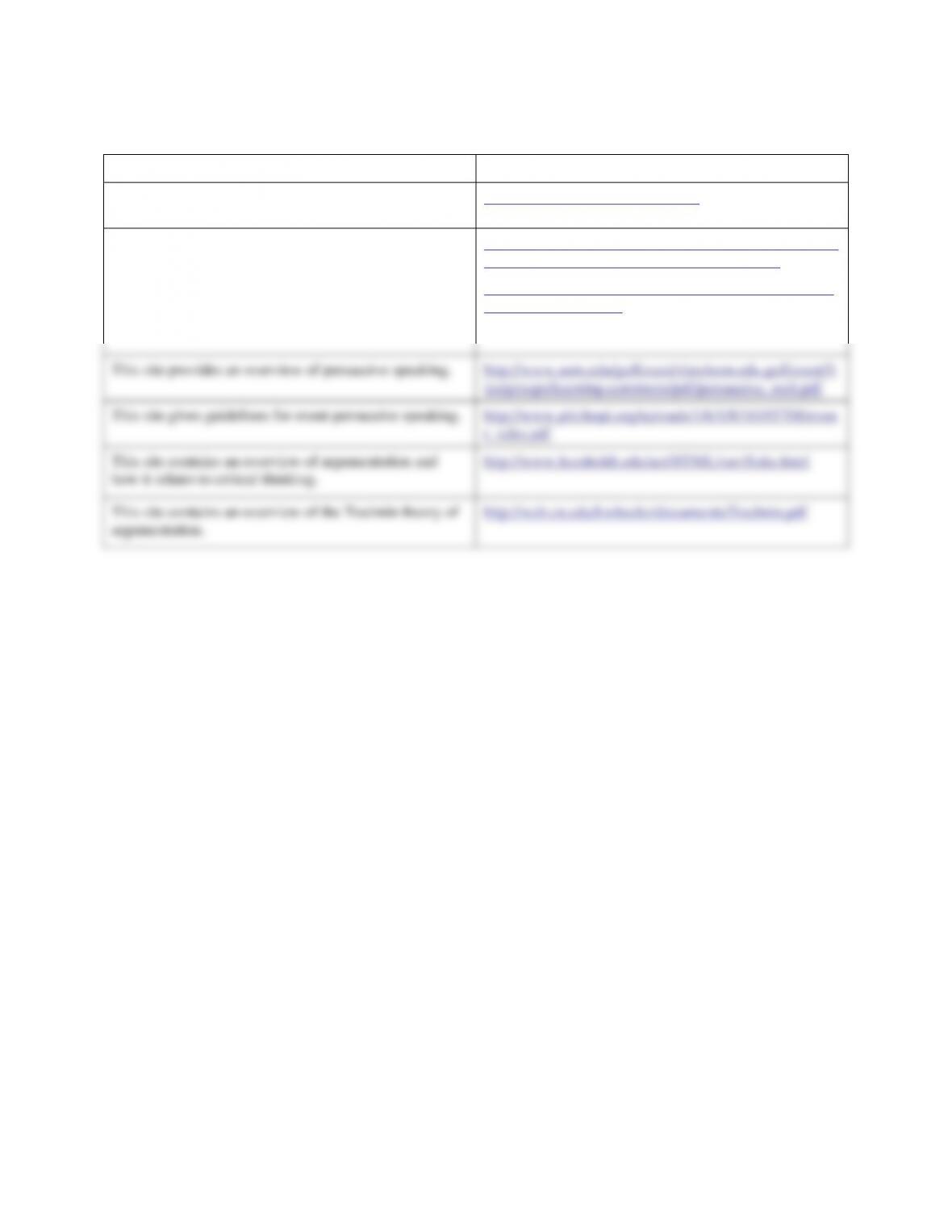
Web Links
Website Description
URL
The American Rhetoric site features hundreds of
speeches you can read, hear, and watch.
http://www.americanrhetoric.com/
Here are two examples of persuasive speeches.
http://www.ted.com/talks/noy_thrupkaew_human_traffic
king_is_all_around_you_this_is_how_it_works
http://www.ted.com/talks/pamela_ronald_the_case_for_
engineering_our_food
This site provides an overview of persuasive speaking.
http://www.usm.edu/gulfcoast/sites/usm.edu.gulfcoast/fi
les/groups/learning-commons/pdf/persuasive_web.pdf
This site gives guidelines for event persuasive speaking.
http://www.phirhopi.org/uploads/1/6/1/8/16185708/even
t_rules.pdf
This site contains an overview of argumentation and
how it relates to critical thinking.
http://www.humboldt.edu/act/HTML/nav/links.html
This site contains an overview of the Toulmin theory of
argumentation.
http://web.cn.edu/kwheeler/documents/Toulmin.pdf
TEST ITEMS
Multiple Choice Items
1. When Jeremy begins his speech, the audience doesn’t know him and has no basis for
assuming he is competent. During his speech, however, Jeremy gains the trust and respect of
listeners because he has good research and clear organization. The increase in Jeremy’s
credibility during the speech is due to which of the following?
a. Derived credibility
b. Initial credibility
c. Terminal credibility
d. Authority-based credibility
e. Assumed credibility
2. Which of the following characteristics are attributed to someone who has ethos?
a. Integrity
b. Trustworthiness
c. Goodwill towards the audience
d. Committed to the topic, shows enthusiasm and dynamism
e. All of these are correct.
3. Which of the following is (are) ways to enhance pathos in persuasive speaking?
a. Personalize the issue, problem, or topic.
b. Use nonverbal to accentuate or highlight the key information.
c. Appear to know about what you (as the speaker) are talking about.
d. Appear to care about the welfare of the audience members.
e. All of the these are correct.
4. Tom’s specific purpose is to convince his audience that texting while driving should not be
made illegal. “I’m a really good driver, and I text a lot. I’m a member of my baseball team, on
student council, and I go to church regularly.” These statements are an example of what kind
of fallacy?
a. Either-or
b. Ad hominem
c. Slippery slope
d. Red herring
e. Hasty generalization
5. What is the form of reasoning that begins with broad claims that listeners accept and then
moves into specific claims?
a. The Toulmin model
b. A warrant
c. A claim
d. Deductive reasoning
e. Inductive reasoning
6. You begin your speech by stating that “global temperature is melting ice in Antarctica.” You
then provide examples that illustrate how the entire planet is experiencing a rise in global
temperature. Your choice to organize information in this way is an example of what type of
reasoning?
a. Deductive
b. Inductive
c. Warrant
d. Claim
e. Qualifier
7. A persuasive speaker relying on arguments, reasoning, and evidence to support claims is
utilizing what type of persuasive proof?
a. Logos
b. Ethos
c. Pathos
d. Mythos
e. Logistics
8. The motivated sequence step that asks listeners to imagine the results that would follow if
they adopt the recommended solution is which of the following?
a. Attention
b. Action
c. Motivation
d. Satisfaction
e. Visualization
9. Which of the following does NOT apply to persuasive speaking?
a. Speakers and listeners interact.
b. It is motivational and artistic.
c. It is incremental and gradual.
d. Persuasive speaking takes longer than informative speaking.
e. All of these answers apply to persuasive speaking.
10. The statement “the death penalty doesn’t deter crime” is an example of
a. a claim.
b. grounds.
c. a warrant.
d. a qualifier.
e. a rebuttal.
Exhibit 16-1
Refer to the following statement: “John is a U.S. citizen because he is native born. We all know
that usually native born Americans are U.S. citizens because of U.S. law and the Constitution
unless, of course, they renounce their citizenship.”
11. Which of the following statements or phrases is the claim?
a. John is a U.S. citizen.
b. John is native born.
c. All native born Americans are U.S. citizens.
d. Unless they renounce their citizenship.
e. usually
12. Which of the following statements or phrases is the warrant?
a. John is a U.S. citizen.
b. John is native born.
c. All native born Americans are U.S. citizens.
d. Unless they renounce their citizenship
e. usually
13. Which of the following statements or phrases is the grounds?
a. John is a U.S. citizen.
b. John is native born.
c. All native born Americans are U.S. citizens.
d. Unless they renounce their citizenship
e. usually
14. Which of the following statements or phrases is the qualifier?
a. John is a U.S. citizen.
b. John is native born.
c. All native born Americans are U.S. citizens.
d. Unless they renounce their citizenship
e. usually
15. Which of the following statements or phrases is the rebuttal?
a. John is a U.S. citizen.
b. John is native born.
c. All native born Americans are U.S. citizens.
d. Unless they renounce their citizenship
e. usually
16. Which of the following is NOT a guideline for effective persuasive speeches?
a. Create common ground with the listeners.
b. Adapt to the listeners.
c. Avoid fallacious reasoning.
d. Organize informative information first.
e. All of these answers are guidelines for effective persuasive speeches.