Archives
BUSI 58663
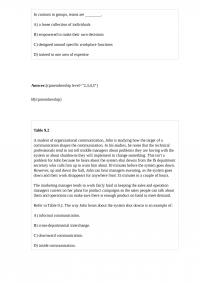
In contrast to groups, teams are ________. A) a loose collection of individuals B) empowered to make their own decisions C) designed around specific workplace functions D) trained in one area of expertise Table 9.2 A student of organizational communication, […]
BUSI 65635
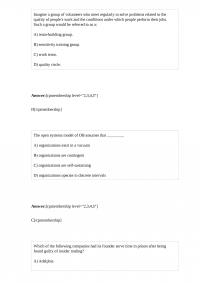
Imagine a group of volunteers who meet regularly to solve problems related to the quality of people’s work and the conditions under which people perform their jobs. Such a group would be referred to as a: A) team-building group. B) […]
BUSI 68636
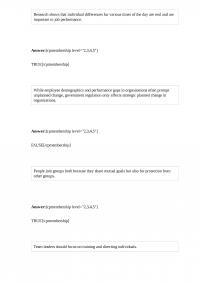
Research shows that individual differences for various times of the day are real and are important to job performance. While employee demographics and performance gaps in organizations often prompt unplanned change, government regulation only affects strategic planned change in organizations. […]
BUSI 69016
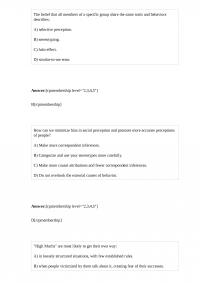
The belief that all members of a specific group share the same traits and behaviors describes: A) selective perception. B) stereotyping. C) halo effect. D) similar-to-me error. How can we minimize bias in social perception and promote more accurate perceptions […]
BUSI 83038
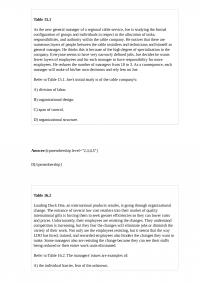
Table 15.1 As the new general manager of a regional cable service, Joe is studying the formal configuration of groups and individuals in respect to the allocation of tasks, responsibilities, and authority within the cable company. He notices that there […]
BUSI 84534
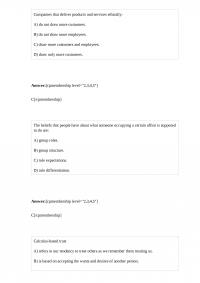
Companies that deliver products and services ethically: A) do not draw more customers. B) do not draw more employees. C) draw more customers and employees. D) draw only more customers. The beliefs that people have about what someone occupying a […]
BUSS 16918
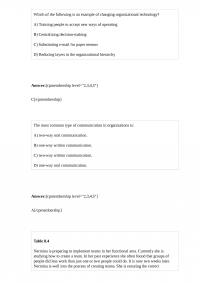
Which of the following is an example of changing organizational technology? A) Training people to accept new ways of operating B) Centralizing decision-making C) Substituting e-mail for paper memos D) Reducing layers in the organizational hierarchy The most common type […]
BUSS 25886
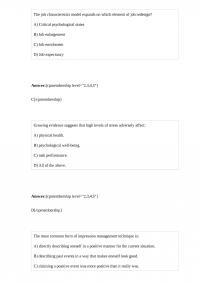
The job characteristics model expands on which element of job redesign? A) Critical psychological states B) Job enlargement C) Job enrichment D) Job expectancy Growing evidence suggests that high levels of stress adversely affect: A) physical health. B) psychological well-being. […]
BUSS 71077
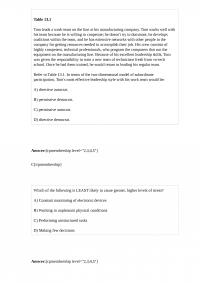
Table 13.1 Tom leads a work team on the line at his manufacturing company. Tom works well with his team because he is willing to cooperate; he doesn’t try to dominate, he develops coalitions within the team, and he has […]
BUSS 73340
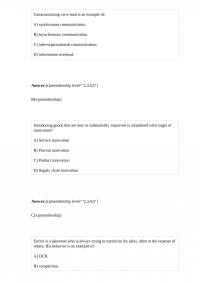
Communicating via e-mail is an example of: A) synchronous communication. B) asynchronous communication. C) inter-organizational communication. D) information overload. Introducing goods that are new or substantially improved is considered what target of innovation? A) Service innovation B) Process innovation C) […]
BUSS 75688
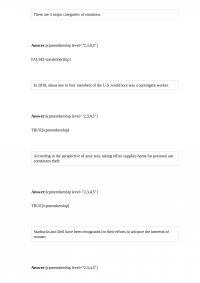
There are 5 major categories of emotions. In 2010, about one in four members of the U.S. workforce was a contingent worker. Answer: TRUE According to the perspective of your text, taking office supplies home for personal use constitutes theft. […]
BUSS 77604
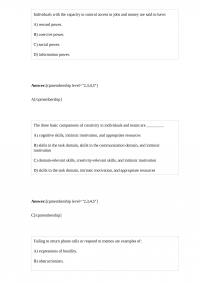
Individuals with the capacity to control access to jobs and money are said to have: A) reward power. B) coercive power. C) social power. D) information power. The three basic components of creativity in individuals and teams are ________. A) […]
BUSS 84747
Cooperation across organizations is being fostered by: A) the need to develop long-term relationships with suppliers. B) the increase in mergers and acquisitions in American business. C) declining competition in stable and mature markets. D) stable business environmental conditions. The […]
BUSS 94577
Research into social loafing and group performance showed that countries like China and Israel with collectivist cultures found that: A) social loafing occurs as much as in individualistic cultures like the U.S. B) workers performed better in groups than they […]
EMBA 36280
Pro-social behavior in organizations is when an individual takes action that exceeds the formal requirements of the job. Like human personalities, organizational cultures do not change, just the mechanical behavior of people changes, but not their values, beliefs, attitudes, or […]
EMBA 42195
In which of the following stages does an individual do whatever keeps her from getting punished? A) Preconventional level B) Conventional level C) Postconventional level D) All of the above. Mediation and arbitration are two popular forms of: A) integrative […]
EMBA 73722
Ronda is a vice president of marketing and mother to three young children. Ronda is probably experiencing which of the following? A) Role conflict B) Qualitative overload C) Role juggling D) Social isolation Organizations that offer employees opportunities to participate […]
EMBA 81388
Learning is: A) a relatively permanent change in behavior occurring as a result of experience. B) reflected by temporary changes in behavior, such as those produced by drugs, illness, or fatigue. C) synonymous with improvements in performance. D) based on […]
EMBA 84988
The stepladder technique adds new members to a group one at a time and requires each new member to present his/her ideas independently to the group. A matrix structure works best in stable, simple environments where there is a need […]
MAN 46878
Arousal is critical to the process of motivation because it: A) defines the direction our actions take. B) is the drive behind our behavior to attain goals. C) helps one to maintain the behavior needed to reach goals. D) explains […]
MAN 54833
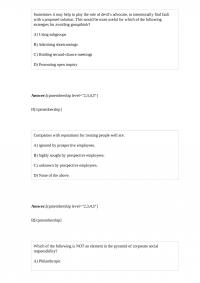
Sometimes it may help to play the role of devil’s advocate, to intentionally find fault with a proposed solution. This would be most useful for which of the following strategies for avoiding groupthink? A) Using subgroups B) Admitting shortcomings C) […]
MAN 74721
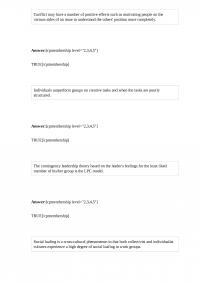
Conflict may have a number of positive effects such as motivating people on the various sides of an issue to understand the others’ position more completely. Individuals outperform groups on creative tasks and when the tasks are poorly structured. Answer: […]
MAN 83027
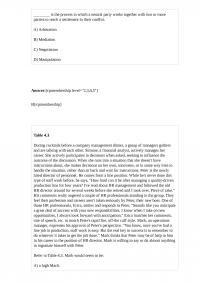
________ is the process in which a neutral party works together with two or more parties to reach a settlement to their conflict. A) Arbitration B) Mediation C) Negotiation D) Manipulation Table 4.3 During cocktails before a company management dinner, […]
MAN 93143
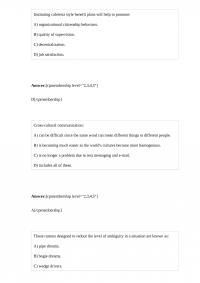
Instituting cafeteria style benefit plans will help to promote: A) organizational citizenship behaviors. B) quality of supervision. C) decentralization. D) job satisfaction. Cross-cultural communication: A) can be difficult since the same word can mean different things to different people. B) […]
MGT 28415
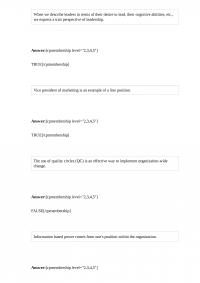
When we describe leaders in terms of their desire to lead, their cognitive abilities, etc., we express a trait perspective of leadership. Vice president of marketing is an example of a line position. Answer: TRUE The use of quality circles […]
MGT 50942
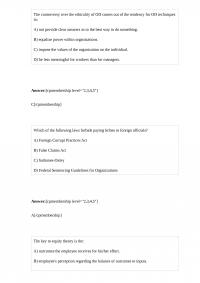
The controversy over the ethicality of OD comes out of the tendency for OD techniques to: A) not provide clear answers as to the best way to do something. B) equalize power within organizations. C) impose the values of the […]
MGT 60860
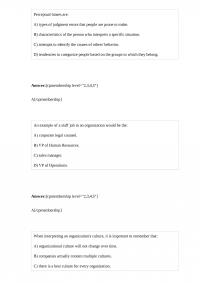
Perceptual biases are: A) types of judgment errors that people are prone to make. B) characteristics of the person who interprets a specific situation. C) attempts to identify the causes of others’ behavior. D) tendencies to categorize people based on […]
MGT 65180
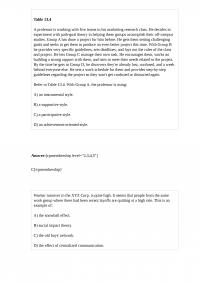
Table 13.4 A professor is working with five teams in his marketing research class. He decides to experiment with path-goal theory in helping these groups accomplish their off-campus studies. Group A has done a project for him before. He gets […]
MGT 85006
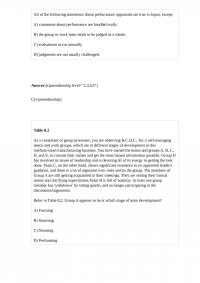
All of the following statements about performance appraisals are true in Japan, except: A) comments about performance are handled orally. B) the group or work team tends to be judged as a whole. C) evaluations occur annually. D) judgments are […]
MGT 92843
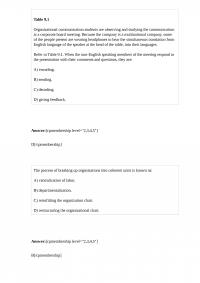
Table 9.1 Organizational communication students are observing and studying the communication at a corporate board meeting. Because the company is a multinational company, some of the people present are wearing headphones to hear the simultaneous translation from English language of […]
MGT 97897
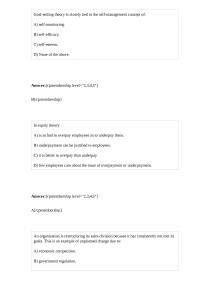
Goal-setting theory is closely tied to the self-management concept of: A) self-monitoring. B) self-efficacy. C) self-esteem. D) None of the above. In equity theory: A) is as bad to overpay employees as to underpay them. B) underpayment can be justified […]
MHR 68717
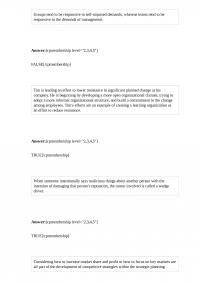
Groups tend to be responsive to self-imposed demands, whereas teams tend to be responsive to the demands of management. Tim is leading an effort to lower resistance to significant planned change at his company. He is beginning by developing a […]
MHR 78086
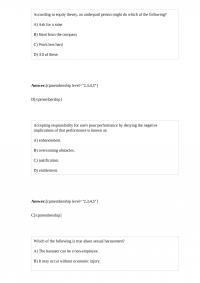
According to equity theory, an underpaid person might do which of the following? A) Ask for a raise B) Steal from the company C) Work less hard D) All of these. Accepting responsibility for one’s poor performance by denying the […]
MHR 86794
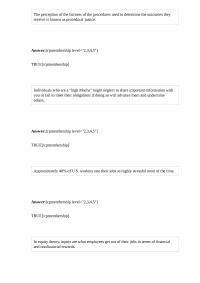
The perception of the fairness of the procedures used to determine the outcomes they receive is known as procedural justice. Individuals who are a “high Machs” might neglect to share important information with you or fail to meet their obligations […]
MHR 92323
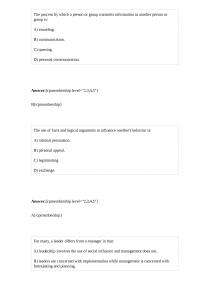
The process by which a person or group transmits information to another person or group is: A) encoding. B) communication. C) queuing. D) personal communication. The use of facts and logical arguments to influence another’s behavior is: A) rational persuasion. […]
OBHR 57337
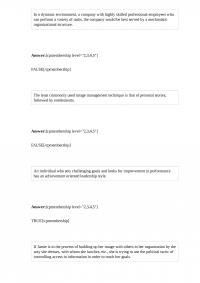
In a dynamic environment, a company with highly skilled professional employees who can perform a variety of tasks, the company would be best served by a mechanistic organizational structure. The least commonly used image management technique is that of personal […]
OBHR 65553
A turnaround strategy involves withdrawing from the market and liquidating assets. Effective teams link individual rewards to team performance. Answer: TRUE Only about 800 people are murdered at work each year in the U.S., and most of these crimes are […]
OBHR 98904
In Japan, an overall evaluation of performance effectiveness is usually given: A) after around 21 years. B) upon termination. C) annually. D) after around 12 years. Table 15.5 INVEX, Inc. is a small manufacturer of low technology consumer goods. They […]