Archives: Quiz
615 Quiz 2
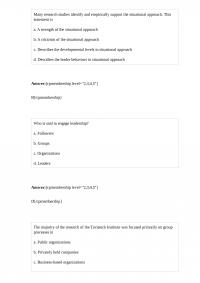
Many research studies identify and empirically support the situational approach. This statement is a. A strength of the situational approach b. A criticism of the situational approach c. Describes the developmental levels in situational approach d. Describes the leader behaviors […]
592 Test 1
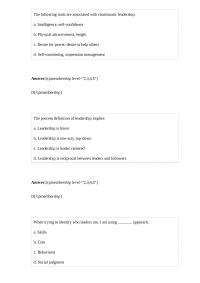
The following traits are associated with charismatic leadership: a. Intelligence, self-confidence b. Physical attractiveness, height c. Desire for power, desire to help others d. Self-monitoring, impression management The process definition of leadership implies a. Leadership is linear b. Leadership is […]
159 Quiz
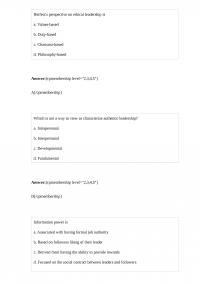
Heifetz’s perspective on ethical leadership is a. Values-based b. Duty-based c. Charisma-based d. Philosophy-based Which is not a way to view or characterize authentic leadership? a. Intrapersonal b. Interpersonal c. Developmental d. Fundamental Answer: D Information power is a. Associated […]
886
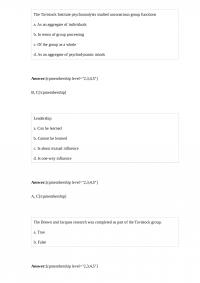
The Tavistock Institute psychoanalysts studied unconscious group functions a. As an aggregate of individuals b. In terms of group processing c. Of the group as a whole d. As an aggregate of psychodynamic minds Leadership a. Can be learned b. […]
118 Test 1
The team leadership model a. Can be applied in many types of teams b. Can be applied in teams in many different types of organizations c. Lacks applicability to structured teams d. Lacks applicability to teams with leaders of variable […]
270
Our early experiences with key individuals like early caregivers contribute to how we respond to people in other contexts with different people. These responses can be described as a. Repeated response patterns b. Conflictual response patterns c. Reactive team patterns […]
604
Teams with distributed leadership have some advantages over single leader teams. a. True b. False Mia expresses interest in her employees’ personal and professional lives. She is employing a. Task behaviors b. Process behaviors c. Relationship behaviors d. Directing behaviors […]
478
Adaptive leadership provides a prescriptive approach to leadership that is useful and practical. What are these prescriptions? a. The adaptive work that takes place b. The leader behaviors used c. Correctly identifying the situational challenge d. The change in followers […]
810 Quiz 2
Ethic theories that are driven from the viewpoint of the leader’s character are called a. Teleological theories b. Virtue-based theories c. Deontological theories d.Utilitarianism theories As a regional sales manager I worked to solve a recent problem of decreased seed […]
494 Quiz
It is accurate to say that Situational Leadership®® II (SLII®®) is primarily a. Descriptive b. Prescriptive c. Well supported by research d. Trait related Which of the following is a strength of the behavioral approach? a. The research supports how […]
637 Midterm
The clearinghouse and research center on servant leadership is now called a. The Center for Applied Ethics b. The Service and Leadership Center c. The Greenleaf Center for Servant Leadership d. The Center for Service and Ethical Behaviors Johanna is […]
725
Jasmine understands the complexities of all levels of her organization and successfully solves problems that meet the organization’s mission. She is using which servant leader behavior? a. Conceptualizing b. Behaving ethically c. Putting followers first d. Empowering People in the […]
383 Quiz 2
Current research on groups focuses more on team variables than exclusively on outcomes of team performance. a. True b. False Situational Leadership® comprises both directive and supportive dimensions a. That are behaviorally similar to task and relationship behaviors in the […]
597 Homework
Individuals displaying the five major traits in the text a. Are leaders in their workplace b. Also display other leader traits in their workplace c. May be leaders in their workplace d. Also display dominance in their workplace Human skills […]
303 Test 2
A follower asks to lead the next team brainstorming session and you let him/her do this. You and the follower are a. In the stranger phase of leadership-making b. In a dyadic in-group relationship c. In a dyadic stranger phase […]
590 Quiz
What scholar(s) studied real-life successful teams and found eight characteristics that were consistently associated with team excellence? a. Hackman and Walton b. Hill c. Larson and LaFasto d. McGrath Human skills are about working with a. Ideas b. Concepts c. […]
174 Homework
As the executive director of the local animal humane society, you work with several employees who are at varying levels of experience in working with animal welfare issues and with varying degrees of motivation to continue this important work. Using […]
308 Test 2
You provide a pay raise to a follower who has received high scores on annual performance reviews two years in a row. You are demonstrating a. Management by exception-passive b. Management by exception-active c. Individualized consideration d. Contingent reward In […]
762 Quiz
Criticisms of transformational leadership are that it is elitist and antidemocratic, and it suffers from heroic leadership bias. a. True b. False In the SLII® model, leaders evaluate how __________ and _________ followers are to perform a task. a. Intentional […]
787 Midterm 1
Which theory challenges the assumption that leaders treat followers in a collective way? a. LMX b. Skills c. Trait d. Style Universally undesirable leadership behaviors include all of the following except a. Asocial b. Loner c. Explicit d. Dictatorial Answer: […]
616 Quiz
Gender-biased prejudice is defined as a. Bias based on known fact about gender differences b. Bias based on the typically male gender leadership roles c. Bias based on the typically female gender leadership roles d. Bias based on gender stereotypical […]
694
Groups in which there is a tendency to split the authority and include avoidance, absenteeism, and resignation are in which of Bion’s unconscious assumptions? a. Dependency b. Social defense c. Pairing d. Fight-flight The problem with the LMX approach is […]
547 Quiz
Leader effectiveness should be assessed along with team effectiveness in the team leadership model. a. True b. False I get involved with my team and create a positive environment while directing daily operations and keeping results of the team high. […]
286 Quiz 1
The intuitive appeal of the skills approach is a. Because it is available to everyone b. Because skills can be learned c. Because we can identify with the leader d. Because skills transform followers Which cultural dimension had no high-score […]
273
An alternative to the glass ceiling metaphor and perhaps a more accurate description of the leadership labyrinth is described as a. Women not in the lower-level pipeline b. The glass cliff c. Difficulty of women to gain leadership positions at […]
509 Test
Kotter suggested that management produces_______ and ________. a. Change and structure b. Vision and order c. Order and consistency d. Change and movement Which of the following attributes begins to decline in later adulthood? a. Personality b. Motivation c. Crystallized […]
564
For task characteristics that are complex, how many possible leader behaviors might be used? a. 1 b. 2 c. 3 d. 4 Authentic leadership a. Has multiple models that provide clear strategies for authentic leadership development b. Is effective in […]
138 Final
Which of the following is not listed as a gender difference in the leadership labyrinth? a. Self-promotion b. Cross-pressures c. Style and effectiveness d. Commitment and motivation Our team has been working on a difficult problem for the past week. […]
642 Test
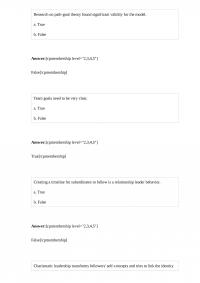
Research on path-goal theory found significant validity for the model. a. True b. False Team goals need to be very clear. a. True b. False Answer: True Creating a timeline for subordinates to follow is a relationship leader behavior. a. […]
772
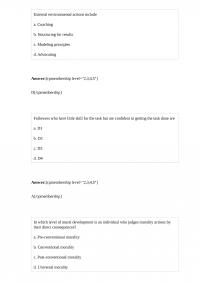
External environmental actions include a. Coaching b. Structuring for results c. Modeling principles d. Advocating Followers who have little skill for the task but are confident in getting the task done are a. D1 b. D2 c. D3 d. D4 […]
230 Homework
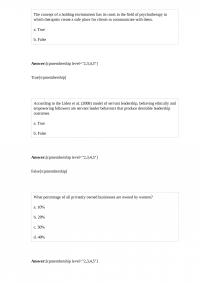
The concept of a holding environment has its roots in the field of psychotherapy in which therapists create a safe place for clients to communicate with them. a. True b. False According to the Liden et al. (2008) model of […]
655
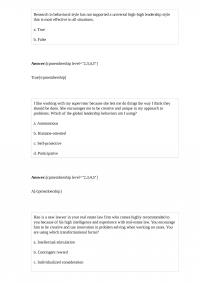
Research in behavioral style has not supported a universal high-high leadership style that is most effective in all situations. a. True b. False I like working with my supervisor because she lets me do things the way I think they […]
294 Quiz 2
I had a really poor performance evaluation last week. It really made me think that I should give work more effort than I have been. This is an example of an authentic leadership factor that is a a. Catalyst for […]
129 Test 1
You tell your staff how and when to do their jobs. You are using a. Process behaviors b. Task behaviors c. Relationship behaviors d. Directing behaviors Why is the term “follower” used infrequently in writings about adaptive leadership? a. It […]
264 Quiz 3
Core Conflictual Relationship Themes a. Occur in childhood but resolve by adulthood b. Develop from early experiences with key individuals c. Develop upon physical maturation in late teen years d. Are recurring relationship patterns that we take into adulthood Which […]
383
The early studies in LMX reported that a. After the in-groups are formed, the vertical dyads are formed b. After the out-groups are formed, the vertical dyads are formed c. The vertical dyads form the basis for in-group and out-group […]
806 Quiz
My team gets along well with one another and has worked together for a long time and consistently exceeded its goals despite recent changes in our company. Recently, the organization has made some reporting structure changes and has had to […]
318 Homework
I am a leader of employees in an auto manufacturing company that just merged with another company after a difficult buyout process. Employees will keep their jobs but will have to learn new systems and work with new people and […]
657 Quiz
Greenleaf ‘s theory of servant leadership a. Says leaders should be concerned with society’s “have-nots.” b. Was based on studies of university professors and students. c. Requires a strict delineation of servant-leader roles. d. Was influenced by the writings of […]
680 Quiz 2
I am meeting my new team, which I will directly supervise for the first time. I introduce myself and invite each team member to share some interesting facts about themselves unrelated to work. I am using a. Authoritative behaviors b. […]
733
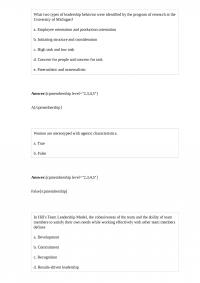
What two types of leadership behavior were identified by the program of research at the University of Michigan? a. Employee orientation and production orientation b. Initiating structure and consideration c. High task and low task d. Concern for people and […]
468 Test 2
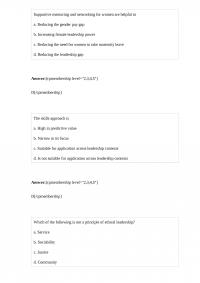
Supportive mentoring and networking for women are helpful in a. Reducing the gender pay gap b. Increasing female leadership power c. Reducing the need for women to take maternity leave d. Reducing the leadership gap The skills approach is a. […]
810 Quiz
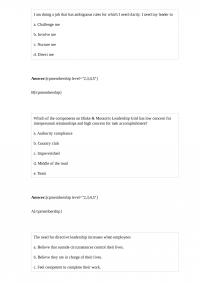
I am doing a job that has ambiguous rules for which I need clarity. I need my leader to a. Challenge me b. Involve me c. Nurture me d. Direct me Which of the components on Blake & Mouton’s Leadership […]
558 Test 1
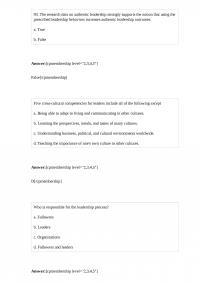
93. The research data on authentic leadership strongly supports the notion that using the prescribed leadership behaviors increases authentic leadership outcomes. a. True b. False Five cross-cultural competencies for leaders include all of the following except a. Being able to […]
872
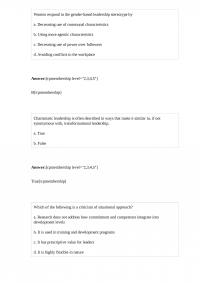
Women respond to the gender-based leadership stereotype by a. Decreasing use of communal characteristics b. Using more agentic characteristics c. Decreasing use of power over followers d. Avoiding conflicts in the workplace Charismatic leadership is often described in ways that […]
653 Quiz 2
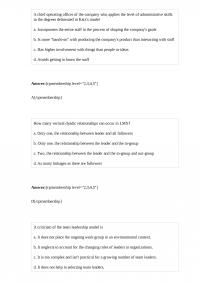
A chief operating officer of the company who applies the level of administrative skills to the degrees delineated in Katz’s model a. Incorporates the entire staff in the process of shaping the company’s goals b. Is more “hands-on” with producing […]
758 Midterm 1
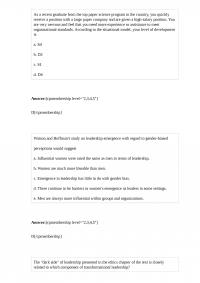
As a recent graduate from the top paper science program in the country, you quickly receive a position with a large paper company and are given a high-salary position. You are very nervous and feel that you need more experience […]
191 Test 2
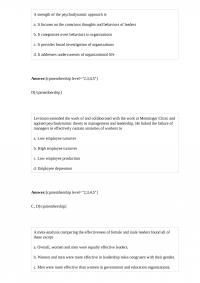
A strength of the psychodynamic approach is a. It focuses on the conscious thoughts and behaviors of leaders b. It categorizes overt behaviors in organizations c. It provides broad investigation of organizations d. It addresses undercurrents of organizational life Levinson […]
432 Midterm 1
How does servant leadership differ from path-goal theory? a. Focuses on the behaviors leaders should exhibit to put followers first. b. Is unconcerned with the way leaders should treat followers. c. Focuses on the need for leaders to perfect themselves […]
863
Which of the following is not a reason followers become part of the in-group? a. How well they work with the leader b. How well the leader works with them c. The amount of interest they show toward negotiating with […]