Archives
978-1319059491 Appendix A
© 2018 Bedford/St. Martin’s. All rights reserved. Appendix A Competent Interviewing CHAPTER OUTCOMES • Define the nature of interviews • Outline the different types of interviews • Describe the three parts of an interview: opening, questions, and conclusion • Devise […]
978-1319059491 Appendix B
© 2018 Bedford/St. Martin’s. All rights reserved. Appendix B Mass and Mediated Communication CHAPTER OUTCOMES • Distinguish different types of communication • Explain how the business of media and the principle of free speech shape the kinds of media messages […]
978-1319059491 Chapter 1 Part 1
INSTRUCTOR’S RESOURCE MANUAL REAL COMMUNICATION An Introduction FOURTH EDITION INSTRUCTOR’S RESOURCE MANUAL REAL COMMUNICATION An Introduction FOURTH EDITION Dan O’Hair Mary Wiemann Dorothy Imrich Mullin Jason Teven Prepared by Jennifer Willis-Rivera Department of Communication Studies University of Wisconsin, River Falls […]
978-1319059491 Chapter 1 Part 2
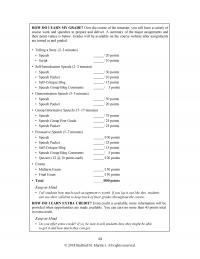
13 HOW DO I EARN MY GRADE? Over the course of the semester, you will have a variety of course work and speeches to prepare and deliver. A summary of the major assignments and their point values is below. Grades […]
978-1319059491 Chapter 1 Part 3
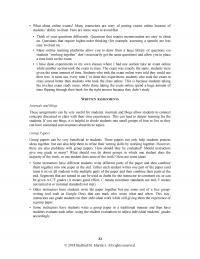
© 2018 Bedford/St. Martin’s. All rights reserved. • What about online exams? Many instructors are wary of putting exams online because of students’ ability to cheat. Here are some ways to avoid that. • Think of your questions differently. Questions […]
978-1319059491 Chapter 1 Part 4
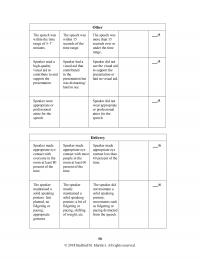
© 2018 Bedford/St. Martin’s. All rights reserved. Other The speech was within the time range of 5–7 minutes. The speech was within 15 seconds of the time range. The speech was more than 15 seconds over or under the time […]
978-1319059491 Chapter 10
© 2018 Bedford/St. Martin’s. All rights reserved. Chapter 10 Communicating in Groups CHAPTER OUTCOMES • List the characteristics and types of groups and explain how groups develop • Describe ways in which group size, social relationships, and communication networks affects […]
978-1319059491 Chapter 11
© 2018 Bedford/St. Martin’s. All rights reserved. Chapter 11 Leadership and Decision Making in Groups CHAPTER OUTCOMES • Explain how a leader’s power, style, and personal qualities impact effectiveness • Identify how culture affects appropriate leadership behavior • List the […]
978-1319059491 Chapter 12
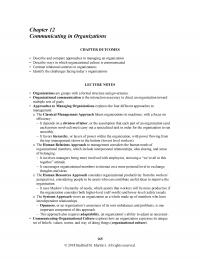
© 2018 Bedford/St. Martin’s. All rights reserved. Chapter 12 Communicating in Organizations CHAPTER OUTCOMES • Describe and compare approaches to managing an organization • Describe ways in which organizational culture is communicated • Contrast relational contexts in organizations • Identify […]
978-1319059491 Chapter 13
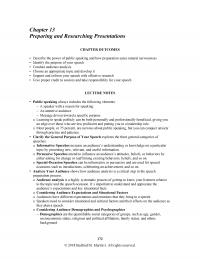
172 Chapter 13 Preparing and Researching Presentations CHAPTER OUTCOMES • Describe the power of public speaking and how preparation eases natural nervousness • Identify the purpose of your speech • Conduct audience analysis • Choose an appropriate topic and develop […]
978-1319059491 Chapter 14
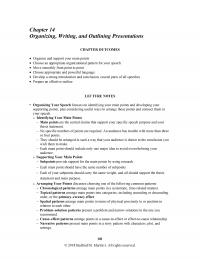
181 Chapter 14 Organizing, Writing, and Outlining Presentations CHAPTER OUTCOMES • Organize and support your main points • Choose an appropriate organizational pattern for your speech • Move smoothly from point to point • Choose appropriate and powerful language • […]
978-1319059491 Chapter 15
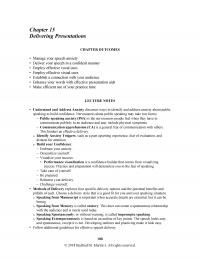
© 2018 Bedford/St. Martin’s. All rights reserved. Chapter 15 Delivering Presentations CHAPTER OUTCOMES • Manage your speech anxiety • Deliver your speech in a confident manner • Employ effective vocal cues • Employ effective visual cues • Establish a connection […]
978-1319059491 Chapter 16
196 Chapter 16 Informative Speaking CHAPTER OUTCOMES • Identify the goals of informative speaking • Distinguish each of the eight categories of informative speeches • Outline the four major approaches to informative speeches • Employ strategies to make your audience […]
978-1319059491 Chapter 17
© 2018 Bedford/St. Martin’s. All rights reserved. Chapter 17 Persuasive Speaking CHAPTER OUTCOMES • Define the goals of persuasive speaking • Develop a persuasive topic and thesis • Build persuasive arguments specifically tailored for your intended audience • Explain three […]
978-1319059491 Chapter 2
© 2018 Bedford/St. Martin’s. All rights reserved. Chapter 2 Communicating in a Digital Age CHAPTER OUTCOMES • Describe the advances in digital technology that have changed communication • Define the characteristics that distinguish different forms of digital communication • Explain […]
978-1319059491 Chapter 3
76 Chapter 3 Perceiving the Self and Others CHAPTER OUTCOMES • Describe how our personal perspective on the world influences our communication • Explain how we use and misuse schemas when communicating with others • Define the attributions we use […]
978-1319059491 Chapter 4
© 2018 Bedford/St. Martin’s. All rights reserved. Chapter 4 Verbal Communication CHAPTER OUTCOMES • Describe the power of language—the system of symbols we use to think about and communicate our experiences and feelings • Identify the ways language works to […]
978-1319059491 Chapter 5
98 Chapter 5 Nonverbal Communication CHAPTER OUTCOMES • Describe the power of nonverbal communication • Outline the functions of nonverbal communication • Describe the set of communication symbols that are nonverbal codes • Illustrate the influence of culture, technology, and […]
978-1319059491 Chapter 6
© 2018 Bedford/St. Martin’s. All rights reserved. Chapter 6 Communication and Culture CHAPTER OUTCOMES • Define and explain culture and its impact on your communication • Delineate important ways that cultural variables affect communication • Describe the communicative power of […]
978-1319059491 Chapter 7
© 2018 Bedford/St. Martin’s. All rights reserved. Chapter 7 Listening CHAPTER OUTCOMES • Outline the listening process and goals for listening • List the advantages of listening well • Identify challenges to good listening and their remedies • Identify types […]
978-1319059491 Chapter 8
© 2018 Bedford/St. Martin’s. All rights reserved. Chapter 8 Developing and Maintaining Relationships CHAPTER OUTCOMES • Explain key aspects of interpersonal relationships • Describe why we form relationships • List ways to manage relationship dynamics • Describe the factors that […]
978-1319059491 Chapter 9
© 2018 Bedford/St. Martin’s. All rights reserved. Chapter 9 Managing Conflict in Relationships CHAPTER OUTCOMES • Describe the factors that lead to productive conflict • Identify conflict triggers in yourself and others • Explain the forces that influence how people […]
978-1319059491 Test Bank Appendix A
Page 1 1. Which of the following is not an accurate statement about interviews? A) They are goal-driven. B) They are dyadic. C) They are unstructured. D) They are transactional. 2. When a television journalist sits down to interview a […]
978-1319059491 Test Bank Appendix A Essay
Page 1 1. What is the difference between an information-gathering interview and a selection interview? 2. Provide an example from your experience or a fictitious example of a problem-solving interview. 3. What are the three issues that should be addressed […]
978-1319059491 Test Bank Appendix B
Page 1 1. Which of the following would be considered mediated communication? A) A telephone conversation B) A text message C) A television news broadcast D) All of the options are correct. 2. The merging of traditional mass communication with […]
978-1319059491 Test Bank Appendix B Essay
Page 1 1. What is the difference between mediated communication and mass media? 2. What term do we use to refer to the way new media have blurred the lines between mass media and more interpersonal forms of communication? 3. […]
978-1319059491 Test Bank Chapter 01 Essay
Page 1 1. Define the term communication. 2. What are the three primary reasons that human beings communicate? 3. What is the difference between encoding and decoding a message? 4. Provide an example of a co-culture to which you belong. […]
978-1319059491 Test Bank Chapter 02 Essay
Page 1 1. Give examples of digital technology that has changed communication 2. Compare and contrast the various types of mediated communication. 3. Prepare a list of digital forms of communication that can foster social support. 4. Write a short […]
978-1319059491 Test Bank Chapter 03 Essay
Page 1 1. Briefly describe the process of selecting information as a step in the perception process. 2. Define the term schema. 3. Describe how using schemas assists us in the perception process. 4. Briefly describe three elements of your […]
978-1319059491 Test Bank Chapter 04 Essay
Page 1 1. Grammar is made up of ____________ that dictate how words should be pronounced and___________ that dictate the placement of words in sentences. 2. Provide a brief example to illustrate how we use the ritualizing function of language. […]
978-1319059491 Test Bank Chapter 05 Essay
Page 1 1. Define nonverbal communication. 2. _______ is an example of a nonvocal form for verbal communication that is often mistaken for nonverbal communication because of its reliance on gestural symbols rather than spoken words. 3. Briefly explain why […]
978-1319059491 Test Bank Chapter 06 Essay
Page 1 1. Define the term culture. 2. Your _________ is the framework through which you interpret the world and the people in it. 3. Briefly describe one way in which mediated interaction is changing the way we experience the […]
978-1319059491 Test Bank Chapter 07 Essay
Page 1 1. Briefly describe the differences between hearing and listening. 2. List the three components of the listening process. 3. A competent listener will listen for the ___________________, or the things that people only hint at instead of communicating […]
978-1319059491 Test Bank Chapter 08 Essay
Page 1 1. In your own words, define an interpersonal relationship. 2. How would you define interpersonal communication? 3. List and describe three of the six important characteristics of friendship identified in your textbook. 4. What is the difference between […]
978-1319059491 Test Bank Chapter 09 Essay
Page 1 1. What is the difference between conflict and conflict management? 2. What are three benefits of engaging in productive conflict? 3. Identify three conflict triggers in yourself and others. 4. List four forms of provocation identified by your […]
978-1319059491 Test Bank Chapter 1
Page 1 1. ____________ is the process by which we use symbols and behaviors to exchange information. A) Encoding B) Decoding C) Communication D) Perception 2. Communication _____________ to help (or not help) us to accomplish our goals in personal, […]
978-1319059491 Test Bank Chapter 10
Page 1 1. “A collection of more than two people who share some kind of relationship with one another, who communicate in an interdependent fashion, and who collaborate toward some shared purpose” defines which of the following terms? A) family […]
978-1319059491 Test Bank Chapter 10 Essay
Page 1 1. Define the term group. 2. What three characteristics do all groups have in common? 3. Provide an example of a problem-solving group. 4. List the five stages of group development. 5. Describe one of the norms that […]
978-1319059491 Test Bank Chapter 11
Page 1 1. ___________ is the ability to direct or influence others’ behaviors and thoughts toward a productive end. A) Control B) Power C) Leadership D) Communication 2. Positions like “manager,” “professor,” and “president” convey which kind of power? A) […]
978-1319059491 Test Bank Chapter 11 Essay
Page 1 1. Define leadership. 2. What is the difference between expert and referent power? 3. What type of power comes from a person’s ability to punish or harm others? 4. List the five group leadership styles discussed in your […]
978-1319059491 Test Bank Chapter 12
Page 1 1. A(n) ________________ is a group with a formal governance and structure. A) institution B) organization C) network D) problem-solving group 2. An approach to managing organizations that likens organizations to machines, with a focus on maximizing efficiency, […]
978-1319059491 Test Bank Chapter 12 Essay
Page 1 1. In your own words, define organizational communication. 2. Provide an example of an organization of which you are a member. 3. Which approach to organizational management is described as treating people like they are a part in […]
978-1319059491 Test Bank Chapter 13
Page 1 1. Speeches that are intended to influence the attitudes, beliefs, and behaviors of an audience are called __________ A) informative. B) persuasive. C) special-occasion. D) impromptu. 2. If the mayor of a city were asked to deliver a […]
978-1319059491 Test Bank Chapter 13 Essay
Page 1 1. Briefly describe the characteristics that distinguish public speaking from other types of communication. 2. Provide an example of a situation where you might have to deliver a public speech. 3. How would you define an informative speech? […]
978-1319059491 Test Bank Chapter 14
Page 1 1. ___________ are the central claims that support a speaker’s specific speech purpose and thesis statement. A) Key words B) Main points C) Subpoints D) Facts 2. The organizational pattern that presents the main points of a speech […]
978-1319059491 Test Bank Chapter 14 Essay
Page 1 1. Describe the test the authors suggest for ensuring that your main points are on the right track. 2. What organizational pattern do the following main points utilize? Single-family homes offer homeowners privacy and a great investment opportunity […]
978-1319059491 Test Bank Chapter 15
Page 1 1. __________ refers to the nervousness we experience when we know we have to communicate publicly to an audience. A) Communication apprehension B) Stage fright C) Public speaking anxiety D) Speech panic response 2. What do we call […]
978-1319059491 Test Bank Chapter 15 Essay
Page 1 1. Define communication apprehension. 2. What is the difference between public speaking anxiety (PSA) and communication apprehension (CA)? 3. What are the three common anxiety triggers your textbook discusses? 4. List two strategies a speaker can use to […]
978-1319059491 Test Bank Chapter 16
Page 1 1. Which of the following adjectives describes an informational speaker? A) Subjective B) Objective C) Opinionated D) Biased 2. Andrew’s informative speech will help his audience understand how to upgrade and replace the hard drive in their computers. […]
978-1319059491 Test Bank Chapter 16 Essay
Page 1 1. In your own words, what does it mean to be an objective speaker rather than a subjective speaker? 2. “People” is just one of the eight categories of informative speech topics. List at least four of the […]
978-1319059491 Test Bank Chapter 17
Page 1 1. “The act of using manipulation, threats, intimidation, or violence to gain compliance” is the definition of which of the following terms? A) Persuasion B) Interrogation C) Coercion D) Compliance gaining 2. “The process of influencing (often changing […]
978-1319059491 Test Bank Chapter 17 Essay
Page 1 1. What is the difference between coercion and persuasion? 2. Define attitude as it relates to persuasive speaking. 3. Provide an example of a proposition of fact. 4. In your own words, define what is meant by a […]
978-1319059491 Test Bank Chapter 2
Page 1 1. The Internet Society was formed in 1992 with a mission to ______ A) promote open development, evolution and use of the Internet for the world. B) build cheaper, more efficient computers and computer programs. C) support the […]
978-1319059491 Test Bank Chapter 3
Page 1 1. “A cognitive process through which we observe people and events, interpret our experiences, and form our own unique understandings,” defines which of the following terms? A) perception B) information selection C) mindfulness D) communication 2. Communication processing […]
978-1319059491 Test Bank Chapter 4
Page 1 1. ________ is the system of symbols (words) we use to think about and communicate experiences and feelings. A) Denotative code B) Connotative code C) Language D) Body language 2. Grammatical rules that dictate how words should be […]
978-1319059491 Test Bank Chapter 5
Page 1 1. “The process of intentionally or unintentionally signaling meaning through behavior other than words” defines which of the following terms? A) verbal communication B) nonverbal communication C) body language D) encoding 2. Which of the following is an […]
978-1319059491 Test Bank Chapter 6
Page 1 1. “A learned system of thought and behavior that belongs to and typifies a relatively large group of people; a composite of shared beliefs, values, and practices” represents which of the following terms? A) Society B) Religion C) […]
978-1319059491 Test Bank Chapter 7
Page 1 1. The physiological process of perceiving sound is best associated with which of the following terms? A) Listening B) Hearing C) Attending D) Selecting 2. Which of the following is NOT one of the steps in the listening […]
978-1319059491 Test Bank Chapter 8
Page 1 1. The interconnection and interdependence between two individuals is referred to as ______ A) a relational network. B) a family. C) an interpersonal relationship. D) interpersonal communication. 2. Which of the following possible relationships you may have with […]
978-1319059491 Test Bank Chapter 9
Page 1 1. ________ is an interaction between two or more interdependent people who perceive that they have contradictory goals or scarce resources. A) Unproductive conflict B) Productive conflict C) Conflict D) Conflict management 2. Conflict that is managed effectively […]