Archives
BUS 149 In the aggregate
In the aggregate expenditures model, if aggregate expenditures (AE) equal $6 trillion and GDP equals $7 trillion, then: a. inventory depletion equals -$1 trillion. b. inventory accumulation equals $1 trillion. c. investment equals $1 trillion. d. investment equals -$1 trillion. […]
BUS 169
Sometimes the government deals with externalities by creating laws to regulate behavior instead of using taxes to correct the market failure. So, requiring auto manufacturers to install a device called a catalytic converter which removes some toxins from exhaust may […]
BUS 240 Test 2
Compared to IACs, LDCs are often characterized by: a. higher life expectancy. b. higher adult literacy rates. c. higher daily calorie supply. d. lower per capita energy consumption. Suppose a wallet firm has been dumping its wastes into the local […]
BUS 258 Quiz 3
Foreachstatementprovided,choosetheletteroftheappropriatetermfromthelistthateachstate mentbestdescribes.Sometermsmaybeusedmorethanonce,whileothersarenotusedatall. a. Capital stock b. Asset c. Owners’ equity d. Time period e. Dividends f. Economic entity concept g. Expense h. Retained earnings i. Cost principle j. Creditor k. Liability l. Revenue m. Going concern n. Monetary unit o. […]
BUS 269 Use the aggregate
Use the aggregate expenditures model and assume the marginal propensity to consume (MPC) is 0.90. A decrease in government spending of $1 billion would result in a decrease in GDP of: a. $0. b. $0.9 billion. c. $1.0 billion. d. […]
BUS 349 Homework
If V = 5, P = 100, and Q = 10, then M is: a. 20. b. 10. c. 500. d. 1,000. e. 200. A strength of the market economy is that: a. it results in an equal distribution of […]
BUS 351 Midterm 2
Which of the following is infrastructure? a. Highways. b. Bridges. c. Airports. d. All of these. When the discount rates fall, the cost: a. of loans to bankers’ best customers goes down. b. of loans between banks falls. c. of […]
BUS 351 Test 2
The primary source of revenue at the federal level is: a. the corporate income tax. b. the personal income tax. c. property taxes. d. sales taxes. e. customs duties. Full employment is the rate of employment that results when: a. […]

BUS 363 Final
If the marginal propensity to consume (MPC) is 0.96, the value of the spending multiplier is: a. 25. b. 40. c. 96. d. 100. Front Corporation’s endÂofÂyear balance sheet consisted of the following amounts: What is Front’s owners’equitybalance at the […]
BUS 450 Test 2
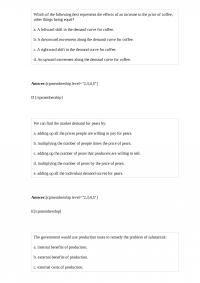
Which of the following best represents the effects of an increase in the price of coffee, other things being equal? a. A leftward shift in the demand curve for coffee. b. A downward movement along the demand curve for coffee. […]
BUS 465 Homework
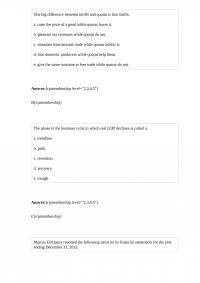
One big difference between tariffs and quotas is that tariffs: a. raise the price of a good while quotas lower it. b. generate tax revenues while quotas do not. c. stimulate international trade while quotas inhibit it. d. hurt domestic […]
BUS 476 Final
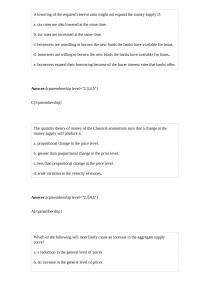
A lowering of the required reserve ratio might not expand the money supply if: a. tax rates are also lowered at the same time. b. tax rates are increased at the same time. c. borrowers are unwilling to borrow the […]
BUS 489
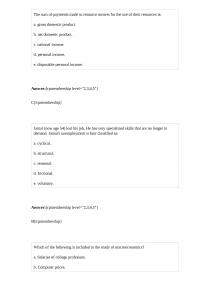
The sum of payments made to resource owners for the use of their resources is: a. gross domestic product. b. net domestic product. c. national income. d. personal income. e. disposable personal income. Jamal (now age 54) lost his job. […]
BUS 490 Ceteris paribus which of
Ceteris paribus, which of the following would cause a decrease in the demand for HD TVs? a. decline in the price of HD TVs. c. increase in consumers’ income. b. increase in the price of HD TVs. d. decrease in […]
BUS 493 Test 1
When the value of our goods exports is less than the value of our goods imports, a. d and e. b. the value of the dollar must fall. c. there will be domestic unemployment. d. there will be an unfavorable […]
BUS 564 Midterm
When people become unemployed because of a higher minimum wage, this type of unemployment is called: a. frictional. b. structural. c. cyclical. d. abnormal. On a production possibilities curve, the opportunity cost of good X, in terms of good Y, […]
BUS 566 Test 2
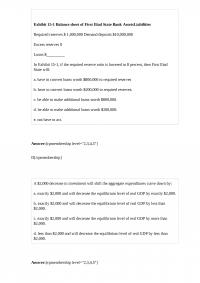
Exhibit 15-1 Balance sheet of First Iliad State Bank AssetsLiabilities Required reserves $ 1,000,000 Demand deposits $10,000,000 Excess reserves 0 Loans $ In Exhibit 15-1, if the required reserve ratio is lowered to 8 percent, then First Iliad State will: […]
BUS 580 Test 1
The Fed: a. has little control over the money supply. b. serves as the central bank for the United States. c. often uses a mix of lower taxes in its fiscal policy. d. ensures commercial bank profitability. The presence of […]
BUS 587 Test 2
If Y = $100 billion, then C = $50 billion, and I = $60 billion. What will autonomous investment be when Y = $200 billion and C = $100 billion? a. $50 billion b. $60 billion c. $100 billion d. […]
BUS 625 Quiz 1
The opportunity cost of an activity means the: a. amount of money the activity costs. b. number of hours that is required to engage in this activity. c. expected gains by engaging in the activity. d. amount of other things […]
BUS 632 Test
Which of the following statements is true? a. The simple money multiplier equals the reciprocal of the required reserve ratio. b. Required reserves is the minimum balance that the Fed requires a bank to hold in vault cash or on […]
BUS 646 Test
Which of the following would generate positive externalities? a. Flu vaccinations. b. Farmers’ use of pesticides. c. Cigarette smoking in elevators. d. Litter left at the beach. e. An unkept front yard. Althea, a brilliant new Ph.D. in economics, has […]
BUS 725
M1 refers to: a. Federal Reserve Notes and gold certificates. b. Currency held by the public plus checking account balances. c. The largest of the money-supply definitions. d. None of these. Demand-pull inflation is associated with: a. decreasing total spending […]
BUS 763
John Steinbeck’s Cannery Row describes a character who takes his own life because of poor job prospects. If he was an unemployed person who gave up looking for work, he would be considered: a. chronically unemployed. b. a discouraged worker. […]
BUS 770 Quiz 1
When an economy is operating at its full employment rate of output: a. the rate of unemployment will be zero. b. output will exceed the economy’s maximum sustainable rate. c. the actual rate of unemployment will equal the natural rate. […]
BUS 780 Test
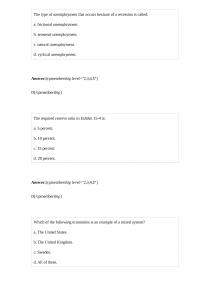
The type of unemployment that occurs because of a recession is called: a. frictional unemployment. b. seasonal unemployment. c. natural unemployment. d. cyclical unemployment. The required reserve ratio in Exhibit 15-4 is: a. 5 percent. b. 10 percent. c. 15 […]
BUS 804 Test 1
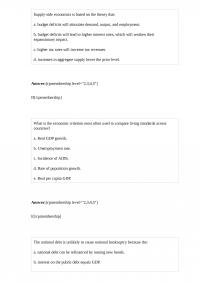
Supply-side economics is based on the theory that: a. budget deficits will stimulate demand, output, and employment. b. budget deficits will lead to higher interest rates, which will weaken their expansionary impact. c. higher tax rates will increase tax revenues. […]
BUS 833 Final
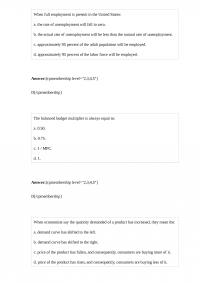
When full employment is present in the United States: a. the rate of unemployment will fall to zero. b. the actual rate of unemployment will be less than the natural rate of unemployment. c. approximately 95 percent of the adult […]
BUS 842 Midterm 2
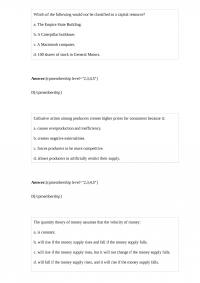
Which of the following would not be classified as a capital resource? a. The Empire State Building. b. A Caterpillar bulldozer. c. A Macintosh computer. d. 100 shares of stock in General Motors. Collusive action among producers creates higher prices […]
BUS 876 Test 1
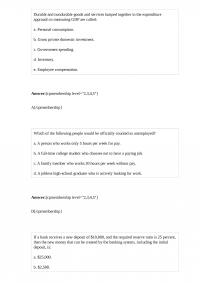
Durable and nondurable goods and services lumped together in the expenditure approach to measuring GDP are called: a. Personal consumption. b. Gross private domestic investment. c. Government spending. d. Inventory. e. Employee compensation. Which of the following people would be […]
BUS 890 Quiz 2
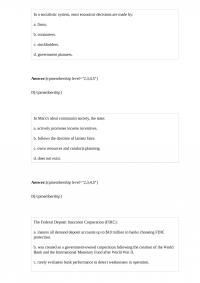
In a socialistic system, most economic decisions are made by: a. firms. b. consumers. c. stockholders. d. government planners. In Marx’s ideal communist society, the state: a. actively promotes income incentives. b. follows the doctrine of laissez faire. c. owns […]
BUS 898 Test
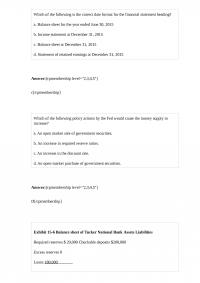
Which of the following is the correct date format for the financial statement heading? a. Balance sheet for the year ended June 30, 2015 b. Income statement at December 31, 2015 c. Balance sheet at December 31, 2015 d. Statement […]
ECB 113 Midterm
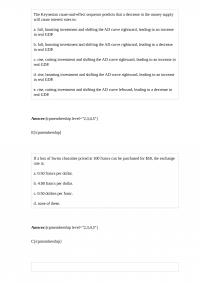
The Keynesian cause-and-effect sequence predicts that a decrease in the money supply will cause interest rates to: a. fall, boosting investment and shifting the AD curve rightward, leading to an increase in real GDP. b. fall, boosting investment and shifting […]
ECB 123 The governments chief
The government’s chief forecasting gauge for business cycles is the: a. unemployment rate. b. real GDP. c. personal income index. d. index of leading indicators. The largest component of GDP is: a. personal consumption expenditures. b. government spending. c. durable […]
ECB 131 Midterm 2
Supply-siders feel that high levels of government spending: a. assist private sector investing by creating infrastructure. b. have no impact on private sector investment. c. complement private spending. d. cause private sector investment to decline because of crowding out. e. […]
ECB 170 Quiz 3
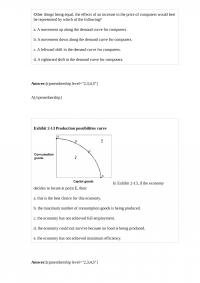
Other things being equal, the effects of an increase in the price of computers would best be represented by which of the following? a. A movement up along the demand curve for computers. b. A movement down along the demand […]
ECB 181 Midterm
SeveralitemsfromthefinancialstatementsofStandardTiresarelistedbelow.Usethefollowing answerchoicestoidentifythetypeofaccountforeachitemlisted.Placeyouranswersinthespac eprovided. a. Assets b. Liabilities c. Revenues d. Expenses e. Owners’ equity Capital stock A price ceiling that sets the price of a good below market equilibrium will cause: a. An increase in quantity demanded of the good. […]
ECB 232
A model is defined as a: a. description of all variables affecting a situation. b. positive analysis of all variables affecting an event. c. simplified description of reality to understand and predict an economic event. d. prediction based on historical […]
ECB 250 Homework
If no fiscal policy changes are made, suppose the current aggregate demand curve will increase horizontally by $1,000 billion and cause inflation. If the marginal propensity to consume (MPC) is 0.80, federal policymakers could follow Keynesian economics and restrain inflation […]
ECB 260 Final
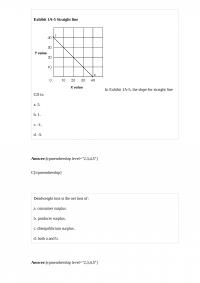
Exhibit 1A-5 Straight line In Exhibit 1A-5, the slope for straight line CD is: a. 5. b. 1. c. -1. d. -5. Deadweight loss is the net loss of: a. consumer surplus. b. producer surplus. c. disequilibrium surplus. d. both […]
ECB 271 Final Exhibit 95
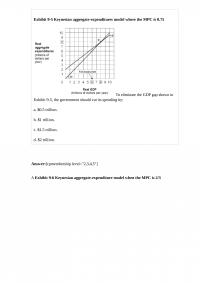
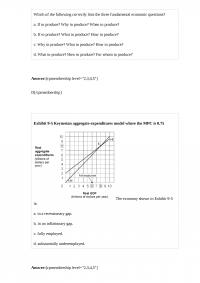
Exhibit 9-5 Keynesian aggregate-expenditures model where the MPC is 0.75 To eliminate the GDP gap shown in Exhibit 9-5, the government should cut its spending by: a. $0.5 trillion. b. $1 trillion. c. $1.5 trillion. d. $2 trillion. Answer: A […]
ECB 284 Test 2
Which of the following is not a characteristic of a public good? a. It is scarce. b. It is not diminished in amount as additional people consume the product. c. Its benefits cannot be withheld from anyone. d. It is […]
ECB 287 Quiz 2
Which of the following is not a function of the Federal Reserve System? a. To control the money supply. b. To print new money. c. To supervise and regulate banks. d. To aid in the check clearing process. e. To […]
ECB 326
Voluntary recycling is available in many parts of the country. If citizens of these areas have collected recyclable material at home, they can bring it to a recycling center. These materials reduce landfill space, reduce the need for virgin material […]
ECB 328 In 1960 US nominal GDP was
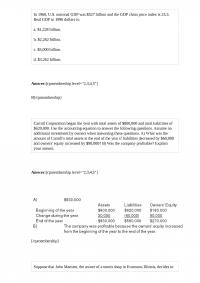
In 1960, U.S. nominal GDP was $527 billion and the GDP chain price index is 23.3. Real GDP in 1996 dollars is: a. $1,228 billion. b. $2,262 billion. c. $3,000 billion. d. $3,262 billion. Carroll Corporation began the year with […]
ECB 332 Midterm 2
If you were told that the exchange rate between the U.S. dollar and the Canadian dollar was 1.2, that would mean that Canadians would have to spend ____ to buy a $12 watch in New York City. a. c and […]
ECB 369 Quiz 1
When an economy dips into recession, automatic stabilizers will: a. enlarge the budget deficit (or reduce the surplus). b. reduce the budget deficit (or increase the surplus). c. ensure that the budget remains in balance. d. expand the supply of […]
ECB 418 Quiz 3
Suppose that Spain has a comparative advantage in hats and Portugal has a comparative advantage in doormats. Under a system of free trade, each country specializes and then trades with the other. If the price starts at four hats per […]
ECB 436 Midterm 1
Which of the following is not evidence of the lower standard of living among less-developed countries? a. High per capita real GDP. b. High percentage of households headed by females. c. High infant mortality rate. d. Low life expectancy. e. […]
ECB 446 Quiz In the United States
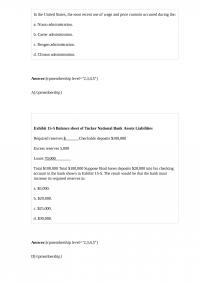
In the United States, the most recent use of wage and price controls occurred during the: a. Nixon administration. b. Carter administration. c. Reagan administration. d. Clinton administration. Exhibit 15-5 Balance sheet of Tucker National Bank Assets Liabilities Required reserves […]
ECB 449 Quiz 1
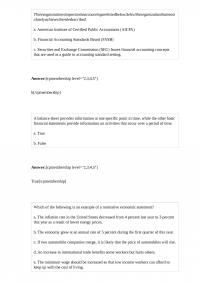
Threeorganizationsimportanttoaccountingarelistedbelow.Selecttheorganizationthatmost closelyachievestheroledescribed. a. American Institute of Certified Public Accountants (AICPA) b. Financial Accounting Standards Board (FASB) c. Securities and Exchange Commission (SEC) Issues financial accounting concepts that are used as a guide to accounting standard setting. A balance sheet provides […]
ECB 459 Test 2
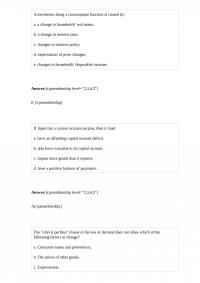
A movement along a consumption function is caused by: a. a change in households’ real assets. b. a change in interest rates. c. changes in taxation policy. d. expectations of price changes. e. changes in households’ disposable incomes. If Japan […]
ECB 461
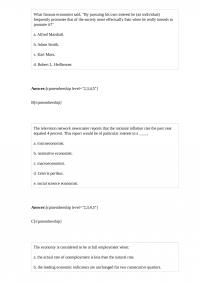
What famous economist said, “By pursuing his own interest he (an individual) frequently promotes that of the society more effectually than when he really intends to promote it?” a. Alfred Marshall. b. Adam Smith. c. Karl Marx. d. Robert L. […]
ECB 467 Test 1
If you buy a book of U.S. postage stamps to use to mail love letters to your sweetheart, the purchase is considered part of: a. C. b. I. c. G. d. X. e. M. When a recession hits, we would […]
ECB 469 Quiz
The discount rate is the interest rate: a. commercial banks charge their low-risk customers for a loan. b. savings and loan associations pay for using savings deposit funds. c. the U.S. Treasury pays individuals who buy Treasury bonds in denominations […]
ECB 537
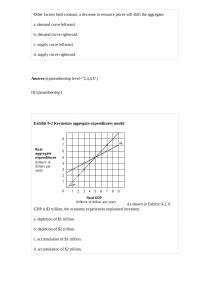
Other factors held constant, a decrease in resource prices will shift the aggregate: a. demand curve leftward. b. demand curve rightward. c. supply curve leftward. d. supply curve rightward. Exhibit 9-2 Keynesian aggregate-expenditures model As shown in Exhibit 9-2, if […]
ECB 551 Quiz 1
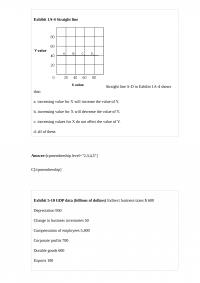
Exhibit 1A-4 Straight line Straight line A-D in Exhibit 1A-4 shows that: a. increasing value for X will increase the value of Y. b. increasing value for X will decrease the value of Y. c. increasing values for X do […]
ECB 601 Test 2
An increase in the equilibrium price of Japanese yen per dollar could be caused by a(n): a. increase in the general level of prices in Japan. b. increase in the U.S. demand for domestically-built automobiles. c. decrease in the U.S. […]
ECB 650 Quiz 3
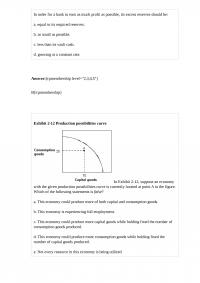
In order for a bank to earn as much profit as possible, its excess reserves should be: a. equal to its required reserves. b. as small as possible. c. less than its vault cash. d. growing at a constant rate. […]
ECB 652 Midterm
In the circular flow model, money flows from the business sector to the household sector through the: a. product market. b. capital market. c. goods market. d. services market. e. resource market. Matchthefollowingbusinessformswiththeircharacteristicsbelow. a. Sole proprietorship b. Partnership c. Corporation […]
ECB 658 Test
Externalities are unintended costs or benefits that are imposed on unsuspecting people and that result from: a. poor planning. b. intentional damages. c. excessive costs. d. excessive losses. e. the economic activity of others. In the aggregate expenditures model, if […]
ECB 674
The largest component of GDP as measured by the expenditure approach is: a. wages and salary earnings. b. personal consumption. c. net profits of corporations. d. gross private investment. A technological breakthrough lowers the cost of manufacturing DVDs. As a […]
ECB 773 Homework
If Y = $500 billion, autonomous consumption = $300 billion, and the marginal propensity to save = 0.20, then saving will equal: a. -$200 billion. b. $200 billion. c. -$100 billion. d. $100 billion. e. $40 billion. The sum of […]
ECB 779 Exhibit 181 Production
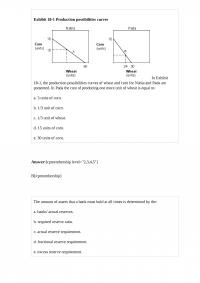
Exhibit 18-1 Production possibilities curves In Exhibit 18-1, the production possibilities curves of wheat and corn for Nabia and Pada are presented. In Pada the cost of producing one more unit of wheat is equal to: a. 3 units of […]
ECB 830 Midterm 1
The exchange rate is the: a. value of money. b. quantity of dollars, yen, etc. that are traded. c. amount of a foreign currency that is brought back to the United States by tourists. d. number of units of your […]
ECB 847 Quiz 2
Which of the following correctly lists the three fundamental economic questions? a. If to produce? Why to produce? When to produce? b. If to produce? What to produce? How to produce? c. Why to produce? What to produce? How to […]
ECB 866 Test 1
The required reserve ratio is the: a. actual amount of reserves that banks must hold. b. excess amount of reserves that a bank must hold. c. minimum amount of reserves the Fed requires a bank to hold. d. total amount […]
ECB 897 Quiz 3
Compared to a barter economy, using money increases efficiency by reducing: a. transaction costs. b. the need to exchange goods. c. the need to specialize. d. inflation. If the long-run Phillips curve is vertical, then any government policy designed to […]
ECON 102 Quiz 1
According to the Phillips curve, a more expansionary macro-policy that causes inflation to be greater will: a. place downward pressure on prices. b. reduce unemployment. c. reduce output. d. reduce the natural rate of unemployment. Which of the following is […]
ECON 125 Quiz
The four components of the aggregate expenditures model are: a. consumption, investment, inventories, and government purchases. b. consumption, planned investment, unplanned changes in inventory, and exports. c. consumption, investment, government purchases, and net exports. d. consumption, investment, exports, and imports. […]
ECON 127
According to the quantity theory of money, if M’s growth is lower than Q’s, then: a. V falls. b. V rises. c. P stays the same d. P falls. e. P rises People who often impose cost on the majority […]
ECON 135 Midterm 2
A depreciation of one’s currency means that: a. the country’s exports will become more expensive. b. the country’s imports will become more expensive. c. the country’s imports will become less expensive. d. it now requires less of this currency in […]
ECON 164 Midterm 1
A nation’s trade deficit will expand when its: a. currency appreciates. b. economy is shrinking. c. investment environment is less attractive to foreigners. d. all of these are true. A worker would be hurt least by inflation when the: a. […]
ECON 172 Quiz
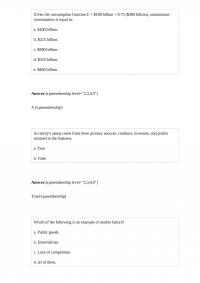
Given the consumption function C = $100 billion + 0.75 ($300 billion), autonomous consumption is equal to: a. $100 billion. b. $225 billion. c. $300 billion. d. $325 billion. e. $400 billion. An entity’s assets come from three primary sources: […]
ECON 198
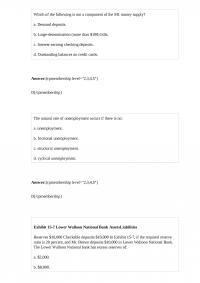
Which of the following is not a component of the M1 money supply? a. Demand deposits. b. Large-denomination (more than $100) bills. c. Interest-earning checking deposits. d. Outstanding balances on credit cards. The natural rate of unemployment occurs if there […]
ECON 219 Midterm 1
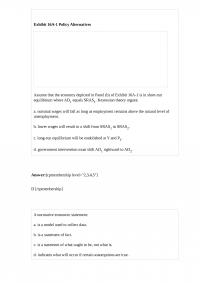
Exhibit 16A-1 Policy Alternatives Assume that the economy depicted in Panel (b) of Exhibit 16A-1 is in short-run equilibrium where AD1 equals SRAS1. Keynesian theory argues: a. nominal wages will fall as long as employment remains above the natural level […]
ECON 249 Quiz 1
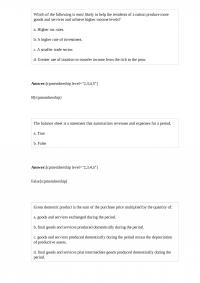
Which of the following is most likely to help the residents of a nation produce more goods and services and achieve higher income levels? a. Higher tax rates. b. A higher rate of investment. c. A smaller trade sector. d. […]
ECON 322 Final
Which one of the following items is correct concerning the time element of financial statements? a. The balance sheet covers a period of time. b. The statement of retained earnings explains changes during a particular period. c. An income statement […]
ECON 329
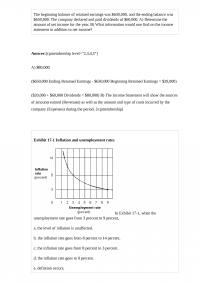
The beginning balance of retained earnings was $630,000, and the ending balance was $650,000. The company declared and paid dividends of $60,000. A) Determine the amount of net income for the year. B) What information would one find on the […]
ECON 440
In the aggregate expenditures model, a decrease in government spending causes a(n): a. upward shift in the aggregate expenditures curve. b. downward shift in the aggregate expenditures curve. c. shift in the 45-degree line. d. rightward movement along the aggregate […]
ECON 475 Final
Assume the Fed purchases a government security from a private dealer and pays with a Fed check of $100,000. If this check is deposited by the dealer in a bank with a 10 percent required reserve ratio, the bank can […]
ECON 475 Quiz
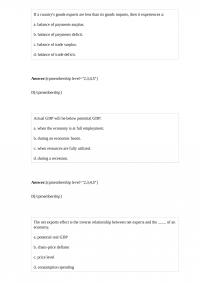
If a country’s goods exports are less than its goods imports, then it experiences a: a. balance of payments surplus. b. balance of payments deficit. c. balance of trade surplus. d. balance of trade deficit. Actual GDP will be below […]
ECON 506 Quiz 1
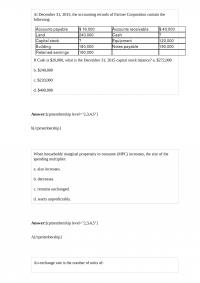
At December 31, 2015, the accounting records of Farmer Corporation contain the following: If Cash is $26,000, what is the December 31, 2015 capital stock balance? a. $272,000 b. $240,000 c. $220,000 d. $400,000 When households’ marginal propensity to consume […]
ECON 539
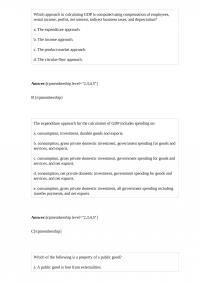
Which approach to calculating GDP is computed using compensation of employees, rental income, profits, net interest, indirect business taxes, and depreciation? a. The expenditure approach. b. The income approach. c. The product-market approach. d. The circular-flow approach. The expenditure approach […]
ECON 542 Midterm 1
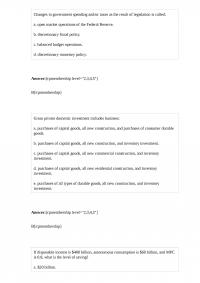
Changes in government spending and/or taxes as the result of legislation is called: a. open market operations of the Federal Reserve. b. discretionary fiscal policy. c. balanced budget operations. d. discretionary monetary policy. Gross private domestic investment includes business: a. […]
ECON 597
All of the following are examples of capital except: a. the robot used to help produce your car. b. a computer used by your professor to write this exam. c. the factory that produces the costume jewelry you buy. d. […]
ECON 606 Midterm 1
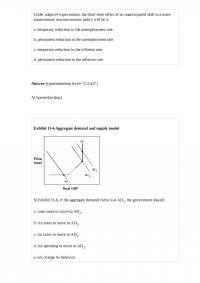
Under adaptive expectations, the short-term effect of an unanticipated shift to a more expansionary macroeconomic policy will be a: a. temporary reduction in the unemployment rate. b. permanent reduction in the unemployment rate. c. temporary reduction in the inflation rate. […]
ECON 627 Final
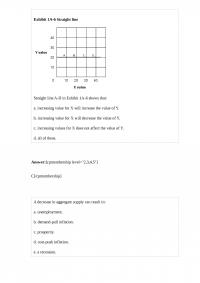
Exhibit 1A-6 Straight line Straight line A-D in Exhibit 1A-6 shows that: a. increasing value for X will increase the value of Y. b. increasing value for X will decrease the value of Y. c. increasing values for X does […]
ECON 638 Final In a dynamic
In a dynamic economy under ideal conditions: a. the unemployment rate should be near zero. b. some unemployment would be present due to workers temporarily being out of work while changing jobs. c. unemployment would tend to move upward slightly […]
ECON 688 Test
The percentage of checkable deposits that banks and other financial intermediaries are required to keep in cash reserves is known as: a. the fractional reserve requirement. b. the excess reserve requirement. c. the required reserve ratio. d. the discount rate. […]
ECON 707 Midterm
The aggregate demand curve indicates the relationship between: a. the real wage rate and the quality of resources demanded by producers of goods and services. b. the interest rate and the amount of loanable funds demanded by borrowers. c. the […]
ECON 756
Which of the following is the best example of an action that imposes an external cost? a. Wear and tear on your car as the result of frequent use. b. Deterioration in the average quality of a house you own […]
ECON 779
A drought destroys much of the grape crop. As a result, consumer surplus in the market for wine: a. decreases. b. increases. c. remains unchanged. d. depends on the deadweight loss. Which of the following would not be counted in […]
ECON 802 Quiz
As the marginal propensity to consume (MPC) decreases, the spending multiplier: a. increases. b. decreases. c. remains constant. d. becomes indefinable. The sum of past federal budget deficits increases the: a. GDP debt. b. trade debt plus debt. c. national […]
ECON 856 Quiz 1
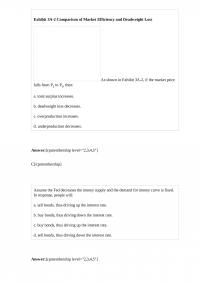
Exhibit 3A-2 Comparison of Market Efficiency and Deadweight Loss As shown in Exhibit 3A-2, if the market price falls from P2 to P3, then: a. total surplus increases. b. deadweight loss decreases. c. overproduction increases. d. underproduction decreases. Assume the […]
ECON 862 Test
Which of the following provides the foundation of the case for free trade? a. The law of diminishing marginal utility b. The anti-dumping argument c. The industrial diversity argument d. The theory of comparative advantage Using the aggregate expenditure-output model, […]
ECON 865 Midterm 2
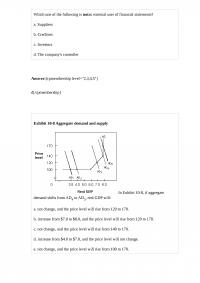
Which one of the following is notan external user of financial statements? a. Suppliers b. Creditors c. Investors d. The company’s controller Exhibit 10-8 Aggregate demand and supply In Exhibit 10-8, if aggregate demand shifts from AD4 to AD5, real […]
ECON A 144 Midterm 1
In the former Soviet economy, the supreme planning board that transmitted economic decisions down to producing and consuming units was called the: a. Soviet Ministry. b. Polit Bureau. c. Gosplan. d. Soviet Central Committee for Economic Planning. Which of the […]
ECON A 178 Quiz 3
Some cities finance their airports with a departure tax: every person leaving the city by plane is charged a small fixed dollar amount that is used to help pay for building and running the airport. The departure tax follows the: […]
ECON A 199 Midterm
A tax system in which the tax rate on everyone’s first $10,000 of income is 10 percent, the tax rate on everyone’s second $10,000 of income is 15 percent, and the tax rate on all income over $20,000 is 25 […]
ECON A 223
When the economy is experiencing high inflation and high unemployment at the same time, then it is experiencing: a. stagnation. b. deflation. c. reflation. d. stagflation. e. innation. A movement along the consumption function is caused by a change in: […]
ECON A 276 Test 1
Consumption spending that is independent of the level of disposable income is known as: a. marginal consumption. b. transitory consumption. c. permanent consumption. d. relative consumption. e. autonomous consumption. The sub-discipline of economics that focuses especially on individual markets is: […]
ECON A 287 Quiz
As the size of a nation’s outstanding debt gets larger and larger relative to the size of the economy: a. eventually it will become difficult for the country to borrow in global credit markets. b. the country will have to […]
ECON A 353 Test
Noise pollution is a serious problem. One major contributor is the recent development of very powerful amplification equipment for automobile radios. Many people complain that the windows in their home vibrate when some cars drive by. Others complain that loud […]
ECON A 375 Midterm 1
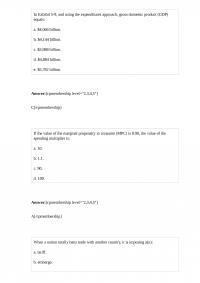
In Exhibit 5-9, and using the expenditures approach, gross domestic product (GDP) equals: a. $4,066 billion. b. $4,144 billion. c. $3,988 billion. d. $4,884 billion. e. $5,782 billion. If the value of the marginal propensity to consume (MPC) is 0.90, […]
ECON A 435 Midterm
Supply curves slope upward because: a. the quality is assumed to vary with price. b. technology improves over time, increasing the ability of firms to produce more at each possible price. c. increases in the price of a good lead […]
ECON A 455 Final
Which of the following is a shortcoming of GDP? a. GDP excludes changes in inventories. b. GDP includes an estimate of illegal transactions. c. GDP excludes nonmarket transactions. d. GDP excludes business investment spending. Which of the following is not […]
ECON A 459 Quiz 1
Currently, the Social Security Trust Fund is running a: a. deficit, which reduces the apparent size of the budget deficit. b. surplus, which reduces the apparent size of the budget deficit. c. surplus, which increases the apparent size of the […]
ECON A 460 Test 1
Providedbelowisalistofimportantusersofaccountinginformation.Belowthelistaredescripti onsofamajorneedofeachofthevarioususers.Fillintheblankwiththeoneusergroupthatismost likelytohavetheneeddescribedtotherightoftheblank.Someusergroupsmaybeusedmorethan onceornotatall. a. Stockholder b. Company management c. Supplier d. Banker e. Internal Revenue Service f. Securities and Exchange Commission g. Labor union The exact amount of profit on each product of the company. If people refused to […]
ECON A 480 Final
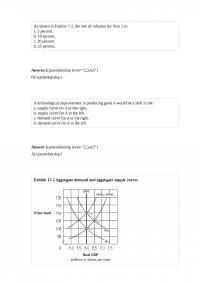
As shown in Exhibit 7-2, the rate of inflation for Year 2 is: a. 5 percent. b. 10 percent. c. 20 percent. d. 25 percent. A technological improvement in producing good A would be a shift in the: a. supply […]
ECON A 480 Quiz
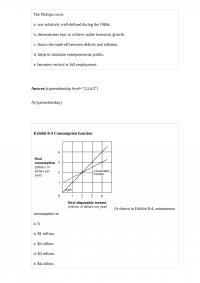
The Phillips curve: a. was relatively well-defined during the 1960s. b. demonstrates how to achieve stable economic growth. c. shows the trade-off between deficits and inflation. d. helps to stimulate entrepreneurial profits. e. becomes vertical at full employment. Exhibit 8-4 […]
ECON A 543
Assume that brand X is an inferior good and name brand Y is a normal good. An increase in consumer income, other things being equal, will cause a(n): a. upward movement along the demand curve for name brand Y. b. […]
ECON A 565 Test 1
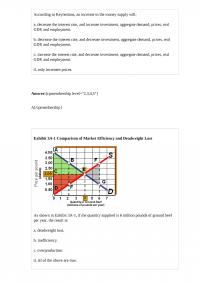
According to Keynesians, an increase in the money supply will: a. decrease the interest rate, and increase investment, aggregate demand, prices, real GDP, and employment. b. decrease the interest rate, and decrease investment, aggregate demand, prices, real GDP, and employment. […]
ECON A 626 Test
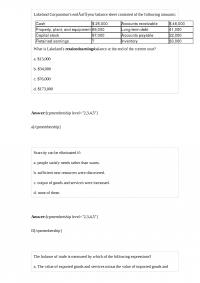
Lakeland Corporation’s endÂofÂyear balance sheet consisted of the following amounts: What is Lakeland’s retainedearningsbalance at the end of the current year? a. $13,000 b. $34,000 c. $76,000 d. $173,000 Scarcity can be eliminated if: a. people satisfy needs rather than […]
ECON A 635 Test 2
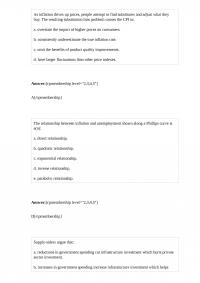
As inflation drives up prices, people attempt to find substitutes and adjust what they buy. The resulting substitution bias problem causes the CPI to: a. overstate the impact of higher prices on consumers. b. consistently underestimate the true inflation rate. […]
ECON A 655 Quiz
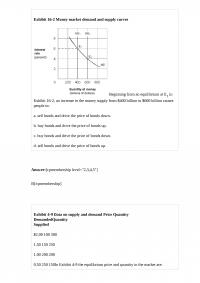
Exhibit 16-2 Money market demand and supply curves Beginning from an equilibrium at E1 in Exhibit 16-2, an increase in the money supply from $400 billion to $600 billion causes people to: a. sell bonds and drive the price of […]
ECON A 656 Quiz 1
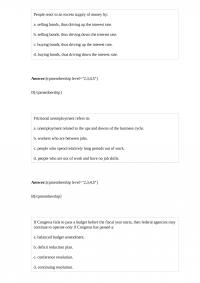
People react to an excess supply of money by: a. selling bonds, thus driving up the interest rate. b. selling bonds, thus driving down the interest rate. c. buying bonds, thus driving up the interest rate. d. buying bonds, thus […]
ECON A 665 Test 2
Threeorganizationsimportanttoaccountingarelistedbelow.Selecttheorganizationthatmost closelyachievestheroledescribed. a. American Institute of Certified Public Accountants (AICPA) b. Financial Accounting Standards Board (FASB) c. Securities and Exchange Commission (SEC) Since there is a lack of a profit motive in nonbusiness entities, they do notneed information provided by […]
ECON A 687 Quiz 3
Economic indicators, like unemployment claims and the average workweek, which change before real GDP changes, are called: a. leading. b. lagging. c. coincident. d. structural. Automatic stabilizers are government programs that: a. exaggerate the ups and downs in aggregate demand […]
ECON A 691
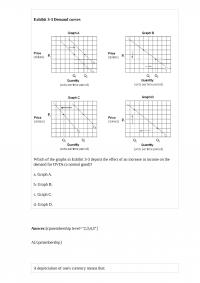
Exhibit 3-3 Demand curves Which of the graphs in Exhibit 3-3 depicts the effect of an increase in income on the demand for DVDs (a normal good)? a. Graph A. b. Graph B. c. Graph C. d. Graph D. A […]
ECON A 696 Test 2
If a country’s real GDP is growing at 5 percent and the population is also growing at 5 percent, its: a. per capita real GDP grows at an increasing rate. b. per capita real GDP grows at a constant rate. […]
ECON A 715 Quiz 3
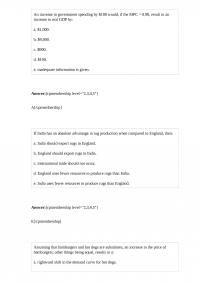
An increase in government spending by $100 would, if the MPC = 0.90, result in an increase in real GDP by: a. $1,000. b. $9,000. c. $900. d. $190. e. inadequate information is given. If India has an absolute advantage […]
ECON A 722 Test 2
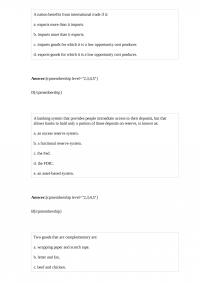
A nation benefits from international trade if it: a. exports more than it imports. b. imports more than it exports. c. imports goods for which it is a low opportunity cost producer. d. exports goods for which it is a […]
ECON A 770
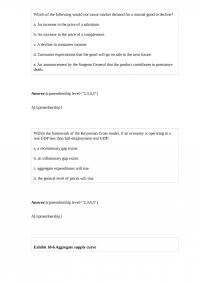
Which of the following would not cause market demand for a normal good to decline? a. An increase in the price of a substitute. b. An increase in the price of a complement. c. A decline in consumer income. d. […]
ECON A 812 Quiz 3
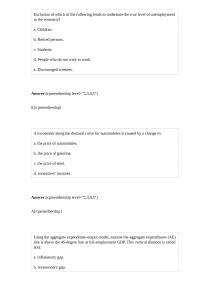
Exclusion of which of the following tends to understate the true level of unemployment in the economy? a. Children. b. Retired persons. c. Students. d. People who do not want to work. e. Discouraged workers. A movement along the demand […]
ECON E 101 Midterm 1
When the opportunity cost of producing carrots increases as more carrots are produced, then: a. no more carrots will be produced. b. resources are equally suited to the production of carrots and to other goods. c. the production possibilities curve […]
ECON E 115 Quiz 3
The primary purpose of WTO is to: a. protect the United States from cheap foreign labor. b. foster trade among nations. c. promote the dumping of foreign products. d. increase worldwide tariffs. e. form a union of European nations. If […]
ECON E 153 Quiz 3
An advantage of automatic stabilizers is that this type of fiscal policy is not subject to: a. imprecise knowledge of full-employment real GDP. b. special interest groups. c. lag time problems. d. All of these are true. The term “balance […]
ECON E 209 Quiz
The economic systems of the former Soviet Union, the People’s Republic of China, and Cuba are best classified as: a. traditional economies. b. command economies. c. market economies. d. decentralized economies. What famous economist said that the market economy seemed […]
ECON E 221 Quiz 3
Keynesians identify three principal motives for demanding money. They are the: a. transactions demand, precautionary demand, and liquidity motive. b. transactions demand, precautionary demand, and convertibility motive. c. transactions demand, speculative demand, and volatility motive. d. transactions demand, speculative demand, […]
ECON E 228 Final
The Phillips Curve shows the trade-off between: a. unemployment and output. b. inflation and output. c. unemployment and inflation. d. imports and exports. e. unemployment and imports. The conduct of monetary policy is the responsibility of: a. commercial banks. b. […]
ECON E 260 Test 1
Suppose the official unemployment rate is 10 percent. We can conclude without question that: a. the same 10 percent of the people in the economy were out of work for the entire ear. b. one of every 10 people in […]
ECON E 262
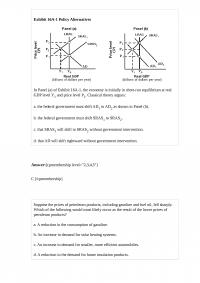
Exhibit 16A-1 Policy Alternatives In Panel (a) of Exhibit 16A-1, the economy is initially in short-run equilibrium at real GDP level Y1 and price level P2. Classical theory argues: a. the federal government must shift AD1 to AD2 as shown […]
ECON E 265
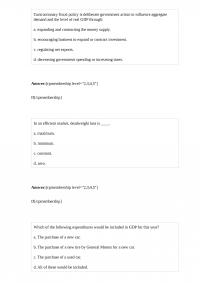
Contractionary fiscal policy is deliberate government action to influence aggregate demand and the level of real GDP through: a. expanding and contracting the money supply. b. encouraging business to expand or contract investment. c. regulating net exports. d. decreasing government […]
ECON E 319
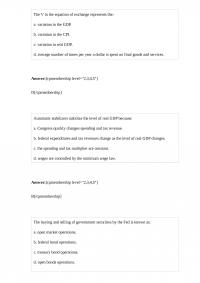
The V in the equation of exchange represents the: a. variation in the GDP. b. variation in the CPI. c. variation in real GDP. d. average number of times per year a dollar is spent on final goods and services. […]
ECON E 362 Quiz
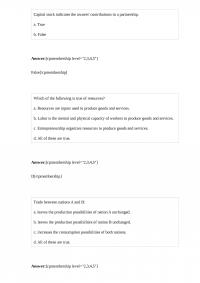
Capital stock indicates the owners’ contributions to a partnership. a. True b. False Which of the following is true of resources? a. Resources are inputs used to produce goods and services. b. Labor is the mental and physical capacity of […]
ECON E 368 Final
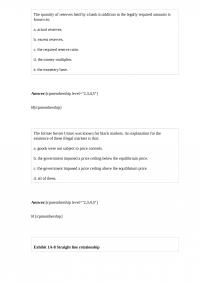
The quantity of reserves held by a bank in addition to the legally required amounts is known as: a. actual reserves. b. excess reserves. c. the required reserve ratio. d. the money multiplier. e. the monetary base. The former Soviet […]
ECON E 387 If an economy is
If an economy is operating at a point inside the production possibilities curve, a. its resources are not being used efficiently. b. the curve will begin to shift inward. c. the curve will begin to shift outward. d. This is […]
ECON E 502 Midterm 2
Advances in technology will shift the aggregate: a. demand curve rightward. b. supply curve rightward. c. demand curve leftward. d. supply curve leftward. The most broadly based price index is the: a. real GDP price index. b. consumer price index. […]
ECON E 507
Which of the following has a direct relationship rather than an inverse relationship with the supply curve? a. The number of sellers. b. Resource prices. c. Consumer income. d. Prices of other goods that firms could produce. United Airlines is […]
ECON E 517 Test 1
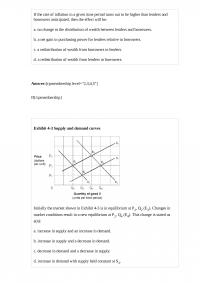
If the rate of inflation in a given time period turns out to be higher than lenders and borrowers anticipated, then the effect will be: a. no change in the distribution of wealth between lenders and borrowers. b. a net […]
ECON E 525 Test 1
Which of the following policy actions by the Fed would cause the money supply to decrease? a. An open-market purchase of government securities. b. A decrease in required reserve ratios. c. An increase in the discount rate. d. A decrease […]
ECON E 630 Test 2
Most economists consider the case for jawboning to control inflation is strongest when this policy is used: a. for a long period of time. b. to combat inflation that is out of control. c. to combat cost-push inflation. d. All […]
ECON E 693 Test
If the federal government were to run a budget deficit, this would: a. increase the size of the national debt. b. reduce the size of the national debt. c. leave the size of the national debt unchanged. d. increase the […]
ECON E 695 Midterm 1
Which of the following is true? a. GDP is a “flow” concept. b. The purchase prices of both intermediate goods and final goods are included in GDP. c. GDP measures economic welfare. d. GDP is a measure of changes in […]
ECON E 708 Quiz 1
In the aggregate expenditures model, if an economy operates above equilibrium GDP, there will be: a. unplanned inventory accumulation. b. a decrease in GDP. c. a decrease in employment. d. all of the above. Which of the following is a […]
ECON E 722 Final
Which one of the following is an economic obligation for a business entity? a. Salaries paid to employees for services rendered b. Amounts owed to creditors c. Materials used in manufacturing products d. Payment of rent for the next year […]
ECON E 770 Midterm 1
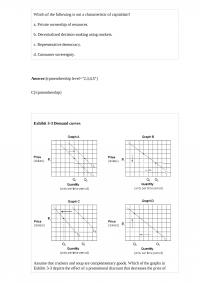
Which of the following is not a characteristic of capitalism? a. Private ownership of resources. b. Decentralized decision-making using markets. c. Representative democracy. d. Consumer sovereignty. Exhibit 3-3 Demand curves Assume that crackers and soup are complementary goods. Which of […]
ECON E 771 Quiz 2
The marginal propensity to consume is defined as the: a. fraction of total income not spent on consumption. b. proportion of any change in income that is spent on consumption. c. fraction of total income spent on consumption. d. fraction […]
ECON E 780
To calculate GDP using the income approach, add: a. indirect business taxes and Social Security taxes. b. capital depreciation and Social Security taxes. c. indirect business taxes and personal taxes. d. indirect business taxes and depreciation. e. compensation of employees, […]
ECON E 796
Which of the following options could be used to eliminate a recessionary gap? a. Decrease consumption. b. Increase investment. c. Decrease investment. d. Increase taxes. The vicious circle of poverty refers to the fact that in LDCs, a. low living […]
ECON E 821 Quiz 2
Pete throws leftover bread onto his front lawn because he enjoys watching the pigeons feeding. His neighbor John is not happy about the pigeons, since they leave a mess on his property. This is an example of: a. a negative […]
ECON E 822 Test
When economists say the quantity supplied of a product has decreased, they mean the: a. supply curve has shifted to the left. b. supply curve has shifted to the right. c. price of the product has risen, and consequently, suppliers […]
ECON E 846
A competitive market economy is unlikely to provide an efficient quantity of some public goods because: a. only the government has the vast resources necessary to produce public goods. b. the nature of public goods makes it difficult for producers […]
ECON E 851 Midterm
Which one of the following would count as investment in the GDP accounts? a. Purchase of a new airplane by an airline. b. Purchase of a U.S. government bond. c. Purchase of 100 shares of Wal-Mart stock. d. Purchase of […]
ECON E 869 Quiz 1
Which of the following items is included when computing M1? a. Checking accounting entries. b. Currency in circulation. c. All of the above. d. None of the above. The equilibrium level of real GDP is $5,000 billion, the full employment […]
ECON E 882 Quiz 2
The aggregate expenditures function (AE) is the total spending in an economy at a given: a. rate of interest. b. level of disposable income. c. level of autonomous investment. d. price level. SeveralitemsfromthefinancialstatementsofStandardTiresarelistedbelow.Usethefollowing answerchoicestoidentifythetypeofaccountforeachitemlisted.Placeyouranswersinthespac eprovided. a. Assets b. Liabilities c. […]
ECON E 897 Midterm 1
In the aggregate expenditures model, if an economy operates below equilibrium GDP, there will be: a. unplanned inventory depletion. b. unplanned inventory accumulated. c. a decrease in GDP. d. a decrease in employment. Over a ten year period, the monthly […]
Economics 102 Homework
When the Fed buys government securities, it: a. lowers the cost of borrowing from the Fed, encouraging banks to make loans to the general public. b. raises the cost of borrowing from the Fed, discouraging banks from making loans to […]
Economics 159
Incomes policies of the federal government include: a. presidential jawboning. b. wage-price guidelines. c. wage-price controls. d. All of these. Assume we have a simplified banking system in balance-sheet equilibrium. Also assume that all banks are subject to a uniform […]
Economics 165 Final
The aggregate supply curve relating the price level to real GDP has three distinguishing segments. Which one of the following indicates the segments? a. The horizontal segment reflects the increasing pressure on the price level as firms bid for resources. […]
Economics 177
Comparative advantage indicates that: a. specialization and exchange will permit trading partners to maximize their joint consumption. b. a nation can gain from trade only if it is not at an absolute disadvantage in producing all goods. c. a nation […]
Economics 198 Quiz 1
Which of the following groups analyzes federal budgets proposals? a. The Council of Economic Advisors. b. The Office of Management and Budget. c. The Congressional Budget Office. d. The House and Senate Budget Committees. Marcos Inc. had net income for […]
Economics 218
The precautionary demand for money: a. varies inversely with the income level. b. varies inversely with the price level. c. is used as an insurance agent against unexpected needs. d. states that nominal income must exceed real income. e. is […]
Economics 221 Quiz 1
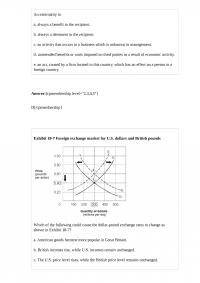
An externality is: a. always a benefit to the recipient. b. always a detriment to the recipient. c. an activity that occurs in a business which is unknown to management. d. unintended benefits or costs imposed on third parties as […]
Economics 240 Midterm 1
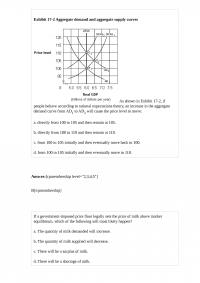
Exhibit 17-2 Aggregate demand and aggregate supply curves As shown in Exhibit 17-2, if people behave according to rational expectations theory, an increase in the aggregate demand curve from AD1 to AD2 will cause the price level to move: a. […]
Economics 254 Which of the
Which of the following events is the most likely to create stagflation? a. An increase in the money supply. b. A reduction in the amount spent on national defense. c. A doubling of oil prices. d. A decrease in investment […]
Economics 379 Test 2
Which of the following provides the best explanation of why money is valuable? a. Money is valuable because it is indivisible. b. Money is valuable because it is scarce. c. Money is valuable because it is backed by precious metals, […]
Economics 384 Midterm 1
Comparing how many dollars it takes to attend college each year to annual earnings on a job represents the use of money as a: a. medium of exchange. b. unit of account. c. store of value. d. store of coincidence. […]
Economics 400 Homework
Assume that full-employment real GDP is Y = $1,200 billion, the current equilibrium real GDP is Y = $800 billion, and the MPC is 0.50. What level of aggregate expenditures will close the recessionary gap? a. $50 billion. b. $80 […]
Economics 424 Quiz 1
The seven members of the Board of Governors serve 14-year terms to: a. reduce political influence. b. provide steady employment. c. inhibit independent decisions. d. prevent illegal appointments. Which of the following represents the proper order of the financial decision […]
Economics 434 In the Keynesian
In the Keynesian aggregate expenditures model, “aggregate expenditures” refer to: a. the amount of GDP that could be produced if unemployment were zero. b. the combined expenditures of consumers, businesses, governments, and foreigners (net exports). c. the amount of demand […]
Economics 448 Final
A change in demand cannot be caused by a change in: a. tastes. b. population. c. the prices of other goods. d. expectations of future prices. e. the price of the good itself. Which of the following is not a […]
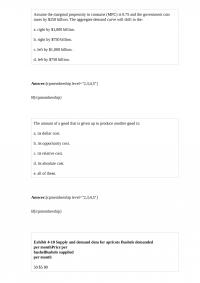
Economics 462 Homework
Assume the marginal propensity to consume (MPC) is 0.75 and the government cuts taxes by $250 billion. The aggregate demand curve will shift to the: a. right by $1,000 billion. b. right by $750 billion. c. left by $1,000 billion. […]
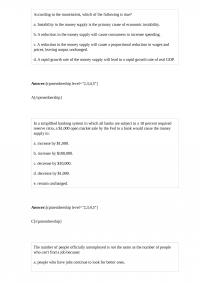
Economics 467 Test
According to the monetarists, which of the following is true? a. Instability in the money supply is the primary cause of economic instability. b. A reduction in the money supply will cause consumers to increase spending. c. A reduction in […]
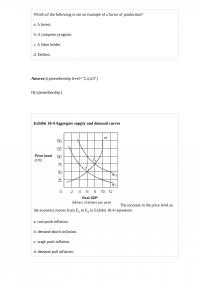
Economics 475 Midterm 1
Which of the following is not an example of a factor of production? a. A forest. b. A computer program. c. A labor leader. d. Dollars. Exhibit 10-4 Aggregate supply and demand curves The increase in the price level as […]
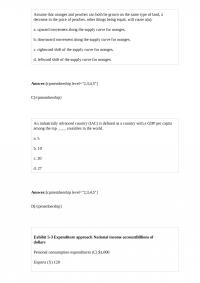
Economics 495 Quiz 2
Assume that oranges and peaches can both be grown on the same type of land, a decrease in the price of peaches, other things being equal, will cause a(n): a. upward movement along the supply curve for oranges. b. downward […]
Economics 498 quotIt would be an
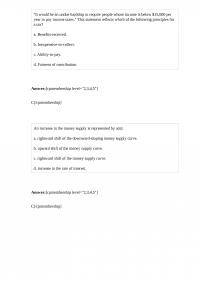
“It would be an undue hardship to require people whose income is below $15,000 per year to pay income taxes.” This statement reflects which of the following principles for a tax? a. Benefits-received. b. Inexpensive-to-collect. c. Ability-to-pay. d. Fairness of […]
Economics 649 Quiz 3
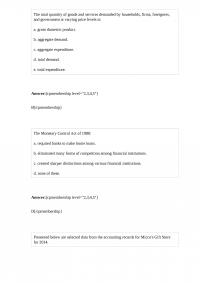
The total quantity of goods and services demanded by households, firms, foreigners, and government at varying price levels is: a. gross domestic product. b. aggregate demand. c. aggregate expenditure. d. total demand. e. total expenditure. The Monetary Control Act of […]
Economics 655
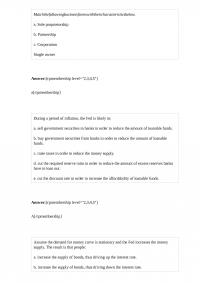
Matchthefollowingbusinessformswiththeircharacteristicsbelow. a. Sole proprietorship b. Partnership c. Corporation Single owner During a period of inflation, the Fed is likely to: a. sell government securities to banks in order to reduce the amount of loanable funds. b. buy government securities from […]
Economics 656
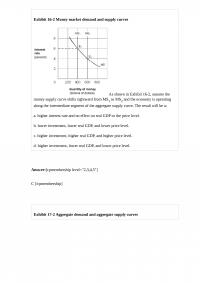
Exhibit 16-2 Money market demand and supply curves As shown in Exhibit 16-2, assume the money supply curve shifts rightward from MS1 to MS2 and the economy is operating along the intermediate segment of the aggregate supply curve. The result […]
Economics 673 Quiz
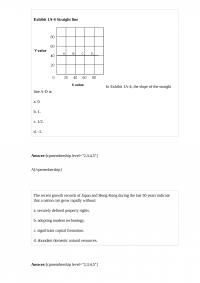
Exhibit 1A-4 Straight line In Exhibit 1A-4, the slope of the straight line A-D is: a. 0. b. 1. c. 1/2. d. -1. The recent growth records of Japan and Hong Kong during the last 50 years indicate that a […]
Economics 684 Quiz 1
Which of the following is a characteristic of an LDC? a. Capital flight. b. Vicious circle of poverty. c. Lack of entrepreneurs. d. All of these. An increase in government spending will have the greatest expansionary impact on the economy […]
Economics 684 Quiz 3
According to Keynesian economists, which of the following is not a consequence of increasing the money supply? a. A lower interest rate. b. Greater investment. c. Lower real GDP. d. Higher real GDP. Which of the following is not an […]
Economics 714 Midterm 2
Which of the following categories accounted for the third largest percentage of total federal government expenditures? a. Education and health. b. National defense. c. Income security. d. Interest on the national debt. Producer surplus is the: a. amount by which […]
Economics 727 Final
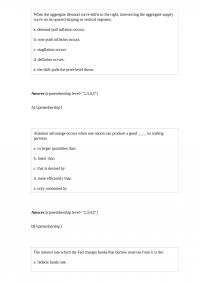
When the aggregate demand curve shifts to the right, intersecting the aggregate supply curve on its upward-sloping or vertical segment, a. demand-pull inflation occurs. b. cost-push inflation occurs. c. stagflation occurs. d. deflation occurs. e. the shift pulls the price […]
Economics 753 Midterm
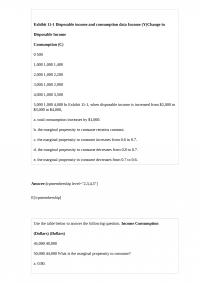
Exhibit 11-1 Disposable income and consumption data Income (Y)Change in Disposable Income Consumption (C) 0 500 1,000 1,000 1,400 2,000 1,000 2,200 3,000 1,000 2,900 4,000 1,000 3,500 5,000 1,000 4,000 In Exhibit 11-1, when disposable income is increased from […]
Economics 755 Final
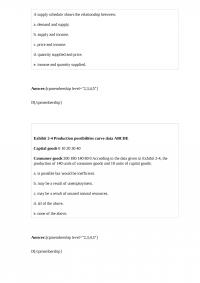
A supply schedule shows the relationship between: a. demand and supply. b. supply and income. c. price and income. d. quantity supplied and price. e. income and quantity supplied. Exhibit 2-4 Production possibilities curve data ABCDE Capital goods 0 10 […]
Economics 782
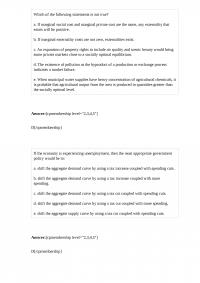
Which of the following statements is not true? a. If marginal social cost and marginal private cost are the same, any externality that exists will be positive. b. If marginal externality costs are not zero, externalities exist. c. An expansion […]
Economics 783 Midterm 1
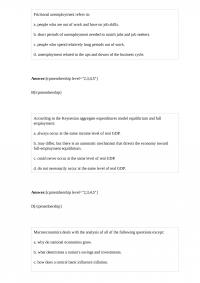
Frictional unemployment refers to: a. people who are out of work and have no job skills. b. short periods of unemployment needed to match jobs and job seekers. c. people who spend relatively long periods out of work. d. unemployment […]
Economics 819 Albert Betty
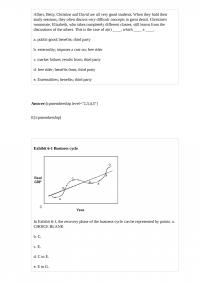
Albert, Betty, Christine and David are all very good students. When they hold their study sessions, they often discuss very difficult concepts in great detail. Christine’s roommate, Elizabeth, who takes completely different classes, still learns from the discussions of the […]
Economics 848
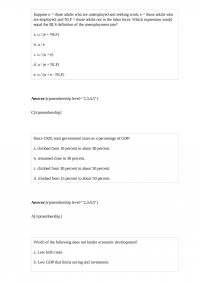
Suppose u = those adults who are unemployed and seeking work; e = those adults who are employed; and NLF = those adults not in the labor force. Which expression would equal the BLS definition of the unemployment rate? a. […]
MicroEconomic 183 Quiz 2
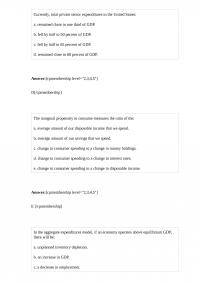
Currently, total private sector expenditures in the United States: a. remained close to one third of GDP. b. fell by half to 50 percent of GDP. c. fell by half to 65 percent of GDP. d. remained close to 60 […]
MicroEconomic 191 Test
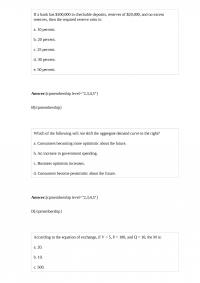
If a bank has $100,000 in checkable deposits, reserves of $20,000, and no excess reserves, then the required reserve ratio is: a. 10 percent. b. 20 percent. c. 25 percent. d. 30 percent. e. 50 percent. Which of the following […]
MicroEconomic 208 Test
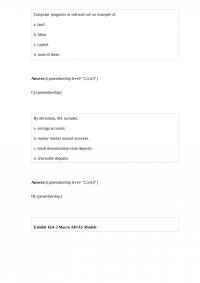
Computer programs or software are an example of: a. land. b. labor. c. capital. d. none of these. By definition, M1 includes: a. savings accounts. b. money market mutual accounts. c. small denomination time deposits. d. checkable deposits. Answer: D […]
MicroEconomic 253 Midterm 2
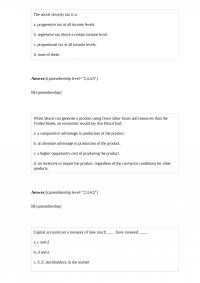
The social security tax is a: a. progressive tax at all income levels. b. regressive tax above a certain income level. c. proportional tax at all income levels. d. none of these. When Brazil can generate a product using fewer […]
MicroEconomic 307 Midterm 1
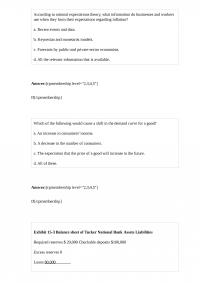
According to rational expectations theory, what information do businesses and workers use when they form their expectations regarding inflation? a. Recent events and data. b. Keynesian and monetarist models. c. Forecasts by public-and private-sector economists. d. All the relevant information […]
MicroEconomic 317
Full employment occurs when the rate of unemployment consists of: a. structural plus frictional unemployment. b. cyclical plus frictional unemployment. c. structural, frictional, and cyclical unemployment. d. none of these. In the United States, the Phillips curve in the 1960s: […]
MicroEconomic 335 Test
Which of the following will most likely cause a nation’s currency to appreciate on the foreign exchange market? a. A decrease in domestic interest rates b. An increase in foreign interest rates c. Domestic inflation of 10 percent while the […]
MicroEconomic 382
Increased production, but not increased inflation, will result in higher: a. nominal GDP. b. money GDP. c. real GDP. d. current dollar GDP. An increase in the real rate of interest that can be earned on U.S. investments above the […]
MicroEconomic 390 Homework
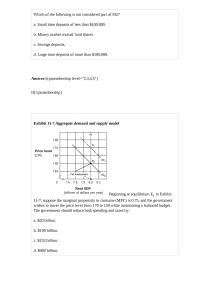
Which of the following is not considered part of M2? a. Small time deposits of less than $100,000. b. Money market mutual fund shares. c. Savings deposits. d. Large time deposits of more than $100,000. Exhibit 11-7 Aggregate demand and […]
MicroEconomic 394 Test
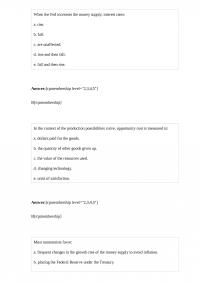
When the Fed increases the money supply, interest rates: a. rise. b. fall. c. are unaffected. d. rise and then fall. e. fall and then rise. In the context of the production possibilities curve, opportunity cost is measured in: a. […]
MicroEconomic 401 Test
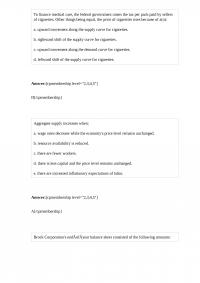
To finance medical care, the federal government raises the tax per pack paid by sellers of cigarettes. Other things being equal, the price of cigarettes rises because of a(n): a. upward movement along the supply curve for cigarettes. b. rightward […]
MicroEconomic 441
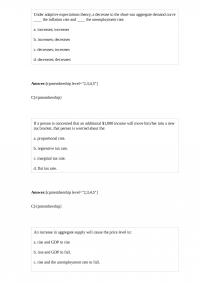
Under adaptive expectations theory, a decrease in the short-run aggregate demand curve ____ the inflation rate and ____ the unemployment rate. a. increases; increases b. increases; decreases c. decreases; increases d. decreases; decreases If a person is concerned that an […]
MicroEconomic 452 Test
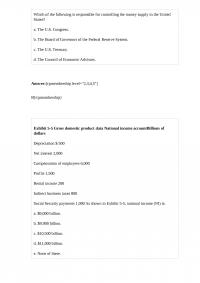
Which of the following is responsible for controlling the money supply in the United States? a. The U.S. Congress. b. The Board of Governors of the Federal Reserve System. c. The U.S. Treasury. d. The Council of Economic Advisors. Exhibit […]
MicroEconomic 468 Final
Assume that full-employment real GDP is Y = $1,200 billion, the current equilibrium real GDP is Y = $1,600 billion, and the MPC = 0.8. In order to bring the economy to a full-employment real GDP, a. a recessionary gap […]
MicroEconomic 471 Quiz 1
Suppose the consumer price index (CPI) stands at 250 this year. If the inflation rate is 10 percent, then next year’s CPI will equal: a. 250. b. 260. c. 275. d. 500. Assume that Paris First National Bank is a […]
MicroEconomic 528 Test
Starting from an initial long-run equilibrium, under the rational expectations hypothesis, an anticipated shift to a more expansionary policy will increase: a. prices but not real output in the short run. b. real output but not prices in the short […]
MicroEconomic 531
All of the following are important provisions of the Sarbanes-Oxley Act except: a. The establishment of a new Public Company Accounting Oversight Board. b. The requirement to prepare both FASB and IASB financial statements. c. A requirement that the external […]
MicroEconomic 547 Midterm 1
Which one of the following people is not a member of the labor force? a. A full-time student who devotes all her time to her classes. b. A person who works 30 hours a week at Burger King and goes […]
MicroEconomic 563 Midterm 1
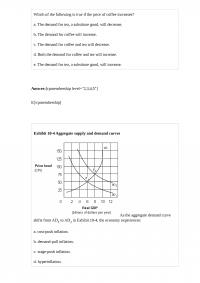
Which of the following is true if the price of coffee increases? a. The demand for tea, a substitute good, will decrease. b. The demand for coffee will increase. c. The demand for coffee and tea will decrease. d. Both […]
MicroEconomic 564
Assume the economy is operating at a real GDP above full-employment real GDP. Keynesian economists would prescribe which of the following policies? a. Nonintervention b. Fixed rule c. Contractionary d. Expansionary The use of a dollar bill to buy a […]
MicroEconomic 602 Test 2
Suppose all of the major computer manufacturers announced that beginning next month there would be major price reductions on their computers. This would cause the current demand for computers to: a. increase. c. remain unchanged. b. decrease. d. increase and […]
MicroEconomic 625 Quiz 3
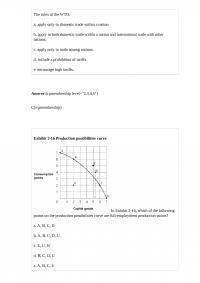
The rules of the WTO: a. apply only to domestic trade within a nation. b. apply to both domestic trade within a nation and international trade with other nations. c. apply only to trade among nations. d. include a prohibition […]
MicroEconomic 693 Midterm
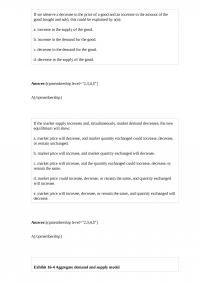
If we observe a decrease in the price of a good and an increase in the amount of the good bought and sold, this could be explained by a(n): a. increase in the supply of the good. b. increase in […]
MicroEconomic 712 Midterm 1
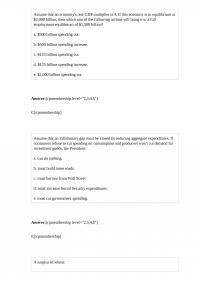
Assume that an economy’s real GDP multiplier is 4. If this economy is in equilibrium at $2,000 billion, then which one of the following actions will bring it to a full employment equilibrium of $1,500 billion? a. $500 billion spending […]
MicroEconomic 744 Midterm 1
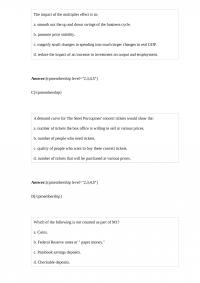
The impact of the multiplier effect is to: a. smooth out the up and down swings of the business cycle. b. promote price stability. c. magnify small changes in spending into much larger changes in real GDP. d. reduce the […]
MicroEconomic 765 Final
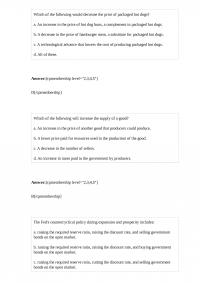
Which of the following would decrease the price of packaged hot dogs? a. An increase in the price of hot dog buns, a complement to packaged hot dogs. b. A decrease in the price of hamburger meat, a substitute for […]
MicroEconomic 780
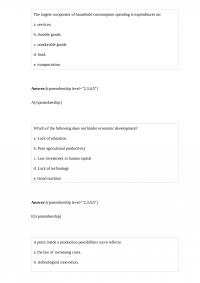
The largest component of household consumption spending is expenditures on: a. services. b. durable goods. c. nondurable goods. d. food. e. transportation. Which of the following does not hinder economic development? a. Lack of education b. Poor agricultural productivity c. […]
MicroEconomic 833 Test 2
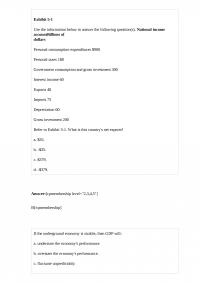
Exhibit 5-1 Use the information below to answer the following question(s). National income accountBillions of dollars Personal consumption expenditures $900 Personal taxes 180 Government consumption and gross investment 300 Interest income 60 Exports 40 Imports 75 Depreciation 60 Gross investment […]
MicroEconomic 884 Quiz 3
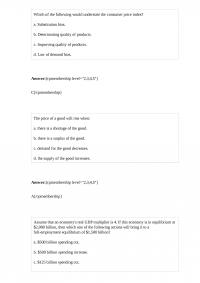
Which of the following would understate the consumer price index? a. Substitution bias. b. Deteriorating quality of products. c. Improving quality of products. d. Law of demand bias. The price of a good will rise when: a. there is a […]
MicroEconomic 886 Test 1
As shown in Exhibit 7-2, the rate of inflation for Year 5 is: a. 5 percent b. 10 percent. c. 20 percent. d. 25 percent. Consider two people, Sandy Smith, who earns $25,000, and Gary Carver, who earns $50,000. If […]
MicroEconomic 891 Quiz
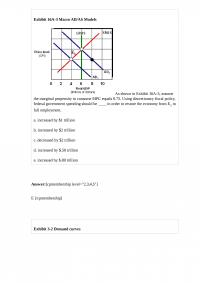
Exhibit 16A-3 Macro AD/AS Models As shown in Exhibit 16A-3, assume the marginal propensity to consume MPC equals 0.75. Using discretionary fiscal policy, federal government spending should be ____ in order to restore the economy from E1 to full employment. […]