If the marginal propensity to consume (MPC) is 0.96, the value of the spending
multiplier is:
a. 25.
b. 40.
c. 96.
d. 100.
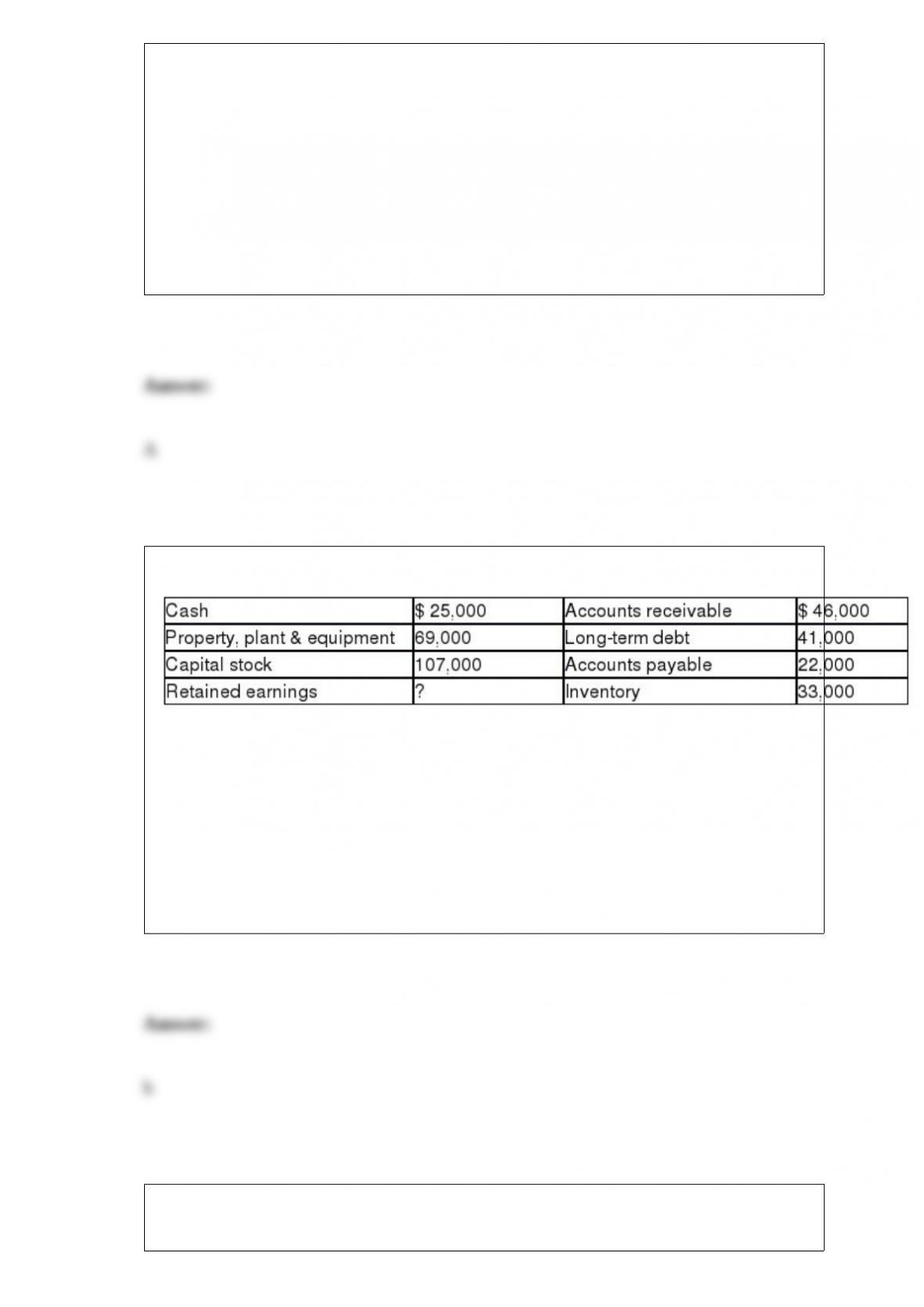
Front Corporation’s endÂofÂyear balance sheet consisted of the following amounts:
What is Front’s owners’equitybalance at the end of the current year?
a. $3,000
b. $110,000
c. $63,000
d. $173,000
After 1970, the share of federal spending allocated to national defense:

a. declined sharply, while the share allocated to income security increased substantially.
b. rose sharply, while the share allocated to income security declined substantially.
c. was relatively constant, while the share allocated to income security declined
modestly.
d. declined modestly, while the share allocated to income security was relatively
constant.
The theory of comparative advantage suggests that nations should produce a good if
they:
a. have the lowest opportunity cost.
b. have the lowest wages.
c. have the most resources.
d. can produce more of the good than any other nation.
A positive economic statement is:
a. an opinion of an action that should be taken.
b. an action that will have a positive effect on the economy.
c. a statement testable by facts.
d. a claim that the speaker is positive will occur.

e. always a microeconomic position.
Inflation is measured by an increase in:
a. homes, autos and basic resources.
b. prices of all products in the economy.
c. the consumer price index (CPI).
d. none of these.
When the Fed lowers the discount rate, it:
a. lowers the cost of borrowing from the Fed, encouraging banks to make loans to the
general public.
b. raises the cost of borrowing from the Fed, discouraging banks from making loans to
the general public.
c. increases the amount of excess reserves that banks hold, encouraging them to make
loans to the general public.
d. increases the amount of excess reserves that banks hold, discouraging them from
making loans to the general public.
e. decreases the amount of excess reserves that banks hold, discouraging them from
making loans to the general public.

Gross domestic product is officially measured by adding together the:
a. quantity of each good and service produced by U.S. residents.
b. market value of all final goods and services produced within the borders of a nation.
c. quantity of goods and services produced by companies owned by U.S. citizens.
d. none of these.
The tradeoff between the inflation rate and unemployment rate is represented by the:
a. consumption function.
b. misery index.
c. Phillips curve.
d. Keynes curve.

The interest-rate effect is the impact on real GDP caused by the direct relationship
between the interest rate and the:
a. price level.
b. exports.
c. consumption.
d. investment.
An increase in the rate of interest, other things being equal, will cause a(n):
a. downward shift in the investment demand curve.
b. movement downward along the investment demand curve.
c. movement upward along the investment demand curve.
d. upward shift in the investment demand curve.
Which of the following statements is true?
a. National income is total income earned by households whereas personal income is
total income received by households (including transfer payments).
b. Disposable personal income equals personal income minus personal taxes.
c. The expenditures approach and the income approach yield the same GDP figure.

d. All of these.
Foreachstatementprovided,choosetheletteroftheappropriatetermfromthelistthateachstate
mentbestdescribes.Sometermsmaybeusedmorethanonce,whileothersarenotusedatall.
a. Capital stock
b. Asset
c. Owners’ equity
d. Time period
e. Dividends
f. Economic entity concept
g. Expense
h. Retained earnings
i. Cost principle
j. Creditor
k. Liability
l. Revenue
m. Going concern
n. Monetary unit
o. Corporation
Claims of the creditors against the assets of a company.

The supply schedule shows the specific quantity of a good that suppliers are willing and
able to:
a. demand at various prices.
b. produce at various costs.
c. hold back from the market when competition is reduced.
d. provide at different prices.
e. demand at various costs.
The economy is fully employed when there is no:
a. seasonal unemployment.
b. frictional unemployment.
c. structural unemployment.
d. cyclical unemployment.
Which of the following is not a solution to the problem of negative externalities due to

pollution?
a. Create private property rights.
b. Levy pollution taxes.
c. Create obligatory controls.
d. Reward the production of these products through subsidies.
e. Establish strict limits on the amount of pollution allowed.
A surplus means a(n):
a. excess demand for this product.
b. situation where the current market price is too low.
c. situation where the quantity demanded exceeds the quantity supplied.
d. situation where the quantity supplied is less than the quantity demanded.
e. excess supply of the product at the current price.
The Monetary Control Act of 1980:
a. extended the Fed’s authority to impose required-reserve ratios on all depository
institutions.
b. excluded the required-reserve ratios as an instrument of short-term policy.

c. provided the Fed with the authority to use open market operations.
d. all of the above.
e. none of the above.
Exhibit 18-4 Coffee and tea output (pounds per hour) Country CoffeeTea
Brazil 10 5
China 8 8 As shown in Exhibit 18-4, the opportunity cost to Brazil of producing one
pound of coffee is:
a. 1 pound of tea.
b. 5 pounds of tea.
c. 1/2 pound of tea.
d. 10 pounds of tea.
Supply-side fiscal policies were advocated by the Reagan administration.

The U.S. Treasury is responsible for preparing and submitting the initial budget
recommendation to the president.
Higher gasoline prices would likely raise the price of large, gas-guzzling automobiles.
Inflation psychosis and wage-price spirals are two types of hyperinflation.
An increase in total spending in the economy will shift the aggregate demand curve to
the left.

The Social Security payroll tax tends to be regressive.