
A depreciation of one’s currency means that:
a. the country’s exports will become more expensive.
b. the country’s imports will become more expensive.
c. the country’s imports will become less expensive.
d. it now requires less of this currency in exchange for one unit of another currency.
e. it now requires more units of other currencies in exchange for one unit of this
currency.
Exhibit 5-7 GDP data (billions of dollars) Personal consumption expenditures $5,207
Interest 425
Corporate profits 735
Government spending 1,406
Depreciation 830
Rental income 146
Gross private domestic investment 1,116
Compensation of employees 4,426
Exports 870
Imports 965
Indirect business taxes 553
Proprietors’ income 520
Personal taxes 886

Social Security taxes 432
Transfer payments 376 In Exhibit 5-7, national income (NI) is:
a. $6,254 billion.
b. $6,495 billion.
c. $6,805 billion.
d. $7,082 billion.
e. $7,637.7 billion.
The downward slope of the demand for money curve is created by the:
a. transactions demand for money.
b. precautionary demand for money.
c. speculative demand for money.
d. all of these.
To abstract from reality in an economic model means that:
a. we include only a few of the essential aspects of reality.
b. the economic study surveys only a very limited period of time.

c. we include only those elements which support our hypothesis.
d. the model includes every aspect of the real world.
e. the model examines the actions of the consumers in the absence of producers and the
government.
Along the intermediate range of the aggregate supply curve, an increase in the
aggregate demand curve will increase:
a. both the price level and real GDP.
b. only real GDP.
c. only the price level.
d. real GDP and reduce the price level.
In Adam Smith’s competitive market economy, the question of what goods to produce is
determined by the:
a. “invisible hand” of the price system.
b. “invisible hand” of government.
c. “invisible hand” of public interest.
d. “visible hand” of laws and regulations.

The ____ phase of the business cycle follows a recession.
a. recovery
b. recession
c. peak
d. trough
Total expenditures by households for domestically produced goods is:
a. $500 billion.
b. $50 billion.
c. $300 billion.
d. $15 billion.
National income is derived from gross domestic product by subtracting:

a. transfer payments.
b. profits.
c. an allowance for depreciation of capital equipment.
d. net exports.
The balance sheet is linked to the retained earnings statement by the ending retained
earnings balance.
a. True
b. False
Which of the following makes long-term low-interest loans to LDCs?
a. Agency for International Development (AID).
b. World Bank.
c. International Monetary Fund (IMF).
d. New International Economic Order (NIEO).

The marginal propensity to consume (MPC) is computed as the change in:
a. consumption divided by the change in savings.
b. consumption divided by the change in income.
c. consumption divided by the change in GDP.
d. None of these.
Positive economics is a(n):
a. reflection of a country’s values.
b. judgment of the correctness of an economic outcome.
c. statement of fact.
d. analysis of what ought to be.
e. analysis of all the good market outcomes.
Which of the following activities would be calculated as part of GDP accounts?
a. Drug trafficking.

b. Money laundry.
c. Prostitution.
d. Purchasing plastic surgery.
e. Burglary.
Presented below are condensed data from the financial statements of Snap Factory for
2015 and 2014. The figures are expressed in thousands. Use this information to answer
the questions that follow.
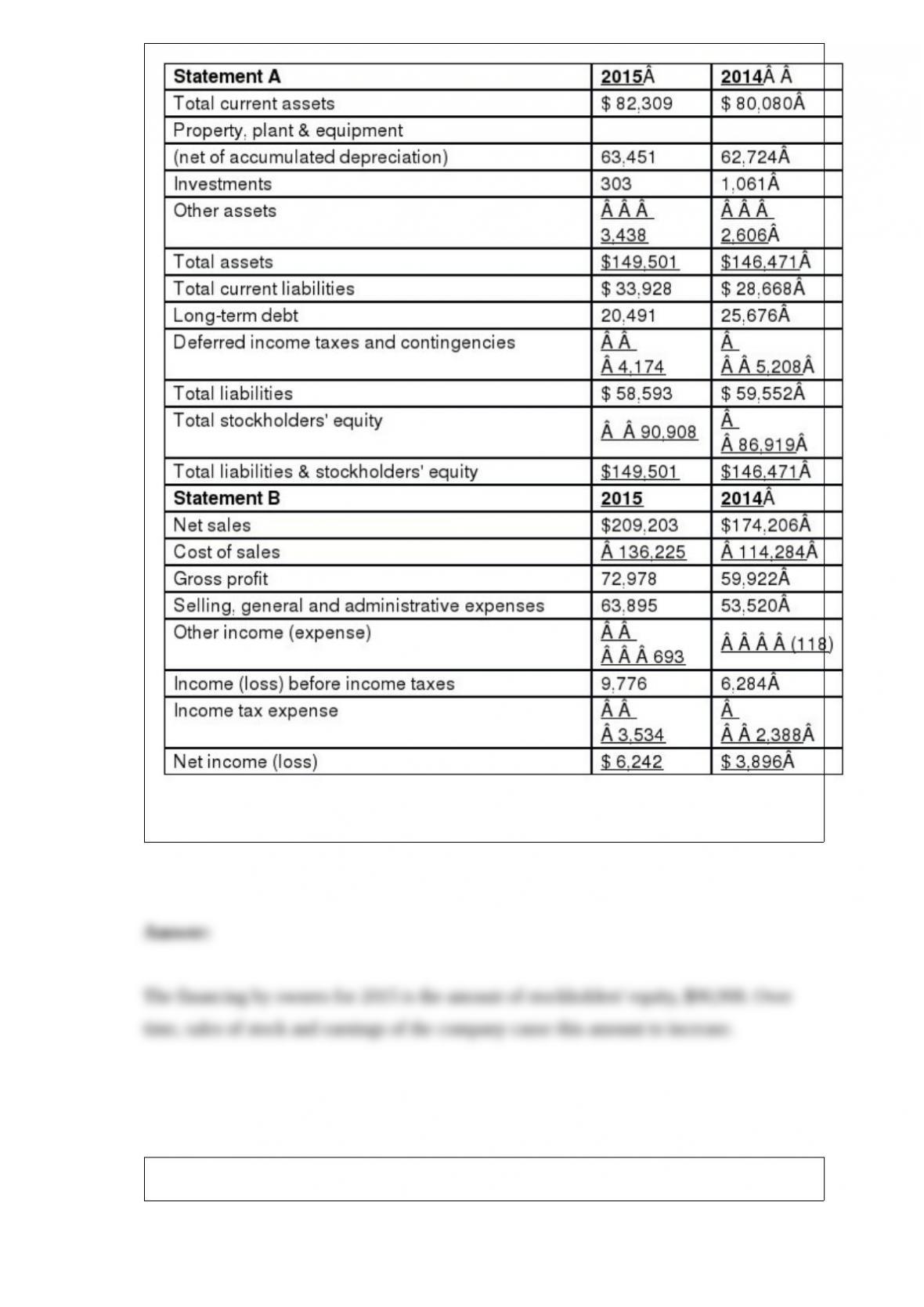
Required: How much of Snap Factory is financed by owners at the end of December of
2015?
An upward-sloping straight line exhibits a direct relationship between two variables.
What is scarcity and why does it exist? How is scarcity related to the study of
economics?
Receipt of foreign aid permits less-developed countries to move to a point outside their
production possibilities curve.
Bond prices and interest rates are directly related.
During periods of inflation, the general price level of goods and services in the
economy rises.