Archives: Quiz
978-1259534959 Test Bank Chapter 1
Chapter 01 Film as Art Multiple Choice Questions 1. Which of the following is NOT one of the modes of production? Bloom’s: Remember Learning Objective: Understand the process of film production Topic: modes of production 2. A “work print” is […]
978-1138594050 Test Bank Chapter 12
Corporate Innovation Lecture Outlines and Exam Questions Chapter 12: Accelerating Momentum: The I-Solution Chapter 12 Outline I. Sustaining the innovative Strategy a. The Role of Managers b. The Role of the Firm: Reengineering Organizational Thinking II. Asking the Key Questions […]
978-1138594050 Test Bank Chapter 11
Corporate Innovation Lecture Outlines and Exam Questions Chapter 11: Effective Innovation Plans Chapter 1l Outline I. Introduction: Effective Innovation Plans II. The Innovation Plan a. Definition b. Planning Pitfalls III. Benefits of an Innovation Plan IV. The Components of an […]
978-1138594050 Test Bank Chapter 10
Corporate Innovation Lecture Outlines and Exam Questions Chapter 10: Innovation to Commercialization Chapter 10 Outline I. Introduction II. Market Research a. Understanding the Real Potential Market i. Define the Research Purpose and Objectives Under Funded ii. Select Type of Data […]
978-1138594050 Test Bank Chapter 9
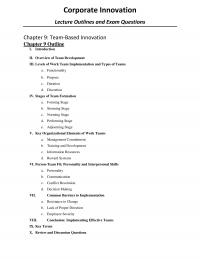
Corporate Innovation Lecture Outlines and Exam Questions Chapter 9: Team-Based Innovation Chapter 9 Outline I. Introduction II. Overview of Team Development III. Levels of Work Team Implementation and Types of Teams a. Functionality b. Purpose c. Duration d. Discretion IV. […]
978-1138594050 Test Bank Chapter 8
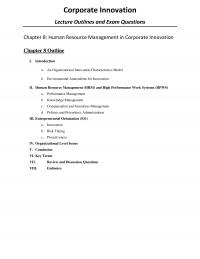
Corporate Innovation Lecture Outlines and Exam Questions Chapter 8: Human Resource Management in Corporate Innovation Chapter 8 Outline I. Introduction a. An Organizational Innovation Characteristics Model b. Environmental Antecedents for Innovation II. Human Resource Management (HRM) and High Performance Work […]
978-1138594050 Test Bank Chapter 7
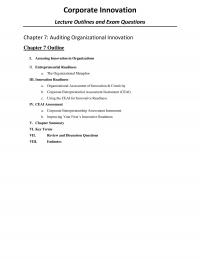
Corporate Innovation Lecture Outlines and Exam Questions Chapter 7: Auditing Organizational Innovation Chapter 7 Outline I. Assessing Innovation in Organizations II. Entrepreneurial Readiness a. The Organizational Metaphor III. Innovation Readiness a. Organizational Assessment of Innovation & Creativity b. Corporate Entrepreneurial […]
978-1138594050 Test Bank Chapter 6
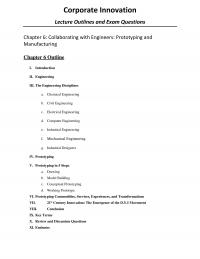
Corporate Innovation Lecture Outlines and Exam Questions Chapter 6: Collaborating with Engineers: Prototyping and Manufacturing Chapter 6 Outline I. Introduction II. Engineering III. The Engineering Disciplines a. Chemical Engineering b. Civil Engineering c. Electrical Engineering d. Computer Engineering e. Industrial […]
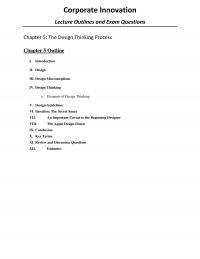
978-1138594050 Test Bank Chapter 5
Corporate Innovation Lecture Outlines and Exam Questions Chapter 5: The Design Thinking Process Chapter 5 Outline I. Introduction II. Design III. Design Misconceptions IV. Design Thinking a. Elements of Design Thinking V. Design Guidelines VI. Iteration: The Secret Sauce VII. […]
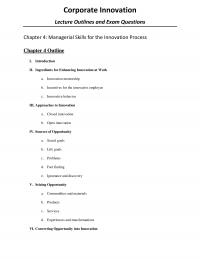
978-1138594050 Test Bank Chapter 4
Corporate Innovation Lecture Outlines and Exam Questions Chapter 4: Managerial Skills for the Innovation Process Chapter 4 Outline I. Introduction II. Ingredients for Enhancing Innovation at Work a. Innovation mentorship b. Incentives for the innovative employee c. Innovative behavior III. […]
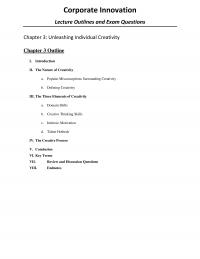
978-1138594050 Test Bank Chapter 3
Corporate Innovation Lecture Outlines and Exam Questions Chapter 3: Unleashing Individual Creativity Chapter 3 Outline I. Introduction II. The Nature of Creativity a. Popular Misconceptions Surrounding Creativity b. Defining Creativity III. The Three Elements of Creativity a. Domain Skills b. […]
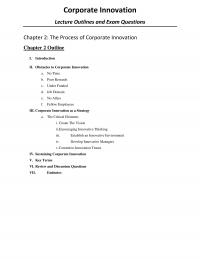
978-1138594050 Test Bank Chapter 2
Corporate Innovation Lecture Outlines and Exam Questions Chapter 2: The Process of Corporate Innovation Chapter 2 Outline I. Introduction II. Obstacles to Corporate Innovation a. No Time b. Poor Rewards c. Under Funded d. Job Domain e. No Allies f. […]
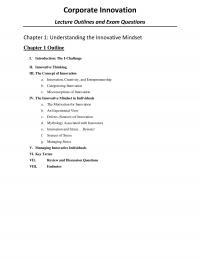
978-1138594050 Test Bank Chapter 1
Corporate Innovation Lecture Outlines and Exam Questions Chapter 1: Understanding the Innovative Mindset Chapter 1 Outline I. Introduction: The I-Challenge II. Innovative Thinking III. The Concept of Innovation a. Innovation, Creativity, and Entrepreneurship b. Categorizing Innovation c. Misconceptions of Innovation […]
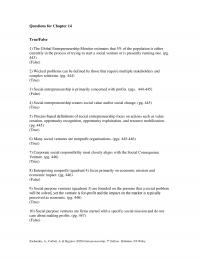
978-1119563228 Test Bank Chapter 14
Questions for Chapter 14 True/False 1) The Global Entrepreneurship Monitor estimates that 5% of the population is either currently in the process of trying to start a social venture or is presently running one. (pg. 443) (False) 2) Wicked problems […]
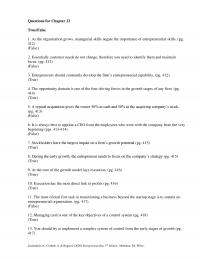
978-1119563228 Test Bank Chapter 13
Questions for Chapter 13 True/False 1. As the organization grows, managerial skills negate the importance of entrepreneurial skills. (pg. 412) (False) 2. Essentially customer needs do not change, therefore you need to identify them and maintain focus. (pg. 412) (False) […]
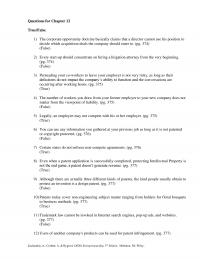
978-1119563228 Test Bank Chapter 12
Questions for Chapter 12 True/False 1) The corporate opportunity doctrine basically claims that a director cannot use his position to decide which acquisition deals the company should enter to. (pg. 374) (False) 2) Every start-up should concentrate on hiring a […]
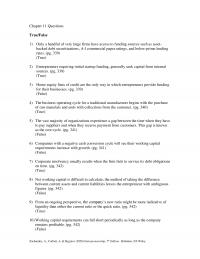
978-1119563228 Test Bank Chapter 11
Chapter 11 Questions True/False 1) Only a handful of very large firms have access to funding sources such as asset- backed debt securitizations, A-l commercial paper ratings, and below-prime lending rates. (pg. 339) (True) 2) Entrepreneurs requiring initial startup funding, […]
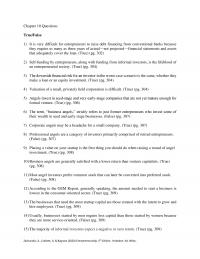
978-1119563228 Test Bank Chapter 10
Chapter 10 Questions True/False 1) It is very difficult for entrepreneurs to raise debt financing from conventional banks because they require as many as three years of actual—not projected—financial statements and assets that adequately cover the loan. (True) (pg. 302) […]
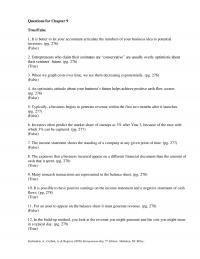
978-1119563228 Test Bank Chapter 9
Questions for Chapter 9 True/False 1. It is better to let your accountant articulate the numbers of your business idea to potential investors. (pg. 276) (False) 2. Entrepreneurs who claim their estimates are “conservative” are usually overly optimistic about their […]
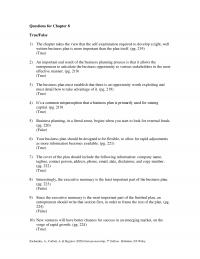
978-1119563228 Test Bank Chapter 8
Questions for Chapter 8 True/False 1) The chapter takes the view that the self-examination required to develop a tight, well written business plan is more important than the plan itself. (pg. 219) (True) 2) An important end result of the […]
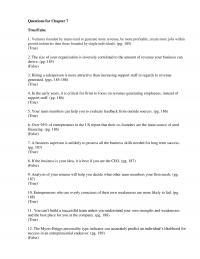
978-1119563228 Test Bank Chapter 7
Questions for Chapter 7 True/False 1. Ventures founded by teams tend to generate more revenue, be more profitable, create more jobs within growth industries than those founded by single individuals . (pg. 185) 2. The size of your organization is […]
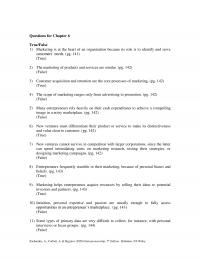
978-1119563228 Test Bank Chapter 6
Questions for Chapter 6 True/False 1) Marketing is at the heart of an organization because its role is to identify and serve customers’ needs. (pg. 141) (True) 2) The marketing of products and services are similar. (pg. 142) (False) 3) […]
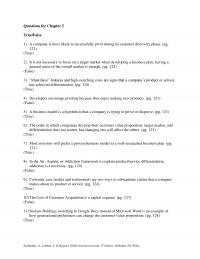
978-1119563228 Test Bank Chapter 5
Questions for Chapter 5 True/False 1) A company is most likely to successfully pivot during its customer discovery phase. (pg. 121) (True) 2) It is not necessary to focus on a target market when developing a business plan; having a […]
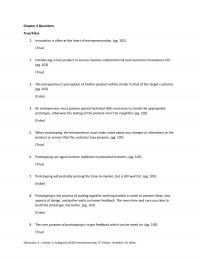
978-1119563228 Test Bank Chapter 4
Chapter 4 Questions True/False 1. Innovation is often at the heart of entrepreneurship. (pg. 102) (True) 2. Introducing a new product or service involves substantial risk and numerous innovations fail. (pg. 103) (True) 3. The entrepreneur’s perception of his/her product […]
978-1119563228 Test Bank Chapter 3
Questions for Chapter 3 True/False 1. Entrepreneurship is all about opportunity. (pg. 71) (True) 2. Entrepreneurs need to conduct a series of tests called family-first tests to identify interesting ideas and then see whether they are viable opportunities by testing […]
978-1119563228 Test Bank Chapter 2
Questions for Chapter 2 True/False 1. A manager is someone who perceives an opportunity and creates an organization to pursue it. (pg. 41) (False) 2. The entrepreneurial process includes all the functions, activities, and actions that are part of perceiving […]
978-1119563228 Test Bank Chapter 1
Questions for Chapter 1 True/False 1. The 2018-2019 Global Entrepreneurship Monitor reports that across the 49 countries investigated 32.6 % of adults were in the process of working to start a new business or were running one they recently started. […]
978-1119165354 Test Bank Chapter 20
CHAPTER 20: QUALITY MANAGEMENT (Difficulty: E = easy, M = medium, H = hard) (E) 1. Customers are now demanding: D. All of the above (H) 2. The balance between quality and cost is called: *A. Salability B. Produceability C. […]
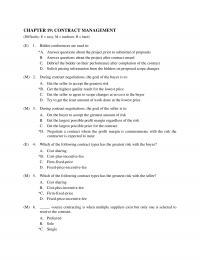
978-1119165354 Test Bank Chapter 19
CHAPTER 19: CONTRACT MANAGEMENT (Difficulty: E = easy, M = medium, H = hard) (E) 1. Bidder conferences are used to: D. Solicit pricing information from the bidders on proposed scope changes (M) 2. During contract negotiations, the goal of […]
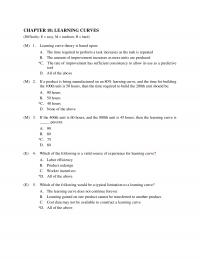
978-1119165354 Test Bank Chapter 18
CHAPTER 18: LEARNING CURVES (Difficulty: E = easy, M = medium, H = hard) (M) 1. Learning curve theory is based upon: (M) 2. If a product is being manufactured on an 80% learning curve, and the time for building […]
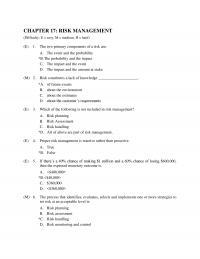
978-1119165354 Test Bank Chapter 17
CHAPTER 17: RISK MANAGEMENT (Difficulty: E = easy, M = medium, H = hard) (E) 1. The two primary components of a risk are: A. The event and the probability (M) 2. Risk constitutes a lack of knowledge ____________________. *A. […]
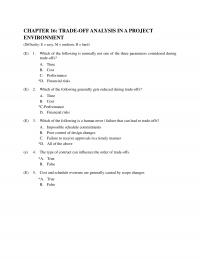
978-1119165354 Test Bank Chapter 16
CHAPTER 16: TRADE-OFF ANALYSIS IN A PROJECT ENVIRONMENT (Difficulty: E = easy, M = medium, H = hard) (E) 1. Which of the following is normally not one of the three parameters considered during trade-offs? A. Time (E) 2. Which […]
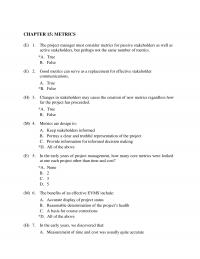
978-1119165354 Test Bank Chapter 15
CHAPTER 15: METRICS (E) 1. The project manager must consider metrics for passive stakeholders as well as active stakeholders, but perhaps not the same number of metrics. (E) 2. Good metrics can serve as a replacement for effective stakeholder communications. […]
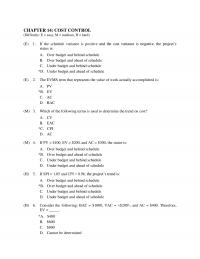
978-1119165354 Test Bank Chapter 14
CHAPTER 14: COST CONTROL (Difficulty: E = easy, M = medium, H = hard) (E) 1. If the schedule variance is positive and the cost variance is negative, the project’s status is: A. Over budget and behind schedule (E) 2. […]
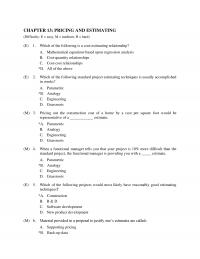
978-1119165354 Test Bank Chapter 13
CHAPTER 13: PRICING AND ESTIMATING (Difficulty: E = easy, M = medium, H = hard) (E) 1. Which of the following is a cost-estimating relationship? (E) 2. Which of the following standard project estimating techniques is usually accomplished in weeks? […]
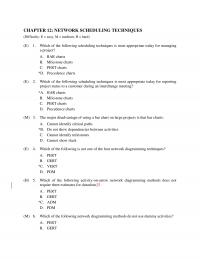
978-1119165354 Test Bank Chapter 12
CHAPTER 12: NETWORK SCHEDULING TECHNIQUES (Difficulty: E = easy, M = medium, H = hard) (E) 1. Which of the following scheduling techniques is most appropriate today for managing a project? A. BAR charts (E) 2. Which of the following […]
978-1119165354 Test Bank Chapter 11
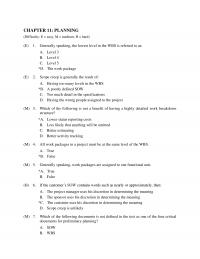
CHAPTER 11: PLANNING (Difficulty: E = easy, M = medium, H = hard) (E) 1. Generally speaking, the lowest level in the WBS is referred to as: A. Level 3 (E) 2. Scope creep is generally the result of: A. […]
978-1119165354 Test Bank Chapter 10
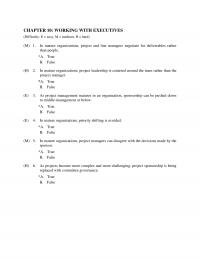
CHAPTER 10: WORKING WITH EXECUTIVES (Difficulty: E = easy, M = medium, H = hard) (M) 1. In mature organizations, project and line managers negotiate for deliverables rather than people. (H) 2. In mature organizations, project leadership is centered around […]
978-1119165354 Test Bank Chapter 9
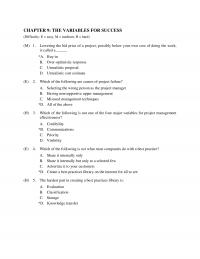
CHAPTER 9: THE VARIABLES FOR SUCCESS (Difficulty: E = easy, M = medium, H = hard) (M) 1. Lowering the bid price of a project, possibly below your own cost of doing the work, is called a _____. D. Unrealistic […]
978-1119165354 Test Bank Chapter 8
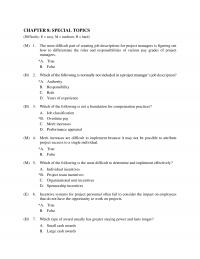
CHAPTER 8: SPECIAL TOPICS (Difficulty: E = easy, M = medium, H = hard) (M) 1. The most difficult part of creating job descriptions for project managers is figuring out how to differentiate the roles and responsibilities of various pay […]
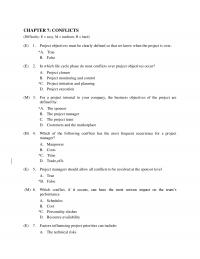
978-1119165354 Test Bank Chapter 7
CHAPTER 7: CONFLICTS (Difficulty: E = easy, M = medium, H = hard) (E) 2. In which life cycle phase do most conflicts over project objectives occur? A. Project closure B. Project monitoring and control *C. Project initiation and planning […]
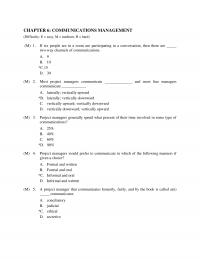
978-1119165354 Test Bank Chapter 6
CHAPTER 6: COMMUNICATIONS MANAGEMENT (Difficulty: E = easy, M = medium, H = hard) (M) 1. If six people are in a room are participating in a conversation, then there are _____ two-way channels of communications. A. 9 (M) 2. […]
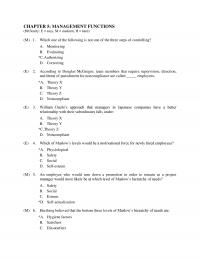
978-1119165354 Test Bank Chapter 5
CHAPTER 5: MANAGEMENT FUNCTIONS (Difficulty: E = easy, M = medium, H = hard) (M) 1. Which one of the following is not one of the three steps of controlling? A. Monitoring (E) 2. According to Douglas McGregor, team members […]
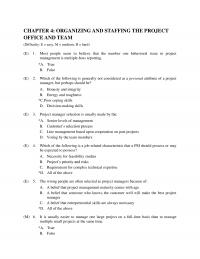
978-1119165354 Test Bank Chapter 4
CHAPTER 4: ORGANIZING AND STAFFING THE PROJECT OFFICE AND TEAM (Difficulty: E = easy, M = medium, H = hard) (E) 1. Most people seem to believe that the number one behavioral issue in project management is multiple-boss reporting. (E) […]
978-1119165354 Test Bank Chapter 3
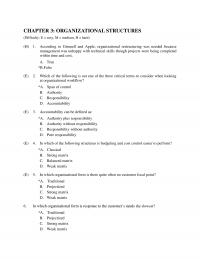
CHAPTER 3: ORGANIZATIONAL STRUCTURES (Difficulty: E = easy, M = medium, H = hard) (H) 1. According to Grinnell and Apple, organizational restructuring was needed because management was unhappy with technical skills though projects were being completed within time and […]
978-1119165354 Test Bank Chapter 2
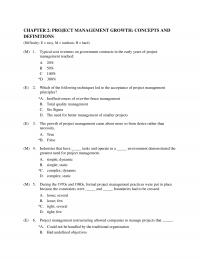
CHAPTER 2: PROJECT MANAGEMENT GROWTH: CONCEPTS AND DEFINITIONS (Difficulty: E = easy, M = medium, H = hard) (M) 1. Typical cost overruns on government contracts in the early years of project management reached: A 20% (E) 2. Which of […]
978-1119165354 Test Bank Chapter 1
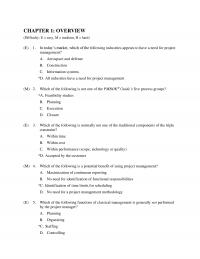
CHAPTER 1: OVERVIEW (Difficulty: E = easy, M = medium, H = hard) (E) 1. In today’s market, which of the following industries appears to have a need for project management? A. Aerospace and defense (M) 2. Which of the […]
978-1118873731 Test Bank Chapter 12
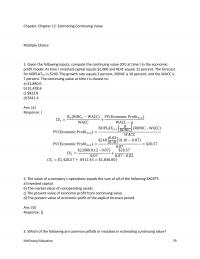
McKinsey/Valuation 79 Chapter: Chapter 12: Estimating Continuing Value Multiple Choice 1. Given the following inputs, compute the continuing value (CV) at time t in the economic- profit model. At time t invested capital equals $2,000 and ROIC equals 12 percent. […]
978-1111138271 Test Bank Chapter 11
Chapter 11 1 Chapter 11: Apraxia of Speech QUESTIONS Multiple Choice 1. The errors in apraxia of speech are caused by: A. muscle weakness B. abnormal muscle tone C. deficits in sequencing motor movements D. decreased muscle steadiness 2. When […]
978-1111138271 Test Bank Chapter 10
Chapter 10 1 Chapter 10: Mixed Dysarthria QUESTIONS Multiple Choice 1. Mixed dysarthria is the result of: A. unilateral upper motor neuron damage B. bilateral upper motor neuron damage C. damage to the spinal nerves D. damage to two or […]