Archives: Quiz
MET MG 79809
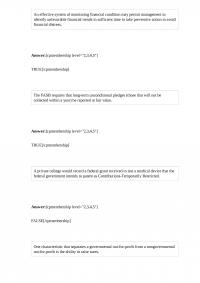
An effective system of monitoring financial condition may permit management to identify unfavorable financial trends in sufficient time to take preventive action to avoid financial distress. The FASB requires that long-term unconditional pledges (those that will not be collected within […]
SMG AC 67598
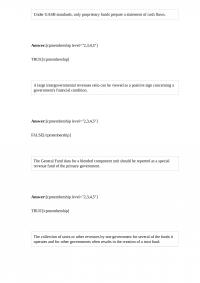
Under GASB standards, only proprietary funds prepare a statement of cash flows. A large intergovernmental revenues ratio can be viewed as a positive sign concerning a government’s financial condition. Answer: FALSE The General Fund data for a blended component unit […]
Acct 43083
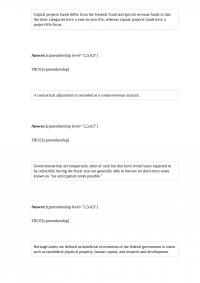
Capital projects funds differ from the General Fund and special revenue funds in that the latter categories have a year-to-year life, whereas capital projects funds have a project-life focus. A contractual adjustment is recorded as a contra-revenue account. Answer: TRUE […]
Acct 94383
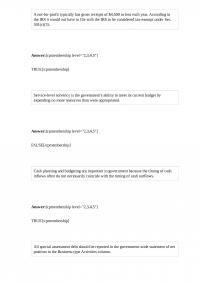
A not-for-profit typically has gross receipts of $4,500 or less each year. According to the IRS it would not have to file with the IRS to be considered tax-exempt under Sec. 501(c)(3). Service-level solvency is the government’s ability to meet […]
Accounting 41957
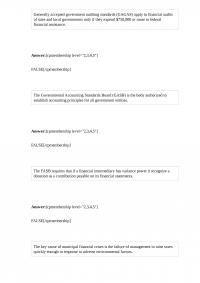
Generally accepted government auditing standards (GAGAS) apply to financial audits of state and local governments only if they expend $750,000 or more in federal financial assistance. The Governmental Accounting Standards Board (GASB) is the body authorized to establish accounting principles […]
ACCT 24398
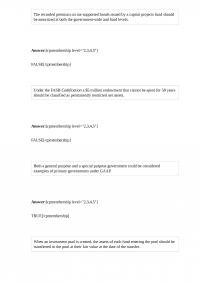
The recorded premium on tax-supported bonds issued by a capital projects fund should be amortized at both the government-wide and fund levels. Under the FASB Codification a $5 million endowment that cannot be spent for 50 years should be classified […]
ACT 16087
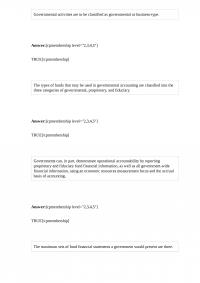
Governmental activities are to be classified as governmental or business-type. The types of funds that may be used in governmental accounting are classified into the three categories of governmental, proprietary, and fiduciary. Answer: TRUE Governments can, in part, demonstrate operational […]
SED EM 72464
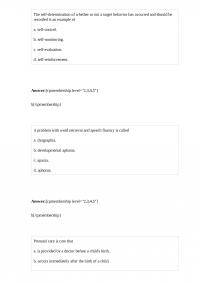
The self-determination of whether or not a target behavior has occurred and should be recorded is an example of a. self-control. b. self-monitoring. c. self-evaluation. d. self-reinforcement. A problem with word retrieval and speech fluency is called a. dysgraphia. b. […]
EDUK 24286
Cognitive development of children with visual impairments a. is no different than the normal development. b. is enhanced because they can only rely on their hearing. c. is affected by their lack of integrating experience. d. is higher than children […]
SED EM 40338
John has a problem with figure-ground, closure, and spatial relationships. He is experiencing a problem in a. megacognitive processes. b. visual perception. c. auditory perception. d. sensory integration. Students with special gifts and talents excel in which of the following […]
SED DS 79846
Eight-year-old Neal has difficulty with pluralization, saying “foot,” for example, when he should say “feet.” Neal’s language disorder is classified as one of a. morphology. b. pragmatics. c. phonology. d. syntax. Children who have another disorder comorbid with their ADHD […]
SED LR 89074
Cerebral palsey includes four major classifications: (a)________, (b)_____________, (c)________________, and (d) _________________. Siblings of children with disabilities a. spend considerably less time with their parents than does the child with a disability. b. typically have many unverbalized questions about the […]
SED AP 58916
During the preschool years, the emphasis of educational programming should be to help the children attain a. a functional communication system and basic social skills. b. beginning reading skills to maximize their success in kindergarten. c. replacement behaviors for their […]
SED DS 97801
Acting out aggressively often and intensely could be considered a a. externalizing disorder. b. internalizing disorder. c. anxious disorder. d. compulsive disorder. When cerebral palsy affects just one side of the body, the paralysis is called a. diplegia. b. hemiplegia. […]
EDUK 83653
Which of the following is a possible negative result of medication for behavior disorders? a. Reducing the student’s own sense of self-control b. Increasing the student’s need for independence c. Reducing the student’s own sense of self-importance d. There are […]
EDUK 83907
A form of cerebral palsy that affect the abnormal voluntary movement involving balance a. ataxic. b. mixed. c. dyskinetic. d. myclonic. In the U.S., early definitions of giftedness were related to a. performance on achievement tests. b. performance in the […]
EDUC 21261
An ASD condition that resembles autism but is a progressive neurological disorder is a. Turner’s syndrome. b. Rhett syndrome. c. Angelman syndrome. d. Kanner’s syndrome. Which of the following is an example of the RTI Tier II intervention? a. Collaboration […]
SESP 94720
Which of these is NOT a role of the classroom teacher in identifying children with a possible hearing loss? a. Being aware of the child’s misarticulations b. Giving each child a hearing test with sophisticated equipment c. Noting the frequency […]
SED CE 98847
is the storage of concepts, words, symbols, and generalization. a. Episodic memory b. Semantic memory c. Mnemonic memory d. Motor memory The most obvious characteristic of children who are mildly or moderately intellectually disabled is limited ________ a. cognitive ability. […]
SED DS 54883
The process of bringing all, or most, children with exceptionalities into the general classroom for their education is called a. acceptance. b. IPM. c. inclusion. d. RTI. Deep processing of information a. is not necessary to understand information so that […]
SED EM 80908
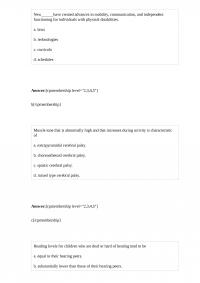
New______have created advances in mobility, communication, and independent functioning for individuals with physical disabilities. a. laws b. technologies c. curricula d. schedules Muscle tone that is abnormally high and that increases during activity is characteristic of a. extrapyramidal cerebral palsy. […]
SED LR 52800
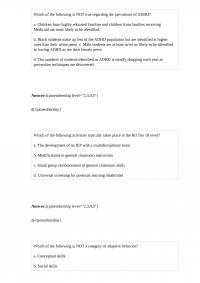
Which of the following is NOT true regarding the prevalence of ADHD? a. Children from highly educated families and children from families receiving Medicaid are most likely to be identified. b. Black students make up less of the ADHD population […]
EDUK 17056
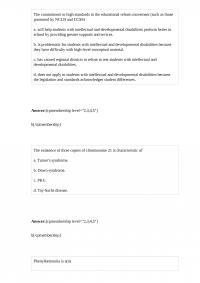
The commitment to high standards in the educational reform movement (such as those promoted by NCLB and CCSS) a. will help students with intellectual and developmental disabilities perform better in school by providing greater supports and sevices. b. is problematic […]
SED AP 93951
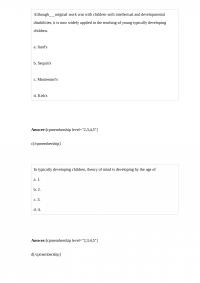
Although___original work was with children with intellectual and developmental disabilities, it is now widely applied to the teaching of young typically developing children. a. Itard’s b. Sequin’s c. Montessori’s d. Kirk’s In typically developing children, theory of mind is developing […]
EDU 30245
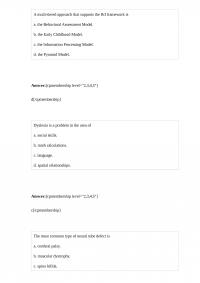
A multi-tiered approach that supports the RtI framework is a. the Behavioral Assessment Model. b. the Early Childhood Model. c. the Information Processing Model. d. the Pyramid Model. Dyslexia is a problem in the area of a. social skills. b. […]
SED CE 32829
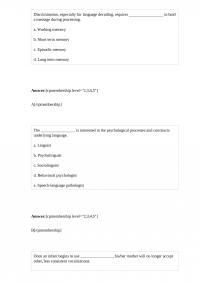
Discrimination, especially for language decoding, requires _________________ to hold a message during processing. a. Working memory b. Short term memory c. Episodic memory d. Long term memory The _________________ is interested in the psychological processes and constructs underlying language. a. […]
SED LR 96700
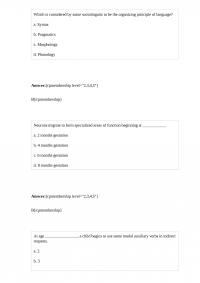
Which is considered by some sociolinguist to be the organizing principle of language? a. Syntax b. Pragmatics c. Morphology d. Phonology Neurons migrate to form specialized areas of function beginning at ___________. a. 2 months gestation b. 4 months gestation […]
EDU 33125
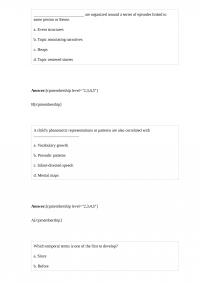
_________________________ are organized around a series of episodes linked to some person or theme. a. Event structures b. Topic associating narratives c. Heaps d. Topic centered stories A child’s phonotactic representations or patterns are also correlated with ______________________. a. Vocabulary […]
SED EM 67261
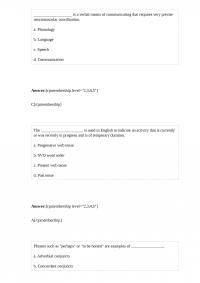
___________________ is a verbal means of communicating that requires very precise neuromuscular coordination. a. Phonology b. Language c. Speech d. Communication The _____________________ is used in English to indicate an activity that is currently or was recently in progress and […]
EDUC 14729
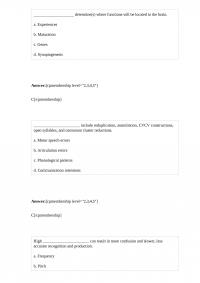
____________________ determine(s) where functions will be located in the brain. a. Experiences b. Maturation c. Genes d. Synaptogenesis _______________________ include reduplication, assimilation, CVCV constructions, open syllables, and consonant cluster reductions. a. Motor speech errors b. Articulation errors c. Phonological patterns […]
SED LR 26883
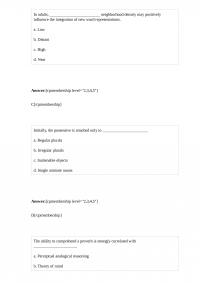
In adults, _________________________ neighborhood density may positively influence the integration of new word representations. a. Low b. Distant c. High d. Near Initially, the possessive is attached only to ______________________. a. Regular plurals b. Irregular plurals c. Inalienable objects d. […]
EDUK 69481
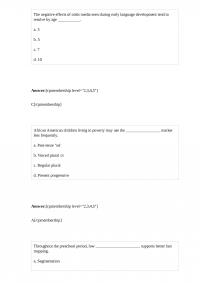
The negative effects of otitis media seen during early language development tend to resolve by age ___________. a. 3 b. 5 c. 7 d. 10 African American children living in poverty may use the _________________ marker less frequently. a. Past-tense […]
SED DS 22880
Most early infant and mother turns last for a. Less than 1 second b. Between 1 and 3 seconds c. Between 5 and 7 seconds d. More than 10 seconds The membranes that cover the CNS are called ________________. a. […]
SED CE 16162
When does actual reading by parents usually begin? a. End of the first year b. End of the second year c. End of the third year d. End of the fourth year Much of preschool syntactic and morphologic development can […]
SED LR 44923
What percent of students receiving special education services are classified with multiple disabilities? A. About 20% B. Nearly 10% C. Over 5% D. About 2% All of the following are typical testing accommodations for students with intellectual disabilities except: A. […]
SED DS 85037
What graphic organizer is used to compare and contrast objects, stories, and characters? A. A web diagram B. A T-chart C. Semantic maps D. Venn diagram Neuroimaging techniques have documented each of the following in gifted individuals except: A. Difficulty […]
EDUK 38868
Many school psychologists use which measure to determine the presence of ADHD? A. Attention Deficit Disorders Evaluation Scales B. Conner’s Rating Scales C. Peterson’s Rating Scales D. ADHD Assessment Tool Problem behavior typically serves: A. To get a student out […]
SED AP 55999
Which of the following is a test of how well the middle ear is functioning and how well the eardrum can move? A. Audiograms B. Tympanography C. Audiometry D. Behavioral audiological evaluations Teaching students how to deal with fights between […]
EDUK 48489
Within the second year of life, the spoken vocabulary of young children increases to which of the following? A.100 words B. 100-200 words C. 200-300 words D. 300-400 words Students with intellectual disabilities have difficulty transferring knowledge or behavior learned […]
SED CE 80771
Based on an IQ score of 125″130 alone, what percent of the general population would be considered gifted? A. 10 to 15% B. 2 to 3% C. 5 to 8% D. About 20% What percent of TBIs are classified as […]
SED CE 99124
Which of the following allows teachers to track two aspects of a behavior together? A. A checklist B. A T-chart C. Curriculum-based measurement D. Goal attainment scaling Which of the following means providing services, resources, and personal assistance on a […]
EDU 16954
By what age have children learned to produce nearly all the consonants and vowels that make up the words of their native language? A. 2 B. 3 C. 5 D. 8 Each is an example of psychological processing except: A. […]
SESP 13922
There are three common forms of spina bifida: meningocele, myelomeningocele, and: A. Spina bifida minor B. Spina bifida major C. Spina bifida occulta D. Nonspecific spina bifida The court case in California that paved the way for the abandonment of […]
EDUK 41044
Which group is the most underrepresented in gifted education? A. Females B. Hispanics C. Black D. Asian/Pacific Islander The majority of students with intellectual disabilities have IQ ranges in which of the following? A. 50″55 to approximately 70 B. 35″40 […]
SED CE 15413
Compare and contrast the causes of cerebral palsy, spina bifida, epilepsy, and asthma. In the RTI model, identification of learning disabilities is based on each of the following except: A. Response to instruction in terms of progress rates and performance […]
SED LR 87938
Having a poor sense of one’s ability to effect change in one’s life is associated with limitations in: A. Range and variety of experiences B. Incidental learning C. Ability to get around D. Interaction with the environment Students with which […]
SED CE 97550
Autism is primarily: A. Biological in origin B. Behavioral in origin C. Environmental in origin D. Familial in origin According to the U.S. Department of Education, what percentage of school age children identified to receive special education services receives services […]
EDUC 24353
Advocacy involves each of the following EXCEPT: A. Seeking win-win solutions B. Preventing problems C. Keeping your conscience primed D. Affirming strengths The design of instructional materials and activities that make content information accessible to all children refers to: A. […]
SED CE 87197
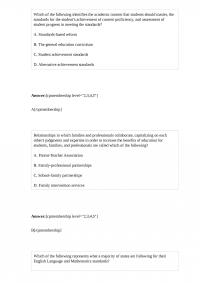
Which of the following identifies the academic content that students should master, the standards for the student’s achievement of content proficiency, and assessment of student progress in meeting the standards? A. Standards-based reform B. The general education curriculum C. Student […]
EDU 64687
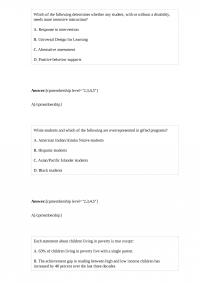
Which of the following determines whether any student, with or without a disability, needs more intensive instruction? A. Response to intervention B. Universal Design for Learning C. Alternative assessment D. Positive behavior supports White students and which of the following […]