Governmental activities are to be classified as governmental or business-type.
The types of funds that may be used in governmental accounting are classified into the
three categories of governmental, proprietary, and fiduciary.
Governments can, in part, demonstrate operational accountability by reporting
proprietary and fiduciary fund financial information, as well as all government-wide
financial information, using an economic resources measurement focus and the accrual
basis of accounting.
The maximum sets of fund financial statements a government would present are three.
A debt service fund is used to account for financial resources segregated for the purpose
of making principal and interest payments on general long-term debt.
A deferred inflow of resources is defined as “an acquisition of net assets by the
government that is applicable to a future reporting period.”
Revenues is an example of what the GASB terms an inflow of resources.
An expenditure is an example of what the GASB terms an outflow of resources.
Deferred inflow of resources and deferred outflow of resources would be shown in
separate sections of a government’s statement of net position.
The GASB concept statements indicate that an asset that is going to be converted to
cash should be reported at a remeasured amount at the financial statement date.
A permanent endowment is an example of a nonspendable fund balance.

The General Fund is the only fund that can have a positive unassigned fund balance.
The positive fund balance in a special revenue fund must at a minimum be reported as
assigned.
Fund-based financial statements are intended to provide detailed financial information
about the governmental, proprietary, and fiduciary activities of the primary government.
Program revenues are distinguished from general revenues on the government-wide
statement of activities under GASB standards.
Three categories of program revenues are reported in the statement of activities: charges
for services, operating grants and contributions, and capital grants and contributions.
On the government-wide statement of activities, depreciation expense for assets that
essentially benefit all functions, such as the city hall, may be reported as a separate line
item or on the same line as the General Government or similar function.
Other financing sources increase fund balance in the same manner as revenues.

Budgetary accounts used in the General Fund include Estimated Revenues, Estimated
Other Financing Sources, Appropriations, Estimated Other Financing Uses, and
Encumbrances.
An encumbrance represents the estimated future liability for goods or services resulting
from placing a purchase order or signing a contract.
The legal level of budgetary control represents the administrative level at which
expenditures may not exceed appropriations without a formal budgetary amendment.

TRUE/FALSE
The legal level of budgetary control represents the administrative level at which
expenditures may not exceed appropriations without a formal budgetary amendment.
TRUE/FALSE
“Available appropriation” is calculated as the difference between appropriations and the
sum of expenditures and encumbrances.
TRUE/FALSE
An allotment may be described as an internal allocation of funds on a periodic basis
usually agreed upon by the department heads and the chief executive.

TRUE/FALSE
In the GASB reporting model, extraordinary items and special items must be reported
as separate line items below General Revenues in the statement of activities to
distinguish these nonrecurring items from normal recurring general revenues.
TRUE/FALSE
An interim schedule comparing the detail of appropriations, expenditures, and
encumbrances should be prepared on an appropriate periodic basis to determine
whether appropriations are being expended at the expected rate for the period and for
the budget year to date.
The Governmental Activities column of the government-wide statement of net position
reports both current and noncurrent assets and liabilities.

The account Budgetary Fund Balance can have either a debit or credit balance.
Governments that are temporarily short of cash but that have levied taxes expected to
be collectible during the fiscal year are generally able to borrow on short-term notes
known as “tax anticipation notes payable.”
If the actual liability for goods received in the current year differs from the estimated
liability recorded when the goods were ordered in the prior year, the Encumbrances
account should be credited in the amount of the estimated liability.
Current financial resources include cash and items such as marketable securities and
receivables expected to be converted into cash in the current period or soon enough
thereafter to pay current period obligations.

Property tax revenue is an example of a nonexchange revenue-one in which the
government receives value without directly giving equal value in exchange.
A tourist tax that is restricted for use on maintenance projects in the historic downtown
district should be recorded as general revenues in the governmental activities journal.
Whenever a significant revenue source is restricted for a specific operating purpose, a
special revenue fund should be established.

A payment made by the General Fund to a debt service fund would not be recorded in
the governmental activities journal.
Fines and forfeits are reported as charges for services on the government-wide
statement of activities.
A payment made by a city-owned utility to the General Fund of the city in lieu of taxes
is an example of an “internal exchange transaction.”
Permanent funds use the modified accrual basis of accounting.

Grant funds received before time requirements are met, but after all other eligibility
requirements have been met, should be reported as an asset and a deferred inflow of
resources by the recipient.
Year-end interfund receivable or payable balances will appear in the line item internal
balances within their respective columns on the government-wide statement of net
position.
Some governments choose to sell the collection rights to unpaid property taxes in tax
lien public auctions and therefore will not have property tax balances reported within
the financial statements.

Encumbrance accounts need not be closed at year-end if the government is required or
intends to honor the encumbrances outstanding at year-end.
General capital assets should be distinguished from capital assets that are specifically
associated with activities financed by proprietary and fiduciary funds, since capital
assets acquired by proprietary and fiduciary funds are accounted for by those funds.
General capital assets purchased or constructed with governmental fund resources are
recorded in the governmental activities general ledger at the government-wide level.
The disposal of a general capital asset, resulting in no revenue or expenditure to the
government, is recorded only in the governmental activities accounts.
Depreciation of general capital assets for the period should be reported in the statement
of activities at the government-wide level.
Acquisition of a general capital asset represents an expenditure in a governmental fund,
but requires capitalization of an asset at the government-wide level.
While the GASB encourages capitalization of all collections or individual works of art
or historical treasures, governments can opt not to capitalize if certain conditions exist.

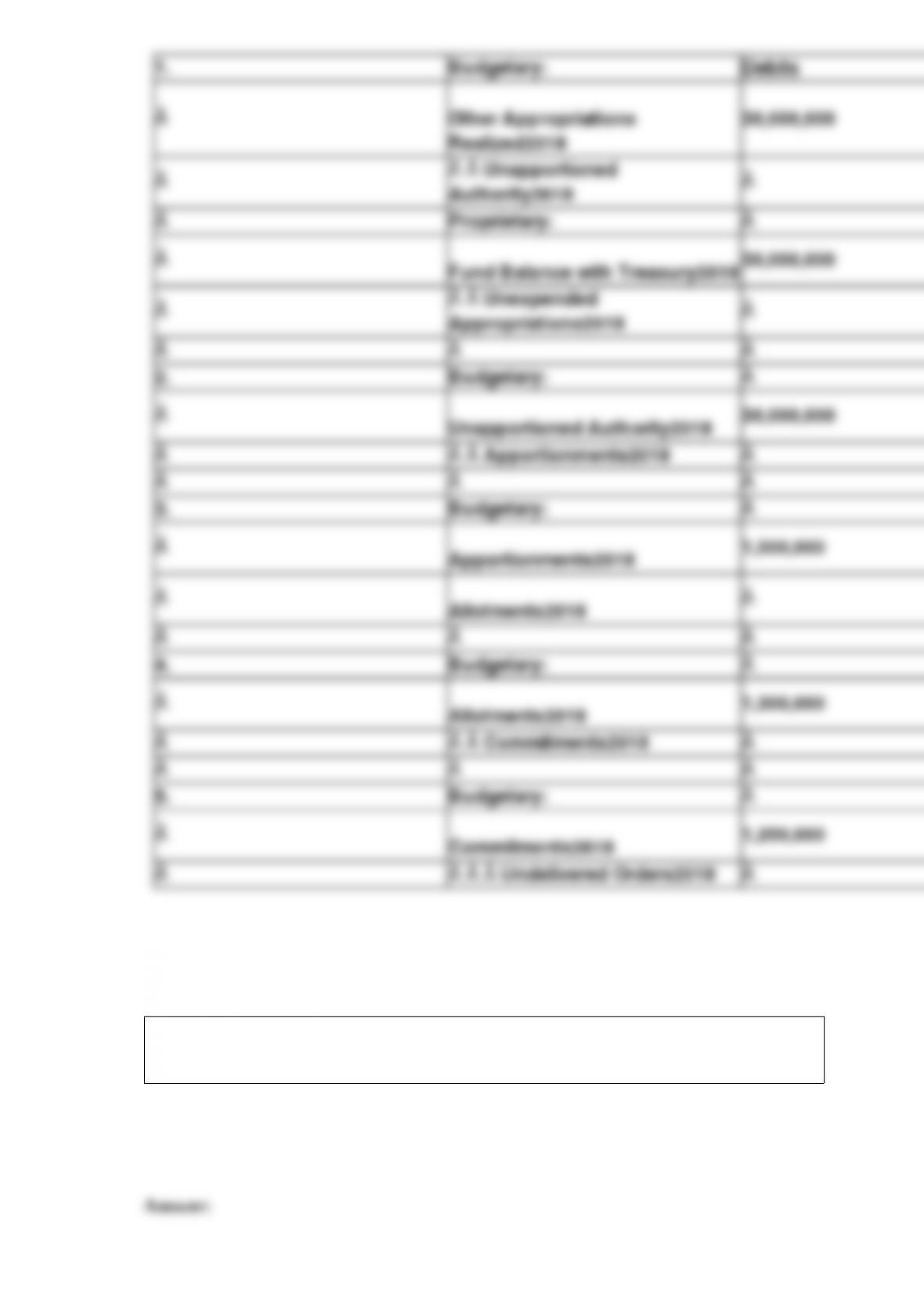
The Federal Monuments Commission began operations on October 1, 2017. Show in
general journal form all entries that should be made in budgetary and proprietary
accounts of the agency to record the following events:
1) The Congress passed, and the President signed, a one-year appropriation for fiscal
year 2018 for the Monuments Commission in the amount of $30,000,000.
2) The OMB notified the agency of the following apportionments of the 2018
appropriation: first quarter, $8,000,000; second quarter, $8,000,000; third quarter,
$7,000,000; and fourth quarter, $7,000,000.
3) The Commission Director allotted $1,500,000 for the operations of October 2017.
4) Commitments for goods and services not yet ordered or received were recorded in
the amount of $1,300,000.
5) Purchase orders and contracts for services were recorded for the month of October
2017 in the amount of $1,250,000.
The FASB, GASB, and FASAB all focus their standards on both internal and external
financial reporting.

The not-for-profit organization applying for tax-exempt status determines the
appropriate subsection under IRC Sec. 501 for which it wants to be considered and the
Internal Revenue Service then approves or denies the application.
A government is financially accountable for another entity if it appoints the voting
majority of the entity’s governing board.
Only state and local governments and their component units must have single audits;
colleges and universities and other not-for-profit organizations that expend federal
financial awards are not required to have single audits.
State laws often require that assets no longer needed in a capital projects fund be
transferred to the fund that will service the debt incurred for the project, a debt service
fund.
It is common for an agency fund to have relatively small net position balances.
The needs of users of government financial reports are the same as those of users of
business entity financial reports.
Debt service funds for term bonds would generally include sinking fund investments.
According to GASB Concepts Statement 1 a primary objective of financial reports is to
provide information useful in determining the accountability of the government.
The Charleston Principles provide guidance to state governments in setting registration
requirements for not-for-profits wanting to raise funds over the Internet.
Assigned fund balances can be either positive or negative.

Long-term debt intended to be repaid from tax levies or special assessments is recorded
in debt service funds.
Under current GASB standards the revenue from property taxes should be recorded in
the amounts collected during the current period.
According to the guidance of GASB Concepts Statement 3, financial information can be
communicated by recognition in the financial statements, disclosure in the notes to the
financial statements, presentation as required supplementary information, or
presentation as supplementary information.
If a government has deposited or transferred financial resources dedicated for payment
of debt service to the debt service fund and payment of principal and interest is due
early in the following year, then the expenditure and related liability may be recognized
in the debt service fund prior to year end.

TRUE/FALSE
Program revenues are distinguished from general revenues on the government-wide
statement of activities under GASB standards.
TRUE/FALSE
Expenses represent the costs to purchase goods or services, whereas expenditures
represent the costs of a goods or services consumed or expired during the period.
TRUE/FALSE
Other financing sources increase fund balance in the same manner as revenues.

When a government experiences delays associated with a bond issuance, it is common
practice to obtain temporary financing by use of bond anticipation notes.
An annuity agreement requires that a college pay the donor (or other designated
individual) a fixed dollar amount at specified time intervals.
A statement of cash flows is required by GAAP for both private colleges and
universities and public colleges and universities engaged in business-type activities.
Notes to the financial statements of a state or local government should include a
schedule, or summary, of debt service requirements (principal and interest payments) of
debt outstanding on the balance sheet date.
Intermediate sanctions are often imposed by the Internal Revenue Service, in addition
to revoking the tax-exempt status for organizations that confer excessive economic
benefits on officers of the organization.
Similar to state and local governments, the federal government uses funds to
demonstrate funds are being used for their intended purposes.
Defined benefit pension plans are classified as either single-employer pension plans or
multiple-employer pension plans.

A permanent endowment is an example of a nonspendable fund balance.
Income a not-for-profit organization earns from a rental property on which it has a
mortgage is subject to unrelated business income tax.
Trust funds often exist over a longer period of time than agency funds, represent and
develop vested interests of a beneficiary to a greater extent, and involve more complex
administration and financial accounting and reporting.

The positive fund balance in a special revenue fund must at a minimum be reported as
assigned.
Under GASB standards, public colleges and universities are considered general purpose
governments.
In accounting for state and local governments the modified accrual basis is required for
A. Proprietary and fiduciary funds.
B. Governmental funds.
C. Governmental and fiduciary funds.
D. Governmental and internal service funds.

A common reason why a government might receive a “modified opinion” from the
external auditors is:
A. A violation of generally accepted accounting principles was noted that does not
cause material misstatement of the financial statements.
B. A fund balance deficit in the General Fund.
C. Poor internal controls such that the accounting records could not be audited.
D. Expenditures exceeded appropriations in the General Fund.
Which of the following actions is not required to convert data from the governmental
fund financial statements to enable preparation of the government-wide financial
statements?
A. Adding annual depreciation expense proportionately to functional expense
categories.
B. Eliminating interfund payables and receivables between governmental funds.
C. Aggregating fund information.
D. Eliminating receivables and payables between governmental and enterprise funds.
Which of the statements concerning agency funds is true?

A. Agency funds use the same basis of accounting as permanent funds.
B. Agency funds are reported only on the statement of fiduciary net position.
C. Agency funds use the temporary accounts Additions and Deductions.
D. Agency funds never receive cash.
Which of the following is a required program revenue category in the government-wide
statement of activities?
A. Special assessments.
B. Operating grants and contributions.
C. Sales taxes.
D. Transfers.
Which of the following statements is not consistent with the GASB’s “Budgeting,
Budgetary Control, and Budgetary Reporting Principle”?
A. An annual budget must be adopted using generally accepted accounting principles.
B. The accounting system should provide the basis for appropriate budgetary control.
C. Budgetary comparisons should be presented for the General Fund and each major
special revenue fund for which an annual budget has been adopted.
D. The budgetary comparisons should present both the original and the final

appropriated budgets for the reporting period.
Which of the following statements is not true about the United States government-wide
financial report?
A. Since 1997, the financial statements of the U.S. government as a whole have been
audited by the GAO.
B. The majority of the 24 major federal agencies required to be audited have received
unqualified audit opinions by the GAO.
C. The Comptroller General of the United States has rendered a disclaimer of opinion
on the U.S. Government’s consolidated financial statements for as long as that office
has audited these statements.
D. The federal government received an unqualified opinion from the GAO on the most
recent financial statements of the U.S. government as a whole.
Under GASB standards which of the following funds can report a positive amount for
unassigned fund balance?
A. Capital projects fund.
B. Special revenue fund.
C. General Fund.

D. All of the above.
The Internal Revenue Service may impose intermediate sanctions on all of the
following transactions between a not-for-profit organization and its executive officer
except:
A. Excessive compensation.
B. More than the fair rental value for property owned by the officer.
C. A bargain on the sale of assets.
D. Fringe benefits comparable to those given to all employees.
The “net position” of a federal agency may include all of the following components,
except:
A. Unexpended appropriations.
B. Cumulative results of operations.
C. Appropriations represented by undelivered orders and unobligated balances.
D. Fund balance with U.S. Treasury.

Which of the following are government-wide financial statements required by GASB
standards?
A. Statement of net position and statement of cash flows.
B. Statement of net position, statement of activities, and statement of cash flows.
C. Statement of net position and statement of activities.
D. Statement of net position and statement of activities.
For financial reasons, two not-for-profit hospice organizations (hospices A and B)
decided to combine. As a result of the combination, the assets and liabilities of the
combined hospice were reported at the amounts that had been previously reported by A
and B on their financial statements. Under the FASB, the combining of hospices A and
B would be classified as which of the following?
A. Merger.
B. Consolidation.
C. Acquisition.
D. Component unit.

Which of the following would be considered a general capital asset?
A. A vehicle purchased from General Fund revenues.
B. A vehicle purchased and maintained by an enterprise fund.
C. A computer purchased from revenues of an internal service fund and used by the
supplies department.
D. Real estate purchased with the assets of a pension trust fund.
Which of the following measures may be useful to decision makers evaluating the
financial condition of a college or university?
A. Number of graduates.
B. Current ratio.
C. Faculty productivity.
D. Graduation rate.
Responsibility for establishing generally accepted accounting principles (GAAP) for
nongovernmental, not-for-profit organizations rests with the FASB and was most
clearly established:
A. By the FASB Codification.
B. When the FASB was created in 1974.
C. When the GASB was created in 1984.
D. In the AICPA’s Statement of Auditing Standards No. 69 (hierarchy of GAAP).
Under service efforts and accomplishments (SEA) reporting, outcome measures gauge
accomplishments, or the results of services provided, such as the percentage of
lane-miles of road in excellent, good, or fair condition.
Population demographics have an impact on financial factors such as revenue per
capita.
A college has collected returnable dormitory room deposits from students. How would
these deposits be reported by the college?
A. A current liability.

B. Unrestricted revenue.
C. Restricted revenue.
D. A long-term liability.
The term that is closely related to the concept of liquidity is
A. Financial condition.
B. Interperiod equity.
C. Financial position.
D. Economic condition.
In the current year, the not-for-profit organization (NFP) How to Read Government
Financial Reports received both cash of $1,000 and pledges of $2,000 to be used for
teaching citizens how to read government financial reports. During the year the
organization spent $1,500 teaching citizens to read financial statements. Assuming the
NFP has a policy of spending its restricted resources first, in the current year what
amount of contributions can be reclassified as unrestricted?
A. $1,000.
B. $1,500.
C. $2,000.
D. $3,000.

Customers’ meter deposits, which cannot be spent for normal operating purposes, would
be classified as restricted cash in the balance sheet of which fund type?
A. Internal service fund.
B. Private-purpose trust fund.
C. Enterprise fund.
D. Special revenue fund.
The board of directors for a voluntary health and welfare organization decided to
designate $20,000 each year for the next three years to fund a special research project it
was planning to conduct at the end of the three year period. How would these
board-designated resources be reported on the statement of financial position?
A. Unrestricted net assets.
B. Temporarily restricted net assets.
C. Permanently restricted net assets.
D. Internal payable.

When Sunny City makes its annual lease payment on an unpaid capital lease obligation,
the journal entry for the debt service fund accounts will include:
A. A debit to Capital Lease Obligation Payable.
B. A credit to Capital Lease Obligation Payable.
C. A debit to Capital Lease Expense.
D. A debit to Expenditures-Principal of Capital Lease Obligation.
On the due date for bond interest, the debt service fund journal entry (or entries) will
include a debit to:
A. Expenditures-Bond Interest.
B. Interfund Transfers In.
C. Appropriations.
D. Interest Expense.
GASB standards require that general capital assets be recorded in the government-wide
statements at:
A. Historical cost.

B. Fair value at the financial statement date.
C. Estimated cost at the financial statement date
D. None of the above.
Which of the following is not a typical reason for evaluating a government’s financial
condition?
A. Prevent financial crises from developing.
B. Hold management accountable for the use of tax revenues.
C. Determine if the government can continue to offer the current level of services.
D. Determine whether residents will receive dividends.
The Town of Golden purchased a squad car for the police department. If the operations
of the police department are financed by general revenues, which of the following is
correct concerning where the capital asset would be recorded?
A. General Fund: No; Governmental Activities: Yes
B. General Fund: No; Governmental Activities: No
C. General Fund: Yes; Governmental Activities: No
D. General Fund: Yes; Governmental Activities: Yes

Which of the following kinds of information would not be provided by management’s
discussion and analysis (MD&A)?
A. A narrative explanation of the contents of the CAFR.
B. A description of the government’s financial condition.
C. A forecast of revenues and expenditures for the next three fiscal years.
D. A discussion of economic factors and the budget and tax rates approved for the next
year.
For the following items that require reconciliation between governmental funds
financial statements and governmental activities financial statements at the
government-wide level according to GASB standards, indicate whether the
reconciliation will (A) always be subtracted from fund balancesgovernmental funds, (B)
always be added to fund balancesgovernmental funds, or (C) may be added to or
subtracted from fund balancesgovernmental funds in arriving at net position of
governmental activities.
_____ 1) Capital assets used in governmental activities
_____ 2) Long-term liabilities that are not payable in the current period
_____ 3) Net position of internal service funds that are primarily governmental in
nature
_____ 4) Accrued interest payable not due in the current period

Which of the following could be included in the performance indicator measure
provided by a nongovernmental not-for-profit hospital?
A. Contribution to an endowment.
B. Gain on sale of equipment.
C. Grant restricted for diabetes research.
D. Interest income that is temporarily restricted.
Show entries in general journal form for the following transactions of Bothwell
Regional Hospital, a nongovernmental not-for-profit hospital.
1) For the month just ended the hospital received in cash $8,000 from the hospital’s gift
shop sales, and received donated medicines with a fair value of $47,000. These
medicines are of the type the hospital normally would purchase.
2) The hospital’s finance officer, in compliance with the directive of the governing
board, invested $600,000 of operating cash in certificates of deposit to be held for
future purchases of equipment.
3) New equipment costing $750,000 was purchased from money given the hospital in a
prior year to be held until needed for equipment purchases.
4) A federal grant was received in cash in the amount of $400,000 to be used for heart
research. During the current year only $50,000 was spent for this research program.
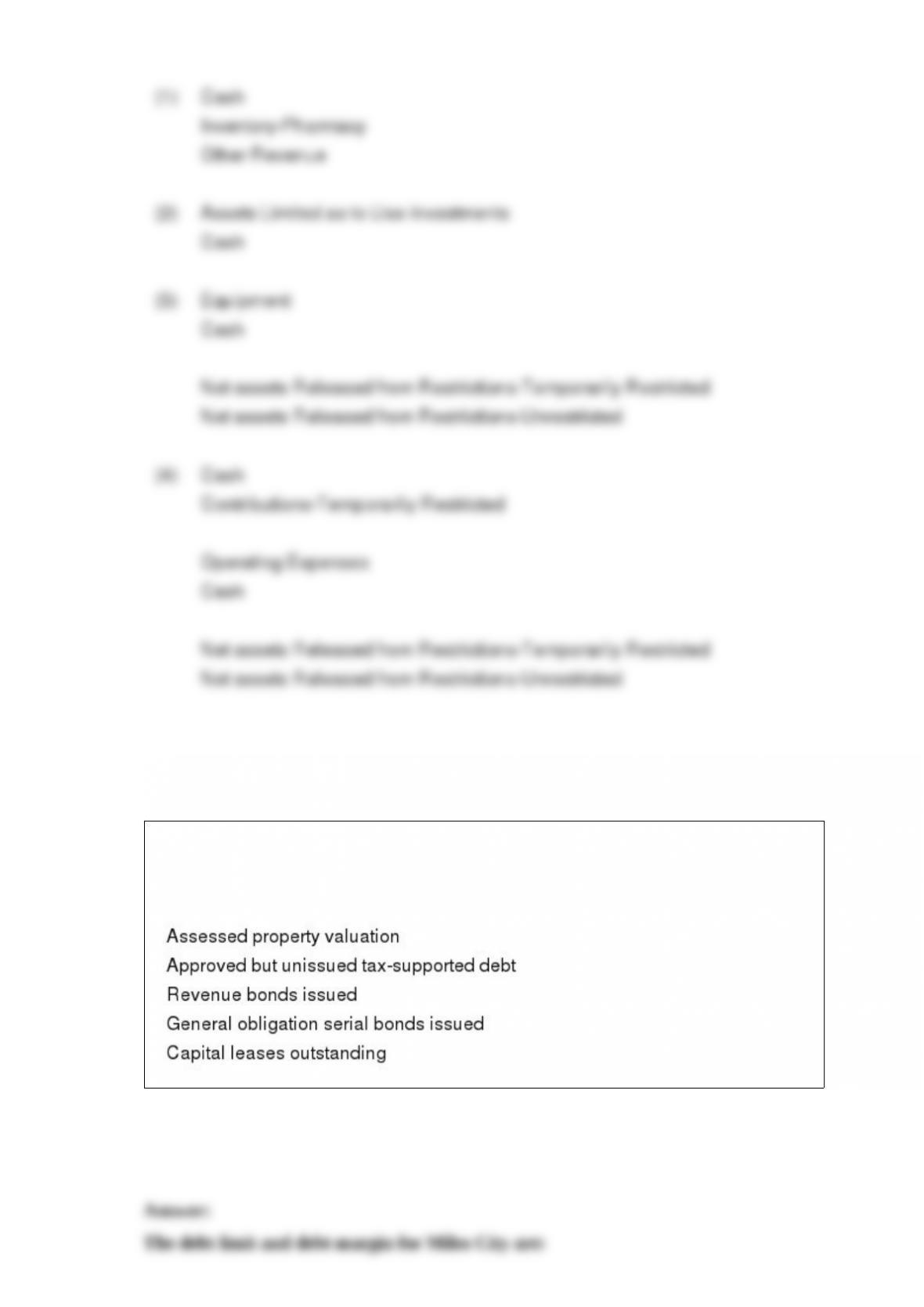
The debt limit for general obligation debt for Milos City is 1 percent of the assessed
property valuation for the city. Using the following information, calculate the city’s debt
limit and debt margin.
In what ways does the government-wide statement of net position differ from the
balance sheet for governmental funds?
Identify and briefly explain the four sections of the performance and accountability
report (PAR) that the Office of Management and Budget requires major federal
departments and agencies to prepare.
Georgetown Hospital, a governmental hospital, recorded during its fiscal year ended
September 30, gross patient services valued at $15,000,000, excluding charity care
services of $1,600,000. However, contractual adjustments by third-party payors
amounted to $1,200,000. In May of that year it received donated medical supplies
worth $2,000; supplies it had planned to purchase had it not been for the gift. At
year-end, the governing board set aside investments in the amount of $500,000 for
future plant expansion and $250,000 to be invested with the related earnings used for a
special prenatal care program.
1) In its operating statement for the year ended September 30, how much Georgetown
should report as net patient services revenue? Justify your answer.
2) For the year ended September 30, how should the donation of medical supplies be
reported?
3) What amount of unrestricted net position should Georgetown report in its balance
sheet as board designated, assuming it had no board designated net position at the
beginning of the year?
What is meant by the term “reporting entity” in accounting for state and local
governments?
How might a citizen become involved in the local government budgeting process?
How should depreciation expense be reported in the government-wide statement of
activities?
Why should persons interested in reading financial reports of government and
not-for-profit entities be familiar with standards set by the GASB and FASB?
Explain the process of financial reporting of the U.S. Government as a whole. Does the
federal government receive an unmodified audit opinion on its financial report?
What auditing issues are of particular significance to the health care industry?

Manthei University, a private university, has provided the following information
concerning selected transactions. Prepare in general journal form the entries required
for each of the transactions.
1) The university was awarded a federal grant in the amount of $1,800,000 to be used
for a specified research project (determined to be a nonexchange transaction). During
the year the entire $1,800,000 was received and expenses for the specified project
totaled $1,000,000.
2) Ira Beaker, a renowned chemist and alumnus, donated $7,000,000 to be used for the
construction of new chemistry building to be named Beaker Hall. The gift is to be paid
to the university in equal installments over a two-year period; the sum for the current
year was received in cash.
3) Cash outlays of $2,750,000 were made during the year for construction in progress
on the new chemistry building. Other construction projects completed during the year,
also financed by temporarily restricted resources, amounted to $1,500,000 for buildings
and $500,000 for improvements other than buildings. There was no debt financing used
for these projects.
4) During the year bonds with a face value of $180,000 were retired.
Explain how federal award programs are selected for audit under the risk-based
approach.
Legislators often believe an internal service fund function will not be subjected to
annual legislative budget review and the legislature will “lose control” of the fund. Do
you agree with this line of reasoning? Why or why not?
Why do agency funds have no fund equity? What classes of accounts are reported in
agency fund financial statements?