Archives: Quiz
SESP 80270
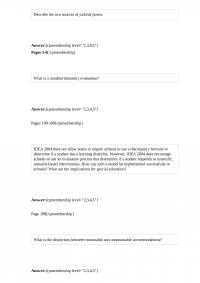
Describe the two sources of judicial power. What is a nondiscriminatory evaluation? Answer: Pages 198-199 IDEA 2004 does not allow states to require schools to use a discrepancy formula to determine if a student has a learning disability. However, IDEA […]
SED AP 95105
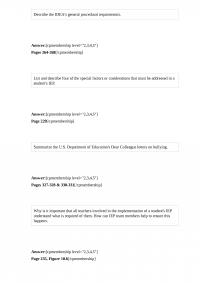
Describe the IDEA’s general procedural requirements. List and describe four of the special factors or cosiderations that must be addressed in a student’s IEP. Answer: Page 229 Summarize the U.S. Department of Education’s Dear Colleague letters on bullying. Answer: Pages […]
EDU 36939
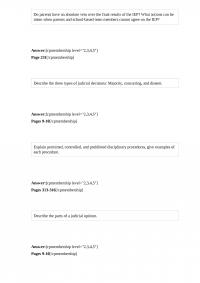
Do parents have an absolute veto over the final results of the IEP? What actions can be taken when parents and school-based team members cannot agree on the IEP? Describe the three types of judicial decisions: Majority, concurring, and dissent. […]
SESP 83855
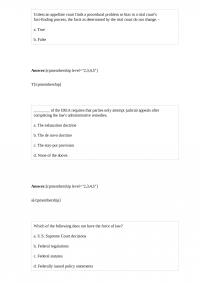
Unless an appellate court finds a procedural problem or bias in a trial court’s fact-finding process, the facts as determined by the trial court do not change. – a. True b. False ________ of the IDEA requires that parties only […]
SESP 89582
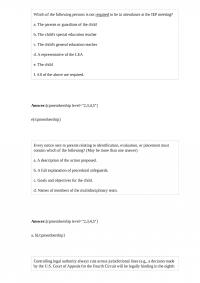
Which of the following persons is not required to be in attendance at the IEP meeting? a. The parents or guardians of the child b. The child’s special education teacher c. The child’s general education teacher d. A representative of […]
SESP 15618
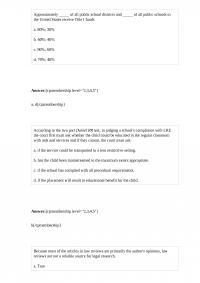
Approximately _____ of all public school districts and _____ of all public schools in the United States receive Title I funds a. 80%; 30% b. 60%; 40% c. 90%; 60% d. 70%; 40% According to the two part Daniel RR […]
SED EM 78148
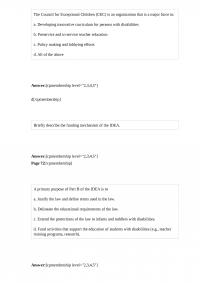
The Council for Exceptional Children (CEC) is an organization that is a major force in: a. Developing innovative curriculum for persons with disabilities b. Preservice and in-service teacher education c. Policy making and lobbying efforts d. All of the above […]
EDUK 87953
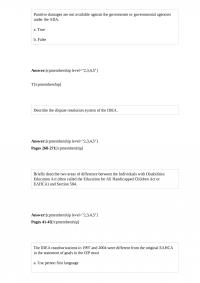
Punitive damages are not available against the government or governmental agencies under the ADA. a. True b. False Describe the dispute resolution system of the IDEA. Answer: Pages 268-271 Briefly describe two areas of difference between the Individuals with Disabilities […]
SED AP 54578
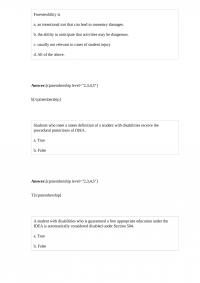
Foreseeability is a. an intentional tort that can lead to monetary damages. b. the ability to anticipate that activities may be dangerous. c. usually not relevant in cases of student injury d. All of the above. Students who meet a […]
EDUK 74332
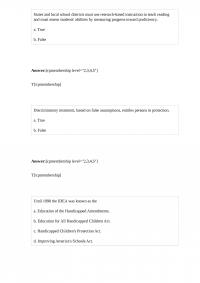
States and local school districts must use research-based instruction to teach reading and must assess students’ abilities by measuring progress toward proficiency. a. True b. False Discriminatory treatment, based on false assumptions, entitles persons to protection. a. True b. False […]
SED EM 15749
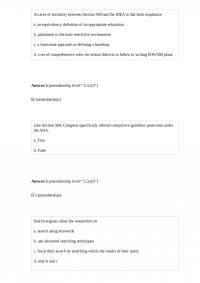
An area of similarity between Section 504 and the IDEA is that both emphasize a. an equivalency definition of an appropriate education. b. placement in the least restrictive environment c. a functional approach to defining a handicap. d. a set […]
SED LR 11184
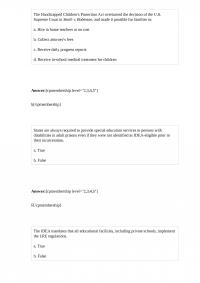
The Handicapped Children’s Protection Act overturned the decision of the U.S. Supreme Court in Smith v. Robinson, and made it possible for families to: a. Hire in home teachers at no cost b. Collect attorney’s fees c. Receive daily progress […]
SED EM 44760
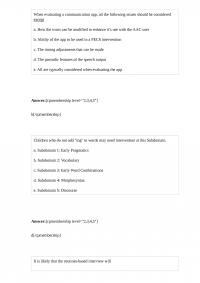
When evaluating a communication app, all the following issues should be considered except a. How the icons can be modified to enhance it’s use with the AAC user b. Ability of the app to be used in a PECS intervention […]
SED EM 41592
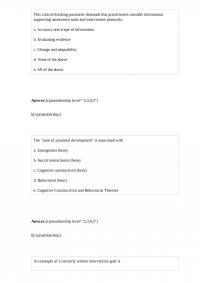
This critical-thinking parameter demands that practitioners consider information supporting assessment tools and intervention protocols. a. Accuracy and scope of information b. Evaluating evidence c. Change and adaptability d. None of the above e. All of the above The “zone of […]
SED DS 55985
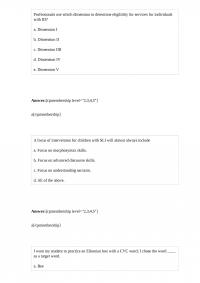
Professionals use which dimension to determine eligibility for services for individuals with ID? a. Dimension I b. Dimension II c. Dimension IIII d. Dimension IV e. Dimension V A focus of intervention for children with SLI will almost always include […]
SESP 44538
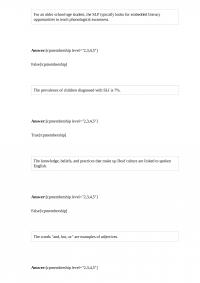
For an older school-age student, the SLP typically looks for embedded literacy opportunities to teach phonological awareness. The prevalence of children diagnosed with SLI is 7%. Answer: True The knowledge, beliefs, and practices that make up Deaf culture are linked […]
SED LR 37857
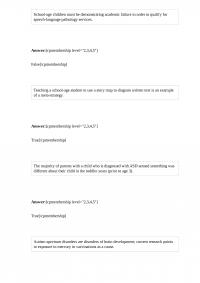
School-age children must be demonstrating academic failure in order to qualify for speech-language pathology services. Teaching a school-age student to use a story map to diagram written text is an example of a meta-strategy. Answer: True The majority of parents […]
SESP 25385
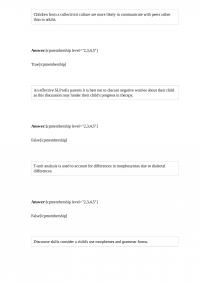
Children from a collectivist culture are more likely to communicate with peers rather than to adults. An effective SLP tells parents it is best not to discuss negative worries about their child as this discussion may hinder their child’s progress […]
SED AP 89124
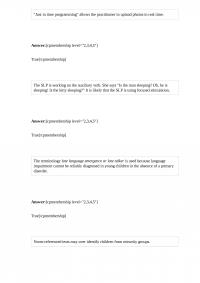
“Just in time programming” allows the practitioner to upload photos in real time. The SLP is working on the auxiliary verb. She says “Is the man sleeping? Oh, he is sleeping! Is the kitty sleeping?” It is likely that the […]
EDUK 93516
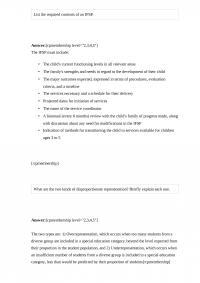
List the required contents of an IFSP. What are the two kinds of disproportionate representation? Briefly explain each one. Answer: The two types are: 1) Overrepresentation, which occurs when too many students from a diverse group are included in a […]
EDU 84659
Guillermina speaks Spanish as her native language. Guillermina is considered A. linguistically diverse. B. culturally assimilated. C. to have a language disorder. D. historically overrepresented. All of the following are indicative of ASD at a very early age EXCEPT A. […]
EDUC 38447
Which is NOT an underrepresented subgroup of gifted students? A. students with learning disabilities B. females C. males D. culturally/linguistically diverse students How well individuals can use their sight is described as A. visual acuity. B. visual efficiency. C. visual […]
SESP 89126
In the past, Francisco gave up as soon as he came across a math problem that he didn’t understand, Now, whenever Francisco comes to a difficult problem, he has learned to talk himself through it, saying things like, “This isn”t […]
SED EM 53539
Dr. Xiong is a professional who measures a person’s vision and prescribes contacts or glasses. Dr. Xiong is a(n) A. optometrist. B. ophthalmologist. C. optician. D. pharmacist. Which of the following would be an example of the UDL principle of […]
EDU 28726
Kailyn has a hereditary disorder which causes a distortion of the red blood cells, thus restricting their passage through the blood vessels. Kailyn has A. sickle cell anemia. B. hemophilia. C. HIV. D. AIDS. Mr. and Mrs. McGill-Chris have just […]
SESP 78715
Connor is a high school senior who has just taken an exam to determine whether he is eligible to graduate with a diploma. Connor has just taken A. a minimum competency exam. B. an alternate assessment. C. a mandatory exit […]
SED LR 80382
Which of the following statements about the drop out rates of gifted students is accurate? A. The number of gifted students who drop out of high school is less than 1 percent. B. Gifted girls are far more likely to […]
EDUK 15512
Jay is an aggressive three-year-old. His parents should be A. unconcerned, as this is common behavior at Jay’s age. B. aware that most aggression diminishes once children reach elementary school. C. aware that aggressive behavior during the early years often […]
EDU 92801
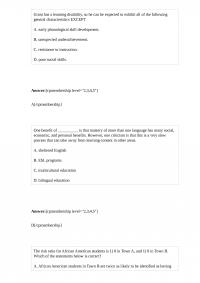
Grant has a learning disability, so he can be expected to exhibit all of the following general characteristics EXCEPT A. early phonological skill development. B. unexpected underachievement. C. resistance to instruction. D. poor social skills. One benefit of __________ is […]
SED DS 22348
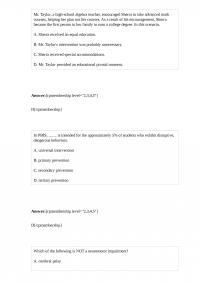
Mr. Taylor, a high-school algebra teacher, encouraged Sherra to take advanced math courses, helping her plan out her courses. As a result of his encouragement, Sherra became the first person in her family to earn a college degree. In this […]
EDUC 24380
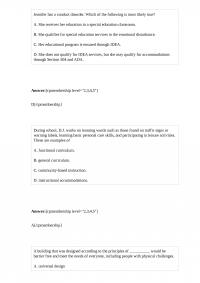
Jennifer has a conduct disorder. Which of the following is most likely true? A. She receives her education in a special education classroom. B. She qualifies for special education services in the emotional disturbance. C. Her educational program is ensured […]
EDU 99202
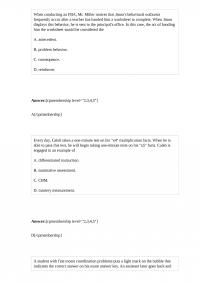
When conducting an FBA, Mr. Miller notices that Jason’s behavioral outbursts frequently occur after a teacher has handed him a worksheet to complete. When Jason displays this behavior, he is sent to the principal’s office. In this case, the act […]
SED DS 81474
Based upon information regarding the three adaptive skill areas, which of the following is NOT a practical adaptive behavior? A. counting money B. getting dressed C. eating D. doing laundry Carlo’s behavioral outbursts have been attributed to his disability, but […]
EDU 45416
Which statement related to childhood lead poisoning is accurate? A. Lead continues to seep into the environment because it is still used in jet fuel and in some industries. B. Lead is still used in household paint. C. Leaded gasoline […]
SED LR 82914
Which best describes the treatment and control groups of the Abecedarian Project? A) children receiving early intervention services in school-based settings vs. those receiving them at home B) parents receiving consultation from a parent trainer vs. those provided readings on […]
EDUK 63549
Mrs. Gonzales is evaluating Maria for a possible communication disorder. She asks Maria a series of open-ended questions to evaluate her expressive speech. This type of assessment is known as a A) case history B) functional analysis C) language application […]
SESP 26093
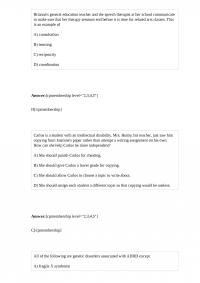
Brianna’s general education teacher and the speech therapist at her school communicate to make sure that her therapy sessions end before it is time for related arts classes. This is an example of A) consultation B) teaming C) reciprocity D) […]
EDUK 63184
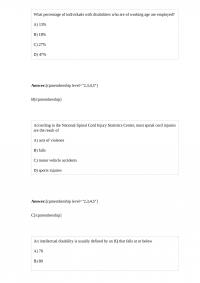
What percentage of individuals with disabilities who are of working age are employed? A) 13% B) 18% C) 27% D) 47% According to the National Spinal Cord Injury Statistics Center, most spinal cord injuries are the result of A) acts […]
EDUC 18137
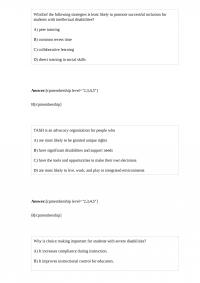
Whichof the following strategies is least likely to promote successful inclusion for students with intellectual disabilities? A) peer tutoring B) common recess time C) collaborative learning D) direct training in social skills TASH is an advocacy organization for people who […]
SED LR 67634
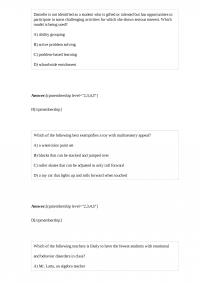
Danielle is not identified as a student who is gifted or talented but has opportunities to participate in some challenging activities for which she shows serious interest. Which model is being used? A) ability grouping B) active problem solving C) […]
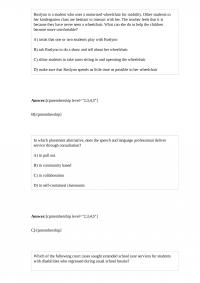
EDU 37014
Roslynn is a student who uses a motorized wheelchair for mobility. Other students in her kindergarten class are hesitant to interact with her. The teacher feels that it is because they have never seen a wheelchair. What can she do […]
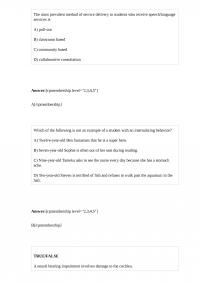
EDUK 56276
The most prevalent method of service delivery to students who receive speech/language services is A) pull-out B) classroom based C) community based D) collaborative consultation Which of the following is not an example of a student with an internalizing behavior? […]
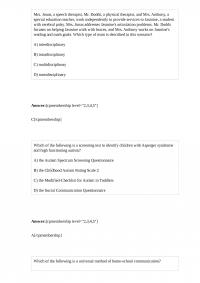
EDU 50178
Mrs. Jonas, a speech therapist, Mr. Dodds, a physical therapist, and Mrs. Anthony, a special education teacher, work independently to provide services to Jasmine, a student with cerebral palsy. Mrs. Jonas addresses Jasmine’s articulation problems. Mr. Dodds focuses on helping […]
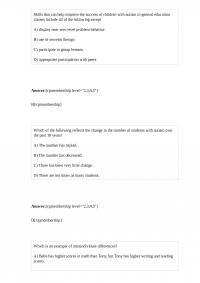
EDUC 64544
Skills that can help improve the success of children with autism in general education classes include all of the following except A) display near zero level problem behavior B) use of secretin therapy C) participate in group lessons D) appropriate […]
SED LR 47495
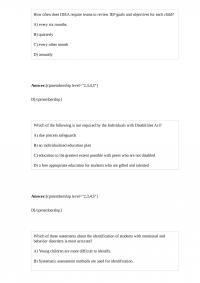
How often does IDEA require teams to review IEP goals and objectives for each child? A) every six months. B) quarterly C) every other month D) annually Which of the following is not required by the Individuals with Disabilities Act? […]
SED LR 11718
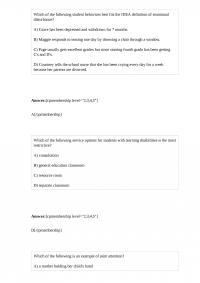
Which of the following student behaviors best fits the IDEA definition of emotional disturbance? A) Grace has been depressed and withdrawn for 7 months. B) Maggie responds to teasing one day by throwing a chair through a window. C) Page […]
SED DS 47386
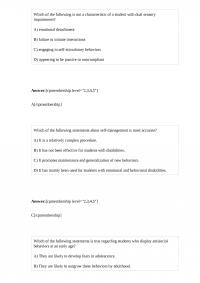
Which of the following is not a characteristic of a student with dual sensory impairments? A) emotional detachment B) failure to initiate interactions C) engaging in self-stimulatory behaviors D) appearing to be passive or noncompliant Which of the following statements […]
SED AP 19736
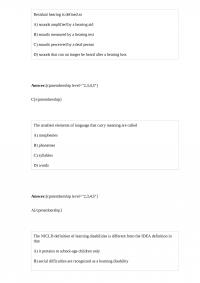
Residual hearing is defined as A) sounds amplified by a hearing aid B) sounds measured by a hearing test C) sounds perceived by a deaf person D) sounds that can no longer be heard after a hearing loss The smallest […]
EDU 93624
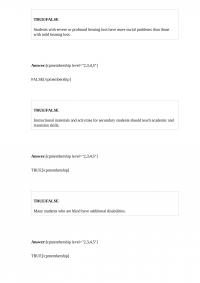
TRUE/FALSE Students with severe or profound hearing loss have more social problems than those with mild hearing loss. TRUE/FALSE Instructional materials and activities for secondary students should teach academic and transition skills. Answer: TRUE TRUE/FALSE Many students who are blind […]
SED CE 73961
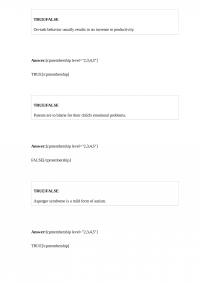
TRUE/FALSE On-task behavior usually results in an increase in productivity. TRUE/FALSE Parents are to blame for their child’s emotional problems. Answer: FALSE TRUE/FALSE Asperger syndrome is a mild form of autism. Answer: TRUE Answer: TRUE TRUE/FALSE School districts may exceed […]