
Under GASB standards, only proprietary funds prepare a statement of cash flows.
A large intergovernmental revenues ratio can be viewed as a positive sign concerning a
government’s financial condition.
The General Fund data for a blended component unit should be reported as a special
revenue fund of the primary government.
The collection of taxes or other revenues by one government for several of the funds it
operates and for other governments often results in the creation of a trust fund.

A private university following the recommendations of the National Association of
College and University Business Officers (NACUBO) chart of accounts for reporting
expenses, must disclose expenses by program and support function in the notes.
TRUE/FALSE
Budgetary accounts used in the General Fund include Estimated Revenues, Estimated
Other Financing Sources, Appropriations, Estimated Other Financing Uses, and
Encumbrances.
Responsibility for setting accounting and reporting standards for federal agencies rests
primarily with the Federal Accounting Standards Advisory Board.

The GASB and the FASB provide the same criteria for recognizing and reporting
services donated to a health care entity.
An example of a college outcome performance metric would be performance on
nationally ranked exams such as the CPA exam.
When revenues are legally restricted by external resource providers or committed by
enabling legislation for particular operating purposes, a private purpose trust fund is
created.

Agency funds are used only if a government holds resources in a purely custodial
capacity for others.
Hospitals, colleges and universities, voluntary health and welfare organizations, and
other not-for-profit organizations all follow the same standards for recognition of
revenues and expenses.
The accounting system used by a state or local government must make it possible to
prepare financial statements as required by the Financial Accounting Standards Board.
Required supplementary information (RSI), such as the MD&A and budgetary
comparison schedules, are within the scope of a financial statement audit.

Enterprise funds are reported as a part of the Governmental Activities column of the
government-wide financial statements when they provide services to governmental
funds.
Only those governmental and proprietary funds that meet the GASB size criteria for
major funds are reported in separate columns of the governmental and proprietary fund
financial statements.
Not-for-profit organizations are so diverse in nature that it is not feasible to find
benchmarks with which to compare their financial and operating performance.

Nonmajor funds are not reported on the fund financial statements.
Under GASB standards, every government, regardless of its size, is instructed to
prepare a cash budget for each month of the fiscal year.
A payment made by a city-owned utility to the General Fund of the city in lieu of taxes
is an example of an “internal exchange transaction.”
A defined benefit plan specifies the amount or rate of contribution that the employer
and employees must contribute to benefit the members’ accounts in the pension plan.

General capital assets financed wholly or partially through collections of special
assessments are recorded in the same manner as any other general capital assets in the
governmental activities category at the government-wide level.
Because budgetary accounts are used by governments, government financial statements
can never be said to be in accord with generally accepted accounting principles.
Similarity in the characteristics of nongovernmental not-for-profit (NFP) organizations
and governmental NFP organizations can make it difficult to determine whether the
NFP is nongovernmental or governmental in nature.

Proceeds of debt issued for the construction or acquisition of capital assets are
recognized by the capital projects fund as “other financing sources” and as a liability in
the governmental activities journal.
TRUE/FALSE
“Available appropriation” is calculated as the difference between appropriations and the
sum of expenditures and encumbrances.
Governmental funds are identical to governmental activities, proprietary funds are
identical to business-type activities, and fiduciary funds are identical to fiduciary
activities of a government.

Debt limit is a term used to denote the total amount of indebtedness of specified kinds
that is allowed by law to be outstanding at any one time.
General capital assets purchased or constructed with governmental fund resources are
recorded in the governmental activities general ledger at the government-wide level.
In the context of regulatory utility plant accounting, original cost and historical cost
have the same meaning.
According to the FASB Codification, donated materials are generally not recognized as
contributions by a not-for-profit organization.

To facilitate the combination of utility financial statements with the statements of other
enterprise funds, GAAP permits utilities to follow the customary format used by
nonutility business organizations.
Which of the following statements is not true for debt service funds?
A. Special assessment debt for which the government has some obligation is paid
through the debt service fund.
B. Interest payable may be reported as a liability of the debt service fund.
C. Bond principal is shown as a liability of the debt service fund only when that
principal is due and payable.
D. All tax-supported bond principal is shown as a liability of the debt service fund.
Which of the following accounts is least likely to be used by a tax agency fund?
A. Cash.
B. Revenues.

C. Taxes receivable for other funds.
D. Due to other governments.
A good measure that can be used to help assess whether a not-for-profit organization is
spending too much on overhead, such as general and administrative expenses, is:
A. Percentage of unrestricted net assets to operating expenses.
B. Current ratio.
C. Total revenues divided by total expenses.
D. Percentage of program expenses to total expenses.
Cartier Village’s capital expenditures during the year ended December 31 included:
What amounts should have been recorded in the General Fund and enterprise fund for
the increase in equipment during the year ended December 31, assuming the electric
utility is considered an enterprise fund?
A. General Fund: $0; Enterprise Fund: $0
B. General Fund: $0; Enterprise Fund: $60,000
C. General Fund: $40,000; Enterprise Fund: $60,000

D. General Fund: $100,000; Enterprise Fund: $0
When a cash and investment pool of a certain city was established, the debt service
fund transferred investments to the pool having a cost of $3,000,000 but a current fair
market value of $3,100,000. To record this transaction, the journal entry made by the
debt service fund will include:
A. A debit to Equity in Pooled Cash and Investments in the amount of $3,000,000.
B. A credit to RevenuesChange in Fair Value of Investments in the amount of $100,000.
C. A debit to Investments in the amount of $3,000,000.
D. A credit to Investments in the amount of $3,100,000.
Governments and not-for-profit entities may be subject to each of the following levels
of audit except:
A. Requirements under AICPA generally accepted auditing standards.
B. Requirements under GAO generally accepted governmental auditing standards.
C. Requirements under OMB compliance standards.
D. Requirements under the Single Audit Act.

The Encumbrances account is properly termed a:
A. Long-term liability.
B. Reservation of unassigned fund balance.
C. Budgetary account.
D. Current liability if paid within a year; otherwise, long-term debt.
The comprehensive annual financial report (CAFR) of a government should contain a
statement of revenues, expenses, and changes in net position for :
A. Both proprietary and governmental funds.
B. Governmental but not proprietary funds.
C. Proprietary but not governmental funds.
D. Both proprietary and fiduciary funds.
How should a capital lease for a general capital asset be recorded in the governmental
activities accounts at the inception of the lease?

A. Debit to a capital asset account.
B. Debit to a capital expense/expenditure account.
C. Credit to Capital Lease Obligations Payable.
D. Both A and C are correct.
The city’s electric utility fund sent $700,000 to the General Fund to help cover the city’s
operating costs. This transaction would be recorded in the governmental activities
journal as
A. Interfund transfer in.
B. Internal balance.
C. Revenue.
D. It would not be recorded since the transaction involves two funds of the same
government.
Which of the following is not a net asset category reported by not-for-profit entities?
A. Unrestricted net assets.
B. Temporarily restricted net assets.
C. Restricted net assets.
D. Permanently restricted net assets.

How would estimated uncollectible tuition and fees be reported on the financial
statements of a university?
A. It would be reported as part of net revenue by a public university.
B. It would be reported as an operating expense by a public university.
C. It would be reported as an operating expense by a private university.
D. Both A and C are correct methods of reporting estimated uncollectible tuition and
fees.
An investment trust fund is used to report the net position available to the:
A. Sponsoring government only.
B. External participants only.
C. Financial institution that acts as custodian for the fund’s investments.
D. All of the above.

Which of the following would be considered Category (b) GAAP for state and local
government auditees?
A. AICPA Practice Bulletins if specifically made applicable to state and local
governments by the AICPA and cleared by the GASB.
B. GASB Technical Bulletins.
C. GASB Statements and Interpretations.
D. GASB Implementation Guides.
The account “Interfund Transfers In” would be classified in a General Fund statement
of revenues, expenditures, and changes in fund balance as a(an):
A. Revenue.
B. Other financing use.
C. Other financing source.
D. Current liability.
Which of the following is a measure of the extent to which the government’s
business-type activities are self-supporting?
A. Unrestricted net position/total revenues.
B. Business-type activities revenues/business-type activities expenses.
C. Total net position (governmental activities and business-type activities) less total net
position at the beginning of the year.
D. Total revenues/total expenses.
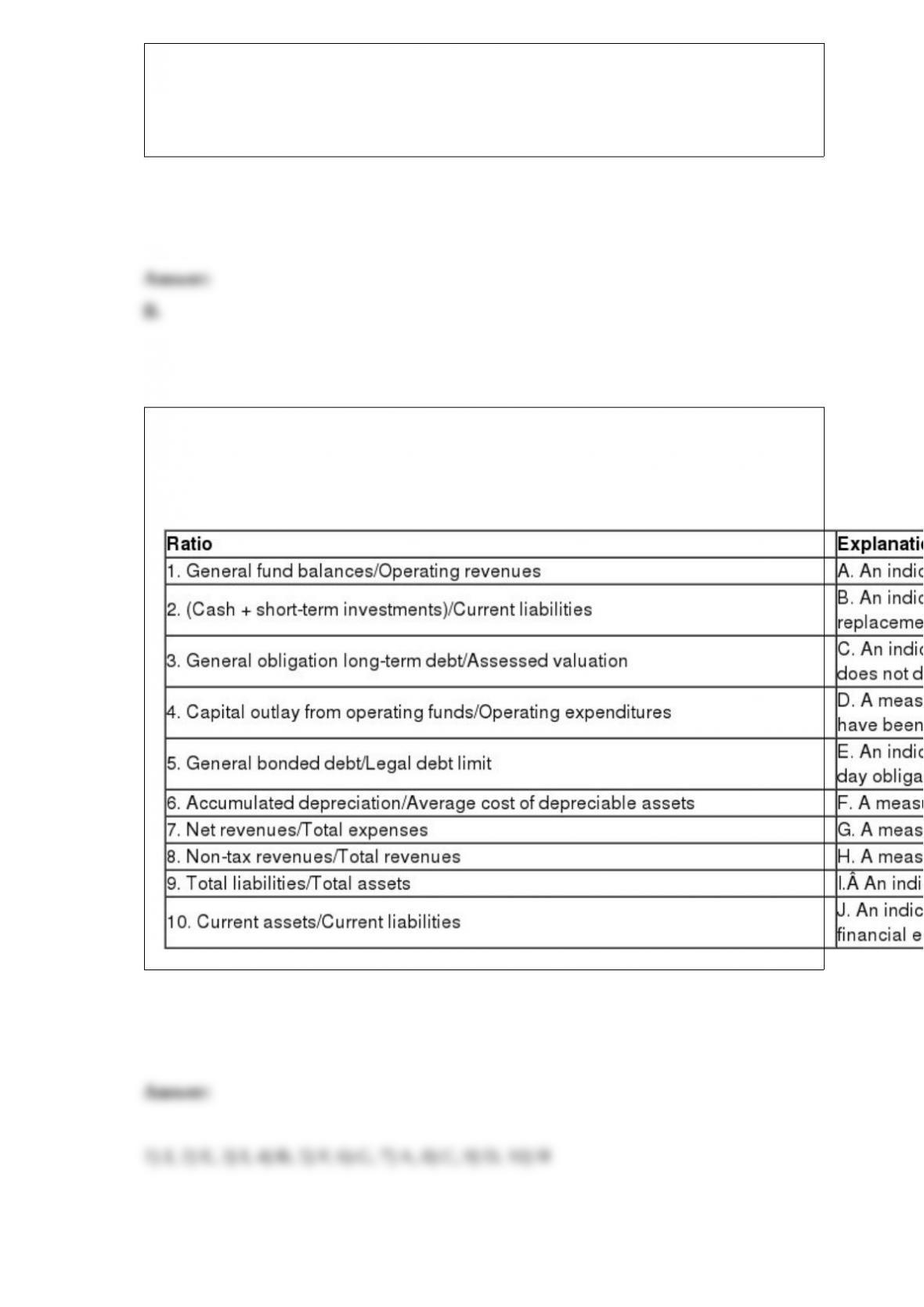
Match the following financial ratios that are based on comprehensive annual financial
report (CAFR) information with the explanation for that ratio. Answers can only be
used once.

Property taxes due and collectible 90 days after the 2017 fiscal year end would be
recorded as revenues in 2017 in which journal?
General Fund Governmental Activities
A. Choice A.
B. Choice B.
C. Choice C.
D. Choice D.
On July 1, the first day of its fiscal year, the Town of Eldon levied a $1,000,000
property tax which is payable in full on December 1 of the same year. On September
15, the town decided to borrow $200,000 in 90-day tax anticipation notes to cover
operating expenditures until the tax revenues are collected. The journal entry on
September 15 to record the issuance of tax anticipation notes will include:
A. A credit to Other Financing Sources-Proceeds of Tax Anticipation Notes.
B. A credit to Tax Anticipation Revenue.
C. A credit to Tax Anticipation Notes Payable.
D. A credit to Deferred Outflow of Resources-Tax Anticipation Notes.

The Financial Accounting Standards Board has the responsibility for setting accounting
and financial reporting standards for
A. All not-for-profit organizations that are nongovernmental and business entities.
B. All not-for-profit organizations and business entities.
C. All not-for-profit organizations.
D. Special purpose governments with a business purpose.
In the current year, the not-for-profit organization Save the Butterflies Foundation
received cash of $500 to be used as the Foundation wishes and $1,000 to be used for
butterfly research. Save the Butterflies also received pledges of $700 that it can use as it
wishes and $600 for its building fund. All pledges are expected to be received next year.
How much would Save the Butterflies report as temporarily restricted contributions in
the current year?
A. $1,000.
B. $1,600.
C. $1,300.
D. $2,300.

Which of the following statements is true regarding generally accepted accounting
principles (GAAP) for colleges and universities?
A. The FASB has set standards for private and public colleges and universities from the
time of its inception in 1974.
B. The National Association of Colleges and University Business Officers (NACUBO)
provides category (b) accounting principles under the FASB GAAP hierarchy.
C. Public and private colleges and universities are subject to the requirements in the
AICPA audit and accounting guide for Not-for-Profit Entities.
D. The GASB is responsible for establishing GAAP for public colleges and universities.
Cactus College, a small private college, received a research grant from NACUBO to
study whether service efforts and accomplishments measures improve institutional
performance. In accordance with FASB standards the grant would be reported as an
increase in:
A. Unrestricted net assets.
B. Temporarily restricted net assets.
C. Permanently restricted net assets.
D. Unrestricted designated net assets.
Which of the following fund types uses the current financial resources measurement
focus and modified accrual basis of accounting?

A. Enterprise fund.
B. Special revenue fund.
C. Investment trust fund.
D. Pension trust fund.
Internal service funds should be used only if:
A. The reporting government funds the activity with general obligation debt.
B. The reporting government provides services primarily to external participants.
C. The reporting government provides services primarily to other departments of the
same government.
D. The reporting government provides services below full cost.
In pension accounting, the employer’s net pension liability:
A. Is measured as the total pension liability less the amount of fiduciary net position
held for future pension payments.
B. Represents the portion of the present value of projected benefit payments to be
provided through the pension plan to current active and inactive employees that is
attributed to those employees’ past periods of service.
C. Is the same as the net pension obligation.

D. Is based on actuarial valuations generally required to be performed at least every five
years.
Which of the following basic financial statements contains a column for the total of all
debt service funds?
A. Statement of cash flows.
B. Statement of revenues, expenditures, and changes in governmental fund balances.
C. Statement of revenues, expenses, and changes in proprietary net position.
D. No basic financial statement contains a column for the total of all debt service funds.
Which of the following is identified by the FASAB as the foundation for federal
financial reporting?
A. Decision usefulness.
B. Accountability.
C. Understandability.
D. Budget integrity.

Which of the following would be considered an internal exchange transaction?
A. The General Fund transfers $200,000 to establish a Central Supplies Fund; this
amount will not be repaid.
B. The General Fund transfers $125,000 to the Debt Service Fund for payment of
currently due bond interest payments.
C. The General Fund transfers $9,000 to the Central Supplies Fund for supplies it
received from Central Supplies.
D. The Capital Projects Fund completes a library building project and transfers the
remaining cash to the Debt Service Fund.
In financial reporting for proprietary funds and at the government-wide level, the
employer’s pension expense for the period is equal to:
A. The employer’s contribution.
B. Annual required contribution.
C. Current year benefits, interest on prior pension liabilities, plan changes, amortization
of deferred amounts, and other changes to the net pension liability.
D. All of the above.

Which of the following is not a true statement about the Allowance for Funds Used
During Construction (AFUDC)?
A. AFUDC may have either a debt component or an equity component.
B. The amount credited to AFUDC may exceed the amount of interest paid during the
period on bonds issued for construction.
C. AFUDC may be credited for an imputed amount of interest on the utility’s own funds
used for construction.
D. AFUDC may include the total amount of borrowing during construction.
The journal entry to record budgeted revenues will include:
A. A debit to Estimated Revenues.
B. A credit to Estimated Revenues.
C. A debit to Revenues Receivable.
D. Only a memorandum entry is necessary.
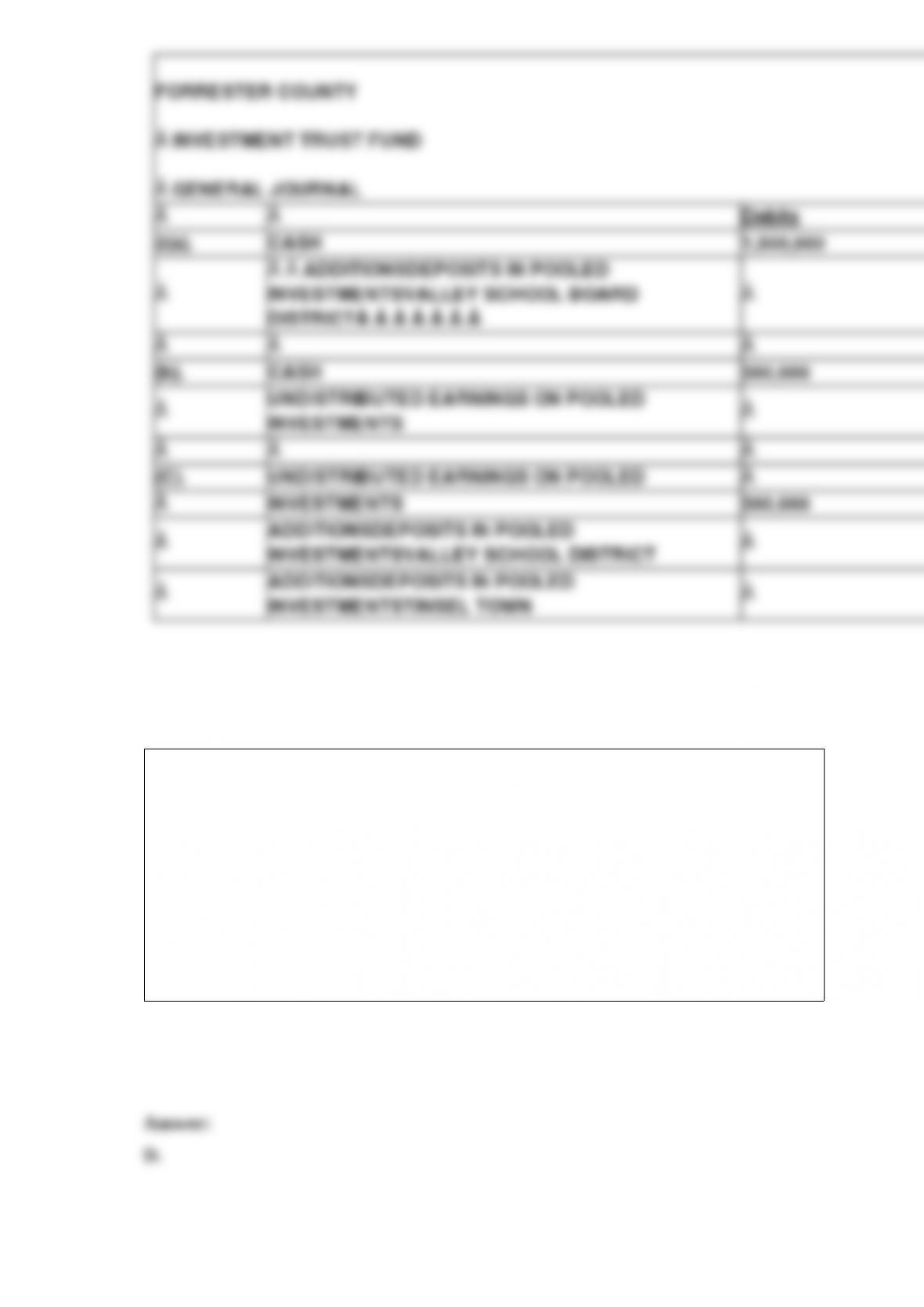
On January 1, Forrester County is holding investments for Tinsel Town valued at
$500,000 in an investment pool, accounted for in an investment trust fund. On January
1, Valley School District invests $1,500,000 in the pool. Earnings on pooled
investments for the six months ended June 30 totaling $300,000 were received in cash.
1) What percentage interest in the pool is held by the town and the school district?

2) (a) Show the entry in the Investment Trust Fund to record the School District’s
investment in the pool.
(b) Show the entry in the Investment Trust Fund to summarize the collection of interest
for the six-month period.
(c) Show the entry in the Investment Trust Fund to record the distribution of the interest
earned on pooled investments, assuming that the interest will be reinvested by the town
and school district.
The schedule of legally required events in the budgeting process is generally referred to
as the:
A. Budget docket.
B. Legal timetable.
C. Hearing schedule.
D. Budget calendar.

Public disclosure rules require that a tax-exempt not-for-profit organization:
A. Make available a copy of its Form 990 to the public for a period of up to three years.
B. Post a copy of its articles of incorporation and by-laws on its Web site.
C. Provide a copy of the minutes to all board meetings to any person who requests the
minutes within 90 days of the board meeting.
D. Make available a copy of its Form 990-T, but not its Form 990, to the public for a
period of up to two years.