Archives
BUS 129 Test
The difference between political risks and economic risks is that: A. political risks stem from instability or weakness in national governments, while economic risks stem from the stability of a country’s monetary system, and its economic and regulatory policies. B. […]
BUS 149
Strategic group mapping is a visual technique for displaying: A. how many rivals are pursuing each type of strategy. B. which companies have the biggest market share and who the industry leader really is. C. the different market or competitive […]
BUS 158 Midterm 1
A “think local, act local” multidomestic strategy works particularly well in all of the following situations, EXCEPT when there are: A. regulations enacted by the host governments requiring that products sold locally meet strictly defined manufacturing specifications or performance standards. […]
BUS 159 Quiz
A company’s strategy is NOT concerned with management’s choices about how to: A. attract and please customers. B. stake out the same market position as successful rival companies. C. grow the business. D. compete successfully. E. conduct operations and improve […]
BUS 211 Midterm
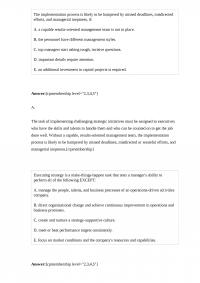
The implementation process is likely to be hampered by missed deadlines, misdirected efforts, and managerial ineptness, if: A. a capable results-oriented management team is not in place. B. the personnel have different management styles. C. top managers start asking tough, […]
BUS 405
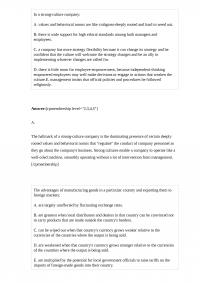
In a strong-culture company: A. values and behavioral norms are like crabgrass-deeply rooted and hard to weed out. B. there is wide support for high ethical standards among both managers and employees. C. a company has more strategy flexibility because […]
BUS 450 Midterm 1
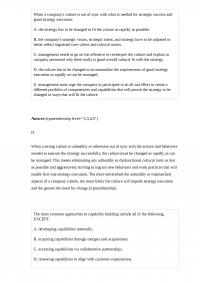
When a company’s culture is out of sync with what is needed for strategic success and good strategy execution: A. the strategy has to be changed to fit the culture as rapidly as possible. B. the company’s strategic vision, strategic […]
BUS 532 Quiz
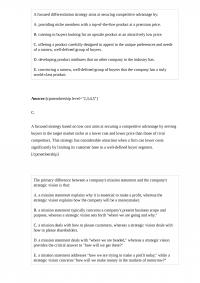
A focused differentiation strategy aims at securing competitive advantage by: A. providing niche members with a top-of-the-line product at a premium price. B. catering to buyers looking for an upscale product at an attractively low price. C. offering a product […]
BUS 785 Quiz 3
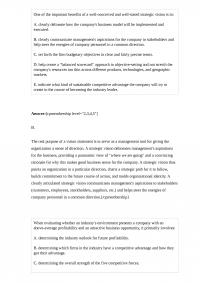
One of the important benefits of a well-conceived and well-stated strategic vision is to: A. clearly delineate how the company’s business model will be implemented and executed. B. clearly communicate management’s aspirations for the company to stakeholders and help steer […]
Business 155 Quiz
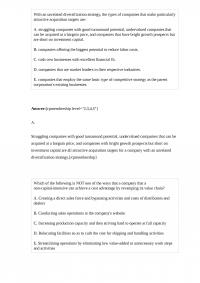
With an unrelated diversification strategy, the types of companies that make particularly attractive acquisition targets are: A. struggling companies with good turnaround potential, undervalued companies that can be acquired at a bargain price, and companies that have bright growth prospects […]
Business 180 Final
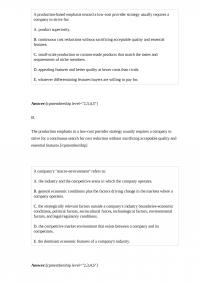
A production-based emphasis toward a low-cost provider strategy usually requires a company to strive for: A. product superiority. B. continuous cost reductions without sacrificing acceptable quality and essential features. C. small-scale production or custom-made products that match the tastes and […]
Business 251 Midterm 2
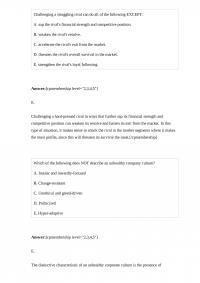
Challenging a struggling rival can do all of the following EXCEPT: A. sap the rival’s financial strength and competitive position. B. weaken the rival’s resolve. C. accelerate the rival’s exit from the market. D. threaten the rival’s overall survival in […]
Business 324
Which of the following is NOT a contributing reason for businesses with strategic fit in R&D or technology activities to perform better together? A. The ability to continue using existing processes B. Cost savings in research and development areas C. […]
Business 334
In doing SWOT analysis and trying to identify a company’s market opportunities, which of the following is NOT an example of a potential market opportunity that a company may have? A. Serving additional customer groups or market segments B. Growing […]
Business 384 Test
When an industry member is a major customer of the supplier, and the relationship (partnership) is unusually effective and mutually advantageous: A. it is rare for such partnerships to have much competitive impact on those industry members not having such […]
Business 439
A firm’s organizational structure is comprised of: A. resource strengths and competitive capabilities that allow it to incorporate attributes at lower costs than rivals whose products have similar attributes. B. the formal and informal arrangement of tasks, responsibilities, lines of […]
Business 502 Midterm 1
Which of the following takes the route of business process reengineering to attain operational excellence? A. AT&T works toward creating a total quality culture by continuously reviewing the performance of every value chain activity. B. Acer Phones uses advanced statistical […]
Business 624 Test 1
Calculating competitive strength ratings for a company and comparing them against strength ratings for its key competitors helps indicate: A. which weaknesses and vulnerabilities of competitors the company might be able to attack successfully. B. which competitors are in profitable […]
Business 649 Final
Which of the following exemplifies location-based advantage for the companies competing on an international basis? A. Microsemi Corporation acquires California based Actel Corporation. B. RBC Wealth Management closes operations in South Florida. C. Samsung diversifies and ventures into textiles and […]
Business 667 Homework
Which of the following is NOT typically a trigger to an evolving strategy? A. The need to keep strategy in step with changing circumstances, market conditions, and changing customer needs and expectations B. The proactive efforts of company managers to […]
Business 711 Midterm
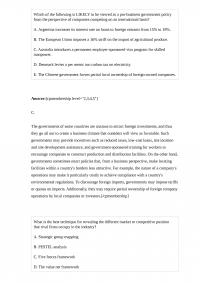
Which of the following is LIKELY to be viewed as a pro-business government policy from the perspective of companies competing on an international basis? A. Argentina increases its interest rate on loans to foreign entrants from 15% to 19%. B. […]
Business 725
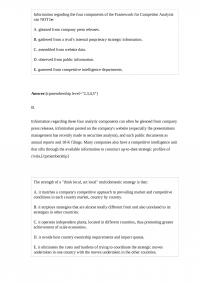
Information regarding the four components of the Framework for Competitor Analysis can NOT be: A. gleaned from company press releases. B. gathered from a rival’s internal proprietary strategic information. C. assembled from website data. D. observed from public information. E. […]
Business 727
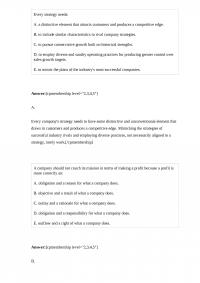
Every strategy needs: A. a distinctive element that attracts customers and produces a competitive edge. B. to include similar characteristics to rival company strategies. C. to pursue conservative growth built on historical strengths. D. to employ diverse and sundry operating […]
Business 736 Quiz 1
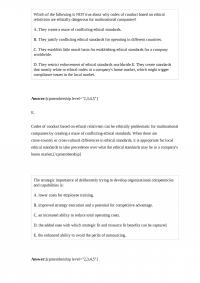
Which of the following is NOT true about why codes of conduct based on ethical relativism are ethically dangerous for multinational companies? A. They create a maze of conflicting ethical standards. B. They justify conflicting ethical standards for operating in […]
Business 866
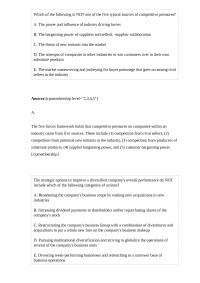
Which of the following is NOT one of the five typical sources of competitive pressures? A. The power and influence of industry driving forces B. The bargaining power of suppliers and seller€supplier collaboration C. The threat of new entrants into […]
GP 230
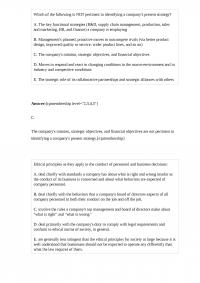
Which of the following is NOT pertinent in identifying a company’s present strategy? A. The key functional strategies (R&D, supply chain management, production, sales and marketing, HR, and finance) a company is employing B. Management’s planned, proactive moves to outcompete […]
GP 373 Quiz
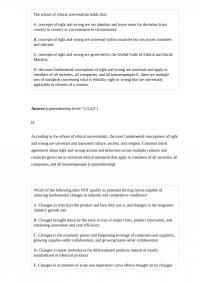
The school of ethical universalism holds that: A. concepts of right and wrong are not absolute and leave room for deviation from country to country or circumstance to circumstance. B. concepts of right and wrong are universal within countries but […]
GP 484
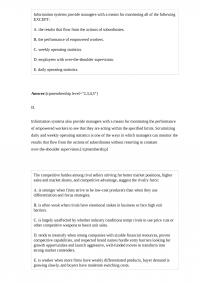
Information systems provide managers with a means for monitoring all of the following EXCEPT: A. the results that flow from the actions of subordinates. B. the performance of empowered workers. C. weekly operating statistics. D. employees with over-the-shoulder supervision. E. […]
GP 485 Test 2
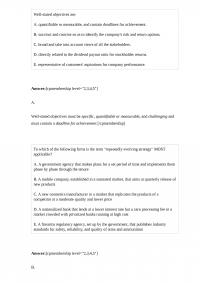
Well-stated objectives are: A. quantifiable or measurable, and contain deadlines for achievement. B. succinct and concise so as to identify the company’s risk and return options. C. broad and take into account views of all the stakeholders. D. directly related […]
GP 549 Final
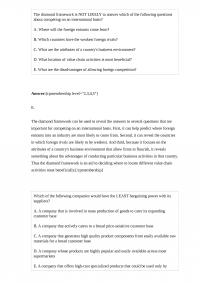
The diamond framework is NOT LIKELY to answer which of the following questions about competing on an international basis? A. Where will the foreign entrants come from? B. Which countries have the weakest foreign rivals? C. What are the attributes […]
GP 579
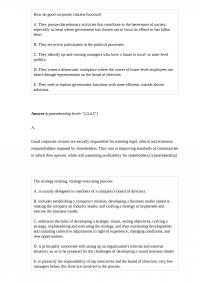
How do good corporate citizens function? A. They pursue discretionary activities that contribute to the betterment of society, especially in areas where government has chosen not to focus its efforts or has fallen short. B. They are active participants in […]
GP 854 Quiz 1
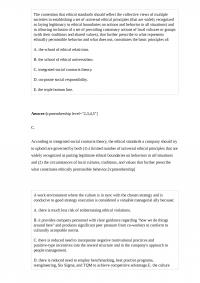
The contention that ethical standards should reflect the collective views of multiple societies in establishing a set of universal ethical principles (that are widely recognized as laying legitimacy to ethical boundaries on actions and behavior in all situations) and in […]
GSM 104
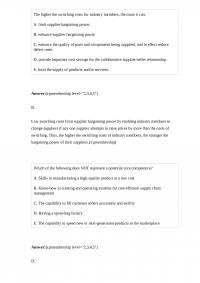
The higher the switching costs for industry members, the more it can: A. limit supplier bargaining power. B. enhance supplier bargaining power. C. enhance the quality of parts and components being supplied, and in effect reduce defect rates. D. provide […]
GSM 281 Midterm 2
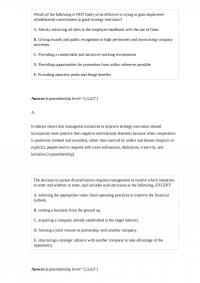
Which of the following is NOT likely to be effective in trying to gain employees’ wholehearted commitment to good strategy execution? A. Strictly enforcing all rules in the employee handbook with the use of fines. B. Giving awards and public […]
GSM 309
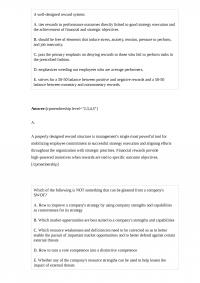
A well-designed reward system: A. ties rewards to performance outcomes directly linked to good strategy execution and the achievement of financial and strategic objectives. B. should be free of elements that induce stress, anxiety, tension, pressure to perform, and job […]
GSM 512 Test
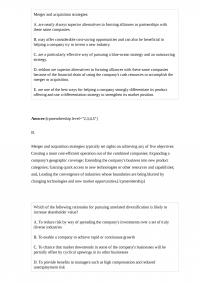
Merger and acquisition strategies: A. are nearly always superior alternatives to forming alliances or partnerships with these same companies. B. may offer considerable cost-saving opportunities and can also be beneficial in helping a company try to invent a new industry. […]
GSM 545 Test 2
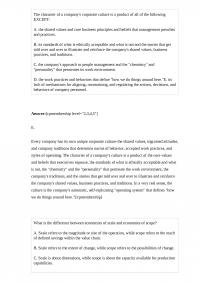
The character of a company’s corporate culture is a product of all of the following EXCEPT: A. the shared values and core business principles and beliefs that management preaches and practices. B. its standards of what is ethically acceptable and […]
GSM 683
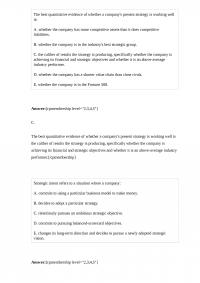
The best quantitative evidence of whether a company’s present strategy is working well is: A. whether the company has more competitive assets than it does competitive liabilities. B. whether the company is in the industry’s best strategic group. C. the […]
GSM 769 Test
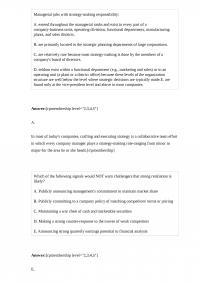
Managerial jobs with strategy-making responsibility: A. extend throughout the managerial ranks and exist in every part of a company-business units, operating divisions, functional departments, manufacturing plants, and sales districts. B. are primarily located in the strategic planning departments of large […]
MG 168 Midterm
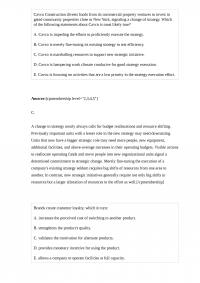
Cavco Construction divests funds from its commercial property ventures to invest in gated community properties close to New York, signaling a change of strategy. Which of the following statements about Cavco is most likely true? A. Cavco is impeding the […]
MG 287 Quiz
Ultimate responsibility for seeing that a strategy is executed successfully primarily falls upon the shoulders of: A. a company’s chief executive officer, its chief operating officer, and the heads of major units (business divisions, functional departments, and key operating units). […]
MG 399 Midterm 1
An option for NOT remedying an internal cost disadvantage includes: A. investing in productivity-enhancing, cost-saving technological improvements. B. redesigning the product or some of its components to facilitate speedier and more economical manufacture or assembly. C. implementing the use of […]
MG 617 Test 1
While ultimate responsibility for implementing and executing strategy falls upon the shoulders of senior executives: A. top-level managers still have to rely on the active support and cooperation of middle and lower-level managers in pushing needed changes in functional areas […]
MG 829 Homework
In order to coordinate and control the complex set of activities, managers must ensure: A. the organizational structure enables bureaucratic waste and strives for eliminating imposed capacity limitations of the strategy. B. the various parts of the organizational structure are […]
MG 899
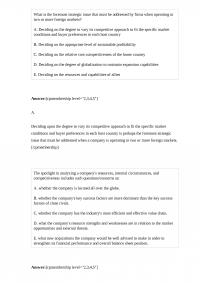
What is the foremost strategic issue that must be addressed by firms when operating in two or more foreign markets? A. Deciding on the degree to vary its competitive approach to fit the specific market conditions and buyer preferences in […]
MOB 197 Test
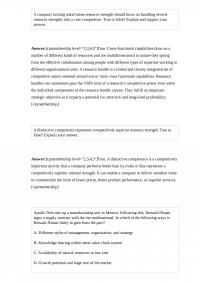
A company lacking stand-alone resource strength should focus on bundling several resource strengths into a core competence. True or false? Explain and support your answer. A distinctive competence represents competitively superior resource strength. True or false? Explain your answer. Answer:True. […]
MOB 249
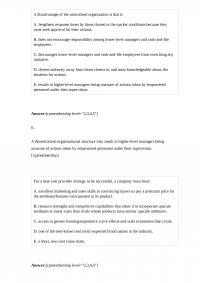
A disadvantage of the centralized organization is that it: A. lengthens response times by those closest to the market conditions because they must seek approval for their actions. B. does not encourage responsibility among lower-level managers and rank-and-file employees. C. […]
MOB 307 Midterm
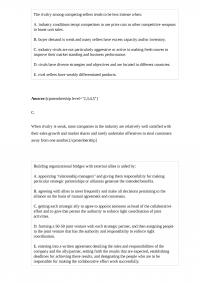
The rivalry among competing sellers tends to be less intense when: A. industry conditions tempt competitors to use price cuts or other competitive weapons to boost unit sales. B. buyer demand is weak and many sellers have excess capacity and/or […]
MOB 344 Homework
Company objectives: A. are needed only in those areas directly related to a company’s short-term and long-term profitability. B. need to be broken down into performance targets for each of its organizational levels-for separate businesses, product lines, functional departments, and […]
MOB 384 Final
Dispersing the performance of value chain activities to many different countries rather than concentrating them in a few country locations tends to be advantageous in all of the following situations, EXCEPT: A. when high transportation costs make it expensive to […]
MOB 402 Midterm 1
In moving to alter a problem culture, management should do all of the following EXCEPT: A. identify which aspects of the present culture are supportive of good strategy execution and which ones are not. B. specify what new actions, behaviors, […]
MOB 425 Midterm
A “balanced scorecard” that includes both strategic and financial performance targets is a conceptually strong approach for judging a company’s overall performance because: A. it assists managers in putting roughly equal emphasis on short-term and long-term performance targets. B. it […]
MOB 481 Quiz 2
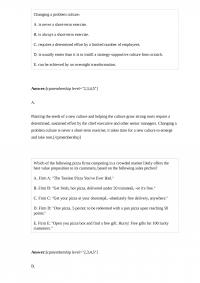
Changing a problem culture: A. is never a short-term exercise. B. is always a short-term exercise. C. requires a determined effort by a limited number of employees. D. is usually easier than it is to instill a strategy-supportive culture from […]
MOB 692
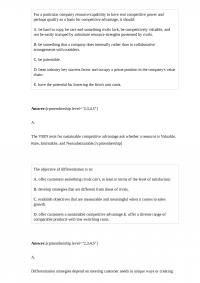
For a particular company resource/capability to have real competitive power and perhaps qualify as a basis for competitive advantage, it should: A. be hard to copy, be rare and something rivals lack, be competitively valuable, and not be easily trumped […]
MOB 776 Homework
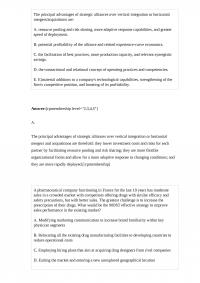
The principal advantages of strategic alliances over vertical integration or horizontal mergers/acquisitions are: A. resource pooling and risk sharing, more adaptive response capabilities, and greater speed of deployment. B. potential profitability of the alliance and related experience-curve economics. C. the […]
MOB 777 Test
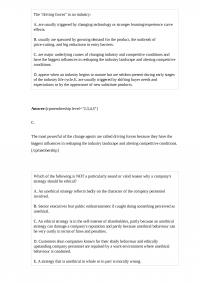
The “driving forces” in an industry: A. are usually triggered by changing technology or stronger learning/experience curve effects. B. usually are spawned by growing demand for the product, the outbreak of price-cutting, and big reductions in entry barriers. C. are […]
MOB 816 Quiz 1
A fast-food restaurant stocks bread, meat, sauces, and other main ingredients, but does not assemble and cook its burgers and sandwiches until a customer places an order. Which cost driver is the restaurant efficiently using to cut costs? A. Supply […]
MSC 100 Test
Which of the following does NOT exemplify a policy or procedure that facilitates strategy execution? A. A nonprofit agency that addresses only specific societal problems through public services B. A toy manufacturing company that plans on reaching three different segments […]
MSC 134 Midterm 1
Motivational and incentive compensation practices that aim at winning the commitment of company personnel to good strategy execution typically: A. use only positive rewards and never involve the use of tension, fear, job insecurity, stress, or anxiety. B. entail decidedly […]
MSC 198 Quiz 3
Companies with change-resistant cultures are: A. typically opposed to performance-based incentive compensation and employee empowerment. B. prone to be preoccupied with avoiding risks and are unlikely to pursue actions to capture emerging opportunities. C. often overly gung ho about looking […]
MSC 338 Midterm 1
Which of the following is NOT a common trait of an unhealthy company culture? A. A politicized internal environment and empire-building managers who jealously guard their turf B. Hostility to change and a wariness of people who champion new ways […]
MSC 352 Quiz 3
A multinational company enters a new geographical location, considered an emerging market, with its established product line: laptops and tablets. Which of the following would NOT serve as a good strategic move to enhance profits? A. Creating a sales plan […]
MSC 358 Midterm 2
Which of the following is particularly pertinent in evaluating whether an industry presents a sufficiently attractive business opportunity? A. The industry’s growth potential, whether competition appears destined to become stronger or weaker, and whether the industry’s overall profit prospects are […]
MSC 521 Midterm 2
What makes related diversification an attractive strategy? A. The ability to broaden the company’s product line B. The opportunity to convert cross-business strategic fit into competitive advantage over business rivals whose operations don’t offer comparable strategic fit benefits C. The […]
MSC 562 Quiz 2
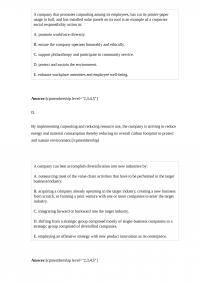
A company that promotes carpooling among its employees, has cut its printer-paper usage in half, and has installed solar panels on its roof is an example of a corporate social responsibility action to: A. promote workforce diversity. B. ensure the […]
MSC 621 Final
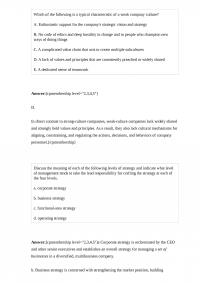
Which of the following is a typical characteristic of a weak company culture? A. Enthusiastic support for the company’s strategic vision and strategy B. No code of ethics and deep hostility to change and to people who champion new ways […]
MSC 839 Final
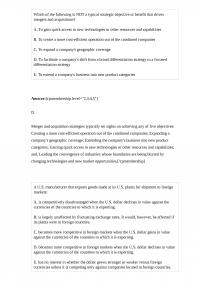
Which of the following is NOT a typical strategic objective or benefit that drives mergers and acquisitions? A. To gain quick access to new technologies or other resources and capabilities B. To create a more cost-efficient operation out of the […]
MSC 845 Final
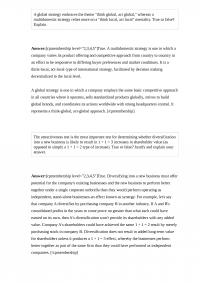
A global strategy embraces the theme “think global, act global,” whereas a multidomestic strategy relies more on a “think local, act local” mentality. True or false? Explain. The attractiveness test is the most important test for determining whether diversification into […]