Archives
978-0134604657 Chapter 1
PART I: SOLUTIONS TO PROBLEMS © 2018 Pearson Education, Inc., Hoboken, NJ. All rights reserved. This material is protected under all copyright laws as they currently exist. No portion of this material may be reproduced, in any form or by […]
978-0134604657 Chapter 11
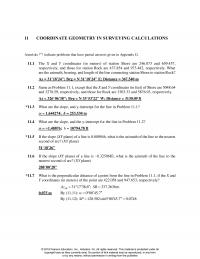
11 COORDINATE GEOMETRY IN SURVEYING CALCULATIONS Asterisks indicate problems that have partial answers given in Appendix G. 11.1 The X and Y coordinates (in meters) of station Shore are 246.873 and 659.457, respectively, and those for station Rock are 437.854 […]
978-0134604657 Chapter 12
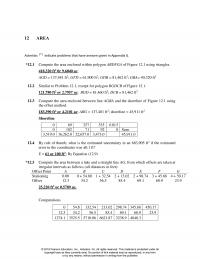
12 AREA Asterisks indicate problems that have answers given in Appendix G. *12.1 Compute the area enclosed within polygon ABDFGA of Figure 12.1 using triangles. 12.2 Similar to Problem 12.1, except for polygon BGDCB of Figure 12.1. 121,780 ft2 or […]
978-0134604657 Chapter 13
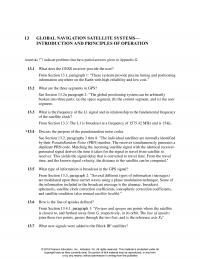
13 GLOBAL NAVIGATION SATELLITE SYSTEMS— INTRODUCTION AND PRINCIPLES OF OPERATION Asterisks indicate problems that have partial answers given in Appendix G. 13.1 What does the GNSS receiver provide the user? 13.2 What are the three segments in GPS? See Section […]
978-0134604657 Chapter 14
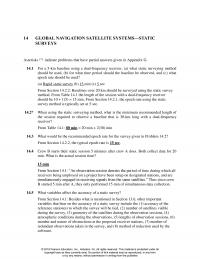
14 GLOBAL NAVIGATION SATELLITE SYSTEMS—STATIC SURVEYS Asterisks indicate problems that have partial answers given in Appendix G. 14.1 For a 5-km baseline using a dual-frequency receiver, (a) what static surveying method should be used, (b) for what time period should […]
978-0134604657 Chapter 15
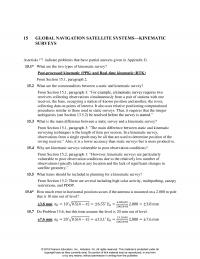
15 GLOBAL NAVIGATION SATELLITE SYSTEMS—KINEMATIC SURVEYS Asterisks indicate problems that have partial answers given in Appendix G. 15.1* What are the two types of kinematic survey? 15.2 What are the commonalities between a static and kinematic survey? From Section 15.1, […]
978-0134604657 Chapter 16
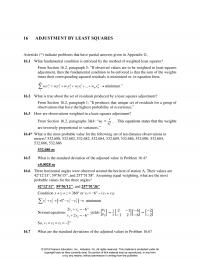
16 ADJUSTMENT BY LEAST SQUARES Asterisks (*) indicate problems that have partial answers given in Appendix G. 16.1 What fundamental condition is enforced by the method of weighted least squares? or by any means, without permission in writing from the […]
978-0134604657 Chapter 17
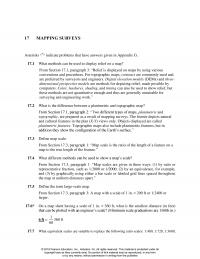
17 MAPPING SURVEYS Asterisks indicate problems that have answers given in Appendix G. 17.1 What methods can be used to display relief on a map? 17.2 What is the difference between a planimetric and topographic map? From Section 17.1, paragraph […]
978-0134604657 Chapter 18
18 MAPPING Asterisks (*) indicate problems that have partial answers given in Appendix G. 18.1 What is the scale of the USGS 7-1/2 minute quadrangle map? 18.2* On a map drawn to a scale of 1:4800, a point has a […]
978-0134604657 Chapter 19
19 CONTROL SURVEYS AND GEODETIC REDUCTIONS Asterisks indicate problems that have partial answers given in Appendix G. 19.1 What are the defining parameters to describe an ellipsoid such as GRS80? 19.2 Define the geoid? From Section 19.2, paragraph 1: “The […]
978-0134604657 Chapter 2
Instructor’ Solution Manual 7 Elementary Surveying: An Introduction to Geomatics 2 UNITS, SIGNIFICANT FIGURES, AND FIELD NOTES 2.1 List the five types of measurements that form the basis of traditional plane surveying. 2.2 Give the basic units that are used […]
978-0134604657 Chapter 20
20 STATE PLANE COORDINATES AND OTHER MAP PROJECTIONS Asterisks indicate problems that have answers given in Appendix G. 20.1 Discuss the advantages of placing surveys on state plane coordinate systems. 20.2 What is a developable surfaces? From Section 20.2, paragraph […]
978-0134604657 Chapter 21
21 BOUNDARY SURVEYS Asterisks indicate problems that have answers given in Appendix G. 21.1 Define the following terms: 21.2 What is the primary responsibility of a professional surveyor? From Section 21.2, paragraph 4: “The responsibility of a professional surveyor is […]
978-0134604657 Chapter 22
22 PUBLIC LAND SURVEYS 22.1* Convert 41.3 chains to feet. 22.2 What is meant by the term public lands? From Section 22.1, paragraph 1: “The term public lands is applied broadly to the areas that have been subject to administration, […]
978-0134604657 Chapter 23
23 CONSTRUCTION SURVEYING Asterisks indicate problems that have partial answers given in Appendix G. 23.1 What are the first requirements in a construction survey? 23.2 List the common steps for surveying engineers in a construction project. From Section 23.1, paragraph […]
978-0134604657 Chapter 24
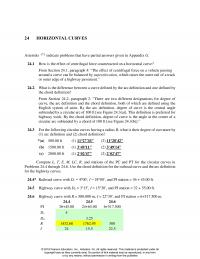
24 HORIZONTAL CURVES Asterisks indicate problems that have partial answers given in Appendix G. 24.1 How is the effect of centrifugal force counteracted on a horizontal curve? 24.2 What is the difference between a curve defined by the arc definition […]
978-0134604657 Chapter 25
25 VERTICAL CURVES Asterisks indicate problems that have partial answers given in Appendix G. 25.1 Why are vertical curves needed on the grade lines for highways and railroads? 25.2 Identify the type of vertical curve (sag or crest) by the […]
978-0134604657 Chapter 26
26 VOLUMES Asterisks indicate problems that have partial answers given in Appendix G. 26.1 What are the principle methods used to determine volumes in surveying? 26.2 Prepare a table of end areas versus depths of fill from 0 to 20 […]
978-0134604657 Chapter 27
27 PHOTOGRAMMETRY Asterisks (*) indicate problems that have partial answers given in Appendix G. 27.1 Describe the difference between vertical, low oblique, and high oblique aerial photos. 27.2 Define the term interpretative photogrammetry. From Section 27.1, Paragraph 1: “Interpretative photogrammetry […]
978-0134604657 Chapter 28
28 INTRODUCTION TO GEOGRAPHIC INFORMATION SYSTEMS Asterisks (*) indicate problems that have partial answers given in Appendix G. 28.1 Describe the concept of layers in a geographic information system. 28.2 Discuss the role of a geographic reference framework in a […]
978-0134604657 Chapter 3
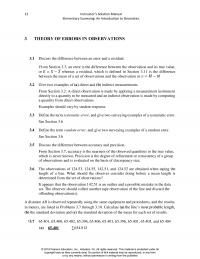
12 Instructor’s Solution Manual Elementary Surveying: An Introduction to Geomatics 3 THEORY OF ERRORS IN OBSERVATIONS 3.1 Discuss the difference between an error and a residual. From Section 3.3, an error is the difference between the observation and its true […]
978-0134604657 Chapter 4
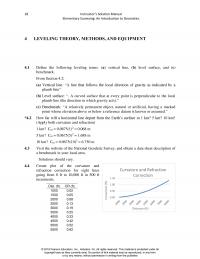
18 Instructor’s Solution Manual Elementary Surveying: An Introduction to Geomatics 4 LEVELING THEORY, METHODS, AND EQUIPMENT 4.1 Define the following leveling terms: (a) vertical line, (b) level surface, and (c) benchmark. From Section 4.2: (a) Vertical line: “A line that […]
978-0134604657 Chapter 5
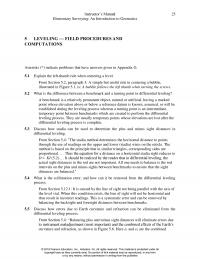
Instructor’s Manual 25 Elementary Surveying: An Introduction to Geomatics 5 LEVELING — FIELD PROCEDURES AND COMPUTATIONS Asterisks (*) indicate problems that have answers given in Appendix G. 5.1 Explain the left-thumb rule when centering a level. 5.2 What is the […]
978-0134604657 Chapter 6
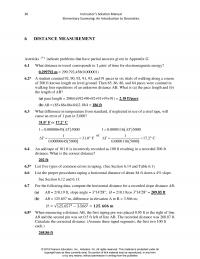
36 Instructor’s Solution Manual Elementary Surveying: An Introduction to Geomatics 6 DISTANCE MEASUREMENT Asterisks (*) indicate problems that have partial answers given in Appendix G. 6.1 What distance in travel corresponds to 1 𝜇sec of time for electromagnetic energy? 6.2* […]
978-0134604657 Chapter 7
7 ANGLES, AZIMUTHS, AND BEARINGS Asterisks indicate problems that have partial answers given in Appendix G. 7.1 Define the different reference meridians that can be used for the direction of a line. 7.2 List the three basic requirements in determining […]
978-0134604657 Chapter 8
8 TOTAL STATION INSTRUMENTS; ANGLE OBSERVATIONS Asterisks indicate problems that have partial answers given in Appendix G. 8.1 Describe the proper procedure for transporting a total station instrument in the field. From Section 8.5, paragraph 5: “When moving between setups […]
978-0134604657 Chapter 9
9 TRAVERSING Asterisks indicate problems that have partial answers given in Appendix G. 9.1 Explain the difference between closed and open traverses. From Section 9.1: Open traverses are mathematically open and offer no means of 9.2 List the disadvantages of […]

978-0134604657 Sample Introductory Part 1
Part II: Sample Introductory Course © 2018 Pearson Education, Inc., Hoboken, NJ. All rights reserved. This material is protected under all copyright laws as they currently exist. No portion of this material may be reproduced, in any form or by […]
978-0134604657 Sample Introductory Part 2
Exam 2 (1 point each) True – False [Fill in the circle indicating whether the statement is true (T) or false (F).] ○ T ○ F 1. EDM’s are unaffected by refraction. ○ T ○ F 2. The length correction […]
Chapter 10 Closed Polygon Traverse
10 TRAVERSE COMPUTATIONS Asterisks indicate problems that have partial answers given in Appendix G. 10.1 In adjusting measured traverse angles, why aren’t adjustments made in proportion to the angle sizes? *10.2 The sum of seven interior angles of a closed-polygon […]