9 TRAVERSING
Asterisks indicate problems that have partial answers given in Appendix G.
9.1 Explain the difference between closed and open traverses.
From Section 9.1: Open traverses are mathematically open and offer no means of
9.2 List the disadvantages of an open traverse.
9.3 Discuss the guidelines to consider when selecting positions for stations of a control
traverse for topographic mapping.
From Section 9.4, paragraph 1: “Of course, intervisibility between adjacent stations,
9.4 In your own words define an angle to the right.
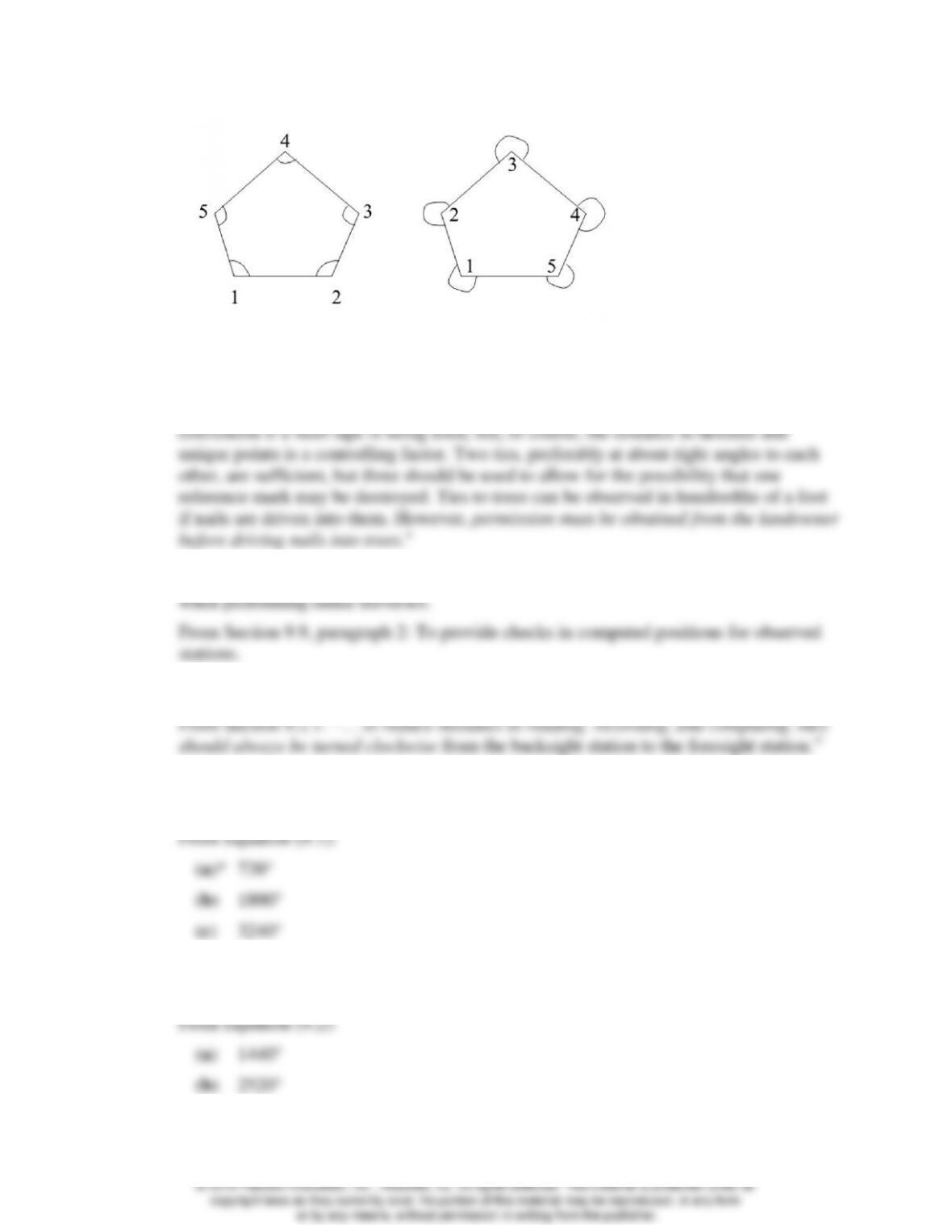
9.5 Draw two five-sided closed polygon traverses with station labels 1 to 5. The first traverse
(*)
© 2018 Pearson Education, Inc., Hoboken, NJ. All rights reserved. This material is protected under all
9.6 Discuss the criteria to consider when making reference ties to traverse stations.
From Section 9.5, paragraph 2: “As illustrated, these ties consist of distance
observations made to nearby fixed objects. Short lengths (less than 100 ft) are
9.7 Explain why it is advisable to use two instrument stations, as O and O′ in Figure 9.7(b),
9.8 Explain the importance of always turning interior angles in a clockwise direction.
9.9 What should be the sum of the interior angles for a closed-polygon traverse that has: (a)*
6 sides (b) 12 sides (c) 20 sides.
9.10 What should the sum of the exterior angles for a closed-polygon traverse that are listed
in Problem 9.9.
9.11 Four interior angles of a five-sided polygon traverse were observed as A=100°32’46″,
B=112°36′ 48″, C=108°13′ 08″, and D=115°42′ 58″. The angle at E was not observed. If
all observed angles are assumed to be correct, what is the value of angle E?
9.12 Similar to Problem 9.11, except the traverse had six sides with observed angles of 𝐴 =
9.13 What is the angular misclosure of a six-sided polygon traverse with observed angles of
9.14 What FGCS standard would the angular misclosure in Problem 9.13 meet?
*9.15 According to FGSC standards, what is the maximum acceptable angular misclosure for a
second order, class I traverse having 20 angles?
*9.16 What is the angular misclosure for a five-sided polygon traverse with observed exterior
angles of
252 26 37 , 255 55 13 , 277 15 53 , 266 35 02 ,
and
207 47 05 ?
9.17 What is the angular misclosure for a five-sided polygon traverse with observed interior
angles of 110°26′48″, 105°55′04″, 113°15′34″, 100°35′24″, and 109°47′20″?
9.18 Discuss how a data collector can be used to check the setup of a total station in traversing.
From Section 9.8, paragraph 4: “Mistakes in orientation can be minimized when a data
collector is used in combination with a total station. In this process, the coordinates of
*9.19 If the standard error for each measurement of a traverse angle is ±5.4″, what is the
expected standard error of the misclosure in the sum of the angles for an eight-sided
traverse?
9.20 If the angles of a traverse are turned so that the 95% error of any angle is ±2.2″ what is
the 95% error in a ten-sided traverse?
9.21 What common mistake can be caught by observing the backsight station with a data
collector?
*9.22 The azimuth from station A of a link traverse to an azimuth mark is
212 12 36 .
The
azimuth from the last station of the traverse to an azimuth mark is
192 12 16 .
Angles to
the right are observed at each station:
136 15 40 , 119 15 36 , 93 48 54 ,A B C
136 04 16 , 108 30 10 , 42 48 03 ,D E F
and
63 17 16 .G
What is the angular
misclosure of this link traverse?
14″
AzA-Mk
+A
AB
BA
+B
BC
CB
+C
CD
DC
212°12’36”
+136°15’40”
348°28’16”
–180°
168°28’16”
+119°15’36”
287°43’52”
–180°
107°43’52”
+93°48’54”
201°32’46”
–180°
21°32’46”
DC
+D
DE
ED
+E
EF
FE
+F
FG
GF
+G
21°32’46”
+136°04’16”
157°37’02”
+180°
337°37’02”
+108°30’10”
446°07’12”
–180°
266°07’12”
+42°48’02”
308°55’14”
–180°
128°55’14”
+63°17’16”
9.23 What FGCS order and class does the traverse in Problem 9.22 meet?
*9.24 The interior angles in a five-sided closed-polygon traverse were observed as
108 28 36 , 110 26 54 , 106 25 58 , 102 27 02 ,A B C D
and
116 11 15 .E
© 2018 Pearson Education, Inc., Hoboken, NJ. All rights reserved. This material is protected under all
copyright laws as they currently exist. No portion of this material may be reproduced, in any form
or by any means, without permission in writing from the publisher.
Compute the angular misclosure. For what FGCS order and class is this survey adequate?
9.25 Similar to Problem 9.24, except for a six-sided traverse with observed exterior angles of
9.26 In Figure 9.6, what is the average interior angle with the instrument at station 102.
9.27 Same as Problem 9.26 except at instrument station 103.
© 2018 Pearson Education, Inc., Hoboken, NJ. All rights reserved. This material is protected under all

© 2018 Pearson Education, Inc., Hoboken, NJ. All rights reserved. This material is protected under all