14 GLOBAL NAVIGATION SATELLITE SYSTEMS—STATIC
SURVEYS
Asterisks indicate problems that have partial answers given in Appendix G.
14.1 For a 5-km baseline using a dual-frequency receiver, (a) what static surveying method
should be used, (b) for what time period should the baseline be observed, and (c) what
epoch rate should be used?
14.2* When using the static surveying method, what is the minimum recommended length of
the session required to observe a baseline that is 30-km long with a dual-frequency
receiver?
14.3 What would be the recommended epoch rate for the survey given in Problem 14.2?
14.4 Crew B starts their static session 5 minutes after crew A does. Both collect data for 20
min. What is the actual session time?
14.5 What variables affect the accuracy of a static survey?
(*)
© 2018 Pearson Education, Inc., Hoboken, NJ. All rights reserved. This material is protected under all
14.6 Why are dual-frequency and GNSS receivers preferred for high-accuracy control
stations?
14.7 What site conditions are required for a good GNSS session?
14.8 Why is it recommended to use a precise ephemeris when processing a static survey?
From 14.5, paragraph 3 and Section 13.6.3: The broadcast ephemeris is a near-future
14.9 What are the recommended rates of data collection in a (a) static survey, and a *(b)
rapid static survey?
14.10 What restrictions apply to performing a rapid static survey?
14.11* How many nontrivial baselines will be observed in one session with four receivers?
14.12 How many trivial baselines will be created in one session with four receivers?
14.13 A site has some overhead obstructions that are over 10° in altitude. What steps should
occur in presurvey planning?
14.14 A baseline of approximately 10 mi is to be observed with a GNSS receiver. (a) What
© 2018 Pearson Education, Inc., Hoboken, NJ. All rights reserved. This material is protected under all
14.15 Describe what a trivial baseline is in a static survey.
14.16 What problems can overhead obstructions cause in a GNSS survey?
14.17 A planned survey site has several potential obstructions near its border. What tools can
a surveyor use to find the optimal time for GNSS sessions?
14.18* When using three receivers, how many sessions will it take to independently observe all
the baselines of a hexagon?
14.19 What determines the appropriate method to use in a GNSS survey?
14.20 What items should be checked during a field reconnaissance to ensure the site is
suitable for a GNSS survey?
14.21 In preplanning it is noticed that for 20 min there is only one satellite in the NW
quadrant of the sky plot. An obstruction will block this satellite for five min during this
time.
(a) What concerns should this raise about the survey at this site?
(b) What can be done to ensure a successful survey at this site?
14.22 Why should the height of the antenna be listed on the site log sheet?
14.23 What is a satellite availability chart and how is it used?
14.24* What order of accuracy does a survey with a standard deviation in the geodetic height
difference of 15 mm between two control stations that are 5 km apart meet?
15 6.71
5
14.25 Do Problem 14.24 when the standard deviation in the geodetic height difference is 5
mm for two control points 15 km apart?
14.26 Use the NGS web site to download the station coordinates for the nearest CORS station.
Answers will vary.
14.27 What steps may be taken to identify an obstruction problem during the post-processing
of a GNSS static survey?
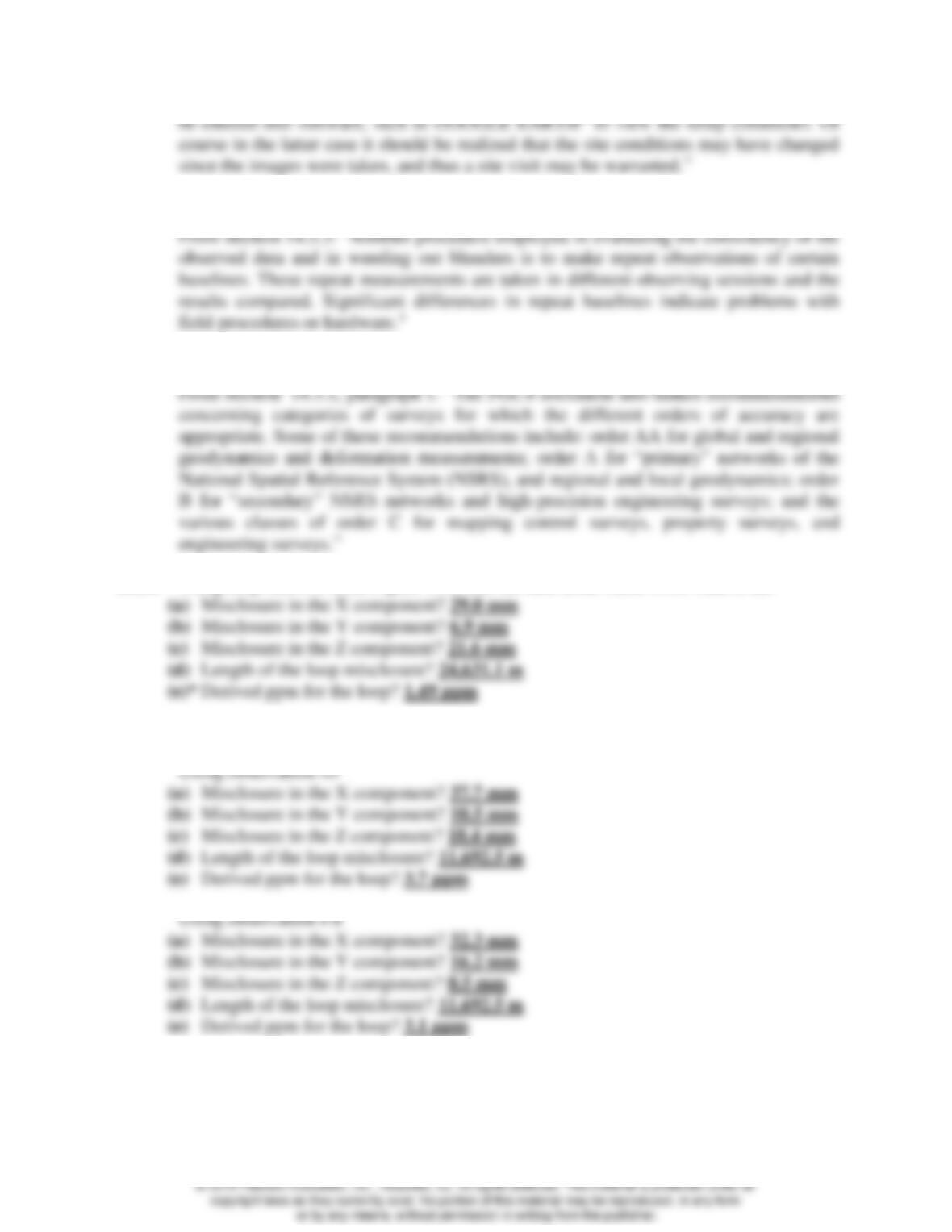
14.28 Why should repeat baselines be performed in a static survey?
14.29 What order of survey should be performed for a mapping control survey?
14.30 Using loop AEDCA from Figure 14.6, and the data from Table 14.6, what is the
14.31 Do Problem 14.30 with loop AFEA.
14.32 Do Problem 14.30 with loop BFDB.
Using observation BF
© 2018 Pearson Education, Inc., Hoboken, NJ. All rights reserved. This material is protected under all
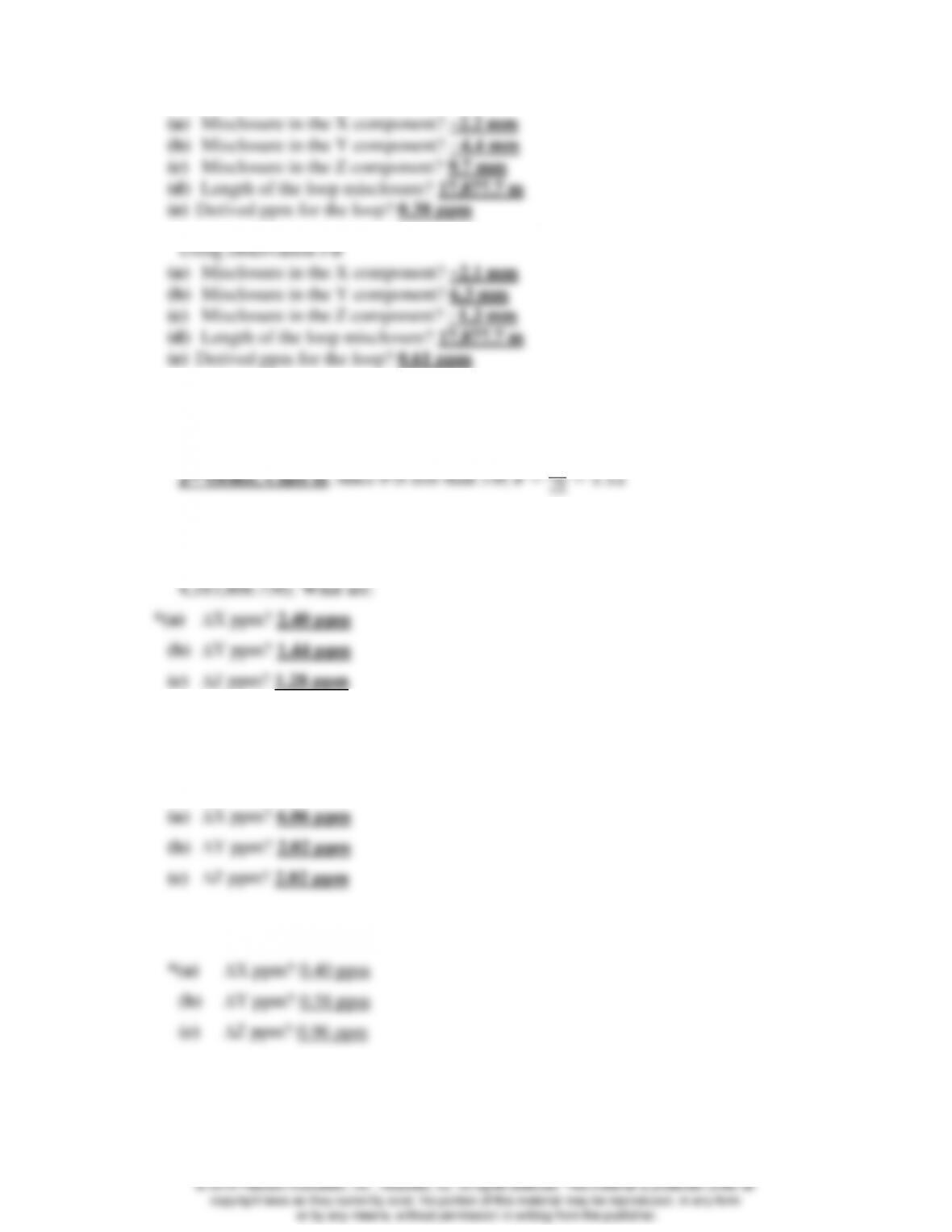
14.33 A survey list the standard deviation in geodetic height of ±2.5 mm, which was derived
from a baseline that is 5 km long. What NGS geodetic height order and class does this
meet?
14.34 The observed baseline vector components in meters between two control stations is
(2405.654, −5618.606, 1243.666). The geocentric coordinates of the control stations are
(1,162,247.650, −4,882,012.315, 4,182,563.098) and (1,164,653.289, −4,887,630.930,
14.35 Same as Problem 14.34 except the two control station have coordinates in meters of
(1,130,295.165, −5,498,572.893, 3,018,271.182) and (1,130,753.822, −5,497,667.568,
3,019,353.825), and the baseline vector between them was (458.657, 905.322,
1082.640).
14.36 Baseline EA for Figure 14.6 is resurveyed at a later time as (5321.7135, −3634.0712,
−3173,6583). What is
14.37 Repeat Problem 14.36 for baseline CF of Figure 14.6, which had vector components of
(−10,527.7683, 994.9506, 956.6045).
© 2018 Pearson Education, Inc., Hoboken, NJ. All rights reserved. This material is protected under all
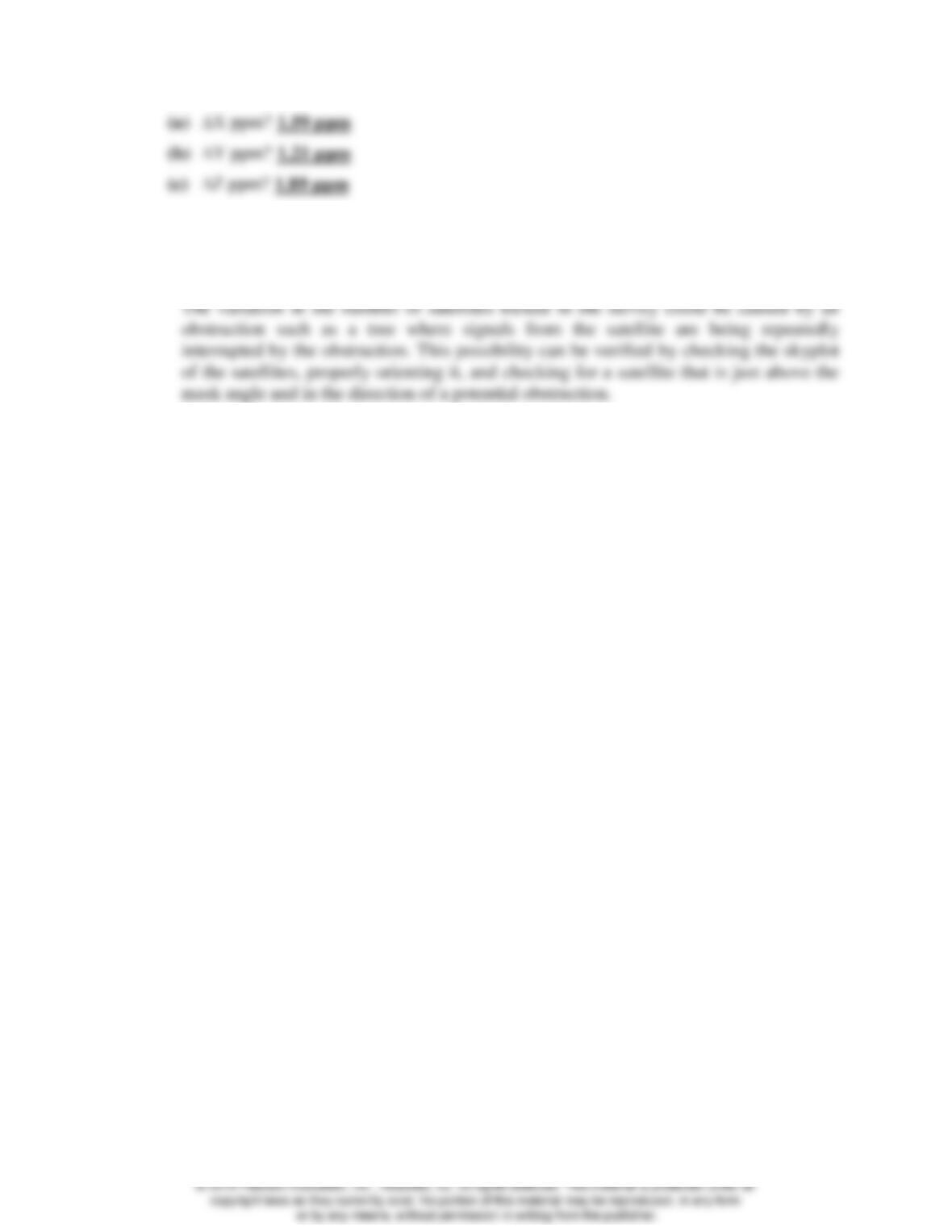
14.38 During the first three minutes of a session the observer notices that the number of
locked satellites varies between 7 and 8. What is the possible reason for this and how
could it be checked in the field?

© 2018 Pearson Education, Inc., Hoboken, NJ. All rights reserved. This material is protected under all