Archives
BUS 78918
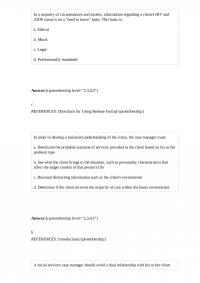
In a majority of circumstances and locales, information regarding a client’s HIV and AIDS status is on a “need to know” basis. This basis is: a. Ethical b. Moral c. Legal d. Professionally mandated In order to develop a balanced […]
BUS 79824
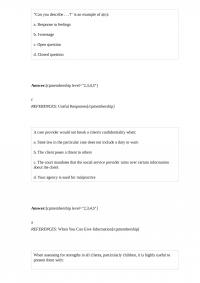
“Can you describe . . .?” is an example of a(n): a. Response to feelings b. I-message c. Open question d. Closed question A care provider would not break a client’s confidentiality when: a. State law in the particular case […]
Counseling Chapter 1 The Case Manager Can Provide Medications That
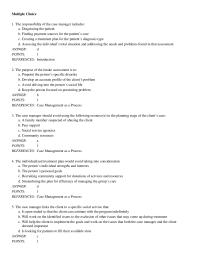
Multiple Choice 1. The responsibility of the case manager includes: a. Diagnosing the patient b. Finding payment sources for the patient’s care c. Creating a treatment plan for the patient’s diagnosis type d. Assessing the individual’s total situation and addressing […]
Counseling Chapter 10 Tentative One Which Display Anger Justified Pleasant
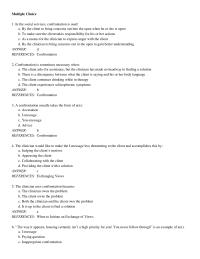
Multiple Choice 1. In the social services, confrontation is used: a. By the client to bring concerns out into the open when he or she is upset b. To make sure the client takes responsibility for his or her actions […]
Counseling Chapter 11 What You Not Want Do 10 Client Group
Multiple Choice 1. Which of the following is not generally regarded as a “common” reason why clients become angered? a. They have a history of feeling marginalized b. Confusion c. Psychopathology d. The need for attention 2. Disarming anger is […]
Counseling Chapter 12 The Counselor Admits That The Situation Is helpless
Multiple Choice 1. Because change does not happen quickly, it is better viewed as: a. A stage b. A process c. The responsibility of the client d. An undertaking for higher functioning clients 2. A person may find that he […]
Counseling Chapter 14 Describe The Reasons Generalities Include All Relevant
Multiple Choice 1. When conducting a client intake by phone, which of the following is not deemed an appropriate reason for speaking with an individual other than the client him- or herself? a. The client is in the midst of […]
Counseling Chapter 15 Create Myriad Negative Reactions Help Alfredo Cope
Multiple Choice 1. In the first face-to-face interview with the client, the counselor has three distinct tasks. Which of the following is not contained in any of the three? a. The establishment of rapport b. Understanding the need of the […]
Counseling Chapter 16 The Treatment Plan Coplanned The Counselor And
Multiple Choice 1. Social histories: a. Are uniform from agency to agency b. Vary widely from profession to profession in terms of format c. Can be almost indiscernible from place to place d. Generally contain the same information though wording […]
Counseling Chapter 17 Unconscious Motives Were Removed From Referenced Statistical
Multiple Choice 1. The Diagnostic and Statistical Manual of Mental Disorders is a collection of: a. Medications used to treat mental disorders b. Diagnoses of mental disorders accompanied by symptoms c. Behaviors associated with mental disorders d. Medical terminology directed […]
Counseling Chapter 18 Cannot Tell You His Name Date Birth
Multiple Choice 1. The mental status examination hinges unequivocally on the practitioner’s power of: a. Diagnosis b. Intuition c. Observation d. Deduction 2. Steven is the subject of a mental status examination (MSE). You, the counselor, should pay particular attention […]
Counseling Chapter 19 Aids Status A need Know Basis This Basis
Multiple Choice 1. When releasing confidential information, you are obligated to ensure that your client understands: a. His or her obligation as pertains to the release b. Procedural aspects of the release c. The aftermath of the release d. Consequences […]
Counseling Chapter 2 The Client Poses Threat Others The Court
Multiple Choice 1. Ethical practices in the social services are in place because: a. They prevent a civil suit being brought against the human service worker b. They prevent the social human worker from being fired c. They prevent the […]
Counseling Chapter 20 Alfredod Having Not Succeeded You Would Have
Multiple Choice 1. Deinstitutionalization directly led to which change in the planning and implementation of treatment plans: a. More reasonable goals b. Family involvement in the process c. The mixture of therapy and more effective drugs d. Less involvement in […]
Counseling Chapter 21 His wife works and the children are doing well in school
Multiple Choice 1. Planning conferences are ____________ formal meetings attended by a team of relevant professionals. a. Always b. Sometimes c. Almost never d. Rarely 2. A panel of professionals that decides on which services to provide to the client […]
Counseling Chapter 22 A specific area of concern on the face-sheet
Multiple Choice 1. Which of the following is not an activity completed following the case meeting? a. The supervisor signs the formal service plan. b. The final plan is discussed with the client. c. The final service plan is rewritten. […]
Counseling Chapter 23 Practice 8 The Use Black Ink When Filling
Multiple Choice 1. Writing and maintaining notes that are accurate, comprehensive, and up–to-date is a(n) ___________ obligation. a. Legal b. Professional c. Moral d. Ethical 2. The case manager, Enrique, meets with the rabbi of his client, Josh. This is […]
Counseling Chapter 24 Collaboration With Other Agencies 6 When Goals Are
Multiple Choice 1. Monitoring of treatment and/or services is a fundamental aspect in the demand for: a. Progress b. Goal achievement c. An agency’s seal of quality d. Reimbursement 2. Once the treatment plan is established and the counselee becomes […]
Counseling Chapter 25 Finishing Touch 7 Helen Work adjustment Training Following Traumatic
Multiple Choice 1. The provider agency: a. Receives general goals, which it then formulates into specific goals and objectives b. Receives specific goals, which are scaled back into broader expectations c. Makes no changes to the goals you have sent; […]
Counseling Chapter 26 The Extent Which The Client Presented Input answer
Multiple Choice 1. Which of the following is an acceptable way in which to close a case? a. A warm phone call b. A highly explanatory and detailed letter c. Face to face d. An e-mail, Skype, or IM 2. […]
Counseling Chapter 3 Looking What The Context Brings 7 Some People
Multiple Choice 1. We apply the ecological model of human services in order to: a. Understand the client’s problem on its own, without the distraction of others’ opinions b. Help patients who express an interest in environmentalism c. Weed inappropriate […]
Counseling Chapter 4 Memorize The Other Cultures Scripts Help The
Multiple Choice 1. It is the ethical responsibility of human services workers to become familiar with the culture of the client so that: a. Cultural differences do not become obstacles to good communication b. Every possible culture that a client […]
Counseling Chapter 5 Letting The Client Know That She Can
Multiple Choice 1. The attitudes of good human services workers influence their interactions with their clients in that: a. When a worker judges his or her own mistakes critically, that worker can then understand those of clients more accurately b. […]
Counseling Chapter 6 You Own The Problem 8 Suppose The Client
Multiple Choice 1. Knowing who owns the problem is important because: a. It allows us to understand who is ultimately responsible for resolving the problem b. It makes us seem uncaring c. It abandons the client with the problem d. […]
Counseling Chapter 7 What is the difference in giving false praise versus positive
Multiple Choice 1. Responses that block communication are ones that: a. Structure therapeutic communication b. Aid the worker in hearing what is really important c. Most likely promote withdrawal and defensiveness d. Most likely promote rapport and clarity 2. Good […]
Counseling Chapter 8 Page 179 essay 15 You Are Area Human Service
Multiple Choice 1. Listening to another person in a way that indicates concern is: a. Not the role of the case worker b. Distracting to the client c. An important part of the healing process d. A roadblock to communication […]
Counseling Chapter 9 Those Which There Clearly One Correct Answer
Multiple Choice 1. Sometimes the worker needs to ask the client closed questions in order to: a. Find a solution to the client’s problem b. Encourage the client to talk about the situation freely c. Better understand which aspects of […]
EMBA 36334
In order for a person to agree to services, he or she must have the capacity to give permission willingly. This patient right is called: a. Comprehension of information b. Informed consent c. Self-determination d. Confidentiality In order to respond […]
MGT 24673
Confrontation is sometimes necessary when: a. The client asks for assistance, but the clinician has made no headway in finding a solution b. There is a discrepancy between what the client is saying and his or her body language c. […]
MHR 13208
The self-acceptance that the client gains through the worker’s reflective listening can be a catalyst for: a. Being corrected by the client b. Heightened emotions on the part of the client c. Defensiveness on the part of the client d. […]
MHR 30994
A summarization letter regarding reasons for termination should: a. Precede the termination interview b. Follow the termination interview c. Be presented at the termination interview d. Be presented as the client departs from the termination interview Taking the client’s side […]
MHR 39691
Refusal to identify next-of-kin is a: a. Legitimate reason to deny services b. Legal issue; there must be a person to be contacted in the event of an emergency c. Generally regarded as a right of the client d. Decision […]
OBHR 47211
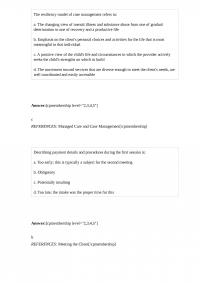
The resiliency model of case management refers to: a. The changing view of mental illness and substance abuse from one of gradual deterioration to one of recovery and a productive life b. Emphasis on the client’s personal choices and activities […]