Archives
Biology & Life Sciences Chapter 1 Homework Or Should Only Done When Something Changes
IM1-13 5. If you rejected the hypothesis, how would you refine and rewrite your hypothesis to account for your findings and begin again? SCENARIO D: PALEOANTHROPOLOGY 1. Generate a hypothesis about what causes the observed phenomena in this scenario (the […]
Biology & Life Sciences Chapter 1 Homework Which Other Scholarly Disciplines Outside Anthropology You
LABORATORY MANUAL AND WORKBOOK FOR BIOLOGICAL ANTHROPOLOGY INSTRUCTOR’S MANUAL Lab 1: Biological Anthropology and the Scientific Method ANSWERS TO LAB 1 CONCEPT REVIEW QUESTIONS 1. Context and comparison are the two fundamental ideas used in anthropology. 2. C. Biological anthropology […]
Biology & Life Sciences Chapter 10 Homework Laboratory Manual And Workbook For Biological Anthropology
3. Lorises D. are nocturnal (they do not rely heavily on their vision, have large bodies, or eat a diet of mostly leaves). IM10-1 4. Madagascar is the only place where you can find lemurs in the wild. insects; being […]
Biology & Life Sciences Chapter 11 Homework The Wooded Areas Offer Variety Trees And
4. Primates tend to form small groups when food is sparsely distributed. her offspring in a territory separate from those of other females and overlapping with that of an adult male, but who hardly ever spends time together with other […]
Biology & Life Sciences Chapter 12 Homework Body Size Small Body Size Digestive
1. A. Insectivorous is the diet type of a primate that has molars with pointy cusps and a simple digestive system (not gummivorous, frugivorous, or folivorous). 3. C. Folivorous is the diet type of a primate that has molars with […]
Biology & Life Sciences Chapter 13 Homework Use The Stratigraphy Drawing Provided Answer The
bilophodont molars and a frugivorous diet, and had some adaptations for terrestrial quadrupedalism (not Aegyptopithecus, Khoratpithecus, or Dryopithecus). 6. C. Apes are the closest living primate group to the fossil genus Proconsul, which lived in Africa around 20 mya, had […]
Biology & Life Sciences Chapter 14 Homework Step Position The Lamp Above The Doll
numerous other apes and monkeys, particularly chimpanzees and capuchin monkeys [Note: See Lab 11 for more information and note that students may also mention tool use in other animals, such as sea otters and certain birds.] 4. A. Anteriorly at […]
Biology & Life Sciences Chapter 15 Homework Fossil Has Smaller Zygomatic Arches Narrower
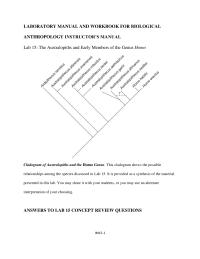
IM15-1 LABORATORY MANUAL AND WORKBOOK FOR BIOLOGICAL ANTHROPOLOGY INSTRUCTOR’S MANUAL Lab 15: The Australopiths and Early Members of the Genus Homo Cladogram of Australopiths and the Homo Genus. This cladogram shows the possible relationships among the species discussed in Lab […]
Biology & Life Sciences Chapter 16 Homework Homo Sapiens Fossil Based This Information Which
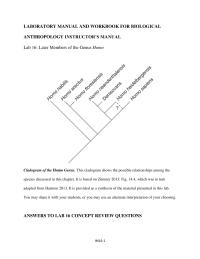
IM16-1 LABORATORY MANUAL AND WORKBOOK FOR BIOLOGICAL ANTHROPOLOGY INSTRUCTOR’S MANUAL Lab 16: Later Members of the Genus Homo ANSWERS TO LAB 16 CONCEPT REVIEW QUESTIONS Cladogram of the Homo Genus. This cladogram shows the possible relationships among the species discussed […]
Biology & Life Sciences Chapter 2 Homework Describe Two Things The Two Karyotypes Have
IM2-1 LABORATORY MANUAL & WORKBOOK FOR BIOLOGICAL ANTHROPOLOGY INSTRUCTOR’S MANUAL Lab 2: Genetics ANSWERS TO LAB 2 CONCEPT REVIEW QUESTIONS 1. Difference: Prokaryote cells lack a nucleus, and are often one-celled organisms; 2. D. Mitochondria produce energy for the cell […]
Biology & Life Sciences Chapter 2 Homework However The Overall Idea That Many Seemingly
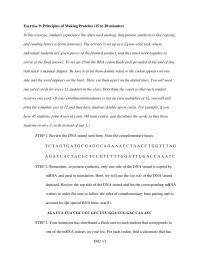
IM2-13 Exercise 9: Principles of Making Proteins (15 to 20 minutes) In this exercise, students experience the often-used analogy that protein synthesis is like copying and reading letters to form sentences. The activity is set up as a jigsaw-style task, […]
Biology & Life Sciences Chapter 3 Homework You May Want Encourage Students Im38 Use
height, pea shape, pea color, pod shape, and pod color. 2. Genotype is defined as the alleles (genetic material) carried by an individual. 3. Phenotype is the physical expression of the alleles carried by an individual. effect of the recessive […]
Biology & Life Sciences Chapter 4 Homework Answers Will Vary Because The Genetic Drift
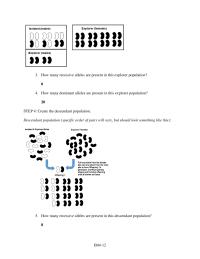
IM4-12 3. How many recessive alleles are present in this explorer population? 0 4. How many dominant alleles are present in this explorer population? 20 STEP 4: Create the descendant population. Descendant population (specific order of pairs will vary, but […]
Biology & Life Sciences Chapter 4 Homework Which Predator You Think Will The Most
IM4-1 LABORATORY MANUAL AND WORKBOOK FOR BIOLOGICAL ANTHROPOLOGY INSTRUCTOR’S MANUAL Lab 4: Forces of Evolution ANSWERS TO LAB 4 CONCEPT REVIEW QUESTIONS 2. B. Evolution occurs in traits (not at the level of the individual, in a single generation, or […]
Biology & Life Sciences Chapter 5 Homework Exercise Bone Features 15 Minutes For This
3. C. 1/3 (approximately) of bone tissue is made of organic components (not 2/3, which is inorganic; 1/4; or all of it). 5. D. Osteoclast is the type of bone cell responsible for removing bone (not osteodon, osteocyte, or osteoblast; […]
Biology & Life Sciences Chapter 6 Homework Part Human Hand Review The Bones The
4. D. Thoracic vertebra is a bone that articulates with the ribs (not sacrum, lumbar, or cervical vertebra). 10. B. The ankle is the area of the body where tarsals are found (not the upper back/thoracic vertebrae, knee, or wrist/carpals). […]
Biology & Life Sciences Chapter 7 Homework You May Want Provide Your Students With
contexts. A bioarchaeologist studies people from the past through the examination of their bones and attempts to reconstruct life histories. 2. Forensic anthropology is the branch of biological anthropology that applies knowledge and methods of skeletal analysis to assist in […]
Biology & Life Sciences Chapter 8 Homework Deficiency Estimated The World Health Organization
7. Lactose is a sugar found in milk. Lactase is an enzyme required in order to properly digest the lactose in milk. 1. B. Central Africa is home to people with the darkest skin colors (not East Asia, 2. A. […]
Biology & Life Sciences Chapter 9 Homework The Second Step Classification Using Homologous Traits
IM9-1 follows: kingdom, phylum, class, order, family, genus, species 2. C. Living offspring that are capable of reproduction are considered “viable offspring” under the biological species concept. 3. D. Location, time period, and physical traits are all used when classifying […]